
In power transmission systems where intersecting shafts are involved, the miter gear, a specific type of bevel gear with a 1:1 ratio, plays a fundamental role. While offering the advantages of simple design, ease of manufacturing, and the ability to change the direction of rotation, miter gears, particularly straight-tooth variants, are prone to dynamic issues. The primary mode of failure under high-speed operation is often fatigue pitting initiated by fluctuating contact stresses at the meshing interfaces. Accurately predicting these dynamic contact stresses through purely theoretical formulas is notoriously challenging due to the complex, time-varying nature of the gear mesh, impacts, and system vibrations. This analysis delves into a comprehensive methodology, employing advanced multi-body dynamics (MBD) simulation to investigate the dynamic behavior and contact stress evolution in a straight-tooth miter gear pair. The process integrates parametric three-dimensional modeling with high-fidelity dynamic simulation to provide a viable foundation for further analysis of vibration and shock in miter gear systems.
Theoretical Foundation: Contact Force Modeling for Miter Gears
The core of the dynamic analysis for a miter gear pair lies in accurately calculating the contact forces between the interacting tooth surfaces during operation. The simulation software utilized here, RecurDyn, employs a penalty-based method to resolve these contacts. This method effectively transforms the contact nonlinearity problem into a material nonlinearity problem. The normal contact force \( F_n \) is computed as a sum of elastic and damping components, derived from the Hertzian contact theory and a damping model:
$$ F_n = k \delta^{m_1} + c \frac{\dot{\delta}}{\left| \dot{\delta} \right|} \delta^{m_2} \dot{\delta}^{m_3} $$
Where:
\( \delta \) is the normal penetration depth between the two contacting bodies.
\( \dot{\delta} \) is the relative velocity at the contact point.
\( k \) is the contact stiffness coefficient.
\( c \) is the contact damping coefficient.
\( m_1, m_2, m_3 \) are nonlinear exponents for the elastic force, damping force, and indentation, respectively.
The stiffness coefficient \( k \) is not a constant but depends on the material properties and the local geometry (curvature) of the contacting surfaces at the instantaneous point of contact. For two curved bodies, such as the teeth of a miter gear pair, it is given by:
$$ k = \frac{4}{3\pi (h_1 + h_2)} \sqrt{\frac{R_1 R_2}{R_1 + R_2}} $$
Here, \( R_1 \) and \( R_2 \) are the instantaneous radii of curvature of the two miter gear tooth surfaces at the contact point. The material parameters \( h_i \) are defined as:
$$ h_i = \frac{1 – \mu_i^2}{\pi E_i}, \quad i=1,2 $$
where \( E \) is the Young’s modulus and \( \mu \) is the Poisson’s ratio of the gear material. For the simulation of the miter gear pair, the contact parameters were carefully selected to ensure a stable and physically accurate solution. The static and dynamic coefficients of friction were set to 0.1, the maximum allowed penetration \( \delta_{max} \) was 0.01 mm, and the nonlinear exponents were configured as \( m_1 = 1.6 \), \( m_2 = 1 \), and \( m_3 = 2 \). The stiffness and damping coefficients were fine-tuned to 10,000 and 1.0, respectively, based on the material properties of the miter gears.
Parametric Three-Dimensional Modeling of the Miter Gear
A critical prerequisite for a meaningful dynamics simulation is an accurate geometric model. A parametric modeling approach was adopted for the miter gear using Creo software. This approach allows for the automatic regeneration of the gear model by changing a set of driving parameters, which is invaluable for design optimization and analysis of different miter gear configurations. The key design parameters for the miter gear pair are defined as follows:
| Parameter | Pinion (Driver) | Gear (Driven) |
|---|---|---|
| Number of Teeth (\( z \)) | 17 | 17 |
| Module (\( m \)) [mm] | 3 | 3 |
| Normal Pressure Angle (\( \alpha \)) | 25° | 25° |
| Shaft Angle (\( \Sigma \)) | 90° | |
| Pitch Cone Angle (\( \delta \)) | 45° | 45° |
| Face Width (\( b \)) [mm] | 12 | 12 |
The tooth profile of a straight bevel gear is based on a spherical involute curve to ensure conjugate action on the pitch sphere. The parametric equations governing the spherical involute, essential for generating the accurate miter gear tooth geometry, were implemented within the Creo relation editor. These equations define the radial and angular coordinates on the gear’s back-cone. The fundamental relationships between key miter gear angles—such as the pitch cone angle (\( \delta \)), base cone angle (\( \delta_b \)), and face cone angle (\( \delta_a \))—were also encoded as parameters. By creating datum curves for the gear’s major and minor ends (including the addendum, pitch, and dedendum circles) and using the spherical involute equations, precise trajectories for the tooth flanks were generated.
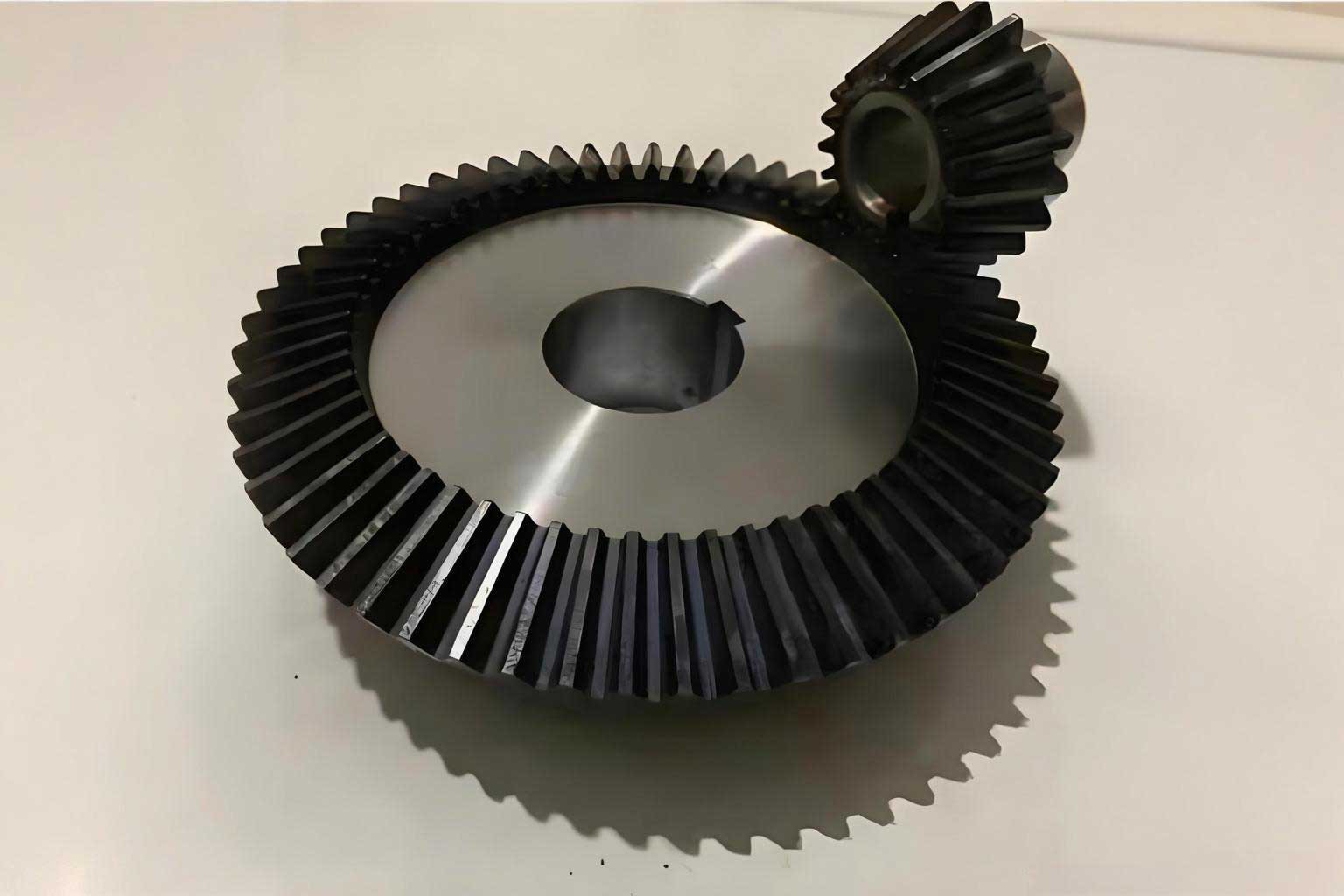
The solid tooth model was created using a variable-section sweep (or blend) feature, with the spherical involute curves as trajectories and the corresponding profile sketches at the gear’s two ends. This single tooth was then patterned circumferentially based on the parameterized tooth count (\( z \)) to complete the miter gear’s tooth system. The gear blank (hub, web, bore) was also modeled with dimensions driven by parameters, resulting in a fully parametric and associative three-dimensional miter gear model. An identical process created the mating miter gear, and an assembly was created to verify correct mesh geometry with zero interference, confirming the accuracy of the parametric miter gear design.
Multi-Body Dynamics Simulation and Analysis
The parameterized miter gear assembly was exported and imported into the RecurDyn multi-body dynamics environment. The material properties were assigned uniformly to both gears in the miter gear pair:
| Property | Value |
|---|---|
| Young’s Modulus (\( E \)) | 2.06e5 MPa |
| Poisson’s Ratio (\( \mu \)) | 0.3 |
| Density (\( \rho \)) | 7800 kg/m³ |
Revolute joints were applied to the centers of both miter gears to constrain their rotation about their respective shaft axes. A surface-to-surface contact force, based on the previously described model, was defined between all teeth of the miter gear pair. The driver miter gear (pinion) was actuated by a rotational velocity applied to its revolute joint. To simulate a smooth startup and avoid numerical instability from a step velocity input, the velocity function was defined using a step function: \( \omega(t) = 157 \times STEP(time, 0, 0, 1, 1) \) rad/s, reaching the target speed of 1500 rpm after 1 second. A corresponding torque load was applied to the revolute joint of the driven miter gear. Similarly, to avoid impact from sudden loading, the torque was ramped up over 1 second: \( \tau(t) = -T_{load} \times STEP(time, 0, 0, 1, 1) \) N·mm.
The simulation was run for a duration of 5 seconds with 500 steps. Several load cases were analyzed to understand the load-dependency of the miter gear system’s dynamics: \( T_{load} = [0, 50, 250, 500] \) N·mm.
Kinematic Results: Angular Velocity
The angular velocity of both miter gears was monitored. As expected, the driven miter gear’s speed mirrored the driver’s speed but in the opposite rotational direction, confirming the 1:1 speed ratio of the miter gear pair. The velocity plots showed minor oscillations around the theoretical mean value (157 rad/s for the driver, -157 rad/s for the driven). A key observation was that the amplitude and frequency of these speed fluctuations increased with the applied load \( T_{load} \). Under no load, the speed trace was relatively smooth. At 500 N·mm load, the driven miter gear’s velocity exhibited more pronounced and frequent variations, indicating heightened dynamic interaction and torsional vibration within the miter gear transmission under torque.
Dynamic Results: Contact Stress Analysis
The primary focus was on the dynamic contact stress developed between the meshing teeth of the miter gear pair. The simulation tracked this stress throughout the engagement cycle for each load case. The results are summarized below:
| Load Torque (\( T_{load} \)) [N·mm] | Maximum Contact Stress (\( \sigma_{c,max} \)) [MPa] | Observation |
|---|---|---|
| 0 | 2636.6 | Peak stress occurs only during the initial 1-second start-up transient due to inertial effects. Steady-state stress is near zero. |
| 50 | ~185.0 | Clear periodic stress pulses corresponding to tooth meshing. Relatively low amplitude. |
| 250 | ~540.0 | Significant increase in stress pulse amplitude. The repeating pattern of single and double-tooth contact is visible. |
| 500 | ~780.0 | Highest steady-state stress amplitude. Pronounced dynamic loading with each tooth engagement, critical for fatigue analysis. |
The contact stress plots revealed a highly dynamic process. During the initial transient phase (0-1s), a significant stress peak was observed even under no external load, attributable to the acceleration of the miter gear masses and initial contact settlement. In the steady-state phase (1-5s), the contact stress for the unloaded miter gear pair was negligible. However, with an applied load, a characteristic repetitive pattern emerged. The stress cycled with the gear mesh frequency, showing periods of lower stress (likely during single-tooth contact) and higher stress peaks (during double-tooth contact or at the point of highest load sharing). Crucially, the magnitude of these cyclic stress peaks scaled almost linearly with the applied load on the miter gear. This dynamic stress history, rather than a static calculated value, is essential for predicting contact fatigue life (pitting) of the miter gear teeth.
Conclusion
This study successfully established an integrated workflow for the analysis of straight-tooth miter gear dynamics. The implementation of parametric three-dimensional modeling based on spherical involute geometry provides an efficient and accurate method for generating miter gear pairs. The subsequent multi-body dynamics simulation using a penalty-based contact force model effectively captured the complex dynamic interactions within the miter gear mesh. The analysis demonstrated that while the kinematic ratio of the miter gear pair remains constant, the dynamic response—specifically, torsional vibration and, most importantly, the dynamic contact stress—is highly dependent on the applied load. The obtained time-history of contact stress under various loading conditions provides critical data that is difficult to acquire through theoretical calculation alone. This data serves as a fundamental and practical动力学 basis for conducting further in-depth studies on root bending stress, system vibration, noise generation, and fatigue life prediction in miter gear transmission systems. The methodology underscores the importance of dynamic simulation in the design and analysis of reliable miter gear applications.