
Gear transmission stands as one of the most prevalent methods in mechanical drive systems, extensively utilized across aerospace, aviation, maritime, and numerous other mechanical domains. The performance of gear transmission profoundly influences the reliability of the entire drive system. Moreover, the reliability of gear meshing is intimately linked to personnel safety. Consequently, conducting a rational analysis of contact stress during gear meshing is crucial for guiding the design and development of components. Spur and pinion gears, fundamental elements in many transmission systems, exhibit contact stress distributions that dictate their operational integrity and longevity.
Numerous experts and scholars globally have performed extensive research on the contact stress during the meshing process of spur gears. However, the majority of these studies rely on deterministic analysis methods, which overlook the impact of uncertainties in related variables on contact stress. As a result, such findings lack universal applicability and cannot effectively inform the design and development of gear components. Therefore, to more objectively and accurately characterize the distribution of contact stress during spur and pinion gear meshing and to enhance the reliability of gear transmission, it is imperative to consider the randomness of influencing factors. This necessitates a shift from deterministic analysis to reliability analysis for gear meshing contact stress.
Probabilistic analysis methods have found widespread application in many fields, yet their use in reliability analysis of contact stress for meshing gears remains limited. Performing probabilistic analysis on spur and pinion gear contact stress not only permits the derivation of contact stress probability distribution characteristics based on random variable distribution features but also enables the determination of random variable variations from the contact stress probability distribution. This is advantageous for the design optimization of meshing gears and contributes to improving the reliability of gear transmission systems. In this work, building upon finite element analysis, a hybrid response surface method integrating the Monte Carlo Method (MCM) and the Response Surface Method (RSM) is employed. By accounting for the influence of random variables in the nonlinear time domain during the meshing stage of spur and pinion gears, a nonlinear reliability sensitivity analysis is conducted on the contact stress of these gears.
Spur and pinion gears are essential components in mechanical systems due to their straightforward design and efficiency in transmitting motion and power. The meshing interaction between spur and pinion gears involves intricate contact mechanics, where stress distribution plays a pivotal role in determining fatigue life and failure modes. Hence, accurate prediction of contact stress under diverse operating conditions is vital for reliable gear design. The hybrid response surface method proposed herein offers a robust framework for addressing the uncertainties inherent in gear parameters and material properties.
The hybrid response surface method merges the Monte Carlo method and the response surface method, involving judicious selection of experimental points and iteration strategies. Through a series of deterministic experiments using the Monte Carlo method, sets of random variable and output response sample points are acquired. A polynomial response surface function is then fitted to approximate the true implicit limit state function within the failure probability for failure probability analysis. To elucidate the mathematical model of the hybrid response surface method, let \( Y \) denote the output response of the structure and \( \mathbf{X} = [X_1, X_2, \ldots, X_i, \ldots, X_r] \) represent the random variables, where \( X_i \sim N(\mu_i, \sigma_i^2) \). Via Monte Carlo random sampling, specifically Latin Hypercube Sampling (LHS), \( s \) groups of sample values for random variables \( \mathbf{X} \) are obtained: \( \mathbf{X} = [x_1, x_2, \ldots, x_s] \). Subsequently, through deterministic experiments, a set of output response sample values \( \mathbf{Y} = [y_1, y_2, \ldots, y_s] \) is derived. These are fitted to a polynomial function as expressed in Equation (1), which subsequently substitutes the complex finite element model for probability analysis.
$$ Y = a_0 + \sum_{i=1}^{r} b_i X_i + \sum_{i=1}^{r} \sum_{j=1}^{r} c_{ij} X_i X_j $$
Here, \( a_0 \), \( b_i \), and \( c_{ij} \) (for \( i=1,\ldots,r \); \( j=1,\ldots,r \)) are the constant term, linear term, and quadratic term coefficients, respectively. Equation (1) is termed the polynomial response surface function. The Latin Hypercube Sampling method is employed in the Monte Carlo simulation to ensure efficient coverage of the random variable space. LHS stratifies the input probability distributions and samples from each stratum, reducing variance and enhancing convergence relative to simple random sampling. This is particularly beneficial for reliability analysis where computational cost is a concern.
In this analysis, the Box-Behnken matrix sampling method is utilized to assign three level points to each random variable. Following specific rules, the center and edge centers are taken as sample points. The level point values for \( X_i \) satisfy:
$$ \int_{-\infty}^{q_s} f(q) \, dq = p_n \quad (n=1,2,3) $$
where \( f(q) \) is the probability density function of the random variable, \( p_n \) denotes the level points, taken as \( p_1 = 0.01 \), \( p_2 = 0.5 \), and \( p_3 = 0.99 \); \( q_s \) is the normal distribution variable, satisfying:
$$ q_s = \mu + \sigma \psi^{-1}(p_n) $$
Here, \( \mu \) is the mean, \( \sigma \) is the standard deviation, \( \psi(\cdot) \) is the standard normal distribution function, and \( \psi^{-1}(p_n) \) can be obtained from statistical tables.
Regression analysis is performed on the \( s \) groups of sample values for random variables and output responses:
$$ S = \sum_{i=1}^{s} \left[ y_i – \left( a_0 + \sum_{i=1}^{r} b_i X_i + \sum_{i=1}^{r} \sum_{j=1}^{r} c_{ij} X_i X_j \right) \right]^2 $$
Solving the subsequent equations:
$$ \frac{\partial S}{\partial a_0} = 0, \quad \frac{\partial S}{\partial b_i} = 0, \quad \frac{\partial S}{\partial c_{ij}} = 0 \quad (i=1,\ldots,r; j=i,\ldots,r) $$
the coefficients \( a_0 \), \( b_i \), and \( c_{ij} \) are estimated, thereby establishing the functional relationship between the system output response \( Y \) and the random variables \( \mathbf{X} \). The hybrid response surface method capitalizes on the precision of the Monte Carlo method and the efficiency of the response surface method, effectively boosting the accuracy and efficiency of reliability analysis for complex structures such as spur and pinion gears.
For the nonlinear analysis of spur and pinion gears, a pair of spur gears from an aircraft engine reducer is selected. To align with analytical requirements, the models of the driving and driven gears are suitably simplified. To augment computational efficiency, surface models are adopted in lieu of solid models to capture the contact stress distribution during the meshing of two gear teeth. Utilizing ANSYS software, a finite element model is constructed. The finite element model for the spur and pinion gears is developed using ANSYS parametric design language (APDL) to automate the meshing and analysis process. The contact pair is defined employing surface-to-surface contact elements, with a penalty method for contact stiffness. The nonlinear solution accommodates large deformations and contact nonlinearities, leveraging a Newton-Raphson iterative scheme for convergence.
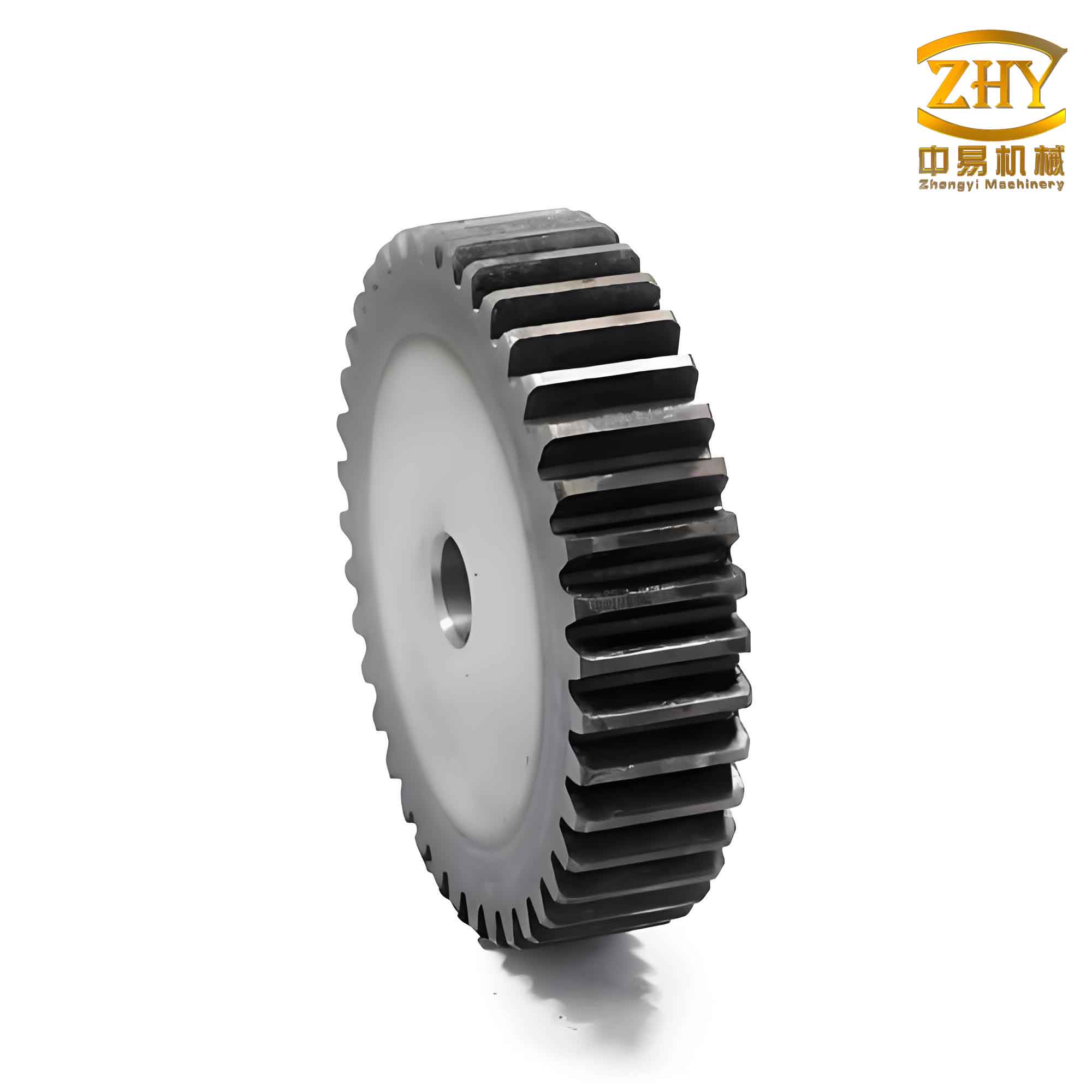
The surface element PLANE182 is chosen to mesh the gear model, generating a total of 13,407 nodes and 11,344 elements. The time domain from the commencement to the conclusion of meshing for a pair of gear teeth in the driving and driven spur and pinion gears, specifically [0, 1] seconds, is designated as the analysis range. The meshing process within this temporal interval can be treated as a nonlinear problem. The material for both driving and driven gears is 20CrMnTi carburizing steel, possessing a yield strength of 850 MPa (per GB/T3077-1988). The gear dimensional parameters and material attributes are detailed in Table 1. Through finite element analysis, dynamic contact between the two gear teeth is realized by inserting a contact pair between the gear pair. The contact stress contour during meshing is derived, revealing a maximum contact stress of 813.859 MPa for the spur and pinion gear pair.
| Random Variable | Mean μ | Standard Deviation σ | Distribution Type |
|---|---|---|---|
| Module m_n (mm) | 8 | 0.16 | Normal Distribution |
| Number of Teeth on Driving Gear Z_1 | 21 | 0.42 | Normal Distribution |
| Number of Teeth on Driven Gear Z_2 | 36 | 0.72 | Normal Distribution |
| Helix Angle β (°) | 13.6 | 0.272 | Normal Distribution |
| Pressure Angle α (°) | 20 | 0.40 | Normal Distribution |
| Elastic Modulus E (MPa) | 2.12e5 | 4.24e3 | Normal Distribution |
| Poisson’s Ratio ν | 0.298 | 0.00596 | Normal Distribution |
| Density ρ (kg/m³) | 7860 | 157.2 | Normal Distribution |
Building upon the nonlinear analysis of the driving and driven spur and pinion gears, probability analysis is executed on the contact stress during the meshing process of the gear pair. Synthesizing the key factors affecting contact stress distribution, the pivotal size parameters of the gears (module, number of teeth, helix angle, pressure angle) and material properties (elastic modulus, Poisson’s ratio, density) are designated as random variables, assumed mutually independent. Their statistical traits are presented in Table 1. The presumption of normal distribution for random variables is commonplace in engineering reliability analysis owing to the central limit theorem. Nonetheless, for parameters with known non-normal distributions, transformations can be applied to normalize the variables or alternative distributions can be incorporated into the Monte Carlo simulation. In this investigation, all random variables are presumed normally distributed for simplicity, though the hybrid response surface method can be extended to manage non-normal distributions.
The distribution characteristics of each random variable are formulated as in Equation (10):
$$ \begin{aligned}
m_n’ &= 6.37332 \cdot m_n – 50.9865 \\
Z_1′ &= 2.36683 \cdot Z_1 – 49.7128 \\
Z_2′ &= 1.35352 \cdot Z_2 – 48.7195 \\
\beta’ &= 3.55913 \cdot \beta – 48.3987 \\
\alpha’ &= 2.47221 \cdot \alpha – 49.4346 \\
E’ &= 2.37379 \times 10^{-4} \cdot E – 50.3243 \\
\nu’ &= 1.66354 \times 10^{-4} \cdot \nu – 49.5723 \\
\rho’ &= 6.43615 \times 10^{-5} \cdot \rho – 50.5859
\end{aligned} $$
Employing the Monte Carlo method and Latin Hypercube Sampling, each random variable is sampled to procure 80 groups of random variable and output response sample points. These sample points are utilized to fit the response surface function. To further investigate the effect of response surface function form—linear function, quadratic function without cross terms, quadratic function with cross terms—on output response distribution characteristics, linear response surface function, quadratic response surface function without cross terms, and quadratic response surface function with cross terms are fitted, as respectively shown in Equations (11), (12), and (13):
$$ Y_1 = 813.863 – 5.05715 \times 10^{-3} \cdot Z_1′ + 16.1654 \cdot m_n’ – 0.759638 \cdot \nu’ $$
$$ Y_2 = 813.859 – 3.94320 \times 10^{-3} \cdot Z_1′ + 16.1647 \cdot m_n’ – 0.759602 \cdot \nu’ + 4.08190 \times 10^{-3} \cdot \nu’^2 $$
$$ \begin{aligned}
Y_3 &= 813.860 + 16.1724 \cdot m_n’ – 0.756951 \cdot \nu’ + 2.48338 \times 10^{-5} \cdot \nu’^2 – 1.85084 \times 10^{-5} \cdot m_n’ \nu’ \\
&+ 1.88130 \times 10^{-5} \cdot Z_1′ \nu’ – 2.01456 \times 10^{-5} \cdot \rho’ \nu’ – 3.07290 \times 10^{-5} \cdot \beta’ \nu’ – 1.50093 \times 10^{-2} \cdot m_n’ \beta’
\end{aligned} $$
Leveraging the response surface function for additional simulation of the meshing spur and pinion gears yields 10,000 output samples. The output sample history and output response probability distribution corresponding to Equations (11), (12), and (13) are analyzed. The simulation outcomes indicate that the quadratic response surface function without cross terms exhibits elevated accuracy and aligns closely with Monte Carlo method results for contact stress characteristics and reliability in spur and pinion gear meshing.
For reliability analysis, assume the maximum limit stress of the spur and pinion gear pair is \( \sigma_{\text{max}} \). Then the contact stress limit state function is:
$$ h(\mathbf{X}) = \sigma_{\text{max}} – Y = \sigma_{\text{max}} – \left( a_0 + \sum_{i=1}^{r} b_i X_i + \sum_{i=1}^{r} \sum_{j=1}^{r} c_{ij} X_i X_j \right) $$
From this, \( h(\mathbf{X}) \leq 0 \) constitutes the failure mode; otherwise, it is the safety mode. If the random variables are independent, their mean and variance matrices are \( \boldsymbol{\mu} = [\mu_1, \mu_2, \ldots, \mu_r] \) and \( \mathbf{D} = [D_1, D_2, \ldots, D_r] \), respectively. Then:
$$ \begin{aligned}
E[X_i] &= \mu_i, \quad D[X_i] = D_i = \sigma_i^2 \\
E[X_i^2] &= \mu_i^2 + D_i, \quad D[X_i^2] = 4\mu_i^2 D_i + 2D_i^2 \\
E[X_i X_j] &= \mu_i \mu_j, \quad D[X_i X_j] = \mu_i^2 D_j + \mu_j^2 D_i + D_i D_j
\end{aligned} $$
Let \( \mu_h = E[h(\mathbf{X})] \) and \( D_h = D[h(\mathbf{X})] \). If \( h(\mathbf{X}) \) follows a normal distribution, the reliability index and reliability of the limit state equation are:
$$ \beta = \frac{\mu_h}{\sqrt{D_h}}, \quad R = \psi(\beta) $$
where \( \psi(\cdot) \) can be determined via the Monte Carlo method. The reliability sensitivity with respect to the mean matrix and variance matrix of random variables is:
$$ \frac{\partial R}{\partial \boldsymbol{\mu}} = \frac{\partial R}{\partial \beta} \left( \frac{\partial \beta}{\partial \mu_h} \frac{\partial \mu_h}{\partial \boldsymbol{\mu}} + \frac{\partial \beta}{\partial D_h} \frac{\partial D_h}{\partial \boldsymbol{\mu}} \right) $$
$$ \frac{\partial R}{\partial \mathbf{D}} = \frac{\partial R}{\partial \beta} \left( \frac{\partial \beta}{\partial \mu_h} \frac{\partial \mu_h}{\partial \mathbf{D}} + \frac{\partial \beta}{\partial D_h} \frac{\partial D_h}{\partial \mathbf{D}} \right) $$
with:
$$ \frac{\partial R}{\partial \beta} = \psi'(\beta), \quad \frac{\partial \beta}{\partial \mu_h} = \frac{1}{\sqrt{D_h}}, \quad \frac{\partial \beta}{\partial D_h} = -\frac{\mu_h}{2 D_h^{3/2}} $$
and the partial derivatives \( \frac{\partial \mu_h}{\partial \boldsymbol{\mu}} \), \( \frac{\partial D_h}{\partial \boldsymbol{\mu}} \), \( \frac{\partial \mu_h}{\partial \mathbf{D}} \), and \( \frac{\partial D_h}{\partial \mathbf{D}} \) are derivable from the response surface function.
For \( \sigma_{\text{max}} = 850 \, \text{MPa} \), the reliability corresponding to different response surface function forms is derived from Equations (5), (11), (12), and (13), as summarized in Table 2. Concurrently, the Monte Carlo method is applied to sample the output response 10,000 times, serving as a benchmark to assess the accuracy of various response surface functions in modeling the relationship between random variables and output response for spur and pinion gears.
| Response Surface Function | Mean (MPa) | Standard Deviation (MPa) | Reliability | Time (s) |
|---|---|---|---|---|
| Monte Carlo Method | 813.81 | 16.292 | 98.6341% | 126000 |
| Linear Function | 813.86 | 16.303 | 98.6112% | 1036 |
| Quadratic Function without Cross Terms | 813.86 | 16.302 | 98.6116% | 1035 |
| Quadratic Function with Cross Terms | 813.86 | 16.310 | 98.6045% | 1038 |
From Table 2, the quadratic response surface function without cross terms demonstrates high accuracy and parallels the Monte Carlo method simulation results for contact stress characteristics and reliability. This signifies that during the meshing process of the driving and driven spur and pinion gears, the contact stress reliability attains 98.6116%, satisfying design requirements. The hybrid response surface method thus proves effective for reliability assessment of spur and pinion gear systems.
Based on reliability analysis results, the quadratic response surface function without cross terms adeptly captures the relationship between each random variable and the output response for spur and pinion gears. Through Equations (5) and (12), the influence magnitude of each random variable on contact stress is ascertained, as depicted in Table 3. Sensitivity analysis quantifies how alterations in input variables affect the output response. In the realm of gear design, comprehending sensitivity aids in pinpointing critical parameters that demand stringent manufacturing tolerances or material control. For example, the pronounced sensitivity of elastic modulus implies that material selection and quality assurance are paramount for contact stress management in spur and pinion gears.
| Variable | Sensitivity (×10^{-3}) | Probability (%) | Variable | Sensitivity (×10^{-3}) | Probability (%) |
|---|---|---|---|---|---|
| Elastic Modulus E (MPa) | 998.82 | 88.15 | Density ρ (kg/m³) | -12.453 | 1.10 |
| Poisson’s Ratio ν | -62.419 | 5.51 | Number of Teeth on Driven Gear Z_2 | 6.9679 | 0.61 |
| Module m_n (mm) | -23.571 | 2.08 | Number of Teeth on Driving Gear Z_1 | -6.8919 | 0.61 |
| Helix Angle β (°) | 16.485 | 1.45 | Pressure Angle α (°) | -5.4633 | 0.48 |
As observed from Table 3, the elastic modulus E emerges as the principal influencing factor for contact stress in the spur and pinion gear pair, commanding an influence probability of 88.15%. Other random variables exert comparatively minor effects on contact stress distribution, which corroborates actual experimental findings. This furnishes a theoretical foundation for the optimization and redesign of spur and pinion gear structures, emphasizing the criticality of material properties in gear performance.
In summary, through nonlinear contact stress analysis of the spur and pinion gear pair during meshing, the distribution characteristics of contact stress are preliminarily examined, with maximum contact stress selected as the output response for probability analysis of gear pair contact stress. The hybrid response surface method, integrating Monte Carlo and response surface techniques, facilitates this analysis efficiently.
Via probability analysis of spur and pinion gear contact stress and sensitivity analysis of random variables, it is discerned that for a maximum limit stress \( \sigma_{\text{max}} = 850 \, \text{MPa} \), the safety probability is 98.6116%, largely meeting design specifications. Simultaneously, the primary determinants of contact stress distribution are identified, offering a theoretical basis for spur and pinion gear structure optimization and redesign.
By contrasting diverse response surface function forms with the Monte Carlo method, the accuracy and efficiency of the hybrid response surface method amalgamating the Monte Carlo method and the quadratic function without cross terms are appraised. The efficacy of the hybrid response surface method is elucidated, supplying a potent methodology for nonlinear probability analysis of output responses in intricate structures like spur and pinion gears. Future work may explore non-normal distributions and time-variant reliability for enhanced gear design robustness.