
In this extensive article, I will delve into the intricate world of miter gears, a fundamental component in mechanical transmission systems. As an engineer with years of experience in gear design, I aim to provide a detailed analysis that covers everything from basic principles to advanced applications. The miter gear, often overlooked in favor of more common gear types, plays a crucial role in scenarios requiring right-angle power transmission with equal shaft speeds. Throughout this discussion, I will emphasize the unique characteristics of miter gears, supported by mathematical formulations and tabular data to enhance understanding. My goal is to offer a resource that not only educates but also inspires further innovation in gear technology.
To begin, let me define what a miter gear is. Essentially, a miter gear is a type of bevel gear where the two mating gears have the same number of teeth, resulting in a 1:1 gear ratio and shafts that intersect at a 90-degree angle. This configuration is pivotal in applications such as differential drives, printing machinery, and robotics, where direction changes are necessary without altering speed. The miter gear’s design involves complex geometry, which I will break down using formulas. For instance, the pitch cone angle for a standard miter gear is 45 degrees, given by $$\theta = \arctan\left(\frac{N_1}{N_2}\right)$$, but since $$N_1 = N_2$$, we have $$\theta = 45^\circ$$. This simplicity belies the engineering challenges involved in manufacturing and optimizing miter gears for high efficiency.
In my analysis, I consider the historical context of miter gears. They have evolved from wooden constructs in ancient mills to precision-machined steel components in modern aerospace. The keyword ‘miter gear’ appears repeatedly in literature, underscoring its importance. For example, early treatises on machinery often highlighted miter gears for their ability to transmit torque smoothly at right angles. Today, advancements in materials science have enabled miter gears to operate under higher loads and speeds. I will explore these developments through tables that compare material properties. Below is a table summarizing common materials used for miter gears and their key attributes:
| Material | Tensile Strength (MPa) | Hardness (HRC) | Application in Miter Gears |
|---|---|---|---|
| Carbon Steel | 600-800 | 20-30 | General industrial use |
| Alloy Steel | 800-1200 | 30-40 | High-load transmissions |
| Stainless Steel | 500-700 | 15-25 | Corrosive environments |
| Plastic (e.g., Nylon) | 50-100 | N/A | Low-noise applications |
Moving to the geometric design, the tooth profile of a miter gear is critical for meshing efficiency. I often use the Gleason system for bevel gears, which applies to miter gears as well. The tooth form is defined by parameters such as module, pressure angle, and spiral angle. For a standard miter gear, the module $$m$$ is calculated from the pitch diameter $$d$$ and number of teeth $$N$$: $$m = \frac{d}{N}$$. The pressure angle $$\alpha$$ typically ranges from 20° to 25°, influencing the contact ratio and load capacity. A higher pressure angle can reduce bending stress but may increase noise. To illustrate, here is a formula for the contact ratio $$C_r$$ of a miter gear pair: $$C_r = \frac{\sqrt{(r_{a1}^2 – r_{b1}^2)} + \sqrt{(r_{a2}^2 – r_{b2}^2)} – a \sin\alpha}{\pi m \cos\alpha}$$, where $$r_a$$ is addendum radius, $$r_b$$ is base radius, and $$a$$ is center distance. This complexity necessitates careful design to ensure smooth operation.
In my experience, the manufacturing process for miter gears involves multiple steps, each affecting performance. I have compiled a table outlining key manufacturing stages and their impact on miter gear quality:
| Manufacturing Stage | Description | Effect on Miter Gear |
|---|---|---|
| Forging | Shaping metal through compressive forces | Enhances grain structure for durability |
| Machining | Cutting teeth using gear hobbing or shaping | Determines tooth accuracy and surface finish |
| Heat Treatment | Processes like carburizing or quenching | Increases hardness and wear resistance |
| Grinding | Precision finishing of tooth surfaces | Reduces noise and improves efficiency |
| Inspection | Measuring dimensions and tolerances | Ensures compliance with design specs |
The performance of a miter gear system can be evaluated using various mechanical principles. I frequently analyze factors like efficiency, load distribution, and thermal effects. For instance, the efficiency $$\eta$$ of a miter gear pair can be estimated from friction losses: $$\eta = 1 – \frac{\mu F_t v}{P_{in}}$$, where $$\mu$$ is coefficient of friction, $$F_t$$ is tangential force, $$v$$ is sliding velocity, and $$P_{in}$$ is input power. This formula highlights the importance of lubrication in miter gear applications. Additionally, bending stress $$\sigma_b$$ at the tooth root is given by the Lewis formula: $$\sigma_b = \frac{F_t}{b m Y}$$, where $$b$$ is face width and $$Y$$ is Lewis form factor. These calculations help in optimizing miter gear designs for longevity.
To provide a visual reference, consider the following image that illustrates a typical miter gear assembly. This depiction aids in understanding the spatial arrangement and tooth engagement of miter gears.
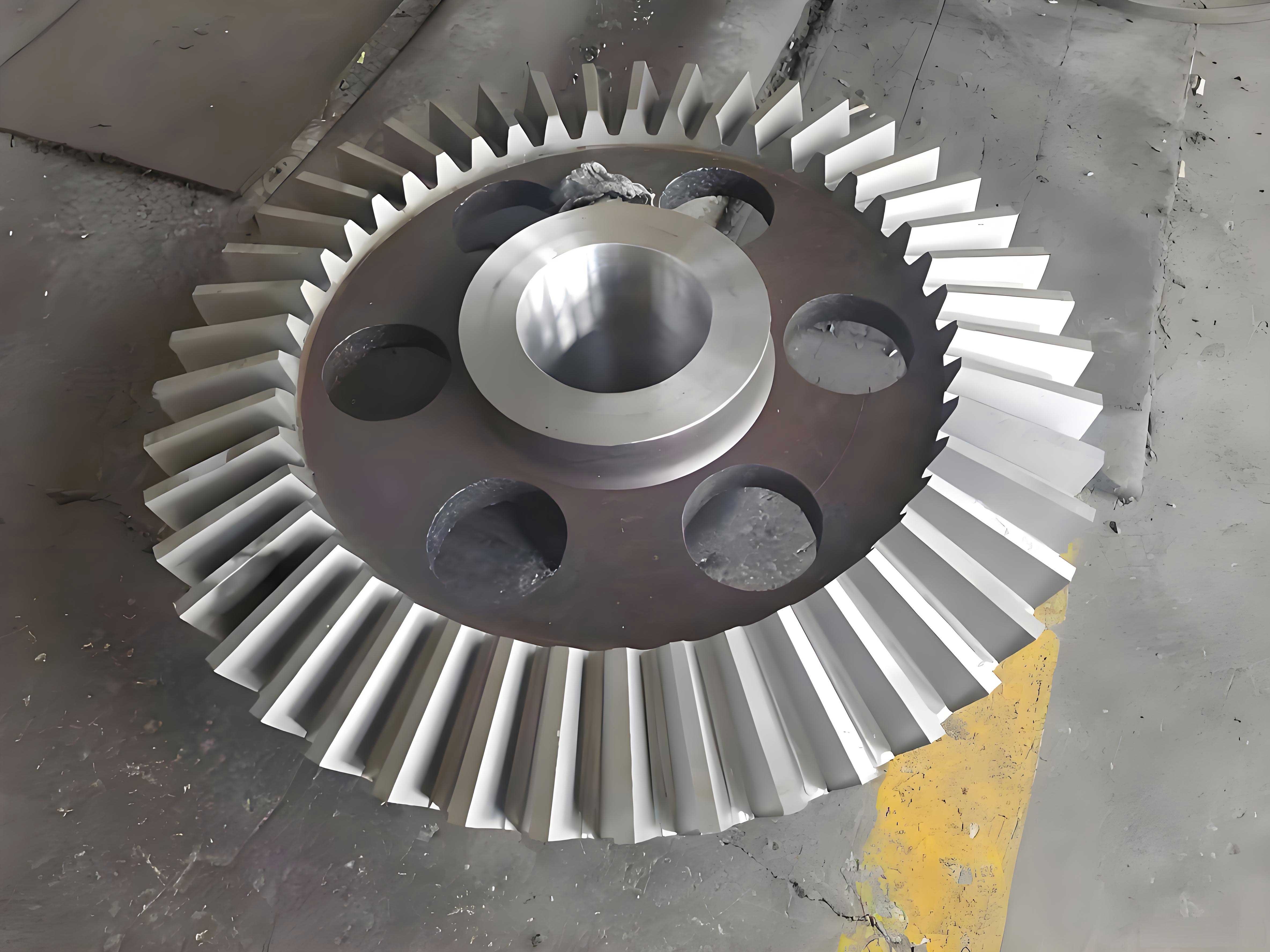
Applications of miter gears are diverse, spanning numerous industries. In my work, I have encountered miter gears in automotive differentials, where they facilitate wheel rotation at different speeds while maintaining torque transmission. Similarly, in robotics, miter gears enable precise joint movements in articulated arms. To summarize, here is a table of common applications and the role of miter gears:
| Industry | Application | Function of Miter Gear |
|---|---|---|
| Automotive | Differential systems | Transmit power at right angles between axles |
| Aerospace | Actuator mechanisms | Control surfaces with high reliability |
| Manufacturing | Conveyor belts | Change direction of material flow |
| Marine | Steering gear | Convert rotational motion for rudder control |
| Consumer Electronics | Printers and scanners | Drive paper feed systems quietly |
In terms of design optimization, I often employ computational tools to simulate miter gear behavior under various loads. Finite element analysis (FEA) allows me to predict stress concentrations and deformation. For example, the von Mises stress $$\sigma_{vm}$$ can be computed from principal stresses: $$\sigma_{vm} = \sqrt{\frac{(\sigma_1 – \sigma_2)^2 + (\sigma_2 – \sigma_3)^2 + (\sigma_3 – \sigma_1)^2}{2}}$$. This helps in identifying weak points in a miter gear design. Additionally, dynamic analysis involves solving equations of motion for gear systems. A simplified model for a miter gear pair can be represented as: $$J_1 \ddot{\theta}_1 + c(\dot{\theta}_1 – \dot{\theta}_2) + k(\theta_1 – \theta_2) = T_1$$ and $$J_2 \ddot{\theta}_2 + c(\dot{\theta}_2 – \dot{\theta}_1) + k(\theta_2 – \theta_1) = T_2$$, where $$J$$ is moment of inertia, $$c$$ is damping coefficient, $$k$$ is stiffness, and $$T$$ is torque. These equations are essential for vibration analysis and noise reduction in miter gear applications.
The lubrication of miter gears is another critical aspect I frequently address. Proper lubrication reduces wear and heat generation. I recommend using oils with extreme pressure (EP) additives for high-load miter gear systems. The film thickness $$h$$ in elastohydrodynamic lubrication can be estimated by the Dowson-Higginson formula: $$h = 2.65 \frac{U^{0.7} G^{0.54}}{W^{0.13}} R^{0.43}$$, where $$U$$ is speed parameter, $$G$$ is material parameter, $$W$$ is load parameter, and $$R$$ is effective radius. This ensures that the miter gear operates within safe limits. Moreover, thermal expansion must be considered, as it affects clearances. The change in dimension $$\Delta L$$ due to temperature change $$\Delta T$$ is given by $$\Delta L = \alpha L \Delta T$$, where $$\alpha$$ is coefficient of thermal expansion. For steel miter gears, $$\alpha$$ is around $$12 \times 10^{-6} \, \text{K}^{-1}$$.
Looking at future trends, I believe that additive manufacturing will revolutionize miter gear production. 3D printing allows for complex geometries and lightweight structures, potentially improving the power-to-weight ratio of miter gears. Also, smart gears with embedded sensors could enable real-time monitoring of condition and performance. In my view, the integration of IoT with miter gear systems will lead to predictive maintenance, reducing downtime. Furthermore, advancements in composite materials may yield miter gears with superior strength and corrosion resistance. I anticipate that these innovations will expand the applications of miter gears into emerging fields like renewable energy and electric vehicles.
To summarize the key geometric parameters, I have compiled a table for standard miter gear specifications based on AGMA standards. This table serves as a quick reference for designers working with miter gears:
| Parameter | Symbol | Typical Value for Miter Gear | Unit |
|---|---|---|---|
| Number of Teeth | N | 20-100 | – |
| Module | m | 1-10 | mm |
| Pressure Angle | α | 20° | degree |
| Face Width | b | 5-50 | mm |
| Pitch Diameter | d | mN | mm |
| Addendum | h_a | 1.0m | mm |
| Dedendum | h_f | 1.25m | mm |
In conclusion, my exploration of miter gears has covered their design, manufacturing, performance, and applications. The miter gear remains a vital component in mechanical engineering, offering reliable right-angle power transmission. Through mathematical models and tabular data, I have highlighted the complexities involved in optimizing miter gears for various duties. As technology advances, I expect the miter gear to evolve, incorporating new materials and smart features. I encourage engineers and designers to continue innovating with miter gears, pushing the boundaries of what is possible in transmission systems. This deep dive into miter gears underscores their enduring relevance and potential for future developments.
Finally, I would like to emphasize the importance of standardization in miter gear production. Organizations like AGMA and ISO provide guidelines that ensure interoperability and safety. For instance, the AGMA 2005 standard outlines rating methods for bevel gears, including miter gears. Adhering to these standards helps in achieving consistent performance. In my practice, I always refer to such documents when designing miter gear systems. Additionally, computational simulations have become indispensable; tools like CAD and CAE allow for virtual prototyping, reducing development time. The miter gear, though seemingly simple, requires a multidisciplinary approach to excel in modern engineering challenges.
Throughout this article, I have repeatedly mentioned ‘miter gear’ to reinforce its significance. From basic definitions to advanced analyses, the miter gear has been the focal point. I hope this comprehensive discussion provides valuable insights and serves as a reference for those interested in gear technology. As I reflect on my experiences, I am convinced that the miter gear will continue to play a crucial role in machinery for years to come. Thank you for joining me in this detailed exploration of miter gears.