
In modern mechanical and aerospace transmission systems, spiral bevel gears are critical components due to their ability to transmit power efficiently between intersecting shafts at high speeds and under heavy loads. Their application in helicopter tail reducers is particularly demanding, where reliability is paramount. Failure of these spiral bevel gears often leads to catastrophic outcomes, with statistical data indicating that fatigue-related fractures and contact fatigue are predominant failure modes. Therefore, a deep understanding of their dynamic meshing behavior and fatigue strength under operational conditions is essential for design optimization and safety assurance. Traditional design approaches often rely on empirical formulas for infinite-life design, which may not accurately capture the complex, transient stress states during actual meshing. This study aims to bridge this gap by developing a high-fidelity nonlinear finite element analysis (FEA) model to simulate the continuous dynamic meshing process of a spiral bevel gear pair over a complete engagement cycle. The primary objectives are to analyze the dynamic contact and bending stress distributions, evaluate the contact and bending fatigue strengths, and identify critical regions prone to fatigue damage. The findings will provide valuable insights for the fatigue life prediction and structural enhancement of spiral bevel gears in high-performance applications.
The foundation of this investigation lies in the construction of an accurate three-dimensional finite element model that captures the intricate geometry and contact conditions of the spiral bevel gears. The gear pair analyzed is based on parameters typical for a helicopter tail reducer. Key geometrical parameters are summarized in Table 1.
| Parameter | Pinion (Driver) | Gear (Driven) |
|---|---|---|
| Number of Teeth (Z) | 31 | 37 |
| Module (m) [mm] | 4.35 | |
| Spiral Angle (β) [deg] | 14 | |
| Input Torque (T) [N·m] | 462.1 | – |
| Material | Alloy Steel (16Cr2Ni2A) | |
| Young’s Modulus (E) [GPa] | 210 | |
| Poisson’s Ratio (μ) | 0.3 | |
| Density (ρ) [kg/m³] | 7800 | |
The tooth geometry was precisely generated based on machine adjustment data to ensure authenticity. To balance computational efficiency and accuracy, the mesh was carefully constructed using eight-node hexahedral elements. Regions of high stress gradient, namely the active tooth flanks and the fillet regions at the tooth roots, were discretized with a finer mesh, while less critical areas like the gear rim employed a coarser mesh. A multi-tooth contact model encompassing three consecutive tooth pairs was established to realistically simulate the load sharing during the meshing cycle. Boundary conditions were applied to mimic actual operation: a rotational speed was imposed on the pinion, and a resistive torque was applied to the driven gear. A structural damping coefficient of 0.04 was incorporated. The resulting finite element model, representing the complex interaction of these spiral bevel gears, is crucial for subsequent dynamic analysis.
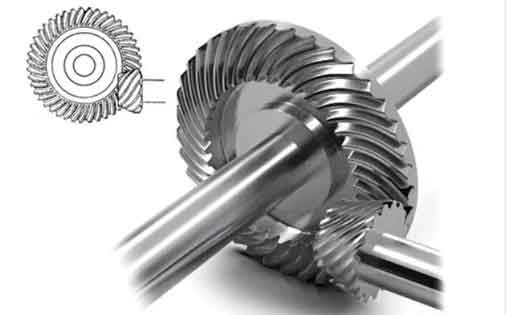
The dynamic meshing simulation was performed over one complete meshing period of the pinion. The pinion was assigned a rotational speed of 3000 rpm, corresponding to the operational condition. The analysis was conducted using an explicit dynamics approach with 100 time increments, effectively capturing the transient response as the teeth engage and disengage. The contact algorithm accounted for the nonlinearities arising from changing contact areas and boundary conditions. The instantaneous state of stress, including von Mises stress and component-specific contact and bending stresses, was extracted at each increment. The simulation successfully revealed the dynamic transfer of load between tooth pairs, the impact of meshing impacts, and the fluctuating stress history experienced by individual teeth on these spiral bevel gears.
The analysis of tooth surface contact stress is vital for assessing pitting and wear resistance. During the dynamic meshing of spiral bevel gears, the contact stress on a given tooth flank varies significantly as it enters, traverses, and exits the contact zone. The transition between single and double tooth pair contact induces notable fluctuations. The acceleration response of nodes on the active tooth surface, shown conceptually, exhibits a sharp impact at initial engagement, which gradually dampens as meshing progresses. The contact stress $\sigma_H$ at critical points can be described by the Hertzian contact theory modified for gear geometry, though the FEA provides a more precise distribution:
$$ \sigma_H \approx \sqrt{ \frac{F_n / l}{\pi \left( \frac{1-\mu_1^2}{E_1} + \frac{1-\mu_2^2}{E_2} \right) \rho_e} } $$
where $F_n$ is the normal load, $l$ is the contact line length, $\mu_i$ and $E_i$ are Poisson’s ratio and Young’s modulus for the two gears, and $\rho_e$ is the equivalent radius of curvature. In our dynamic simulation for the spiral bevel gears, the contact stress on specific nodes peaked during the double-pair contact phase. For instance, at a mid-meshing position (increment 40), the maximum contact stress observed on the pinion tooth flank reached approximately 1271 MPa. The variation of contact stress for nodes on successive teeth is presented in Table 2, highlighting the stress concentration during the load transfer.
| Meshing Phase (Approx. Increment) | Node ID (Tooth A) | Contact Stress $\sigma_H$ [MPa] | Node ID (Tooth B) | Contact Stress $\sigma_H$ [MPa] |
|---|---|---|---|---|
| Initial Engagement (4) | 23200 | 985 | 23500 | 210 |
| Mid-Meshing (40) | 23200 | 1271 | 23500 | 650 |
| Exit (100) | 23200 | 85 | 23500 | 1105 |
This dynamic pattern confirms that the spiral bevel gears experience cyclic, high-magnitude contact stresses, which are a primary driver for surface fatigue. However, for the material used (16Cr2Ni2A), the experimentally determined contact fatigue limit is around 2550 MPa, which is substantially higher than the maximum computed stress. This suggests that for this specific design and load case, contact fatigue failure is less likely compared to other failure modes, underscoring the importance of material selection for spiral bevel gears.
The bending stress at the tooth root is arguably more critical for overall gear integrity, as it can lead to catastrophic tooth breakage. The dynamic meshing induces a complex, time-varying bending moment at the root. The stress state alternates between compression and tension on opposite sides of the root fillet. The simulation results clearly show that the maximum bending stress typically occurs on the compressive side of the root. The bending stress $\sigma_b$ can be related to the applied torque and geometry through the Lewis formula, augmented for dynamic effects:
$$ \sigma_b = \frac{F_t}{b m_n Y} K_v K_m $$
where $F_t$ is the tangential force, $b$ is the face width, $m_n$ is the normal module, $Y$ is the Lewis form factor, $K_v$ is the dynamic factor, and $K_m$ is the load distribution factor. Our FEA provides a direct calculation without requiring these approximate factors. The dynamic bending stress history for nodes on the compressive and tensile sides of the root for two consecutive teeth is summarized in Table 3. Node 22730 (compressive side, first engaging tooth) experienced the highest stress of 266.1 MPa during initial impact. This confirms that the root compressive region is the most severely stressed during the operation of these spiral bevel gears.
| Node Location & ID | Stress State | Bending Stress at Increment 4 [MPa] | Bending Stress at Increment 40 [MPa] | Bending Stress at Increment 100 [MPa] |
|---|---|---|---|---|
| Tooth 1, Node 22730 | Compressive Side | 266.1 | 202.2 | 21.3 |
| Tooth 1, Node 22738 | Tensile Side | 227.5 | 146.4 | 8.0 |
| Tooth 2, Node 28041 | Compressive Side | 37.3 | 35.9 | 192.9 |
| Tooth 2, Node 28057 | Tensile Side | 36.8 | 34.6 | 145.0 |
The fluctuating bending stress, especially the high compressive stress peak, drives fatigue crack initiation and propagation. To assess the bending fatigue strength, a fatigue analysis was performed using the stress-life (S-N) approach. The material S-N curve for 16Cr2Ni2A steel under bending was incorporated, which follows the Basquin’s equation:
$$ \sigma_a = \sigma_f’ (2N_f)^b $$
Here, $\sigma_a$ is the stress amplitude, $\sigma_f’$ is the fatigue strength coefficient, $N_f$ is the number of cycles to failure, and $b$ is the fatigue strength exponent. For the studied material, the curve was defined by experimental data points. The fatigue simulation was conducted using the stress history from the most critical loading condition (increment 4, where root stress was highest). The resulting fatigue life distribution contour on the pinion tooth is highly informative. It clearly indicates that the minimum fatigue life, and thus the most probable site for fatigue crack initiation, is located in the fillet region on the compressive side of the tooth root. This aligns perfectly with the stress analysis results for these spiral bevel gears.
The fatigue life at specific critical nodes, both in the as-machined state and after a surface enhancement process like carburizing, was extracted. Carburizing is known to introduce compressive residual stresses and increase surface hardness, thereby significantly improving fatigue resistance. Research indicates it can improve the fatigue limit by approximately 29%. The calculated fatigue lives (in terms of meshing cycles) are presented in Table 4. Even after carburizing, the life at the critical compressive-side node is on the order of $10^6$ cycles. While this may be acceptable for some applications, for highly reliable systems like helicopter transmissions operating under continuous high load, further design optimization is warranted to extend the fatigue life of these spiral bevel gears.
| Node ID & Location | Fatigue Life (As-Machined) [Cycles] | Fatigue Life (After Carburizing) [Cycles] |
|---|---|---|
| Node 22730 (Compressive Side) | 8.23 × 10⁵ | 1.102 × 10⁶ |
| Node 22738 (Tensile Side) | 1.168 × 10⁶ | 1.790 × 10⁶ |
The dynamic behavior of spiral bevel gears is inherently complex due to factors like time-varying mesh stiffness, damping, and lubrication effects. While this model incorporates structural damping, it does not explicitly model tribological effects at the contact interface. The presence of a lubricant film can reduce friction and alter the surface stress state, potentially affecting both contact and bending fatigue. Furthermore, initial manufacturing imperfections or micro-cracks could serve as nucleation sites, reducing the actual fatigue life compared to the simulated ideal geometry. Future work on spiral bevel gears should integrate these aspects for an even more comprehensive fatigue life prediction. Additionally, probabilistic methods could be employed to account for scatter in material properties and loading conditions.
From a design perspective, the identified weak spot in the tooth root fillet on the compressive side suggests several potential optimization paths for spiral bevel gears. These include geometric modifications such as optimizing the fillet radius and root profile to reduce stress concentration, employing advanced shot peening processes to induce deeper compressive residual stresses, and exploring higher-grade alloys or composite materials. The dynamic FEA model developed here serves as a powerful tool to virtually test and compare the effectiveness of such modifications before physical prototyping, thereby accelerating the development of more durable spiral bevel gears.
In conclusion, this investigation successfully employed a detailed nonlinear finite element model to simulate the continuous dynamic meshing process of a spiral bevel gear pair from a helicopter reducer. The simulation captured the realistic transient stress states, revealing that the maximum contact stresses remain below the material’s contact fatigue limit for this specific case, while the bending stresses at the tooth root, particularly on the compressive side, are the primary concern for fatigue failure. The dynamic pattern of stress variation, with significant impacts during tooth engagement, was quantified. Fatigue life analysis, based on the dynamic stress history, pinpointed the root fillet’s compressive region as the critical location for bending fatigue damage. Even with carburizing treatment, the predicted fatigue life at this hotspot indicates a need for further design refinement for ultra-high-reliability applications. This study underscores the critical importance of dynamic analysis over static approaches in accurately assessing the fatigue performance of spiral bevel gears. The methodologies and findings presented provide a robust framework for the fatigue-driven design and optimization of spiral bevel gears in demanding transmission systems, contributing to enhanced safety and longevity. Future research directions should focus on incorporating more physical phenomena like lubrication and wear into the dynamic model to achieve an even more holistic understanding of spiral bevel gear performance under operational conditions.