
In my experience as a manufacturing engineer, the machining of miter gears—specifically straight bevel gears with a shaft angle of 90°—presents unique challenges that often require specialized equipment or modifications to standard machinery. Miter gears are crucial components in various mechanical transmissions, and their precise fabrication is essential for smooth operation and longevity. This article details a first-person account of adapting a conventional milling machine to produce miter gears using form milling cutters, a method that balances cost-effectiveness with acceptable accuracy for certain applications. The process involves mechanical retrofitting, electrical adjustments, meticulous calculations, and careful execution. Throughout this discussion, I will emphasize the key aspects of working with miter gears, employing formulas and tables to summarize critical data, and ensuring that the keyword ‘miter gear’ is frequently referenced to underscore its importance.
The core of this adaptation lies in modifying a standard horizontal milling machine to accommodate the angular requirements of miter gear teeth. The original setup involved a milling head that moved laterally along the machine bed. To machine miter gears, we installed an auxiliary mechanical slide unit onto the bed. This unit provides two essential motions: a transverse linear travel of the slide and a rotational capability around the longitudinal slide axis, allowing the workpiece to be tilted to the root cone angle. Specifically, the mechanical slide’s transverse travel is ±150 mm, and its rotation around the longitudinal slide is ±45°. The original milling head is relocated to the left side of the machine bed and, during operation, moves laterally along with this entire assembly, while other machine motions remain unchanged. This mechanical modification enables the cutter to approach the gear blank at the correct angle relative to the root cone, which is fundamental for miter gear generation.
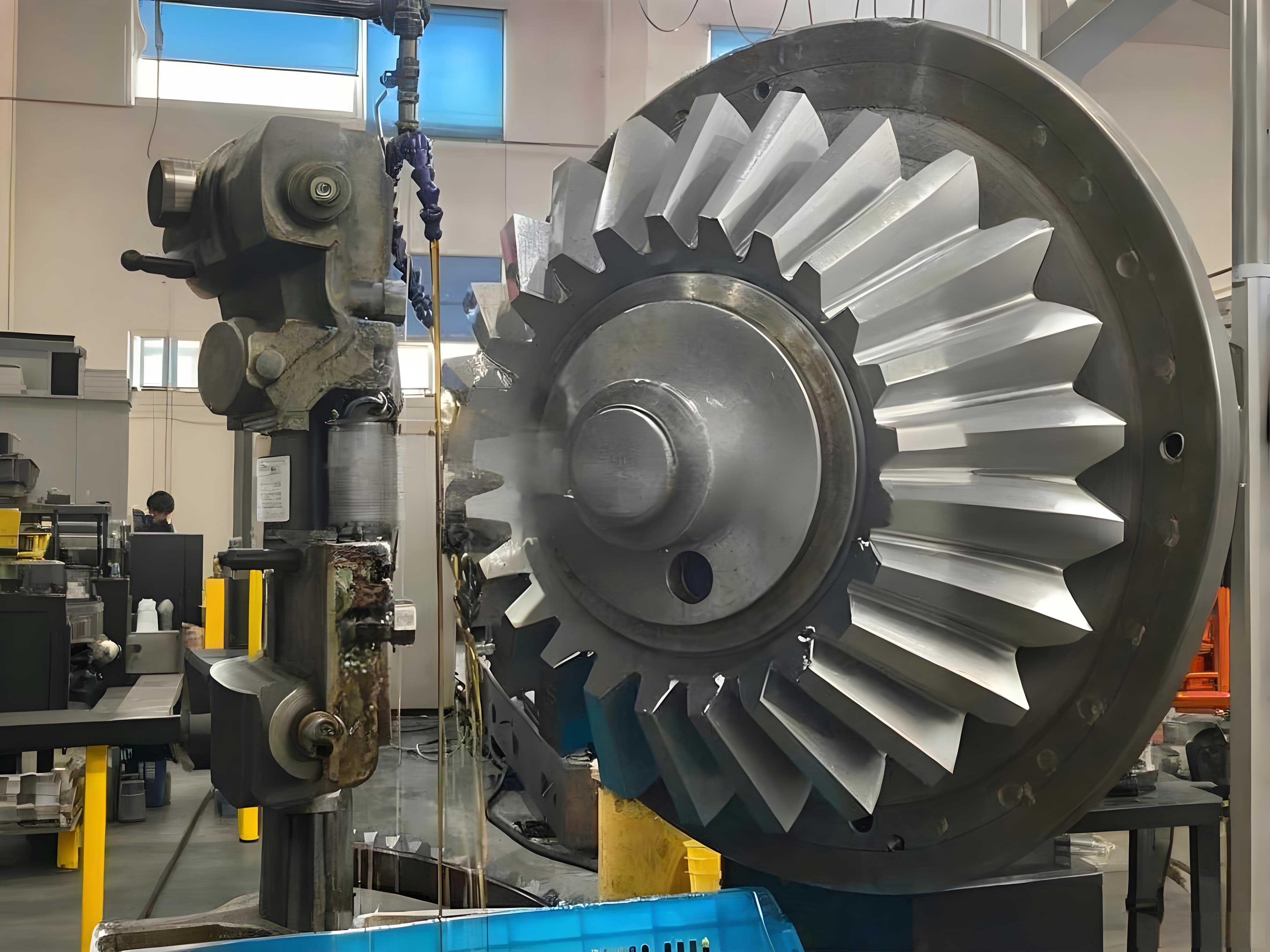
With the mechanical changes in place, the electrical control system of the machine required significant rewiring to synchronize the new motions with the existing feed and rapid traverse functions. Since the machining method for the miter gear shifts from a conventional setup to one involving compound slide movements, the limit switches on the original milling head slide and the machine bed had to be repositioned and rewired according to a new control schematic. The power supply for the original milling head motor was redirected to the spindle motor of the form milling cutter attached to the slide unit. Furthermore, the control lines for the feed and rapid traverse motors on the mechanical slide were integrated into the main circuit. An additional DC power supply was incorporated to operate the electromagnetic clutch (designated as DT) within the slide mechanism for engaging specific feeds. Two critical notes: first, the contactors for the motors had to be swapped because the original milling head motor had a much higher power rating than the feed motors; second, the feed direction selector switch must be set to the “right milling” position to ensure proper sequence. After these modifications, the automated cycle for machining a miter gear proceeds as follows: the milling head rapidly moves right → dwell → forward working feed → dwell → milling head rapidly moves left → dwell → indexing combined with rapid retraction → dwell → milling head rapidly moves right to begin the next cycle. This cycle repeats until all teeth of the miter gear are rough-machined.
Preparation for machining a miter gear begins with calculating the tooth profile dimensions based on the gear drawing specifications. For any miter gear, key parameters include: module \( m \), number of teeth \( z \), pitch cone angle \( \delta \), addendum cone angle \( \delta_a \), dedendum cone angle \( \delta_f \), cone distance \( R \), face width \( b \), and required accuracy grade. The profile dimensions at both the large end and small end of the tooth must be computed and detailed with tolerance values. The small-end dimensions are proportionally derived from the large-end data. The geometry of a miter gear tooth is inherently tapered, so the tooth thickness \( s \) or space width \( e \) varies along the face width. A fundamental relationship governs the taper: the tooth profile is projected onto a plane perpendicular to the root cone. The calculation involves determining the chordal dimensions at the large and small ends, which are crucial for setting the cutter depth. For a miter gear with a 90° shaft angle, the pitch cone angle for the gear and pinion are complementary (e.g., \( \delta_1 + \delta_2 = 90^\circ \)). A table summarizing these parameters is essential for clarity.
| Parameter | Symbol | Value (Example) | Remarks |
|---|---|---|---|
| Module | \( m \) | 5 mm | Defines tooth size |
| Number of Teeth | \( z \) | 20 | For gear member |
| Pitch Cone Angle | \( \delta \) | 45° | For a standard miter gear |
| Cone Distance | \( R \) | \( \frac{m z}{2 \sin \delta} \) | Calculated: \( R = \frac{5 \times 20}{2 \sin 45^\circ} \approx 70.71 \text{ mm} \) |
| Face Width | \( b \) | 20 mm | Typically \( b \leq R/3 \) |
| Addendum | \( h_a \) | \( m \) | At large end |
| Dedendum | \( h_f \) | \( 1.25m \) | At large end |
Selecting the correct form milling cutter is a critical step for machining a miter gear. The cutter number is determined by the virtual number of teeth \( z_v \), which for a bevel gear is given by \( z_v = \frac{z}{\cos \delta} \). For a miter gear with \( \delta = 45^\circ \), \( z_v \approx 1.414z \). This virtual number accounts for the tapered tooth form when selecting a standard cutter designed for spur gears. Importantly, the cutter tooth thickness is designed based on the small-end space width of the miter gear, assuming a ratio of cone distance to face width \( R/b = 3 \). This ensures that the cutter is slightly smaller than one used for a spur gear of the same module, as it must fit the narrowing tooth space toward the small end. Consequently, the machined tooth profile will be most accurate at the large end, with some inherent error along the face width, especially for miter gears with low tooth counts. The following table guides cutter selection based on \( z_v \).
| Virtual Number of Teeth \( z_v \) | Recommended Cutter Number | Application Note for Miter Gear |
|---|---|---|
| 12 – 13 | 1 | For coarse-pitch miter gears |
| 14 – 16 | 2 | Common range for many miter gears |
| 17 – 20 | 3 | Ensures better profile accuracy |
| 21 – 25 | 4 | For finer-toothed miter gears |
| 26 – 34 | 5 | Used in precision miter gear sets |
| 35 – 54 | 6 | For high-tooth-count miter gears |
| 55 – 134 | 7 | Rare in typical miter gear applications |
| 135 – ∞ | 8 | Not typical for miter gears |
Determining the workpiece rotation angle \( \theta \) and the cutter offset \( \Delta \) is essential for the multi-cut method used in miter gear machining. After the first cut that mills the tooth space to full depth at the small end, the tooth thickness on the pitch cone surface at the large end is excessive. To remove this excess material from the sides, the workpiece must be rotated and the cutter offset radially. The rotation angle \( \theta \) and offset \( \Delta \) are derived from the geometry of the miter gear tooth. Let \( s_L \) be the chordal tooth thickness at the large end and \( s_S \) at the small end. The excess thickness per side after the first cut is approximately \( \frac{s_L – s_S}{2} \). The relationship involves the cone distance \( R \), face width \( b \), and pitch cone angle \( \delta \). A detailed derivation yields:
$$ \theta = \arctan\left( \frac{s_L – s_S}{2R \sin \delta} \right) $$
$$ \Delta = \frac{s_L – s_S}{2 \cos \delta} $$
However, in practice, for a miter gear, these values are often determined using projection methods. Considering the horizontal projection of the tooth taper, the offset \( \Delta \) can be related to the rotation by \( \Delta = R_\text{top} \cdot \theta \), where \( R_\text{top} \) is the radius at the top land of the tooth. For simplicity, empirical tables or interpolation based on gear parameters are used. The following table provides calculated values for a sample miter gear.
| Gear Parameter | Symbol | Value | Calculated \( \theta \) | Calculated \( \Delta \) |
|---|---|---|---|---|
| Module | \( m \) | 5 mm | Approx. 1.5° | Approx. 0.87 mm |
| Teeth Number | \( z \) | 20 | ||
| Pitch Cone Angle | \( \delta \) | 45° | ||
| Cone Distance | \( R \) | 70.71 mm |
Setting up the machine involves several adjustments akin to those for spur gear milling but with added complexities for the miter gear. First, the indexing mechanism must be configured based on the number of teeth \( z \). For a universal dividing head, the indexing ratio is \( 40:z \). With our mechanical slide, the gear blank is mounted on the rotary table of the slide, ensuring its axis is aligned with the rotation center. The milling cutter spindle speed and feed rates are selected based on the cutter material and miter gear blank material—typically, for steel, a cutting speed of 20-30 m/min and a feed per tooth of 0.05-0.1 mm are suitable. The feed rate for the mechanical slide during the working stroke is set to achieve the desired surface finish. Additionally, the alignment of the cutter center with the gear blank center is critical; any misalignment will cause asymmetrical tooth profiles on the miter gear.
The machining process for a miter gear can be performed using either a three-cut method or a two-cut method. The three-cut method is more thorough and is described here. In the first cut, the form milling cutter is centered on the gear blank, and a tooth space is milled to the full dedendum depth at the large end, i.e., depth \( h_f = 1.25m \). This is repeated for all teeth around the miter gear blank. The second cut addresses the lower flank (drive side typically): the workpiece is rotated counterclockwise by angle \( \theta \) (e.g., 1.5°), and the cutter is offset upward by distance \( \Delta \) (e.g., 0.87 mm). All lower flanks are milled sequentially. The third cut mills the upper flanks: the workpiece is rotated clockwise by \( \theta \), and the cutter is offset downward by \( \Delta \). After completing these cuts, the large-end tooth dimensions should meet the drawing specifications. The two-cut method omits the initial full-depth slotting cut and starts directly with the flank milling cuts, adjusting \( \theta \) and \( \Delta \) accordingly for each side. This method is faster but requires precise initial setup to avoid overcutting. For both methods, leaving a finishing allowance of 0.1-0.2 mm per side is advisable to achieve better surface roughness and accuracy in the final miter gear.
To illustrate the calculations, consider a pair of straight bevel gears—essentially miter gears since the shaft angle is 90°. The primary parameters are: module \( m = 5 \text{ mm} \), pinion teeth \( z_1 = 20 \), gear teeth \( z_2 = 20 \) (making it a true miter gear pair), pitch cone angles \( \delta_1 = 45^\circ \), \( \delta_2 = 45^\circ \), addendum cone angles \( \delta_{a1} = 47.5^\circ \), \( \delta_{a2} = 47.5^\circ \), dedendum cone angles \( \delta_{f1} = 42.5^\circ \), \( \delta_{f2} = 42.5^\circ \), cone distance \( R = 70.71 \text{ mm} \), face width \( b = 20 \text{ mm} \), and accuracy grade AGMA 9. The virtual number of teeth is \( z_v = \frac{20}{\cos 45^\circ} \approx 28.28 \), so from the cutter table, a No. 5 cutter is selected. The chordal tooth space dimensions at large and small ends are computed using standard gear formulas. The chordal space width at the large end \( e_L \) and small end \( e_S \) are:
$$ e_L = m \left( \frac{\pi}{2} + 2x \tan \alpha \right) \quad \text{(for standard tooth, } x=0, \alpha=20^\circ\text{)} $$
$$ e_S = e_L \cdot \frac{R – b}{R} $$
For this miter gear, with \( \alpha = 20^\circ \), \( e_L \approx 7.85 \text{ mm} \), and \( e_S \approx 7.85 \times \frac{70.71 – 20}{70.71} \approx 5.63 \text{ mm} \). The difference \( e_L – e_S \approx 2.22 \text{ mm} \). Then, \( \theta \) and \( \Delta \) are approximated as:
$$ \theta \approx \arctan\left( \frac{2.22}{2 \times 70.71 \times \sin 45^\circ} \right) \approx 1.27^\circ $$
$$ \Delta \approx \frac{2.22}{2 \cos 45^\circ} \approx 1.57 \text{ mm} $$
These values guide the setup for the flank milling cuts. The table below summarizes the gear data and results.
| Calculation Step | Symbol | Value | Formula |
|---|---|---|---|
| Module | \( m \) | 5 mm | Given |
| Number of Teeth | \( z \) | 20 | Given |
| Pitch Cone Angle | \( \delta \) | 45° | Given for miter gear |
| Cone Distance | \( R \) | 70.71 mm | \( R = \frac{m z}{2 \sin \delta} \) |
| Virtual Teeth Number | \( z_v \) | 28.28 | \( z_v = z / \cos \delta \) |
| Cutter Number | — | 5 | From \( z_v \) range |
| Large-End Space Width | \( e_L \) | 7.85 mm | Chordal approximation |
| Small-End Space Width | \( e_S \) | 5.63 mm | \( e_S = e_L \cdot (R-b)/R \) |
| Workpiece Rotation Angle | \( \theta \) | 1.27° | Calculated |
| Cutter Offset | \( \Delta \) | 1.57 mm | Calculated |
The accuracy of machining a miter gear using this form milling method is influenced by several factors: cutter profile accuracy, machine rigidity, workpiece mounting, blank dimensions, and the setup precision. Typically, this method is suitable for miter gears with accuracy grades below AGMA 10, especially when the tooth count is low (e.g., \( z < 20 \)). The inherent error arises because the cutter is designed for the small-end space, so the large-end profile is approximated. This error increases with decreasing tooth number. However, for many industrial applications, such as in non-critical power transmission, this method yields acceptable miter gears. To ensure quality, the gear blank must meet drawing tolerances, with runout controlled within 0.05 mm for the pitch circle. The alignment error between the cutter axis and the blank axis should be less than ±0.02 mm, and the cutter runout must be under 0.01 mm. For miter gear blanks larger than 200 mm in diameter, balancing weights should be added to the mounting fixture to prevent vibration during machining, as imbalance can cause surface finish issues and dimensional inaccuracies in the final miter gear.
In the two-cut method, after setting the initial workpiece and cutter positions, the first cut (which would be the second cut in the three-cut method) directly mills one flank with the corresponding \( \theta \) and \( \Delta \), followed by the opposite flank with adjusted values. This approach reduces machining time but requires even more careful calculation of depths to avoid gouging. Regardless of the method, leaving a finish allowance of about 0.1-0.2 mm per side for a subsequent finishing operation (e.g., grinding or lapping) is recommended to achieve the desired surface roughness and tooth profile accuracy for high-performance miter gears. Throughout the process, frequent inspection of the large-end dimensions using gear tooth calipers or projectors is necessary to ensure the miter gear conforms to specifications.
In conclusion, adapting a standard milling machine for machining miter gears via form milling cutters is a viable solution for small-batch production or repair work. This first-person narrative has detailed the mechanical and electrical modifications, the comprehensive preparation involving geometric calculations and cutter selection, the determination of rotation angles and offsets, and the step-by-step machining methods. Emphasizing the term ‘miter gear’ throughout underscores the specific application of these techniques to bevel gears with 90° shaft angles. By leveraging tables and formulas, as shown, one can systematically plan and execute the manufacturing of such gears. While the method has limitations in precision compared to dedicated bevel gear generators, it offers flexibility and cost savings, making it a valuable skill for machinists working with miter gears in various mechanical systems.