
The design of modern gear transmissions increasingly prioritizes compactness, lightweight construction, and the ability to handle high speeds under significant loads. In this context, surface distress mechanisms such as scuffing (adhesive wear) and abrasive wear have become predominant failure modes. Both theoretical and empirical evidence strongly indicate that the presence and the thickness of a lubricating film between the contacting teeth are of paramount importance in preventing these surface failures. For spiral gears, which feature complex point contact kinematics, understanding and predicting the lubricant film condition is particularly crucial. This article employs the principles of elastohydrodynamic lubrication (EHL) to derive and analyze a comprehensive formula for calculating the minimum film thickness in spiral gears. This foundation is essential for advancing research into the lubrication performance and reliability of spiral gear transmissions.
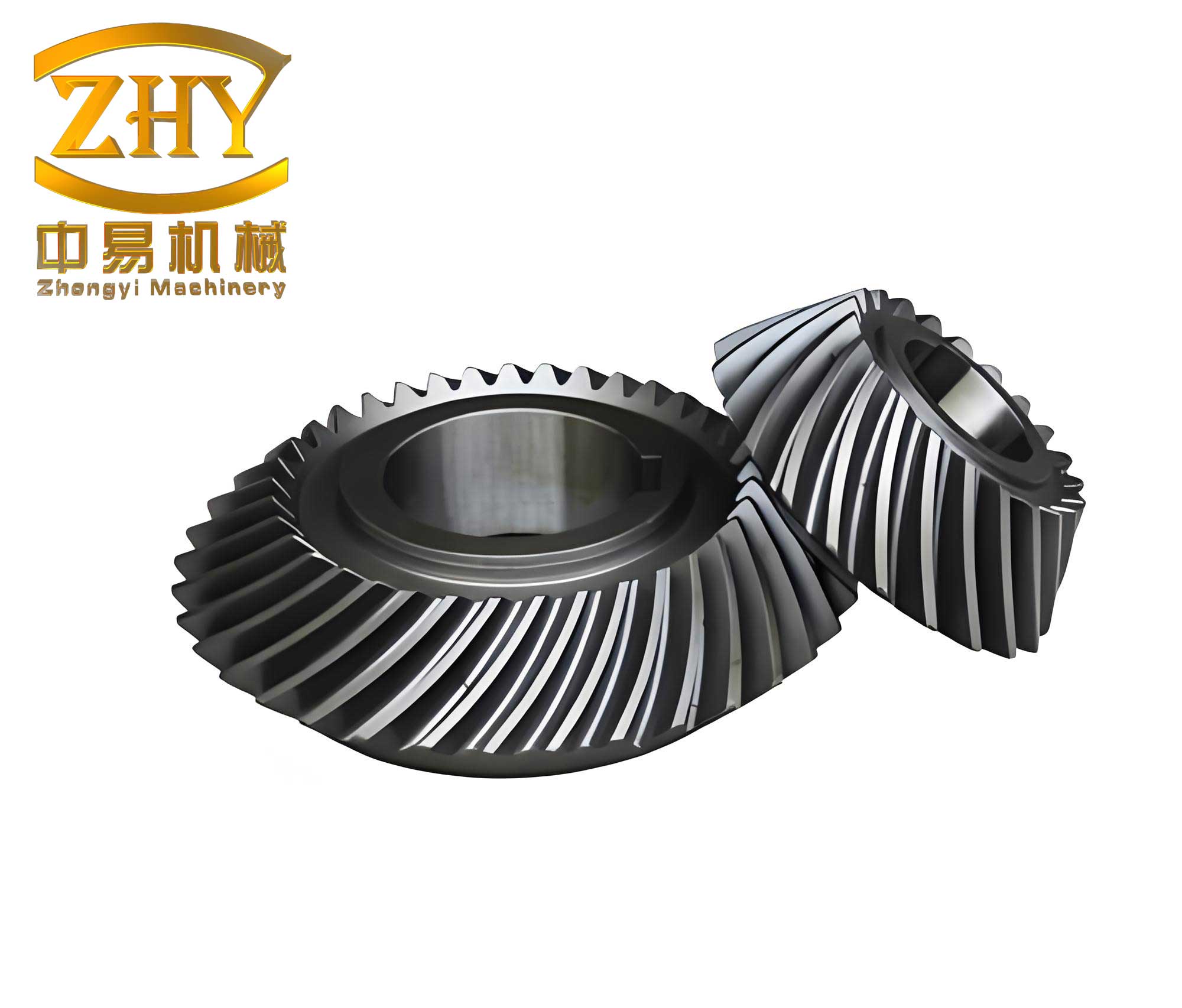
1. Fundamental Concepts of Spiral Gear Contact and Lubrication
Spiral gears, also known as crossed helical gears, are used to transmit motion and power between non-parallel, non-intersecting shafts. The contact between two teeth is theoretically a point contact, which under load deforms into a small elliptical area. The lubrication regime in such concentrated contacts is classified as elastohydrodynamic lubrication (EHL), where the high contact pressure significantly increases the lubricant’s viscosity (piezo-viscous effect) and elastically deforms the contacting surfaces.
The primary goal of EHL analysis is to determine the minimum film thickness ($h_{min}$) separating the surfaces. This parameter is critical for assessing the risk of wear and surface fatigue. A widely accepted empirical formula for line contacts, which serves as a starting point for spiral gear analysis, is the Dowson-Higginson equation:
$$ H_{min} = 2.65 \alpha^{0.54} (\eta_0 u)^{0.7} R^{0.43} E^{‘ \,-0.03} w^{-0.13} $$
Where the dimensionless group $H_{min} = h_{min}/R$. The key parameters in dimensional form are:
- $\alpha$: Pressure-viscosity coefficient of the lubricant [Pa$^{-1}$]
- $\eta_0$: Dynamic viscosity at atmospheric pressure [Pa·s]
- $u$: Mean entrainment (rolling) speed [m/s]
- $R$: Effective radius of curvature [m]
- $E’$: Effective elastic modulus [Pa], given by $\frac{2}{1/E_1 + 1/E_2}$
- $w$: Load per unit width [N/m]
To apply this to spiral gears, each of these parameters must be expressed in terms of the gear’s geometric and operational parameters.
2. Geometric and Kinematic Analysis for Spiral Gears
The complex contact geometry of spiral gears requires a detailed derivation of the equivalent radius ($R$) and rolling speed ($u$). At any instantaneous point of contact, the meshing teeth can be modeled as two equivalent cylinders. The geometry is defined at the pitch point P, where the pitch cylinders of the two spiral gears are tangent.
2.1 Principal Curvatures and Effective Radius (R)
The tooth surface of an involute spiral gear is a helicoid. It has two principal directions at any point. One direction is along the tooth trace (straight generatrix of the helicoid), where the normal curvature ($b^I$) is zero. The other principal direction is perpendicular to the tooth trace. For gears 1 and 2, the principal curvatures in this second direction are:
$$ b^{II}_1 = \frac{2 \cos^2 \alpha_n}{d_1 \sin \alpha_n (\tan^2 \alpha_n + \cos^2 \beta_1)} $$
$$ b^{II}_2 = \frac{2 \cos^2 \alpha_n \cos \beta_2}{d_1 \mu \sin \alpha_n \cos \beta_1 (\tan^2 \alpha_n + \cos^2 \beta_2)} $$
Where:
- $\alpha_n$: Normal pressure angle
- $\beta_1, \beta_2$: Helix angles of gear 1 and 2 (positive for right-hand, negative for left-hand)
- $d_1$: Pitch diameter of the pinion (gear 1) [m]
- $\mu = z_2/z_1$: Gear ratio
The principal directions of the two contacting surfaces are not aligned. The angle $\phi$ between them is the sum of the angles each gear’s tooth trace makes with the common tangent line $t$-$t$ in the plane of action:
$$ \cos \phi_1 = \frac{\cos \beta_1}{\cos \beta_{b1}} = \cos \beta_1 \cos \alpha_n \sqrt{\frac{1}{\cos^2 \beta_1 + \tan^2 \alpha_n}} $$
$$ \cos \phi_2 = \frac{\cos \beta_2}{\cos \beta_{b2}} = \cos \beta_2 \cos \alpha_n \sqrt{\frac{1}{\cos^2 \beta_2 + \tan^2 \alpha_n}} $$
$$ \phi = \phi_1 + \phi_2 $$
The contact ellipse for spiral gears is typically very elongated. For shaft angles $\Sigma \le 90^\circ$, the major axis of the ellipse aligns closely with the direction of the tooth trace. Therefore, the contact can be approximated as a line contact along this direction for the purpose of calculating minimum film thickness using line-contact EHL theory. The effective radius of curvature $R$ for this equivalent line contact is derived from the relative curvatures:
$$ \frac{1}{R} = A = \frac{1}{2} \left[ (b^I_1 + b^{II}_1) + (b^I_2 + b^{II}_2) + \sqrt{ (b^I_1 – b^{II}_1)^2 + (b^I_2 – b^{II}_2)^2 + 2(b^I_1 – b^{II}_1)(b^I_2 – b^{II}_2) \cos 2\phi } \right] $$
Since $b^I_1 = b^I_2 = 0$, the expression simplifies to:
$$ R = \frac{2}{ b^{II}_1 \left[ 1 + \frac{b^{II}_2}{b^{II}_1} + \sqrt{ \left(1 + \frac{b^{II}_2}{b^{II}_1}\right)^2 + 2 \frac{b^{II}_2}{b^{II}_1} \cos 2\phi } \right] } $$
2.2 Mean Entrainment Velocity (u)
The entrainment velocity is the average speed at which the surfaces roll together into the contact zone, which is critical for building hydrodynamic pressure. For spiral gears at the pitch point, the circumferential velocities are $v_{p1}$ and $v_{p2}$. Their components along the common normal in the plane of action contribute to rolling. The sliding velocity component has a negligible effect on central film thickness and is often omitted in this calculation. Thus:
$$ u \approx \frac{1}{2} (v_{p1} \cos \beta_1 + v_{p2} \cos \beta_2) \sin \alpha_n \approx v_{p1} \cos \beta_1 \sin \alpha_n = \pi m_n z_1 n_1 \sin \alpha_n $$
Where $m_n$ is the normal module, $z_1$ is the number of teeth on the pinion, and $n_1$ is its rotational speed [rps].
2.3 Load per Unit Width (w)
The normal force $F_n$ between the teeth is derived from the transmitted torque $T_1$. For face width $B$, the load per unit width is:
$$ w = \frac{F_n}{B} = \frac{2 T_1}{d_1 B \cos \beta_1 \cos \alpha_n} $$
It is important to note that for spiral gears, due to the point contact, this $w$ represents an idealized load intensity over the effective contact length approximated by the face width.
3. Derivation of the Minimum Film Thickness Formula for Spiral Gears
Substituting the expressions for $R$, $u$, and $w$ into the Dowson-Higginson equation yields the comprehensive formula for the minimum oil film thickness in spiral gear transmissions.
First, let’s restate the key substitutions:
$$ R = \frac{2}{ b^{II}_1 \cdot K } \quad \text{where} \quad K = 1 + \frac{b^{II}_2}{b^{II}_1} + \sqrt{ \left(1 + \frac{b^{II}_2}{b^{II}_1}\right)^2 + 2 \frac{b^{II}_2}{b^{II}_1} \cos 2\phi } $$
$$ u = \pi m_n z_1 n_1 \sin \alpha_n $$
$$ w = \frac{2 T_1}{d_1 B \cos \beta_1 \cos \alpha_n} $$
Also, $d_1 = m_n z_1 / \cos \beta_1$.
Inserting these into $h_{min} = 2.65 \alpha^{0.54} (\eta_0 u)^{0.7} R^{0.43} E^{‘ \,-0.03} w^{-0.13}$ and performing algebraic simplification, we obtain:
$$ h_{min} = \frac{0.085 \cdot B^{0.13} \sin^{1.13}\alpha_n \cdot \alpha^{0.54} (\eta_0 n_1)^{0.7} (m_n z_1)^{1.13} \cdot T_1^{\,-0.13} E^{‘ \,-0.03} }{ \cos^{0.73}\alpha_n \cos^{0.43}\beta_1 (\tan^2\alpha_n + \cos^2\beta_1)^{0.43} \cdot K^{0.43} } $$
This is the central result for calculating the minimum EHL film thickness in spiral gear pairs. The parameter $K$ encapsulates the complex geometric interaction of the two helicoids:
$$ K = 1 + \frac{\cos \beta_2 (\tan^2\alpha_n + \cos^2\beta_1)}{\mu \cos \beta_1 (\tan^2\alpha_n + \cos^2\beta_2)} + \sqrt{ \left[1 + \frac{\cos \beta_2 (\tan^2\alpha_n + \cos^2\beta_1)}{\mu \cos \beta_1 (\tan^2\alpha_n + \cos^2\beta_2)}\right]^2 + 2 \left[\frac{\cos \beta_2 (\tan^2\alpha_n + \cos^2\beta_1)}{\mu \cos \beta_1 (\tan^2\alpha_n + \cos^2\beta_2)}\right] \cos 2\phi } $$
The following table summarizes all parameters in the final spiral gear film thickness formula:
| Symbol | Parameter | Typical Unit | Influence on $h_{min}$ |
|---|---|---|---|
| $h_{min}$ | Minimum Elastohydrodynamic Film Thickness | $\mu m$ or m | Output variable |
| $B$ | Face Width | m | Positive, weak ($B^{0.13}$) |
| $\alpha_n$ | Normal Pressure Angle | rad or deg | Complex (see numerator & denominator) |
| $\alpha$ | Pressure-Viscosity Coefficient | Pa$^{-1}$ | Positive ($\alpha^{0.54}$) |
| $\eta_0$ | Atmospheric Dynamic Viscosity | Pa·s | Positive ($\eta_0^{0.7}$) |
| $n_1$ | Pinion Rotational Speed | rps | Positive ($n_1^{0.7}$) |
| $m_n$ | Normal Module | m | Positive ($m_n^{1.13}$) |
| $z_1$ | Number of Teeth on Pinion | – | Positive ($z_1^{1.13}$) |
| $T_1$ | Pinion Torque | N·m | Negative ($T_1^{\,-0.13}$) |
| $E’$ | Effective Elastic Modulus | Pa | Negative ($E^{‘ \,-0.03}$), very weak |
| $\beta_1, \beta_2$ | Helix Angles of Gear 1 and 2 | rad or deg | Complex (via $\cos\beta_1$ and $K$) |
| $\mu$ | Gear Ratio ($z_2/z_1$) | – | Complex (via $K$) |
| $\phi$ | Angle Between Principal Directions | rad | Complex (via $\cos 2\phi$ in $K$) |
4. Parametric Influence and Design Implications
The derived formula explicitly shows how design and operational parameters influence the lubricant film thickness in spiral gear systems.
4.1 Strong Positive Influences
- Speed ($n_1$) and Viscosity ($\eta_0$): The combined term $(\eta_0 n_1)^{0.7}$ indicates that increasing either the rotational speed or using a higher viscosity oil significantly increases film thickness. This is the primary hydrodynamic effect.
- Size Parameters ($m_n, z_1$): The product $(m_n z_1)^{1.13}$, which relates to the pitch diameter, has a strong positive effect. Larger spiral gears naturally develop thicker films.
- Lubricant Property ($\alpha$): A higher pressure-viscosity coefficient, typical of mineral and synthetic oils, enhances the film-building capacity under high pressure.
4.2 Negative Influence
- Load ($T_1$): The exponent $-0.13$ shows that increased load decreases film thickness, but the dependence is relatively weak. This is a characteristic feature of EHL where the film is remarkably resilient to load changes.
4.3 Complex Geometric Influences
- Helix Angles ($\beta_1, \beta_2$): The effect is multifaceted. The term $\cos^{0.43}\beta_1$ in the denominator suggests a slight decrease in $h_{min}$ with increasing $\beta_1$. However, $\beta_1$ and $\beta_2$ also critically affect the effective radius $R$ through the complex geometric factor $K$. The helix angles also determine the shaft angle $\Sigma = |\beta_1 + \beta_2|$.
- Pressure Angle ($\alpha_n$): Its influence is spread across multiple terms ($\sin^{1.13}\alpha_n$, $\cos^{0.73}\alpha_n$, and within $K$), requiring case-specific evaluation.
The following table provides a qualitative guide for designers of spiral gear systems seeking to improve lubrication:
| Objective | Favorable Design or Operational Change | Potential Trade-off or Limitation |
|---|---|---|
| Increase $h_{min}$ | Increase normal module ($m_n$) or pinion teeth ($z_1$) | Increases gear size and weight. |
| Increase $h_{min}$ | Select lubricant with higher $\eta_0$ and $\alpha$ | May increase churning losses and operating temperature. |
| Increase $h_{min}$ | Operate at higher speeds ($n_1$) | May induce dynamic loads, noise, and require better balancing. |
| Mitigate load effect | The weak $T_1^{-0.13}$ dependence is beneficial; moderate load increases are tolerable for the film. | Excessive load can still lead to subsurface fatigue. |
| Optimize geometry | Analyze the combined effect of $\beta_1, \beta_2, \alpha_n$ on the factor $K$ for a given ratio $\mu$. | Geometry is often constrained by shaft angle and center distance requirements. |
5. The Lambda Ratio and Failure Prevention
The absolute value of $h_{min}$ is most meaningful when related to the composite surface roughness $\sigma$ of the two gear teeth, where $\sigma = \sqrt{\sigma_1^2 + \sigma_2^2}$. The dimensionless $\lambda$ ratio is defined as:
$$ \lambda = \frac{h_{min}}{\sigma} $$
This ratio predicts the expected lubrication regime and associated risks for spiral gears:
- $\lambda < 1$: Boundary Lubrication. High risk of adhesive wear (scuffing) and abrasive wear. Surface coatings or extreme pressure (EP) additives are essential.
- $1 < \lambda < 3$: Mixed Lubrication. Some asperity contact occurs alongside fluid film pressure. Risk of mild wear and pitting fatigue is present.
- $\lambda > 3$: Full Film Elastohydrodynamic Lubrication. Surfaces are fully separated. The primary failure mode, if any, is subsurface-originated pitting fatigue.
Therefore, the calculation of $h_{min}$ is not an end in itself but a critical step in calculating $\lambda$ and performing a reliability-based design for spiral gear sets. The goal is to achieve a $\lambda$ ratio sufficient for the intended application life and reliability target.
6. Assumptions, Limitations, and Further Considerations
The analysis presented relies on several key assumptions that define its scope and accuracy:
- Steady-State, Isothermal Condition: The formula assumes a constant temperature, ignoring localized flash temperatures in the contact which can significantly reduce effective viscosity.
- Line Contact Approximation: Modeling the elliptical contact of spiral gears as a line contact is a simplification. For highly skewed configurations, more advanced point contact EHL models may yield more accurate results.
- Neglect of Lubricant Non-Newtonian Effects: At very high shear rates present in gear contacts, lubricants may exhibit shear-thinning, which can reduce the effective film thickness compared to predictions using Newtonian viscosity.
- Inlet Zone Analysis: The empirical formula is based on conditions at the inlet of the contact. Severe starvation, where insufficient lubricant is available at the inlet, can drastically reduce film thickness.
Despite these limitations, the derived formula provides an excellent first-order approximation and a powerful tool for understanding the parametric sensitivity of lubrication in spiral gear designs. For critical applications, the results should be validated or refined using specialized EHL simulation software that can account for transient effects, thermal conditions, and precise contact geometry.
7. Conclusion
The reliable performance of spiral gear transmissions under high-speed and heavy-load conditions is intimately linked to the state of lubrication at the tooth contact. This analysis has demonstrated the application of elastohydrodynamic lubrication theory to derive a comprehensive analytical formula for the minimum oil film thickness. The formula integrates the fundamental gear geometry (module, teeth number, helix angles, pressure angle), material properties, lubricant characteristics (viscosity, pressure-viscosity coefficient), and operational parameters (speed, torque).
The calculation reveals that film thickness in spiral gears is most strongly enhanced by increasing size, speed, and lubricant viscosity, while being only weakly diminished by increased load. The complex interaction of the helix angles, encapsulated in the geometric factor $K$, highlights the unique tribological character of crossed-axis spiral gear meshes compared to parallel-axis helical gears.
Ultimately, the minimum film thickness calculation serves as the foundation for estimating the $\lambda$ ratio, which is a direct indicator of the prevailing lubrication regime and the associated risks of surface failure. By enabling designers to quantify and optimize this key parameter, the methodology supports the development of more durable, efficient, and reliable spiral gear systems. Future work may integrate this film thickness model with wear progression models and dynamic load analysis for a fully predictive life assessment framework for spiral gear transmissions.