
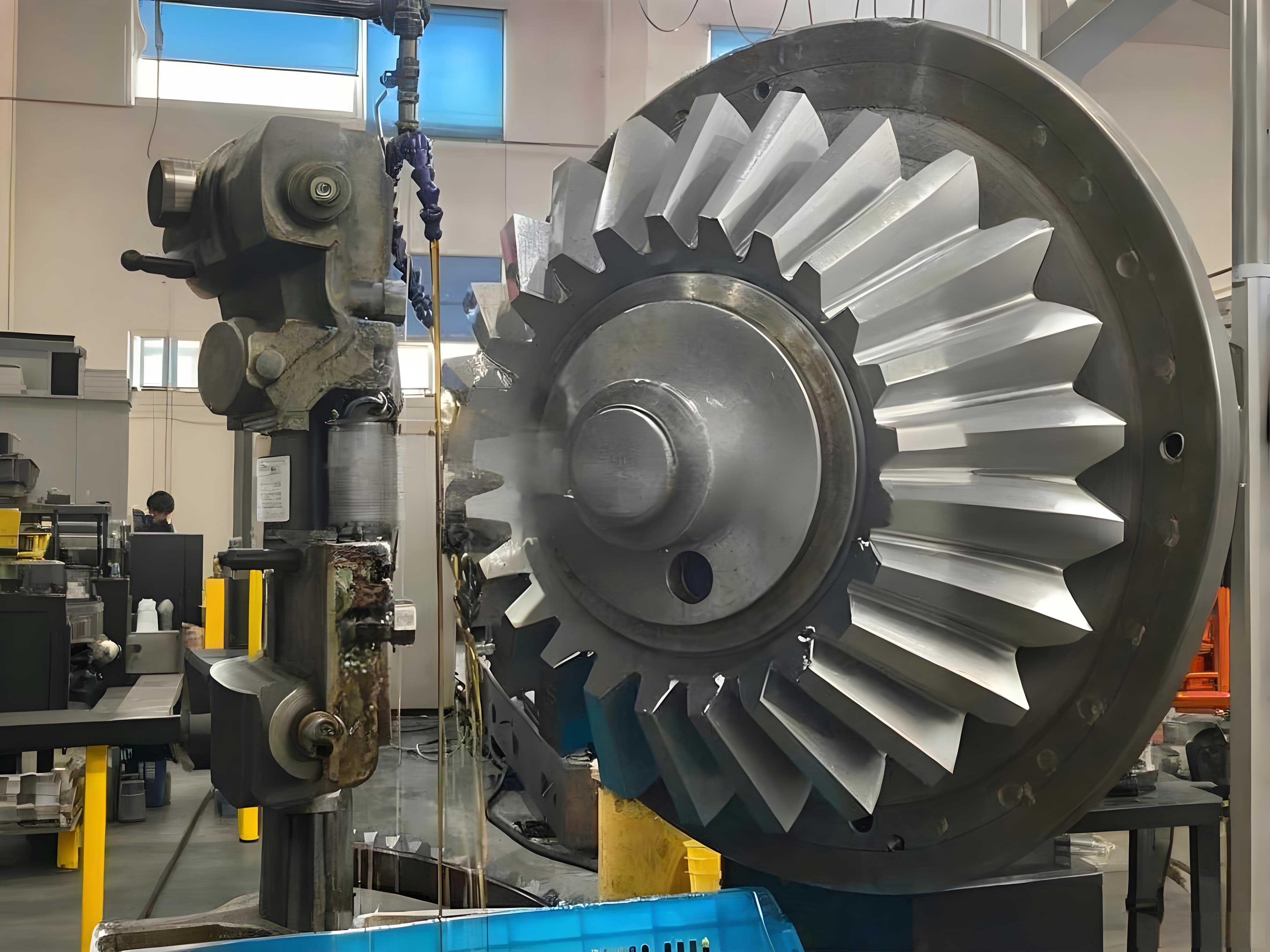
In the realm of mechanical power transmission, the straight bevel gear, a specific and crucial type of bevel gear, holds a position of significant importance. Characterized by straight teeth that, if extended, would converge at the apex of the pitch cone, this gear type is fundamental for transmitting motion and power between intersecting shafts, typically at a 90-degree angle. A special case, the miter gear, with a 1:1 ratio, is indispensable for pure direction change. Their advantages, including high重合度, smooth operation, and efficient power transfer at angles, make them ubiquitous in demanding applications such as automotive differentials, aerospace actuators, and heavy industrial machinery. However, the traditional engineering design process for a miter gear or any straight bevel gear is fraught with challenges. It involves numerous interrelated parameters, lengthy manual calculations prone to error, and repetitive drafting tasks, all of which hinder efficiency and innovation in product development cycles.
This article explores the development and implementation of a comprehensive, automated system built within the AutoCAD environment using the Visual Lisp programming language. The core objective is to streamline the entire workflow for straight bevel gear design—from initial parameter selection and geometric calculation to rigorous strength verification, automated drafting, and design optimization. By encapsulating engineering knowledge and design rules into a modular program, we can transform a tedious, error-prone process into a rapid, reliable, and optimized procedure. This approach is particularly valuable for the development of product families and series, where a miter gear of one size might need numerous variants. The system not only reduces repetitive labor but also enforces design standards and facilitates the exploration of optimal solutions, thereby significantly elevating design quality and productivity.
Leveraging Visual Lisp for Automated Design within AutoCAD
AutoCAD stands as a cornerstone in computer-aided design and drafting, yet its true potential for domain-specific automation is unlocked through its integrated programming interfaces. Among these, Visual Lisp (VLISP) is a powerful tool tailored for deep customization. Unlike generic programming languages, Visual Lisp provides direct, seamless access to the entire AutoCAD object model, command set, and system variables. This allows a developer to create functions that can query, modify, and generate drawing entities programmatically, far beyond the capabilities of interactive command-line use.
The strategic advantage of using Visual Lisp for gear design automation includes:
- Native Integration: Programs run within the AutoCAD process, eliminating compatibility issues and enabling direct manipulation of the drawing database.
- Command Access: Any AutoCAD command can be invoked programmatically, allowing the automated execution of complex drawing sequences.
- Dialog Control: Visual Lisp supports the creation of custom dialog boxes (DCL – Dialog Control Language), enabling the development of professional, user-friendly interfaces for data input and system control, as opposed to rudimentary command-line prompts.
- Modularity and Reusability: Code can be organized into logical, reusable functions and stored in `.lsp` files. These modules can be loaded on demand, promoting a structured and maintainable system architecture.
Essentially, Visual Lisp acts as the intelligent engine that drives the automation of the miter gear design process, turning AutoCAD from a passive drafting tool into an active design assistant.
Modular System Architecture for Parametric Design
The philosophy of parametric design is central to this system. Instead of creating a static drawing, we define a generative model where the geometry is driven by a set of key parameters (e.g., number of teeth, module, face width). Changing a parameter automatically triggers a recalculation and regeneration of the entire model. To manage the complexity of a straight bevel gear’s design process, a modular architecture is adopted. The system is decomposed into cohesive functional units, each responsible for a specific phase of the design workflow. This structure enhances clarity, simplifies debugging, and allows for future enhancements.
The primary modules of the system are:
- Initial Parameter Input Module: This module, often fronted by a custom dialog box, collects the fundamental design requirements from the user. Key input parameters are summarized in the table below.
- Geometric Calculation Module: This core module contains the algorithms that compute all geometric dimensions of the pinion and gear based on the initial input and standard gear relations.
- Contact Fatigue Strength Verification Module: This module performs the necessary calculations to ensure the gear teeth can withstand the surface contact stresses, using standardized engineering formulas.
- Bending Fatigue Strength Verification Module: This parallel verification module ensures the tooth root has sufficient strength to resist bending failure under load.
- Parametric Drawing Module: This module translates the calculated geometric data into precise 2D drawing entities (lines, arcs, hatches) within the AutoCAD model space, fully annotated and layered.
- Optimization Module: An advanced module that applies search algorithms to refine the initial design parameters towards an optimal goal, such as minimum volume or weight.
A logical control flow integrates these modules, often presenting the user with a master interface to navigate through the design stages: from input to calculation, verification, and finally, drafting or optimization.
| Parameter | Symbol | Typical Input/Consideration |
|---|---|---|
| Pinion Torque | T1 | From power and speed requirements (e.g., 140 N·m) |
| Pinion Speed | n1 | Driver speed (e.g., 960 rpm) |
| Gear Speed | n2 | Driven speed (e.g., 325 rpm) |
| Transmission Ratio | u | Calculated as n1/n2 |
| Number of Pinion Teeth | z1 | Chosen to avoid undercutting (≥17 often for 20° pressure angle) |
| Module (at large end) | me | Standardized value, a primary design variable |
| Pressure Angle | α | Typically 20° |
| Face Width Factor | φR = b/Re | Usually between 0.25 and 0.3 |
| Shaft Angle | Σ | Most commonly 90° |
Detailed Design Calculations for the Straight Bevel and Miter Gear
The design process follows a rigorous sequence of calculations, which are codified within the Geometric and Strength Verification modules.
Geometric Parameter Computation
Once the initial parameters (z1, z2, me, Σ=90°, α) are set, the system computes all necessary dimensions. For the common case of a 90° shaft angle, the pitch cone angles (δ) are fundamental:
$$
\delta_1 = \arctan\left(\frac{z_1}{z_2}\right) = \arctan\left(\frac{1}{u}\right)
$$
$$
\delta_2 = 90^\circ – \delta_1
$$
For a standard miter gear pair (u=1), this simplifies to δ1 = δ2 = 45°.
The subsequent geometric calculations proceed deterministically. Key formulas include:
$$
\text{Pitch Diameter (Large End): } d_{e1} = m_e \cdot z_1, \quad d_{e2} = m_e \cdot z_2
$$
$$
\text{Reference Cone Distance: } R_e = \frac{d_{e1}}{2 \sin \delta_1} = \frac{d_{e2}}{2 \sin \delta_2}
$$
$$
\text{Face Width: } b = \phi_R \cdot R_e \quad \text{(and must be checked against practical limits, } b \leq 10m_e \text{ and } b \leq R_e/3 \text{)}
$$
$$
\text{Addendum: } h_{ae} = m_e \cdot (1 + x) \quad \text{(x is addendum modification coefficient, often 0)}
$$
$$
\text{Dedendum: } h_{fe} = 1.25m_e \quad \text{(for full-depth teeth)}
$$
The system calculates over 20 such parameters, including apex distances, tip and root angles, and tip diameters, presenting them in a comprehensive results table.
Contact Fatigue Strength Verification
This verification ensures the flank surface can endure repeated contact stresses. The fundamental check is based on the Hertzian contact stress at the pitch point, adapted for bevel gears. The core verification formula, as implemented in the module, is:
$$
\sigma_H = \sqrt{ \frac{K_A K_V K_{H\beta} K_{H\alpha} F_t}{d_{m1} b_m} \cdot \frac{\sqrt{u^2 + 1}}{u} } \cdot Z_{M-B} Z_H Z_E Z_{LS} Z_\beta Z_K \leq \sigma_{HP}
$$
Where:
- $K_A, K_V, K_{H\beta}, K_{H\alpha}$: Application, dynamic, face load, and transverse load factors.
- $F_t$: Nominal tangential load at the reference diameter.
- $d_{m1}, b_m$: Mean pitch diameter and mean face width.
- $Z_{M-B}, Z_H, Z_E$: Mid-zone, zone, and elasticity factors.
- $Z_{LS}, Z_\beta, Z_K$: Load sharing, spiral angle (1 for straight), and bevel gear factors.
- $\sigma_{HP}$: Permissible contact stress ($\sigma_{Hlim} \cdot Z_N Z_L Z_V Z_R Z_W Z_X / S_{Hmin}$).
The module prompts the user for necessary coefficients (via a dialog) and performs the calculation, outputting the calculated stress $\sigma_H$ and the safety factor against pitting.
Bending Fatigue Strength Verification
This verification guards against tooth breakage. The nominal bending stress at the root is calculated and compared to a permissible limit. The governing formula used is:
$$
\sigma_F = \frac{K_A K_V K_{F\beta} K_{F\alpha} F_t}{b m_{mn}} \cdot Y_{FS} Y_E Y_K Y_{LS} \leq \sigma_{FP}
$$
Where:
- $K_{F\beta}, K_{F\alpha}$: Face load and transverse load factors for bending.
- $m_{mn}$: Mean normal module.
- $Y_{FS}$: Combined tooth form factor (incorporating stress concentration).
- $Y_E, Y_K, Y_{LS}$: Contact ratio, bevel gear, and load sharing factors.
- $\sigma_{FP}$: Permissible bending stress ($\sigma_{FE} \cdot Y_N Y_\delta Y_R Y_X / S_{Fmin}$).
This verification is performed separately for the pinion and the gear, as their $Y_{FS}$ factors differ. The system automatically fetches or calculates the form factor based on the virtual number of teeth ($z_v = z / \cos \delta$).
Automated Parametric Drafting with Visual Lisp
The parametric drawing module is where the calculated geometry materializes into a precise, standards-compliant 2D engineering drawing. The process is algorithmic and follows these steps:
- Drawing Setup: The function sets the appropriate AutoCAD environment: creating and setting layers for outlines, centerlines, dimensions, and hatches; defining linetypes and text styles.
- Base Point Calculation: A base insertion point in model space is defined by the user or set programmatically.
- Geometric Construction: Using the full set of calculated parameters (like $d_e$, $\delta$, $h_a$, $h_f$, $R_e$), the function computes the Cartesian coordinates of key points defining the gear’s front, side, and detailed sectional views. This involves trigonometry to project points from the pitch cone to the drawing plane.
- Entity Generation: Visual Lisp functions like `command`, `entmake`, or `vla-*` methods are used to create drawing primitives. For example:
- `(command “_line” point1 point2 “”)` to draw a轮廓线.
- `(entmake (list (cons 0 “CIRCLE”) (cons 10 center) (cons 40 radius)))` to programmatically create a circle.
- Detailing: The program adds standard details: drawing chamfers, generating tooth profiles in a enlarged detail view (using calculated root and tip arcs), applying hatch patterns to sectioned areas, and adding all necessary dimensions and annotations automatically based on the geometry.
The power of this module is that executing it with a different set of parameters (e.g., for a different size miter gear) instantly produces a new, correct drawing without any manual intervention, ensuring consistency and saving immense amounts of time.
Optimization of Design Parameters
Traditional design often settles for a “safe” or “works” solution. The integration of an optimization module elevates the system by seeking the “best” solution according to a defined objective. For a miter gear or any gear pair, minimizing volume (and thus weight and material cost) is a common goal while respecting all design constraints.
Mathematical Optimization Model
Design Variables: The key independent variables are chosen: pinion tooth count $z_1$, face width factor $\phi_R$, and the large end module $m_e$.
Objective Function: Minimize the total volume $V_{total}$ of the gear pair. Modeling each gear as a conical frustum, the volume is:
$$
V_{total} = V_1 + V_2 = \frac{\pi}{3} b \cos\delta_1 \left[ \left(\frac{d_{e1}}{2}\right)^2 + \left(\frac{d_{m1}}{2}\right)^2 + \frac{d_{e1}}{2} \cdot \frac{d_{m1}}{2} \right] + \frac{\pi}{3} b \cos\delta_2 \left[ \left(\frac{d_{e2}}{2}\right)^2 + \left(\frac{d_{m2}}{2}\right)^2 + \frac{d_{e2}}{2} \cdot \frac{d_{m2}}{2} \right]
$$
This can be simplified and expressed in terms of the design variables for a 90° shaft angle setup as:
$$
V_{total} = \frac{\pi}{8} \cdot u \cdot (u+1) \cdot m_e^3 \cdot z_1^2 \cdot \phi_R \left(1 – \phi_R + \frac{\phi_R^2}{3} \right)
$$
For a miter gear (u=1), this simplifies further to:
$$
V_{miter} = \frac{\pi}{4} \cdot m_e^3 \cdot z_1^2 \cdot \phi_R \left(1 – \phi_R + \frac{\phi_R^2}{3} \right)
$$
Constraints: The optimization must satisfy all design rules and strength conditions:
- Tooth Count: $17 \leq z_1 \leq 36$ (to avoid undercutting and ensure smoothness).
- Face Width Factor: $0.25 \leq \phi_R \leq 0.33$.
- Module Check: $m_e (1 – 0.5\phi_R) \geq 1.5$ (to ensure sufficient tooth strength at the narrow end).
- Strength Constraints: The calculated contact stress $\sigma_H$ and bending stresses $\sigma_{F1}, \sigma_{F2}$ must be less than their respective permissible limits ($\sigma_{HP}, \sigma_{FP}$). These are the most computationally intensive nonlinear constraints.
Optimization Method and Results
The system can employ various search algorithms, such as the Random Direction Search Method or more advanced gradient-based methods. The process iteratively adjusts $z_1$, $\phi_R$, and $m_e$ within their bounds, recalculates geometry and stresses for each candidate solution, and evaluates the objective function, driving towards a minimum volume solution that satisfies all constraints.
A comparative result between an initial feasible design and an optimized design might look like this:
| Parameter | Symbol | Initial Design | Optimized Design | Change/Note |
|---|---|---|---|---|
| Pinion Teeth | $z_1$ | 17 | 21 | Increased for smoother operation |
| Large End Module (mm) | $m_e$ | 4.5 | 3.5 | Reduced, lowering volume |
| Face Width Factor | $\phi_R$ | 0.30 | ~0.301 | Remained near upper bound for strength |
| Face Width (mm) | $b$ | 34.0 | 34.0 | Constrained by other factors |
| Total Volume (mm³) | $V_{total}$ | ~26,451 | ~19,058 | Reduction of ~28% |
This demonstrates the significant material savings achievable through systematic optimization, which would be extremely difficult to find through manual trial-and-error, especially for a component like a miter gear produced in quantity.
Conclusion
The development of a parametric design and optimization system for straight bevel gears, including the specialized miter gear, using Visual Lisp within AutoCAD presents a powerful paradigm for modern mechanical engineering. By integrating the entire design workflow—from initial specification and analytical calculation to automated drafting and multi-variable optimization—into a single, cohesive environment, it addresses the core inefficiencies of traditional methods. The system encapsulates expert knowledge and standards, minimizing errors and freeing the designer from repetitive tasks. This allows engineers to focus on higher-level design challenges, explore more alternatives, and arrive at superior, optimized solutions faster. The modular architecture ensures maintainability and extensibility, making it a robust foundation that can be adapted or expanded for the parametric design of other complex mechanical components, thereby offering a validated blueprint for enhancing productivity and innovation in computer-aided engineering.