
In the field of automotive engineering, the reliable transmission of power through the final drive assembly is paramount. Among its core components, the hyperbolic gear pair, often referred to in technical literature as hypoid gears, plays a critical role. My research focuses on a persistent challenge: accurately predicting the tooth root bending stress in these complex gears during operation. Traditional isolated gear modeling approaches often fall short because they struggle to replicate the真实的约束 and loading conditions imposed by the surrounding drive axle structure. In this extensive study, I develop and validate a novel finite element analysis methodology based on a complete drive axle assembly model to overcome these limitations. This article details the process, from geometric modeling and simulation to experimental verification, emphasizing the behavior of hyperbolic gear teeth under load.
The failure of hyperbolic gears in automotive drive axles typically manifests as either contact fatigue or, more critically, bending fatigue. Bending fatigue, leading to tooth fracture, results in immediate and catastrophic drivetrain failure. Therefore, precise prediction of the stress state at the tooth root fillet region during meshing is essential for design reliability. The stress state in hyperbolic gears is multiaxial and varies continuously along the tooth face width due to the complex spatial geometry and changing contact conditions, unlike simpler spur gears. While the Finite Element Method (FEM) is a recognized tool for such predictions, a significant hurdle has been defining accurate boundary conditions for standalone hyperbolic gear models. These models often apply idealized constraints or concentrated loads that do not account for the deflections of supporting components like the axle housing, differential casing, and bearings. These system-level deflections can significantly alter the load distribution and meshing pattern of the hyperbolic gear pair.
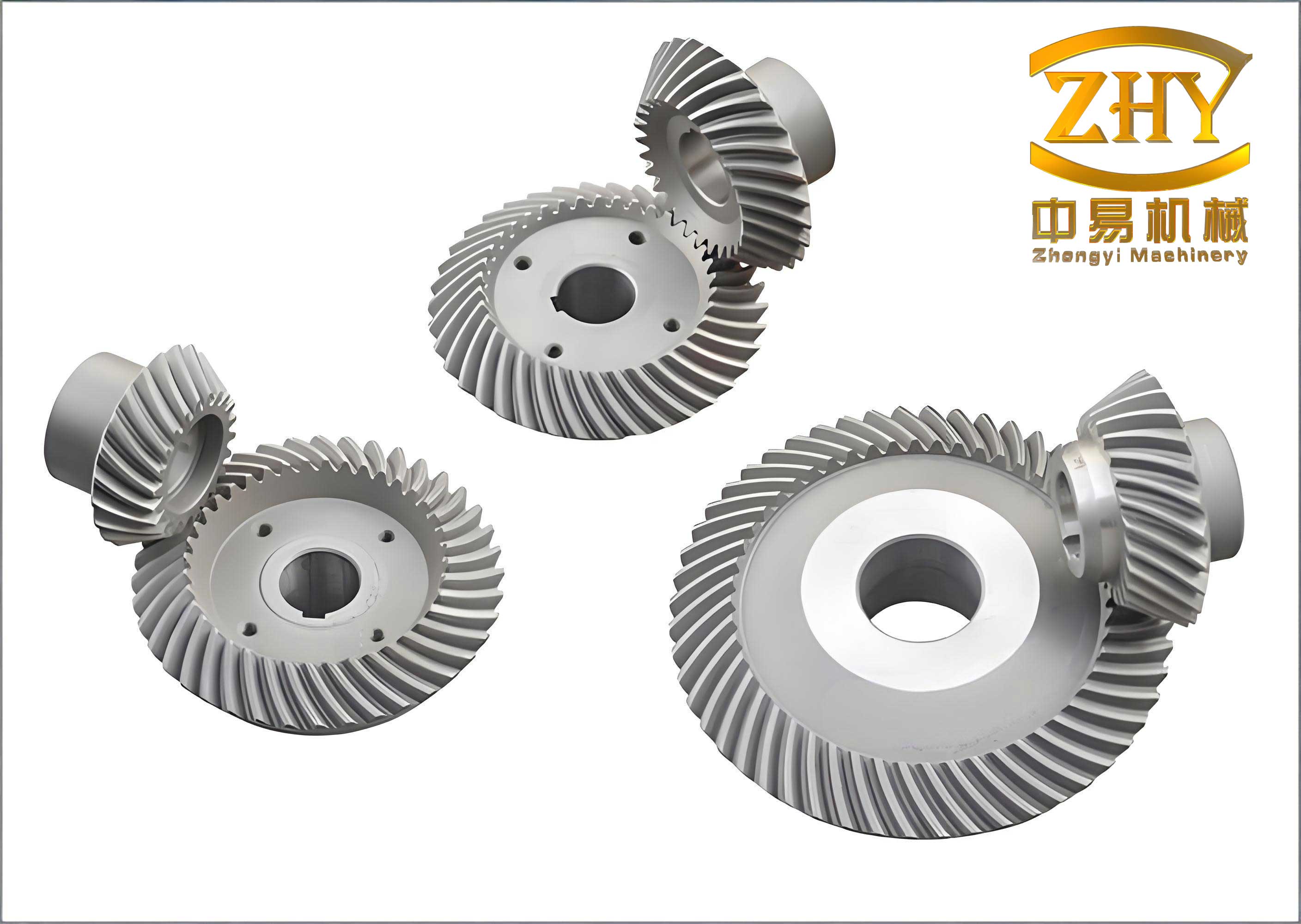
To address this, my approach centers on constructing a high-fidelity, full-vehicle rear drive axle model. The core of this model is the accurate geometric representation of the hyperbolic gear pair. Generating the tooth surfaces of these gears is non-trivial due to their complex curvature, a result of specific manufacturing processes like face-hobbing or face-milling. I employed a mathematical model based on the theory of gearing and machine-tool settings to define the pinion and gear tooth surfaces. The pinion, being the smaller drive gear, is typically generated, while the larger driven gear is often formate cut. The surface points are calculated via coordinate transformations from the cutter to the workpiece, governed by the kinematic relationship of the virtual machine tool. These discrete points are then interpolated using Non-Uniform Rational B-Splines (NURBS) to create smooth, continuous 3D surfaces. The final digital models of the pinion and gear are assembled within a CAD environment alongside all other drive axle components: the differential assembly (including side gears and planet gears), axle shafts, wheel hubs, and the housing structures (axle housing, differential carrier). This complete digital assembly allows for interference checks and forms the basis for the subsequent finite element discretization.
The transition from a geometric model to a finite element model requires careful preparation. The assembled geometry is imported into a pre-processing software for meshing. Given the focus on contact stresses and structural deformation, a hybrid meshing strategy is adopted. Components with complex geometries, such as the axle housing and differential carriers, are discretized using 10-node modified tetrahedral elements (C3D10M in ABAQUS notation), known for their accuracy in handling contact and large deformations. The hyperbolic gears, axle shafts, bearings, and hubs, where stress gradients are high, are meshed with 8-node linear reduced-integration hexahedral elements (C3D8R) to improve computational efficiency while controlling hourglassing. A typical mesh for the entire assembly consists of several hundred thousand elements. The material properties assigned to the components are standard for automotive drivetrains, as summarized in Table 1.
| Component | Material | Young’s Modulus, E (GPa) | Poisson’s Ratio, ν | Density, ρ (kg/m³) |
|---|---|---|---|---|
| Gear & Pinion (Hyperbolic Gears) | Alloy Steel | 206 | 0.27 | 7900 |
| Axle Housing/Carrier | Ductile Iron | 173 | 0.30 | 7550 |
| Axle Shafts & Hubs | Steel | 206 | 0.30 | 7900 |
| Bearings (Rollers/Races) | Bearing Steel | 210 | 0.30 | 7900 |
The finite element analysis is performed using the ABAQUS/Standard implicit solver, suitable for static, nonlinear problems involving contact. The solution is divided into two sequential analysis steps to ensure convergence. The first step is a static load application. In this step, the input pinion shaft is fixed, and a resisting torque, representing vehicle motion, is applied as a ramp load to the output wheel hubs. All other translational and rotational degrees of freedom at the hubs are constrained except for rotation about their axis. This step establishes the initial stress state from the applied load. The second step simulates the meshing process. Here, the constraints are changed: both the input and output shafts are only allowed to rotate about their axes. A finite rotation is applied to the pinion shaft to turn the gear pair through a partial mesh cycle, while the resisting torque is maintained on the hubs. To stabilize the highly nonlinear contact solution, which includes gear tooth contact and bearing interactions, automatic stabilization with a small damping factor is employed. The contact interactions are defined using a surface-to-surface discretization with a “hard” contact pressure-overclosure relationship in the normal direction and a penalty friction formulation with a coefficient of 0.1 in the tangential direction. Components like bolts and press-fits are modeled using tie constraints.
The core of the simulation is the static meshing analysis of the hyperbolic gear pair within the fully constrained system. The applied torque and rotation correspond to a specific vehicle operating condition. The nonlinear solution accounts for large deformations and changing contact areas. The primary output of interest is the stress history at the tooth root fillet. The maximum principal stress (often equated to bending stress) is monitored. The analysis reveals a distinct pattern for the pinion and gear of the hyperbolic gear set. Figure 9 (represented conceptually in the simulation outputs) shows the evolution of maximum principal stress on the concave side root fillet of the pinion. The stress concentration moves across the face width as the contact zone travels. Critically, the maximum bending stress for the pinion occurs near the heel (larger end of the tooth) at the initial engagement phase. The stress history at this critical location, as extracted from the FEA results, shows that the material first experiences compressive stress (third principal stress) before transitioning to tensile stress (first principal stress). This can be conceptually represented by the stress state equations at a point. The general 3D stress tensor is:
$$\sigma = \begin{bmatrix} \sigma_{xx} & \tau_{xy} & \tau_{xz} \\ \tau_{yx} & \sigma_{yy} & \tau_{yz} \\ \tau_{zx} & \tau_{zy} & \sigma_{zz} \end{bmatrix}$$
The principal stresses (σ1, σ2, σ3) are the eigenvalues of this tensor, where σ1 ≥ σ2 ≥ σ3. For bending-dominated failure, σ1 (maximum tensile) is most critical. The bending stress can be related to the applied torque and geometry via a simplified formula, though it is insufficient for hyperbolic gears:
$$ \sigma_b \approx \frac{F_t \cdot h}{I} \cdot K_f $$ where \( F_t \) is the tangential force, \( h \) is the distance from neutral axis, \( I \) is the area moment of inertia, and \( K_f \) is the stress concentration factor. For hyperbolic gears, \( F_t \), \( h \), and the effective \( I \) vary continuously along the face width and during meshing, necessitating FEA.
Conversely, for the driven hyperbolic gear, the maximum root bending stress appears on the convex side near the toe (smaller end of the tooth) during the disengagement phase. The stress history at its critical point indicates an initial tensile stress state shifting to compressive stress. This reversal and location difference between the pinion and gear are direct consequences of their opposing convex/concave contact geometries and the system stiffness effects captured by the full-assembly model. The inclusion of housing and bearing compliance in the model modifies the load distribution across the face width compared to a rigidly supported standalone gear model. This system effect is a key finding of this modeling approach. Table 2 summarizes the characteristic stress patterns observed in the hyperbolic gear pair.
| Gear Member | Critical Stress Location | Maximum Stress Phase | Initial Stress State | Subsequent Stress State |
|---|---|---|---|---|
| Pinion (Driver) | Concave side, near Heel | Initial Engagement | Compressive | Tensile |
| Gear (Driven) | Convex side, near Toe | Final Disengagement | Tensile | Compressive |
To validate the accuracy of this comprehensive finite element model, a physical experiment was conducted. A static torsion test rig was constructed for the drive axle. In this setup, the wheel hubs are locked, and a known input torque is applied to the pinion flange via a hydraulic actuator and torque cell. The primary goal was to measure the tooth root bending strain on the driven hyperbolic gear under a static load, corresponding to one of the simulated meshing positions. Strain gauges were installed at three critical locations on the fillet radius of the gear tooth: Point A (near the toe), Point B (mid-face), and Point C (near the heel). The gauges were connected to a high-precision static strain measurement system. The axle was loaded incrementally, and strain readings were recorded at a stabilized torque level. The measured strain was then converted to stress using Hooke’s law for uniaxial stress (a reasonable assumption for the surface strain gauge reading):
$$ \sigma_{measured} = E \cdot \epsilon $$
where \( \epsilon \) is the measured strain. The test was repeated for multiple static positions of the gear pair to capture the stress variation at the fixed points as different tooth pairs carry the load. The experimental results for the gear tooth root stress were then compared directly with the FEA-predicted stresses at the corresponding locations and load steps. The comparison for Points A, B, and C is presented in Table 3. The agreement between the simulation and experimental data is satisfactory. The trends across the face width are accurately captured: higher stress near the toe (Point A) and lower near the heel (Point C) for the gear under this loaded condition. The relative errors fall within an acceptable engineering range, typically under 15-20%, considering uncertainties in material properties, exact boundary conditions in the test, and strain gauge positioning. The largest discrepancies often occur at points of highest stress gradient, where small positional errors in gauge placement have a magnified effect.
| Measurement Point | Location on Gear Tooth | FEA Stress (MPa) | Experimental Stress (MPa) | Relative Error (%) |
|---|---|---|---|---|
| A | Near Toe (Convex side) | 287 | 310 | -7.4 |
| B | Mid-Face Width | 225 | 210 | +7.1 |
| C | Near Heel | 165 | 190 | -13.2 |
The close correlation between the finite element analysis and the physical test validates the proposed full-assembly modeling methodology. It confirms that the system-level deflections significantly influence the meshing and stress state of hyperbolic gears, a factor that isolated gear models cannot adequately incorporate. This model provides a more reliable tool for predicting tooth root bending fatigue life. The life prediction often involves using the calculated stress history in a multiaxial fatigue criterion. For example, a simplified approach using the maximum principal stress amplitude (\( \sigma_{a} \)) and mean stress (\( \sigma_{m} \)) in a modified Goodman relation could be applied:
$$ \frac{\sigma_a}{S_f} + \frac{\sigma_m}{S_u} = \frac{1}{N_f^b} $$
where \( S_f \) is the fatigue strength coefficient, \( S_u \) is the ultimate tensile strength, \( N_f \) is cycles to failure, and \( b \) is the fatigue strength exponent. The accurate stress history from this FEA model provides the necessary \( \sigma_a \) and \( \sigma_m \) for such calculations at the critical point in the hyperbolic gear.
In conclusion, this study successfully demonstrates a robust framework for analyzing tooth root bending stress in automotive drive axle hyperbolic gears. By constructing a complete system-level finite element model that includes the gears, housing, shafts, and bearings, I have circumvented the major limitation of defining artificial boundary conditions. The simulation results provide detailed insight into the complex, multiaxial, and reversing stress states at the tooth root fillets of both the pinion and gear in a hyperbolic gear set. The validation through static torsion testing confirms the model’s predictive accuracy. This methodology offers significant value for the design and optimization of hyperbolic gears, enabling engineers to assess not only the gear geometry in isolation but also its performance within the complete driveline system. Future work could extend this approach to dynamic meshing analysis to study the effects of inertia and impact loads, or to incorporate thermo-mechanical effects from lubrication. Nonetheless, the current static, system-based model establishes a reliable foundation for enhancing the durability and reliability of hyperbolic gear drives in automotive applications.