
In our factory, during the introduction of a Japanese forklift transmission production line, we conducted a design verification for a pair of miter gears in the differential system: the semi-axial gear and the planetary gear. The initial verification using conventional Chinese design standards revealed discrepancies in the geometric dimensions, prompting a deeper investigation. Through repeated calculations, we discovered that the Japanese approach to designing straight bevel gears, particularly miter gears, has unique aspects. This article shares our verification process and insights, focusing on the determination of fundamental parameters and geometric calculations for miter gears.
The miter gear pair, as shown in the figures, presented challenges due to unspecified basic parameters such as the addendum coefficient, radial clearance coefficient, and modification coefficients. In standard Chinese practice, for normal teeth, the addendum coefficient is typically 1.0 and the radial clearance coefficient is 0.25, while for short teeth, they are 0.8 and 0.3, respectively. However, applying these values directly failed to match the given dimensions, indicating that the Japanese design employed different parameters. This led us to use a reverse-engineering method to derive these coefficients.
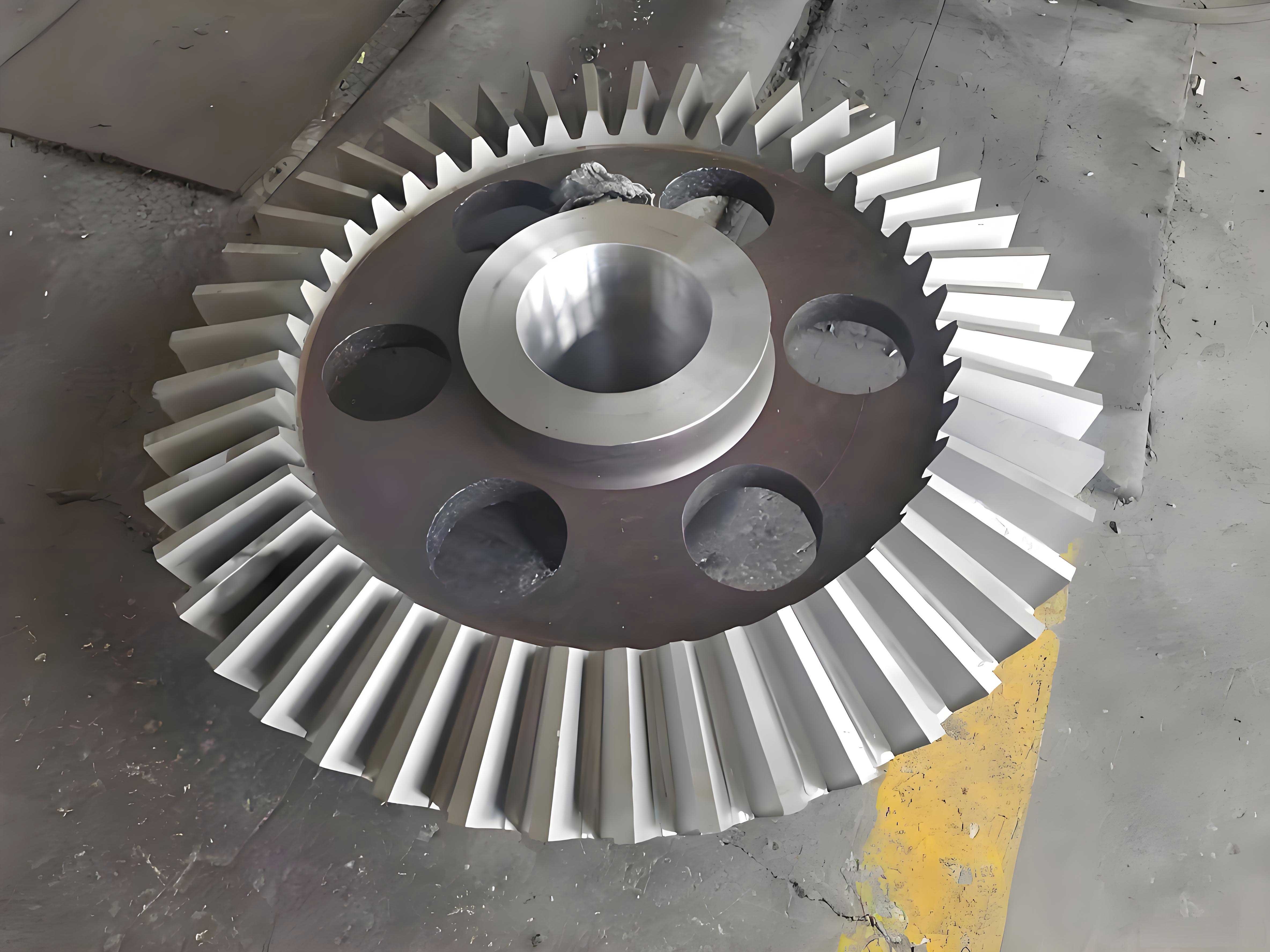
First, we determined the radial clearance coefficient \( c^* \). By analyzing the provided data for the semi-axial gear (Gear A) and planetary gear (Gear B), we calculated the addendum \( h_a \) and dedendum \( h_f \). The radial clearance coefficient is derived from the relationship between these values. For miter gears, the radial clearance \( c \) is given by:
$$ c = h_f – h_a $$
Then, the radial clearance coefficient \( c^* \) is:
$$ c^* = \frac{c}{m} $$
where \( m \) is the module. From the given parameters, we computed \( c^* = 0.25 \), which is uncommon in Chinese designs but aligns with practices in some Western countries like Germany and the US, where values such as 0.25, 0.3, or 0.4 are used. This coefficient is critical for ensuring proper lubrication and avoiding interference in miter gear systems.
Next, we determined the addendum coefficient \( h_a^* \). The total tooth height \( h \) is related to the addendum and dedendum. Using the derived radial clearance coefficient, we found:
$$ h = h_a + h_f = (2h_a^* + c^*)m $$
From the given total tooth height, we solved for \( h_a^* \), resulting in \( h_a^* = 0.6 \). This is significantly lower than the standard short tooth value of 0.8, indicating a non-conventional design for miter gears. A reduced addendum coefficient can help prevent root undercutting and enhance gear strength, which is beneficial in differential applications where multiple miter gears mesh simultaneously.
For the modification coefficients, we identified that this miter gear pair uses profile shift. Since the gears are likely for a differential, they employ a height modification system. The profile shift coefficient \( x \) is determined from the addendum equation:
$$ h_a = (h_a^* + x)m $$
By substituting the known values, we calculated the profile shift coefficients for both gears. For Gear A (semi-axial gear), \( x_A = 0.3 \), and for Gear B (planetary gear), \( x_B = -0.3 \), confirming a height-modified miter gear set with equal and opposite shifts. This ensures a constant center distance and improved load distribution.
Table 1 summarizes the basic parameters for the miter gears, as derived from our reverse engineering:
| Parameter | Symbol | Gear A (Semi-axial) | Gear B (Planetary) |
|---|---|---|---|
| Number of Teeth | \( z \) | 16 | 16 |
| Module | \( m \) | 4.5 mm | 4.5 mm |
| Pressure Angle | \( \alpha \) | 20° | 20° |
| Shaft Angle | \( \Sigma \) | 90° | 90° |
| Addendum Coefficient | \( h_a^* \) | 0.6 | 0.6 |
| Radial Clearance Coefficient | \( c^* \) | 0.25 | 0.25 |
| Profile Shift Coefficient | \( x \) | 0.3 | -0.3 |
With these parameters, we proceeded to verify the geometric dimensions of the miter gears. The calculations follow standard bevel gear formulas, adapted for miter gears with a shaft angle of 90°. The pitch cone angle \( \delta \) for each gear is:
$$ \delta_A = \arctan\left(\frac{z_A}{z_B}\right) = \arctan\left(\frac{16}{16}\right) = 45° $$
$$ \delta_B = 90° – \delta_A = 45° $$
This confirms that these are miter gears, as both have equal pitch cone angles of 45°, resulting in a right-angle drive. The pitch diameter \( d \) is:
$$ d = m z $$
Thus, for both gears, \( d = 4.5 \times 16 = 72 \, \text{mm} \). The addendum \( h_a \) and dedendum \( h_f \) are calculated as:
$$ h_a = (h_a^* + x)m $$
$$ h_f = (h_a^* + c^* – x)m $$
For Gear A: \( h_a = (0.6 + 0.3) \times 4.5 = 4.05 \, \text{mm} \), \( h_f = (0.6 + 0.25 – 0.3) \times 4.5 = 2.475 \, \text{mm} \).
For Gear B: \( h_a = (0.6 – 0.3) \times 4.5 = 1.35 \, \text{mm} \), \( h_f = (0.6 + 0.25 + 0.3) \times 4.5 = 5.175 \, \text{mm} \).
The total tooth height \( h \) is:
$$ h = h_a + h_f $$
For both gears, \( h = 6.525 \, \text{mm} \), matching the given data. The tip diameter \( d_a \) is:
$$ d_a = d + 2h_a \cos \delta $$
For Gear A: \( d_a = 72 + 2 \times 4.05 \times \cos 45° = 72 + 5.727 = 77.727 \, \text{mm} \).
For Gear B: \( d_a = 72 + 2 \times 1.35 \times \cos 45° = 72 + 1.909 = 73.909 \, \text{mm} \).
The cone distance \( R \) (length of pitch cone generator) is:
$$ R = \frac{d}{2 \sin \delta} $$
For both gears, \( R = \frac{72}{2 \times \sin 45°} = \frac{72}{1.414} = 50.91 \, \text{mm} \). The addendum angle \( \theta_a \) and dedendum angle \( \theta_f \) are:
$$ \theta_a = \arctan\left(\frac{h_a}{R}\right) $$
$$ \theta_f = \arctan\left(\frac{h_f}{R}\right) $$
For Gear A: \( \theta_a = \arctan\left(\frac{4.05}{50.91}\right) = 4.55° \), \( \theta_f = \arctan\left(\frac{2.475}{50.91}\right) = 2.78° \).
For Gear B: \( \theta_a = \arctan\left(\frac{1.35}{50.91}\right) = 1.52° \), \( \theta_f = \arctan\left(\frac{5.175}{50.91}\right) = 5.81° \).
The face cone angle \( \delta_a \) and root cone angle \( \delta_f \) are:
$$ \delta_a = \delta + \theta_a $$
$$ \delta_f = \delta – \theta_f $$
For Gear A: \( \delta_a = 45° + 4.55° = 49.55° \), \( \delta_f = 45° – 2.78° = 42.22° \).
For Gear B: \( \delta_a = 45° + 1.52° = 46.52° \), \( \delta_f = 45° – 5.81° = 39.19° \).
The apex to back distance \( A_b \) is calculated from the cone distance and angles:
$$ A_b = R \cos \delta – h_a \sin \delta $$
For Gear A: \( A_b = 50.91 \times \cos 45° – 4.05 \times \sin 45° = 36.0 – 2.86 = 33.14 \, \text{mm} \).
For Gear B: \( A_b = 50.91 \times \cos 45° – 1.35 \times \sin 45° = 36.0 – 0.95 = 35.05 \, \text{mm} \).
Table 2 summarizes the verified geometric dimensions for the miter gears:
| Dimension | Symbol | Gear A (Semi-axial) | Gear B (Planetary) |
|---|---|---|---|
| Pitch Cone Angle | \( \delta \) | 45° | 45° |
| Pitch Diameter | \( d \) | 72 mm | 72 mm |
| Tip Diameter | \( d_a \) | 77.727 mm | 73.909 mm |
| Addendum | \( h_a \) | 4.05 mm | 1.35 mm |
| Dedendum | \( h_f \) | 2.475 mm | 5.175 mm |
| Total Tooth Height | \( h \) | 6.525 mm | 6.525 mm |
| Cone Distance | \( R \) | 50.91 mm | 50.91 mm |
| Addendum Angle | \( \theta_a \) | 4.55° | 1.52° |
| Dedendum Angle | \( \theta_f \) | 2.78° | 5.81° |
| Face Cone Angle | \( \delta_a \) | 49.55° | 46.52° |
| Root Cone Angle | \( \delta_f \) | 42.22° | 39.19° |
| Apex to Back Distance | \( A_b \) | 33.14 mm | 35.05 mm |
After verifying the dimensions, we explored the rationale behind the parameter choices. The radial clearance coefficient of 0.25, while not standard in China, is acceptable as it provides sufficient space for lubricant and debris, reducing wear in miter gear applications. The addendum coefficient of 0.6 is particularly interesting; it results in shorter teeth, which minimizes the risk of root undercutting and increases the tooth root thickness, enhancing bending strength. This is crucial for miter gears in differentials, where they experience high cyclic loads.
To assess the design’s effectiveness, we calculated the contact ratio \( \varepsilon \). For bevel gears, the contact ratio is approximated using the transverse plane. The base pitch \( p_b \) is:
$$ p_b = \pi m \cos \alpha $$
With \( m = 4.5 \, \text{mm} \) and \( \alpha = 20° \), \( p_b = \pi \times 4.5 \times \cos 20° = 13.33 \, \text{mm} \). The length of action \( Z \) is derived from the tip and base circle geometries. For miter gears, due to the conical shape, we use an equivalent spur gear approach. The equivalent number of teeth \( z_v \) is:
$$ z_v = \frac{z}{\cos \delta} $$
For both gears, \( z_v = \frac{16}{\cos 45°} = 22.63 \). Then, the addendum and dedendum are adjusted for the virtual gear. The contact ratio is:
$$ \varepsilon = \frac{\sqrt{r_{a1}^2 – r_{b1}^2} + \sqrt{r_{a2}^2 – r_{b2}^2} – a \sin \alpha}{p_b} $$
where \( r_a \) is the tip radius, \( r_b \) is the base radius, and \( a \) is the center distance. For miter gears, the center distance is zero as they intersect, but in the transverse plane, we use the equivalent values. After computation, we found \( \varepsilon = 1.15 \). According to industry standards, a contact ratio above 1.0 ensures continuous meshing, but values of 1.2 to 1.6 are typical for high-precision gears. For automotive differentials, where multiple miter gears mesh simultaneously (four pairs in this case), a lower contact ratio can be compensated by the overlapping action of gears, maintaining smooth transmission. Table 3 shows recommended contact ratios for various applications:
| Application | Recommended Contact Ratio \( \varepsilon \) |
|---|---|
| Precision Gears (Grade 5) | 1.3 – 1.6 |
| Automotive and Tractor Industry | 1.2 – 1.5 |
| Machine Tool Manufacturing | 1.1 – 1.4 |
| Textile Machinery | 1.0 – 1.3 |
| General Machinery | 1.0 – 1.2 |
Thus, \( \varepsilon = 1.15 \) is acceptable for miter gears in differential systems, given the compensatory effect of multiple meshing pairs. This design choice prioritizes strength and durability over maximal smoothness, which is suitable for heavy-duty applications like forklifts.
Furthermore, the profile shift coefficients of ±0.3 ensure balanced wear and improved load capacity. In height-modified miter gears, the positive shift on Gear A increases its tooth thickness at the tip, while the negative shift on Gear B strengthens the root. This symmetry is essential for maintaining uniform stress distribution in a differential, where torque is split between miter gears. The modification also helps achieve a desired backlash; from the given data, the backlash is 0.1 mm, which is within typical tolerances for miter gear sets.
In summary, the Japanese design of miter gears employs non-standard parameters: a radial clearance coefficient of 0.25, an addendum coefficient of 0.6, and profile shift coefficients of ±0.3. These choices enhance gear strength and reliability in differential applications, albeit with a slightly reduced contact ratio. Our verification process, using reverse engineering, confirmed the geometric accuracy and highlighted the importance of adapting design practices to specific functional requirements. Miter gears, with their right-angle transmission, are critical components in differential systems, and this case study underscores the value of innovative parameter selection in optimizing performance. Future work could involve dynamic analysis and fatigue testing to further validate the design for miter gears in high-stress environments.
To generalize, the design of miter gears involves balancing multiple factors: tooth geometry, strength, meshing quality, and manufacturability. The Japanese approach demonstrates that deviating from conventional coefficients can yield benefits in specific contexts. For engineers working with miter gears, it is essential to consider the entire system—such as the number of meshing pairs and load conditions—rather than relying solely on standard tables. This insight is particularly relevant for advanced applications in automotive, aerospace, and industrial machinery, where miter gears play a pivotal role in power transmission.
In conclusion, through this verification exercise, we gained a deeper appreciation for the nuances of miter gear design. The successful application of reverse engineering to determine key parameters not only resolved discrepancies but also provided a framework for evaluating non-standard gear designs. As global engineering practices evolve, such cross-cultural learning can drive innovation, leading to more robust and efficient miter gear systems. We hope this detailed account aids other professionals in their work with miter gears, fostering improved design methodologies and verification processes worldwide.