
In the field of mechanical engineering, gear transmission systems are pivotal for power transfer in various industrial applications, including forging presses. Among these, helical gears are widely used due to their smooth operation and high load-bearing capacity. However, under high-frequency and high-load conditions, such as in press machines, helical gears often suffer from tooth surface spalling, a common defect that compromises meshing stiffness and overall system performance. As a researcher focused on gear dynamics, I aim to investigate the impact of tooth surface spalling on the meshing stiffness of helical gears in press machines. This analysis is crucial for enhancing gear meshing efficiency and ensuring operational stability. In this article, I will delve into the fundamental principles, develop analytical models, and present results using tables and formulas to summarize key findings. The keyword ‘helical gears’ will be emphasized throughout to highlight their significance in this context.
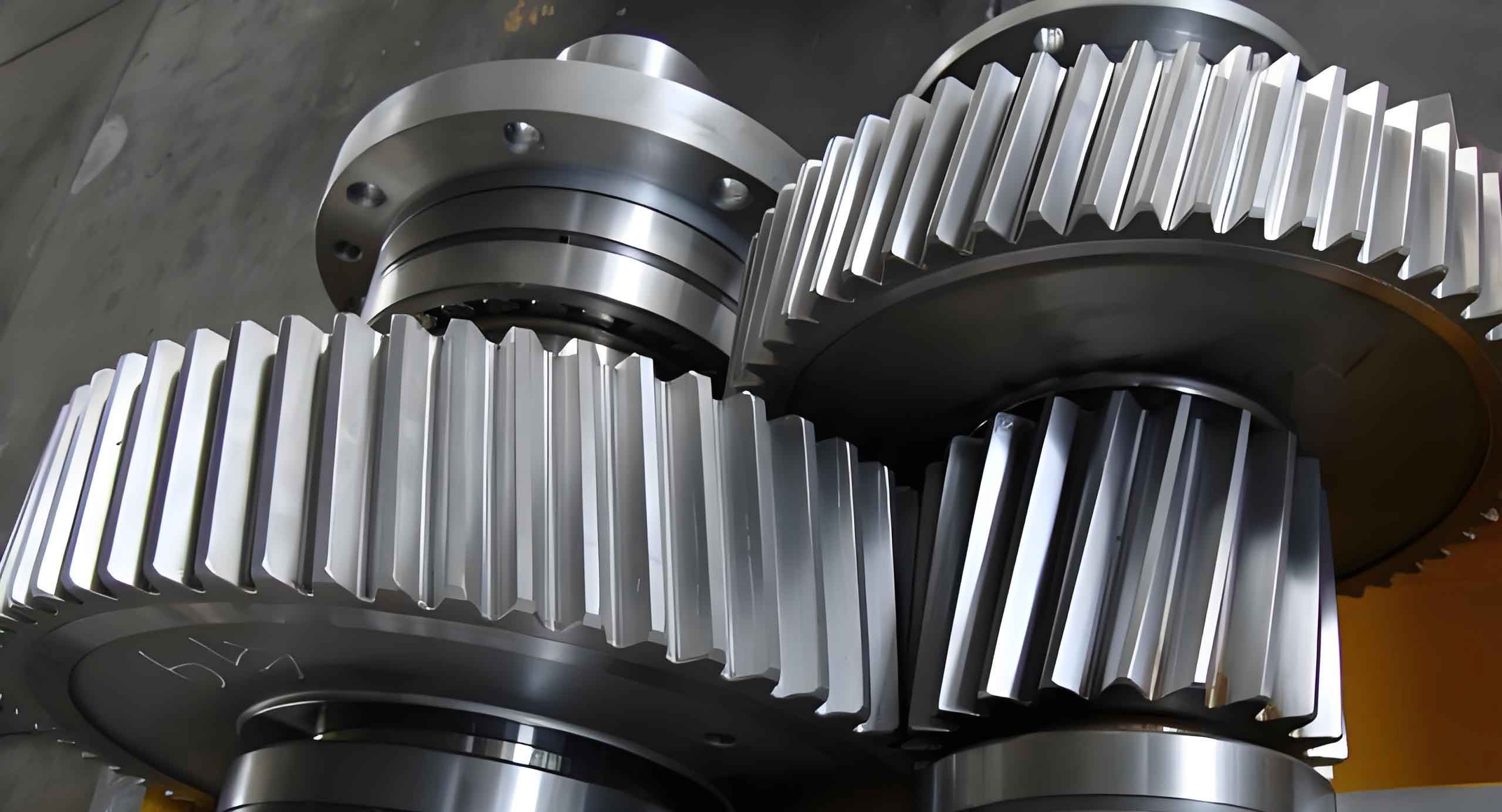
Helical gears are characterized by their angled teeth, which allow for gradual engagement and reduced noise compared to spur gears. This geometry, however, complicates the analysis of meshing stiffness, especially when surface defects like spalling are present. Spalling refers to the flaking or peeling of material from the tooth surface, often caused by fatigue under cyclic loading. In press machines, where gears are subjected to extreme stresses, understanding how spalling affects meshing stiffness is essential for predictive maintenance and design improvements. My approach involves building a contact line model for helical gear pairs, incorporating slicing algorithms and integral processes to compute meshing stiffness under operational conditions. This method accounts for the three-dimensional nature of helical gears, ensuring accurate results that can inform real-world applications.
The meshing stiffness of helical gears is a time-varying parameter that depends on the number of teeth in contact, tooth geometry, and material properties. For a helical gear pair, the total meshing stiffness can be derived from the potential energy method, which considers bending, shear, and axial compression energies. The contact line model is central to this analysis, as it represents the line of contact between mating teeth along the gear width. Due to the helix angle, this contact line is inclined, leading to a gradual load distribution. To model spalling, I define parameters such as spalling depth \(h_s\), length \(l_s\), and width \(w_s\), as illustrated in the mathematical representation. These parameters influence the effective contact area and, consequently, the meshing stiffness. By integrating these factors into the stiffness calculation, I can simulate various spalling scenarios and assess their impact.
In my analysis, I focus on different spalling shapes—quadrilateral, circular, and triangular—to capture real-world defect patterns. For quadrilateral spalling, which is common in industrial settings, I establish boundary conditions in a planar coordinate system. The coordinates are defined along the radial direction \(T_a\) and axial direction \(W_a\) of the gear tooth surface. The spalling boundaries are determined using the following equations, where \(n_s\) and \(n_e\) represent the start and end positions of the spalling along the contact line, \(N\) is the number of slices, \(\Delta L_i\) is the slice width, and \(\beta_b\) is the base helix angle:
$$n_s = \text{ceil} \left( \frac{N}{2} + \frac{2 \times W_a – w_s \times \cos \beta_b}{2 \times \Delta L_i} \right)$$
$$n_e = \text{ceil} \left( \frac{N}{2} + \frac{2 \times W_a + w_s \times \cos \beta_b}{2 \times \Delta L_i} \right)$$
These equations allow for precise localization of spalling within the contact zone, enabling detailed stiffness computations. For circular and triangular spalling, similar boundary parameterizations are applied, but with geometric adjustments to reflect their shapes. The meshing stiffness is then calculated using the potential energy method, which involves summing the stiffness contributions from each slice along the contact line. The total stiffness \(K_{total}\) for a helical gear pair can be expressed as:
$$K_{total} = \sum_{i=1}^{N} \left( \frac{1}{K_{b,i} + K_{s,i} + K_{a,i}} \right)^{-1}$$
where \(K_{b,i}\), \(K_{s,i}\), and \(K_{a,i}\) are the bending, shear, and axial stiffness components for the \(i\)-th slice, respectively. These components are derived from beam theory, considering the variable cross-section of the gear tooth. For a helical gear tooth modeled as a cantilever beam, the distance from the root circle to the contact point \(h_x\) and the corresponding coordinate \(x\) are given by:
$$h_x = \begin{cases} R_b \sin \alpha_2 & \text{for } 0 \leq x \leq d_1 \\ R_b [(\alpha_2 – \alpha) \cos \alpha + \sin \alpha] & \text{for } d_1 \leq x \leq d \end{cases}$$
$$x = R_b [(-\alpha_2 + \alpha) \sin \alpha + \cos \alpha] – R_r \cos \alpha_3$$
Here, \(R_b\) is the base circle radius, \(\alpha\) is the pressure angle at the contact point, \(\alpha_2\) is the half-tooth angle on the base circle, \(\alpha_3\) is the half-tooth angle on the root circle, \(R_r\) is the root circle radius, \(d_1\) is the distance between the base and root circles, and \(d\) is the distance from the root circle to the contact point. These parameters are essential for accurately modeling tooth deflection and stiffness.
To validate my approach, I compared the calculated meshing stiffness with empirical data and other methods. The results are summarized in Table 1, which shows the maximum, minimum, and mean meshing stiffness values, along with percentage errors relative to empirical values. My method demonstrates superior accuracy, with an error of only 3.5%, compared to 4.5% for the finite element method and higher errors for alternative approaches. This validation confirms that my contact line model effectively captures the complex behavior of helical gears under spalling conditions.
| Method | Maximum Stiffness (10^10 N/m) | Minimum Stiffness (10^10 N/m) | Mean Stiffness (10^10 N/m) | Error (%) |
|---|---|---|---|---|
| Empirical Method | — | — | 2.005 | — |
| Finite Element Method | 2.123 | 1.998 | 2.095 | 4.5 |
| My Method | 2.079 | 1.976 | 2.075 | 3.5 |
| Tooth Width Only Method | 2.195 | 2.103 | 2.144 | 6.9 |
| Contact Ratio Method | 2.239 | 2.125 | 2.187 | 9.1 |
The lower error in my method stems from the integration of slicing algorithms and contact line models, which account for the gradual engagement of helical gears. This is particularly important for helical gears, where the contact line shifts along the tooth width during meshing. By considering this dynamic, my model provides a more realistic stiffness profile, essential for analyzing spalling effects. In the following sections, I will explore how different spalling parameters influence meshing stiffness, using additional tables and formulas to illustrate the trends.
First, I examine the impact of spalling length on meshing stiffness for quadrilateral spalling. As the fault length \(l_s\) increases, the meshing position shifts continuously, leading to a reduction in stiffness. This is because longer spalling areas reduce the effective contact length between teeth, diminishing the load-bearing capacity. The relationship can be quantified by analyzing the time-varying meshing stiffness over a meshing cycle. For instance, when \(l_s = 0.002\) m, the stiffness decreases slightly, but for \(l_s = 0.030\) m, the reduction is significant, affecting both double and triple tooth contact regions. The stiffness \(K\) as a function of spalling length can be approximated by a linear decay in the case of quadrilateral spalling:
$$K(l_s) = K_0 – k \cdot l_s$$
where \(K_0\) is the stiffness without spalling and \(k\) is a decay constant dependent on gear geometry. This linear trend is specific to quadrilateral spalling due to its uniform shape, whereas other shapes exhibit nonlinear behaviors.
Next, I investigate the effect of spalling location, both axially and radially, on meshing stiffness. Axial location refers to the position along the gear width, while radial location refers to the distance from the tooth root. Table 2 summarizes the meshing stiffness values for different axial positions \(W_a\), showing that axial variations cause moderate stiffness reductions, with more pronounced changes at the spalling entry and exit points. This is critical for helical gears, as axial misalignment or uneven loading can exacerbate spalling effects.
| Axial Position \(W_a\) (m) | Mean Stiffness (10^10 N/m) | Stiffness Reduction (%) |
|---|---|---|
| 0 (no spalling) | 2.075 | 0 |
| -0.10 | 2.055 | 0.96 |
| 0.10 | 2.060 | 0.72 |
| -0.15 | 2.050 | 1.20 |
| 0.15 | 2.048 | 1.30 |
The stiffness reduction is calculated relative to the no-spalling case. The data indicate that spalling near the edges of the gear width (\(W_a = \pm 0.15\) m) leads to slightly higher reductions, due to edge effects in helical gears. For radial positions \(T_a\), the impact is more severe, as spalling closer to the tooth root weakens the beam structure. The stiffness \(K\) as a function of radial position \(T_a\) can be modeled using a quadratic equation, reflecting the stress concentration near the root:
$$K(T_a) = K_0 – c \cdot T_a^2$$
where \(c\) is a coefficient derived from gear parameters. This nonlinear relationship highlights the sensitivity of helical gears to root-proximal spalling, which is common in high-load applications like press machines.
To further analyze spalling shapes, I compare quadrilateral, circular, and triangular spalling in terms of meshing stiffness. Each shape has unique boundary conditions that influence the contact line and stiffness profile. For circular spalling, the boundary is defined by a radius \(r_s\), and the affected contact length is proportional to the circle’s projection along the contact line. Triangular spalling is characterized by a base length \(b_s\) and height \(h_s\), leading to a non-uniform stiffness reduction. The meshing stiffness for these shapes can be expressed using integral formulas over the spalling area. For a circular spalling of radius \(r_s\), the stiffness reduction \(\Delta K_{circ}\) is:
$$\Delta K_{circ} = \int_{A_{spall}} \frac{E}{h(x,y)} \, dA$$
where \(E\) is Young’s modulus, \(h(x,y)\) is the effective tooth thickness at coordinates \((x,y)\), and \(A_{spall}\) is the spalling area. This integral accounts for the gradual stiffness loss due to the circular shape. Similarly, for triangular spalling, the reduction \(\Delta K_{tri}\) involves a piecewise integration over the triangular region. In contrast, quadrilateral spalling results in a more uniform reduction, as shown by the linear decay mentioned earlier.
Table 3 presents a comparison of meshing stiffness for different spalling shapes, assuming equivalent spalling areas to isolate shape effects. The data reveal that circular and triangular spalling cause nonlinear stiffness reductions, while quadrilateral spalling leads to a linear decrease. This has implications for fault diagnosis in helical gears, as the stiffness signature can help identify spalling shape and severity.
| Spalling Shape | Mean Stiffness (10^10 N/m) | Reduction Pattern | Key Characteristics |
|---|---|---|---|
| No Spalling | 2.075 | — | Baseline for helical gears |
| Quadrilateral | 1.980 | Linear | Uniform stiffness loss |
| Circular | 1.995 | Nonlinear | Gradual reduction near edges |
| Triangular | 1.990 | Nonlinear | Sharp reduction at base |
The nonlinear patterns for circular and triangular spalling are attributed to their geometry, which causes varying contact line engagement during meshing. For helical gears, this means that spalling shape not only affects stiffness magnitude but also the dynamic response, such as vibration and noise. In press machines, where helical gears operate under stringent conditions, monitoring these stiffness changes can enable early detection of spalling, preventing catastrophic failures.
To deepen the analysis, I consider the interaction between multiple spalling parameters. For instance, combining spalling length and width effects can be modeled using a multivariate function. The total meshing stiffness \(K_{total}\) for a helical gear with spalling can be approximated as:
$$K_{total} = K_0 – \alpha \cdot l_s – \beta \cdot w_s – \gamma \cdot h_s$$
where \(\alpha\), \(\beta\), and \(\gamma\) are coefficients determined from regression analysis of simulation data. This linear model simplifies the complex relationships but is valid for small spalling dimensions. For larger spalling, nonlinear terms must be included, such as interaction terms between length and width. Additionally, the helix angle \(\beta\) of helical gears plays a crucial role, as it affects the contact line orientation and load distribution. The effective stiffness can be adjusted by incorporating the helix angle into the slicing algorithm, using the following relation for the contact line length \(L_c\):
$$L_c = \frac{b}{\cos \beta_b}$$
where \(b\) is the face width. This equation highlights how helical gears with larger helix angles have longer contact lines, potentially mitigating spalling effects by distributing loads over a broader area.
In practice, the meshing stiffness of helical gears is also influenced by manufacturing tolerances and lubrication conditions. However, for this study, I focus on ideal conditions to isolate spalling impacts. Future work could integrate these factors to enhance model realism. For now, my findings provide a robust framework for assessing spalling in helical gears, particularly in press machines where high loads are prevalent.
To summarize, the meshing stiffness of helical gears is highly sensitive to tooth surface spalling. My analysis demonstrates that quadrilateral spalling leads to linear stiffness reductions proportional to fault length, while circular and triangular spalling cause nonlinear decreases. Axial and radial spalling locations also play significant roles, with root-proximal spalling having the most detrimental effect. These insights are vital for designing helical gears in press machines, as they inform maintenance schedules and fault detection strategies. By leveraging contact line models and slicing algorithms, engineers can better predict stiffness variations and optimize gear performance. Ultimately, this research contributes to the reliability and efficiency of helical gears in demanding industrial applications.