
In the field of power transmission for intersecting axes, spiral bevel gears are indispensable components, renowned for their high load capacity, smooth operation, and ability to transmit motion at high speeds and torques. The complex geometry of their tooth flanks, characterized by localized point contact and non-conjugate action, presents a significant challenge for accurate digital representation. This article details a comprehensive methodology, developed from my own research and application experience, for generating precise three-dimensional digital models of spiral bevel gears directly from their manufacturing parameters. This approach bridges the gap between theoretical design, physical production, and virtual analysis.
The core challenge in modeling spiral bevel gears lies in accurately replicating the tooth surface geometry, which is not a simple analytical surface but is defined by the kinematics of the gear-generating machine. The manufacturing process, typically performed on dedicated gear generators like those from Gleason or Klingelnberg, involves simulating a theoretical gear (the generating gear or cradle) whose teeth are represented by the cutting edges of a rotating cutter head. The relative rolling motion between this imaginary cradle and the work gear blank produces the desired tooth form. Therefore, a true digital twin must start from this fundamental generating principle.
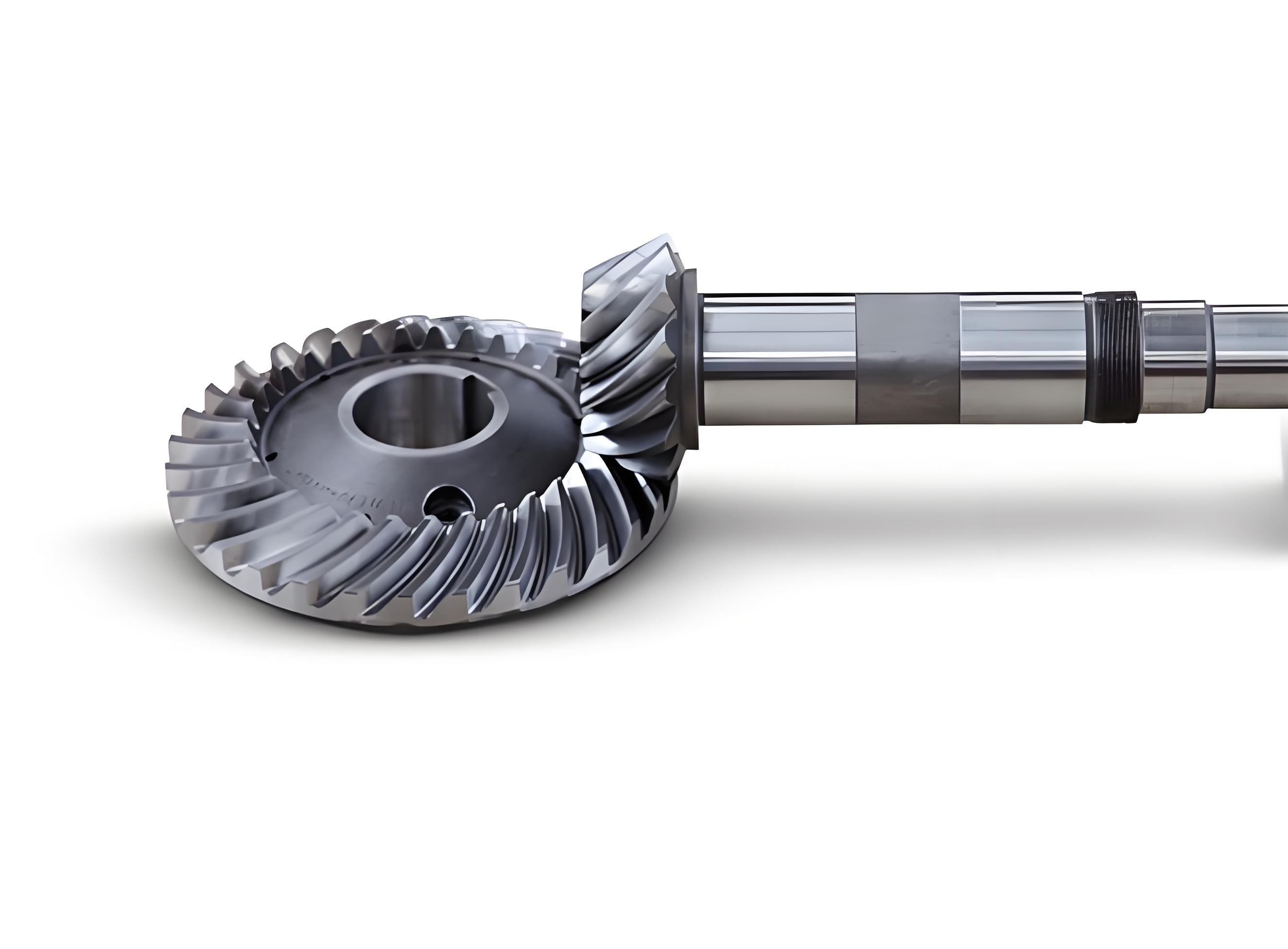
The foundation of our modeling process is the derivation of the mathematical equations for the tooth surfaces. This involves a series of coordinate transformations that trace the cutter edge from its local coordinate system to the final gear coordinate system. For the gear member cut by the Formate (non-generated) process, typically the larger gear, the surface is simply the envelope of the cutter surface in a fixed position. For the pinion, cut by the Generate process, the surface is the envelope of the cutter surface undergoing a defined rolling motion relative to the workpiece.
We begin by defining the cutter surface. A standard spiral bevel gear cutter head consists of alternate inner and outer blades, each with straight-line cutting edges oriented at the pressure angle. In the cutter coordinate system \( S_c \), the position vector \( \mathbf{r}_c \) of a point on the blade and its unit normal vector \( \mathbf{n}_c \) are given by:
$$
\mathbf{r}_c(u, \theta) =
\begin{bmatrix}
(r_0 \pm u \sin \alpha) \cos \theta \\
(r_0 \pm u \sin \alpha) \sin \theta \\
-u \cos \alpha \\
1
\end{bmatrix}, \quad
\mathbf{n}_c(\theta) =
\begin{bmatrix}
-\cos \alpha \cos \theta \\
-\cos \alpha \sin \theta \\
\sin \alpha \\
0
\end{bmatrix}
$$
where \( u \) and \( \theta \) are the surface parameters, \( r_0 \) is the cutter point radius, \( \alpha \) is the blade pressure angle (positive for convex side, negative for concave side of the generated gear tooth), and the ± sign corresponds to the inner or outer blade.
The transformation from the cutter to the gear involves a chain of homogeneous coordinate transformations that model the machine setup. This chain typically includes transformations from the cutter system \( S_c \) to the cradle system \( S_q \), then to the machine fixed system \( S_m \), and finally to the gear blank system \( S_g \). The complete transformation is represented by the product of these matrices:
$$
\mathbf{r}_g(u, \theta, \phi_q) = \mathbf{M}_{g m}(\phi_g) \cdot \mathbf{M}_{m q}(\phi_q) \cdot \mathbf{M}_{q c} \cdot \mathbf{r}_c(u, \theta)
$$
Here, \( \phi_q \) is the cradle rotation angle and \( \phi_g \) is the gear blank rotation angle. The matrix \( \mathbf{M}_{q c} \) accounts for the radial (\( S_r \)), angular (\( S_t \)), and tilt settings. \( \mathbf{M}_{m q} \) represents the cradle rotation. \( \mathbf{M}_{g m}(\phi_g) \) represents the machine root angle, offset (\( E_m \)), and the rolling motion governed by the ratio \( m_{gq} = \frac{d\phi_g}{d\phi_q} = \frac{N_q}{N_g} \), where \( N_q \) is the number of teeth of the imaginary generating gear and \( N_g \) is the number of teeth of the actual gear.
For the generated member, the surface equation is not complete without the equation of meshing, which ensures that the cutter surface and the gear being generated are in tangency at every instant. The condition is that the relative velocity vector at the contact point is perpendicular to the common surface normal:
$$
\mathbf{n} \cdot \mathbf{v}^{(cg)} = 0
$$
Solving this equation simultaneously with the coordinate-transformed surface equation allows us to eliminate one parameter (typically \( u \)), expressing the final gear tooth surface \( \mathbf{r}_g \) as a function of two independent parameters, such as \( \theta \) and \( \phi_q \).
Obtaining a usable set of data points for surface construction requires a systematic sampling strategy. A uniform grid in the parameter space \( (\theta, \phi_q) \) does not yield a uniform distribution of points on the actual gear tooth surface. A more effective method is to define a grid on the projection of the tooth surface onto the pitch cone or a rotational projection plane. For each grid node \( j \) on this plane, defined by its radial distance \( L_j \) and angular offset \( \delta_j \) from the axis, we solve for the corresponding surface point \( i \) whose coordinates satisfy:
$$
\tan \delta_j = \frac{\sqrt{Y_i^2 + Z_i^2}}{X_i}, \quad L_j = \sqrt{X_i^2 + Y_i^2 + Z_i^2}
$$
This nonlinear system is solved iteratively using the surface equations \( \mathbf{r}_g(\theta, \phi_q) \), yielding a cloud of points \( (X_i, Y_i, Z_i) \) that uniformly covers the active tooth flank. I implement this calculation in a computational environment like MATLAB to generate dense point clouds for both the convex and concave sides of the spiral bevel gears. The core parameters for a sample gear pair are summarized in the table below:
| Parameter | Gear (Large Wheel) | Pinion (Small Wheel) |
|---|---|---|
| Number of Teeth | 41 | 11 |
| Module (mm) | 5 | |
| Hand of Spiral | Right | Left |
| Shaft Angle (°) | 90 | |
| Mean Spiral Angle (°) | 35 | |
| Face Width (mm) | 31.8 | |
| Pressure Angle (°) | 20 | |
| Pitch Apex to Crown (mm) | Calculated | Calculated |
| Cutter Radius (mm) | 95.25 | 95.25 |
| Blade Angle (°) for Concave/Convex | +18 / -22 | -18 / +22 |
| Machine Settings: Radial, Angular, Tilt | Specific Values | Specific Values |
The transition from a point cloud to a continuous, analyzable 3D model is achieved using advanced Computer-Aided Design (CAD) software. I import the generated point data for a single tooth flank into a surface modeling module. Using functions designed to create surfaces from point nets (like the *Net Surface* command), I fit a Non-Uniform Rational B-Spline (NURBS) surface. NURBS are the industry standard for representing complex, free-form surfaces because of their mathematical robustness and ability to accurately approximate sculpted shapes. The quality of the initial point cloud directly determines the accuracy of this NURBS representation for the spiral bevel gears.
Once a single tooth flank surface is created, the process is repeated for the opposite flank. These two surfaces are then connected with fillets at the root and tip to form a complete, solid tooth. Using the CAD software’s patterning tools, this single tooth is rotated and copied around the gear axis according to the tooth count, resulting in a full gear model. The final step is the virtual assembly of the pinion and gear models, ensuring proper alignment based on the shaft angle and mounting distance. This assembly model is crucial for all subsequent analyses.
The accurate 3D model of spiral bevel gears is not an endpoint but a critical starting point for advanced engineering simulations. The primary applications enabled by this precise geometry include:
1. Tooth Contact Analysis (TCA): TCA is performed by simulating the meshing of the theoretically modeled gear pair under lightly loaded conditions. The assembly model is adjusted with small misalignments (pinion offset, mounting distance error, etc.), and the computer calculates the path of contact, transmission error, and bearing pattern. The TCA results for our modeled spiral bevel gears can be summarized as follows:
| Analysis Output | Description & Typical Target | Significance for Spiral Bevel Gears |
|---|---|---|
| Transmission Error (TE) | Deviation from perfect uniform angular motion; should be minimal and smooth. | Directly linked to vibration and noise excitation. A smooth, low-amplitude TE curve is ideal. |
| Contact Path | Locus of contact points on the tooth surface. | Should be centrally located, of appropriate length, and oriented correctly for optimal load distribution. |
| Bearing Pattern (Unloaded) | Elliptical shape indicating the zone of contact. | Must be centered away from edges (toe, heel, top, root) to prevent stress concentrations and edge loading. |
2. Finite Element Analysis (FEA): The solid model is meshed with finite elements to perform stress, strain, and deformation analysis under load. This is essential for evaluating the structural integrity of the spiral bevel gears. Key analyses include:
- Bending Stress Analysis: To ensure the tooth root fillet can withstand the cyclic loading without fatigue failure.
- Contact Stress Analysis: To verify that the Hertzian contact pressure on the tooth flanks is below the allowable limit for the material, preventing pitting and spalling.
- Static and Dynamic Load Analysis: To assess overall gear body deflection and dynamic response.
The von Mises stress \( \sigma_v \) is a common output, calculated from the stress tensor \( \boldsymbol{\sigma} \):
$$
\sigma_v = \sqrt{\frac{(\sigma_{11}-\sigma_{22})^2 + (\sigma_{22}-\sigma_{33})^2 + (\sigma_{33}-\sigma_{11})^2 + 6(\sigma_{12}^2+\sigma_{23}^2+\sigma_{31}^2)}{2}}
$$
3. Kinematic and Dynamic Simulation: The assembly model can be integrated into a multi-body dynamics (MBD) software package. Here, the spiral bevel gears are connected to shafts, bearings, and other system components. Simulations can predict dynamic loads, system vibrations, and efficiency under real operating conditions, far beyond the static or quasi-static assumptions of TCA and basic FEA.
4. Manufacturing Simulation (CAM): The digital model serves as the reference for generating CNC tool paths for modern 5-axis gear grinding or cutting machines. The ability to precisely define the target geometry is fundamental for creating accurate and efficient machining programs.
The methodology described establishes a closed-loop, digital thread for spiral bevel gears. It begins with theoretical machine settings, generates a precise digital twin via mathematical modeling and CAD, and uses that twin for performance prediction and optimization before physical manufacturing. This process allows for the virtual testing of design modifications—such as changes to pressure angle, spiral angle, or minor corrections to machine settings (eased-off edges, bias) to improve the contact pattern—with significant cost and time savings. The accuracy of the initial surface generation, rooted in the manufacturing kinematics, ensures that the virtual behavior of the spiral bevel gears closely mirrors their real-world performance, making it an indispensable tool for modern high-performance gear design and analysis.