
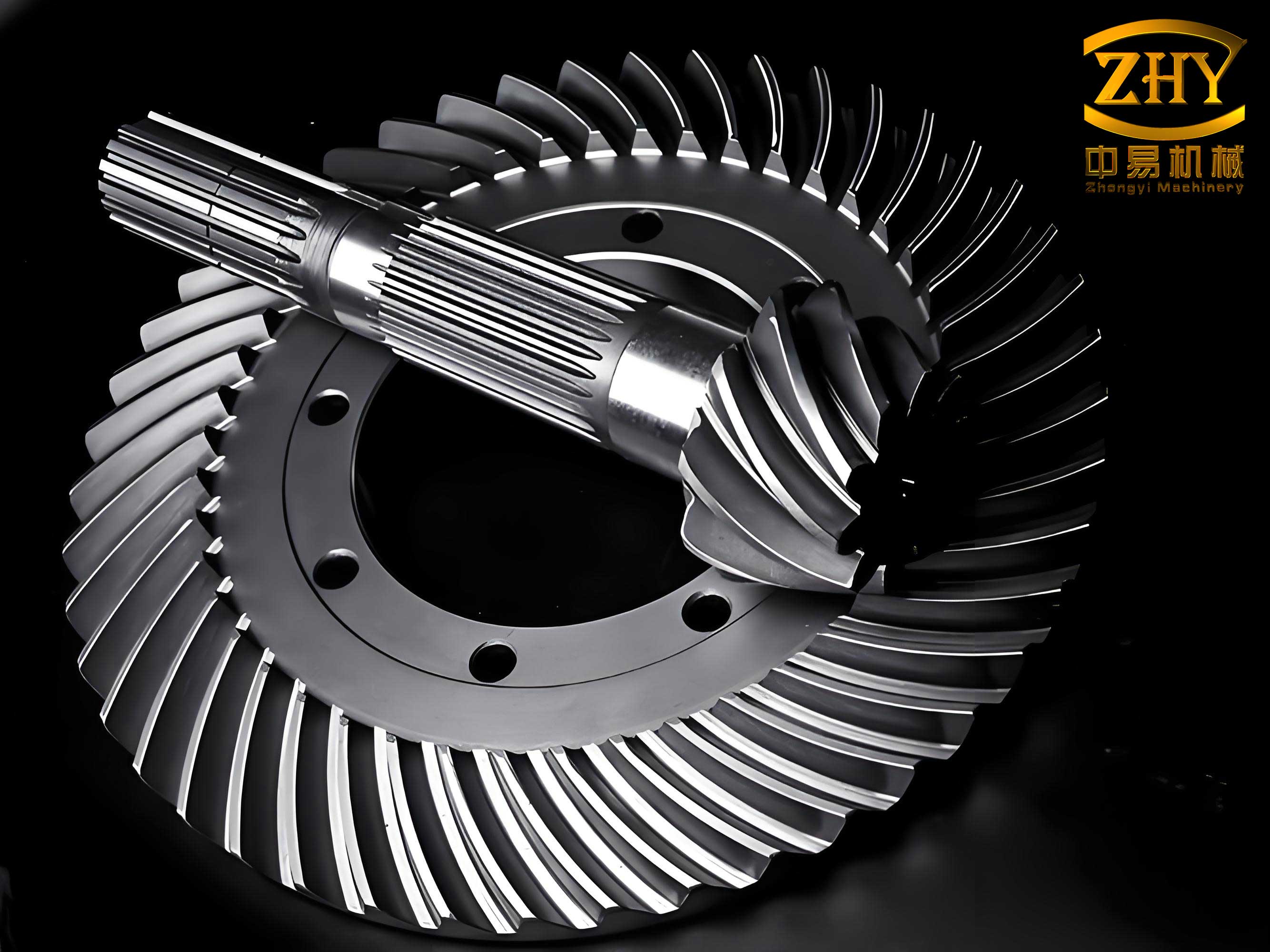
In modern mechanical engineering, the precision and performance of spiral bevel gears are critical for applications in automotive, aerospace, and industrial machinery. Spiral bevel gears are widely used due to their high load capacity and smooth operation, but achieving optimal tooth contact after heat treatment requires advanced lapping processes. This paper, from my perspective as a researcher in gear technology, delves into the development and analysis of lapping motion trajectory models for spiral bevel gears. I focus on reciprocating lapping patterns using three-position points and multi-position points, which are essential for controlling the lapping process to achieve full-tooth-surface or localized-area lapping effects. The goal is to provide a comprehensive methodology that simplifies adjustments, facilitates parameter settings, and enhances the efficiency of spiral bevel gear lapping, contributing to the advancement of domestic manufacturing capabilities in this field.
The lapping of spiral bevel gears involves refining tooth surfaces through abrasive action to correct distortions caused by heat treatment and improve contact patterns. Traditional methods often rely on manual adjustments, but with the advent of CNC lapping machines, precise motion control has become possible. In this study, I analyze two primary trajectory models: the three-point reciprocating model and the multi-point cyclic path model. These models leverage V and H adjustments—vertical offset and pinion axial displacement—to manipulate contact zones across tooth surfaces. The effectiveness of these models is demonstrated through experimental validation, highlighting their role in optimizing spiral bevel gear performance. Throughout this discussion, I will emphasize the importance of spiral bevel gears in high-precision systems and how advanced lapping techniques can address challenges in their manufacturing.
To understand the lapping process, consider the kinematic model of a CNC lapping machine for spiral bevel gears. Such machines typically feature multi-axis control, including X, Y, and Z linear axes along with rotational axes for gear rotation. The V and H adjustments are fundamental: V represents the vertical offset between gear axes, and H denotes the axial displacement of the pinion. These parameters are adjusted dynamically during lapping to sweep the contact zone across the tooth flank. The relationship between V, H, and contact zone movement can be expressed mathematically. For instance, the total displacement in V and H directions when shifting from heel to toe positions is given by:
$$ V_{\text{total}} = |V_T – V_H| $$
$$ H_{\text{total}} = |H_T – H_H| $$
where \( V_T \) and \( H_T \) are values at the toe position, and \( V_H \) and \( H_H \) are at the heel position. This linear interpolation forms the basis of trajectory planning. The midpoint position, often used as a starting point, is calculated as:
$$ V_{S0} = \frac{V_T + V_H}{2} $$
$$ H_{S0} = \frac{H_T + H_H}{2} $$
These formulas ensure that the contact zone is centered initially, allowing for controlled lapping across the entire surface of spiral bevel gears. In practice, adjustments may be needed based on post-lapping inspection, leading to corrected values such as \( V’ = V – V_0 \) and \( H’ = H – H_0 \), where \( V_0 \) and \( H_0 \) are correction factors derived from empirical testing.
The three-point reciprocating lapping motion trajectory is a widely adopted model for spiral bevel gears. It involves three key positions: the offset point S0, heel point H1, and toe point T1. The trajectory can be linear or polyline, as shown in Figure 2 of the original text. In linear mode, the contact zone moves directly between points via linear interpolation, while polyline mode allows for more complex paths. The V and H values for these points are determined through rolling tests on a gear testing machine. For example, for a drive side of spiral bevel gears, the process involves:
- Setting the gear pair at standard mounting distance and applying marking compound.
- Adjusting V and H until an ideal contact pattern appears at the toe, recording \( V_T \) and \( H_T \).
- Repeating for the heel to obtain \( V_H \) and \( H_H \).
- Computing the midpoint values \( V_{S0} \) and \( H_{S0} \) using the above formulas.
This method ensures that spiral bevel gears are lapped uniformly. The motion sequence typically follows: S0 → H1 → S0 → T1 → S0, completing a full scan. Dwell times at each point can be adjusted to emphasize specific areas; for instance, longer dwell at S0 enlarges the contact zone, while dwell at H1 or T1 reduces it. The parameters for lapping spiral bevel gears are summarized in Table 1 below, which includes speed, torque, and clearance settings.
| Position Point | Speed (rpm) | Torque (N·m) | Clearance (mm) | Dwell Time (s) |
|---|---|---|---|---|
| S0 (Offset) | 1500 | 9.5 | 0.30 | 0 |
| H1 (Heel) | 1500 | 9.5 | 0.30 | 0 |
| T1 (Toe) | 1500 | 9.5 | 0.30 | 0 |
For multi-position point cyclic path lapping, up to ten points can be defined—five on the heel side (H1 to H5) and five on the toe side (T1 to T5). This model offers finer control over spiral bevel gear lapping, accommodating irregular tooth distortions. The trajectory follows a cyclic order: T1 → T2 → … → T5 → H5 → … → H1 → T1, forming环形 or figure-eight paths. Each point’s V and H values are determined individually through rolling tests, allowing customization based on specific gear geometry. The motion is controlled via CNC interpolation, with the path shape depending on point coordinates rather than a fixed pattern. This flexibility is crucial for high-precision spiral bevel gears, where minor variations can affect performance. The relationship between point positions and contact zone movement can be modeled using linear equations. For instance, the displacement between consecutive points is:
$$ \Delta V = V_{i+1} – V_i $$
$$ \Delta H = H_{i+1} – H_i $$
where \( i \) denotes the point index. By optimizing these increments, lapping efficiency for spiral bevel gears is enhanced. Table 2 compares the two trajectory models, highlighting their applications for spiral bevel gears.
| Model | Number of Points | Trajectory Shape | Advantages | Typical Use Case |
|---|---|---|---|---|
| Three-Point | 3 | Linear/Polyline | Simple adjustment, easy parameter setting | Full-tooth-surface lapping |
| Multi-Point | Up to 10 | Cyclic/Figure-eight | High precision, localized control | Complex distortion correction |
Experimental analysis was conducted to validate these models for spiral bevel gears. A gear pair with a ratio of 9:39, shaft angle of 90°, and spiral angle of 50° was selected. Pre-lapping inspection revealed a contact pattern slightly biased toward the toe, as shown in Figure 10 of the original text. Using the three-point reciprocating model, V and H values were determined via rolling tests. For the drive side, measurements yielded:
$$ V_T = +0.275 \, \text{mm}, \quad H_T = -0.375 \, \text{mm} $$
$$ V_H = -0.525 \, \text{mm}, \quad H_H = +0.700 \, \text{mm} $$
$$ V_{S0} = -0.200 \, \text{mm}, \quad H_{S0} = +0.075 \, \text{mm} $$
Corrections were applied based on post-lapping checks, with \( V_0 = +0.0762 \, \text{mm} \) and \( H_0 = -0.0254 \, \text{mm} \), leading to adjusted values. The lapping process involved two stages for both drive and coast sides, with parameters as in Table 1. After lapping, the contact pattern shifted toward the center and became shorter, indicating improved uniformity—a key outcome for spiral bevel gears. Surface smoothness also increased, as confirmed by tactile inspection. The results demonstrate that the trajectory models effectively control lapping for spiral bevel gears, aligning with industrial requirements for noise reduction and load distribution.
Mathematical modeling further supports these findings. The contact zone movement on spiral bevel gears can be described as a function of V and H adjustments. For linear trajectories, the path between points is given by:
$$ V(t) = V_{\text{start}} + (V_{\text{end}} – V_{\text{start}}) \cdot t $$
$$ H(t) = H_{\text{start}} + (H_{\text{end}} – H_{\text{start}}) \cdot t $$
where \( t \) ranges from 0 to 1 over the interpolation interval. For polyline paths, piecewise linear functions are used. The effectiveness of lapping spiral bevel gears depends on optimizing these trajectories through iterative testing. In my experience, factors such as abrasive slurry viscosity and machine stiffness also play roles, but motion control remains paramount. Future work could integrate real-time feedback using sensors to adapt trajectories dynamically, further enhancing spiral bevel gear quality.
In conclusion, this research on lapping motion trajectory models for spiral bevel gears provides a robust framework for improving gear manufacturing. By analyzing three-point and multi-point reciprocating models, I have established methods for calculating and adjusting V and H values, validated through experiments. These models offer simplicity in adjustment, convenience in parameter setting, and precise control over lapping processes, enabling full-tooth-surface or localized-area effects for spiral bevel gears. The integration of CNC technology with these trajectories paves the way for advanced lapping machines, reducing reliance on imported equipment and boosting domestic production of high-precision spiral bevel gears. As industries demand higher performance, continued innovation in lapping methodologies will be essential for spiral bevel gears, ensuring their reliability in critical applications.
The development of these models underscores the importance of spiral bevel gears in modern machinery. From automotive differentials to helicopter transmissions, spiral bevel gears enable efficient power transfer at angles, and their precision directly impacts system longevity and efficiency. By refining lapping techniques, we can address common issues like edge loading and noise, which are prevalent in spiral bevel gears post-heat treatment. The trajectory models discussed here not only optimize contact patterns but also reduce lapping time, contributing to sustainable manufacturing. As I reflect on this work, it is clear that spiral bevel gears will continue to evolve, driven by advancements in motion control and materials science. Therefore, ongoing research into lapping dynamics for spiral bevel gears is warranted, potentially exploring nonlinear trajectories or AI-based optimization for further gains.