
The harmonic drive gear, a transformative transmission technology emerging in the mid-20th century, represents a significant advancement in precision motion control. Characterized by its exceptional compactness, low mass, high reduction ratios, and superior positional accuracy, the harmonic drive gear has become indispensable in demanding fields such as aerospace, nuclear facilities, robotics, and medical equipment. In critical applications, particularly within aerospace systems, stringent constraints are imposed on the volume, net mass, and load-carrying capacity of these transmissions. These applications are often defined by short operational durations coupled with the need to withstand extremely high transient loads. This presents a complex engineering challenge: designing a harmonic drive gear that simultaneously satisfies strict miniaturization and lightweight requirements while possessing the structural integrity to endure significant overloads.
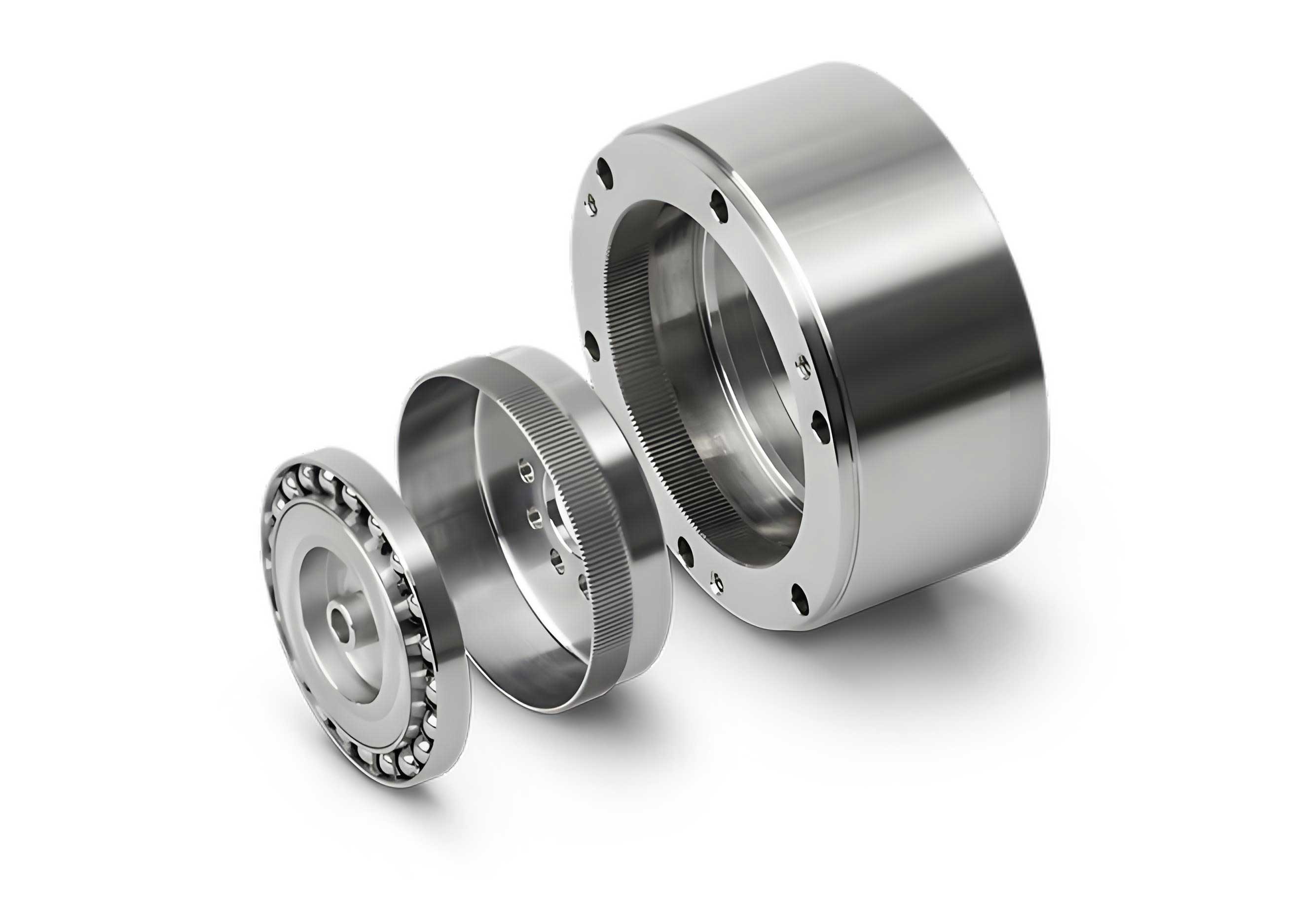
Within the harmonic drive gear assembly, the flexspline is universally recognized as the critical, life-limiting component. Its thin-walled, compliant nature makes it the primary determinant of the system’s ultimate load capacity and the principal obstacle to further miniaturization and weight reduction. Consequently, a detailed investigation into the stress state of the flexspline under operational loads is of paramount importance for advancing harmonic drive gear technology. This article employs a comprehensive finite element analysis (FEA) methodology to systematically examine the influence of key flexspline geometric parameters on its stress distribution. The objective is to establish design guidelines that enable the creation of robust, lightweight harmonic drive gears capable of performing reliably in short-duration, high-overload scenarios.
1. Establishment of the Finite Element Model
The analysis focuses on a cup-type flexspline, which is fixed at its flange base to the output shaft. The wave generator consists of an elliptical cam and a flexible bearing, while the transmission utilizes a double-wave configuration. To reduce computational cost without sacrificing critical accuracy, strategic modeling simplifications were implemented. The wave generator assembly was modeled as a rigid elliptical ring with a profile designed to approximate the deformed shape of a flexible bearing under load from the flexspline. Bolt holes on the flange were omitted, as their local stress effects were deemed secondary to the global parametric study.
The primary geometric and meshing parameters for the harmonic drive gear model are as follows:
| Parameter | Symbol | Value | Unit |
|---|---|---|---|
| Module | $$m$$ | 0.6 | mm |
| Pressure Angle | $$\alpha$$ | 20 | ° |
| Number of Flexspline Teeth | $$z_1$$ | 120 | – |
| Number of Circular Spline Teeth | $$z_2$$ | 122 | – |
| Flexspline Root Diameter | $$d_{f1}$$ | 73.44 | mm |
| Flexspline Internal Diameter | $$d$$ | 72.00 | mm |
| Nominal Radial Deformation | $$\omega_0$$ | 0.57 | mm |
| Nominal Torque | $$T_n$$ | 90 | N·m |
| Overload Torque | $$T_{over}$$ | 270 | N·m |
The key structural parameters of the flexspline, which are the subject of this parametric study, are the length-to-diameter ratio ($$n = L / d$$), the wall thickness ($$\delta$$), and the cup bottom taper angle ($$\gamma$$). The nominal wall thickness used as a baseline is 0.5 mm.
The finite element model was constructed using ABAQUS/Standard. Given the prevalence of complex, sliding contact conditions between the flexspline, wave generator, and circular spline, the use of second-order elements was avoided to prevent potential convergence issues related to contact interaction. The model employed 8-node linear brick elements with reduced integration (C3D8R), which provide a good balance of accuracy and computational efficiency for this class of problem involving large deformations and contact.
Material properties were assigned as follows: the circular spline was modeled as 40Cr steel, the flexspline as high-strength 35CrMnSiA alloy steel, and the simplified wave generator as 45 steel. Isotropic linear elastic material behavior was assumed for the initial parametric screening. The governing finite element equation for the static stress analysis is given by the global equilibrium equation:
$$ [K] \{u\} = \{F\} $$
where $$[K]$$ is the global stiffness matrix, $$\{u\}$$ is the nodal displacement vector, and $$\{F\}$$ is the applied load vector incorporating both the kinematic constraint from the wave generator and the torsional reaction torque.
Boundary conditions were applied to simulate real operation: the circular spline was fixed in all degrees of freedom. The wave generator was given a prescribed radial displacement pattern to achieve the nominal elliptical deformation $$\omega_0$$. The flange base of the flexspline was coupled to a reference point, where a pure torque was applied to simulate the output loading conditions (0 N·m, 90 N·m, 270 N·m). Frictional contact was defined between all interacting surfaces with a Coulomb friction coefficient of 0.1.
2. Influence of Structural Parameters on Flexspline Stress
The performance and reliability of a harmonic drive gear are acutely sensitive to the geometry of its flexspline. This section presents a detailed FEA-based investigation into three critical parameters.
2.1 The Role of Length-to-Diameter Ratio ($$n = L/d$$)
The cylindrical body length $$L$$ of the cup flexspline is crucial for ensuring a smooth transition from the fully deformed zone near the teeth to the relatively fixed base. An insufficient length leads to interference from the stiff base, causing undesirable stress concentrations and disrupting the ideal conjugate motion of the harmonic drive gear. The length-to-diameter ratio $$n$$ quantifies this characteristic. To analyze its effect, the cylindrical length $$L$$ was varied while keeping the cup bottom geometry constant, and the peak von Mises stress was extracted for three load cases.
| Length-to-Diameter Ratio (n) | Max Stress @ T=0 N·m (MPa) | Max Stress @ T=90 N·m (MPa) | Max Stress @ T=270 N·m (MPa) |
|---|---|---|---|
| 0.35 | 662.9 | 682.9 | 830.2 |
| 0.40 | 479.7 | 524.5 | 683.4 |
| 0.45 | 356.5 | 410.5 | 470.5 |
| 0.50 | 270.3 | 333.0 | 444.6 |
| 0.55 | 206.1 | 272.7 | 442.4 |
| 0.60 | 167.2 | 250.9 | 440.6 |
| 0.65 | 135.4 | 245.7 | 439.5 |
| 0.70 | 114.9 | 245.2 | 438.6 |
| 0.75 | 102.4 | 241.6 | 437.6 |
| 0.80 | 86.4 | 243.7 | 437.5 |
| 0.85 | 75.6 | 244.8 | 436.4 |
| 0.90 | 66.6 | 245.5 | 437.2 |
The data reveals a strongly nonlinear relationship. For $$n < 0.5$$, stresses escalate dramatically as the ratio decreases, particularly under load. This is the region where boundary effects from the rigid base dominate. For $$n > 0.5$$, the rate of stress reduction diminishes significantly. Under pure kinematic deformation (T=0 N·m), stress continues to decrease slowly, but under operational torque, the maximum stress plateaus at approximately 245 MPa for the nominal load and 437 MPa for the overload. This indicates that beyond a critical threshold, increasing the length provides diminishing returns for stress mitigation while directly increasing the mass and axial envelope of the harmonic drive gear. Therefore, for a lightweight and compact design, an optimal length-to-diameter ratio for this specific harmonic drive gear configuration lies in the range of $$0.5 \leq n \leq 0.6$$.
2.2 The Complex Interplay of Wall Thickness ($$\delta$$)
Wall thickness is perhaps the most influential and complex parameter in flexspline design for a harmonic drive gear. It governs a fundamental trade-off: a thicker wall increases bending stiffness and moment of inertia, which affects both stress and deformation. The total stress state is a superposition of bending stresses from the kinematic deformation and shear stresses from transmitted torque.
The bending stress in the thin-walled cylinder can be approximated by beam theory:
$$ \sigma_b \propto \frac{M \cdot \delta}{I} $$
where $$M$$ is the local bending moment induced by the wave generator and $$I$$ is the area moment of inertia per unit width, proportional to $$\delta^3$$. Thus, for a given deformation, bending stress is inversely proportional to the square of the wall thickness: $$\sigma_b \propto 1 / \delta^2$$. Conversely, the torsional shear stress is given by:
$$ \tau_t = \frac{T \cdot r}{J} $$
where $$T$$ is the transmitted torque, $$r$$ is the mean radius, and $$J$$ is the polar moment of inertia, proportional to $$\delta$$ for a thin wall. Therefore, the torsional shear stress is inversely proportional to the wall thickness: $$\tau_t \propto 1 / \delta$$.
The von Mises equivalent stress combines these components:
$$ \sigma_{vM} = \sqrt{\sigma_b^2 + 3\tau_t^2} $$
The competition between the $$\delta^{-2}$$ and $$\delta^{-1}$$ dependencies dictates the overall trend. The FEA results for varying wall thickness are summarized below.
| Wall Thickness, δ (mm) | Max Stress @ T=0 N·m (MPa) | Max Stress @ T=90 N·m (MPa) | Max Stress @ T=270 N·m (MPa) |
|---|---|---|---|
| 0.35 | 71.3 | 256.1 | 591.4 |
| 0.40 | 82.0 | 251.9 | 553.4 |
| 0.45 | 90.0 | 249.1 | 523.6 |
| 0.50 | 98.5 | 247.0 | 499.5 |
| 0.55 | 105.3 | 245.7 | 479.8 |
| 0.60 | 111.4 | 245.0 | 463.5 |
| 0.65 | 117.0 | 244.8 | 450.1 |
| 0.70 | 122.3 | 245.0 | 438.9 |
The results confirm the theoretical interplay. Under zero torque, stress is dominated by bending and increases monotonically with $$\delta$$, following a $$\sigma_b \propto 1/\delta^2$$ trend less strictly due to changing contact conditions. At the nominal torque (90 N·m), a minimum stress is observed around $$\delta = 0.6$$ mm, indicating a balance between bending and shear. At the high overload (270 N·m), the shear stress term dominates the von Mises criterion, leading to a consistent decrease in maximum stress as wall thickness increases. Furthermore, a thicker wall enhances torsional stiffness, reducing elastic wind-up and improving the positional accuracy of the harmonic drive gear. For short-duration, high-overload applications common in aerospace actuators, selecting a relatively larger wall thickness is beneficial for both stress reduction and precision. For this model, the relative wall thickness $$\delta / d$$ should be no less than 0.0083, with values towards 0.0097 (δ=0.7mm) offering superior overload performance.
2.3 Optimization of the Cup Bottom Taper Angle ($$\gamma$$)
The transition region between the flexspline’s cup bottom and the flange is a known site for stress concentration and potential fatigue failure. Introducing a controlled taper or angle $$\gamma$$ at the cup bottom helps to distribute the strain more smoothly from the thin cylindrical wall into the thick flange, mitigating the stress concentration factor. The effect of varying $$\gamma$$ on the peak stress specifically in the cup bottom region was analyzed.
| Cup Bottom Taper Angle, γ (°) | Max Cup Stress @ T=0 N·m (MPa) | Max Cup Stress @ T=90 N·m (MPa) | Max Cup Stress @ T=270 N·m (MPa) |
|---|---|---|---|
| 0.0 | 9.1 | 67.0 | 173.8 |
| 0.5 | 9.4 | 61.5 | 157.1 |
| 1.0 | 9.7 | 56.0 | 142.8 |
| 1.5 | 10.5 | 51.7 | 131.4 |
| 2.0 | 10.6 | 48.6 | 121.7 |
| 2.5 | 11.5 | 49.3 | 114.1 |
| 3.0 | 12.1 | 49.8 | 114.7 |
| 3.5 | 12.2 | 49.8 | 114.7 |
| 4.0 | 12.7 | 50.4 | 115.2 |
The trends are insightful. Under pure kinematic deformation (T=0 N·m), stress in the cup region increases slightly with $$\gamma$$, as the taper locally increases stiffness, resisting the bending deformation. However, under operational torque, a pronounced beneficial effect is observed. The maximum stress decreases significantly as $$\gamma$$ increases from 0° to approximately 2°. Beyond this point, the stress reaches a minimum plateau, with further increases in angle yielding negligible improvement or even a slight reversal. This indicates the existence of an optimal taper that best manages the strain transition. For the studied harmonic drive gear, the optimal cup bottom taper angle lies between $$2.0^\circ$$ and $$2.5^\circ$$. The selection within this band can be fine-tuned based on the primary load case: a value closer to $$2.0^\circ$$ is suitable for near-nominal loads, while a value closer to or at $$2.5^\circ$$ provides the best performance under severe overload conditions.
3. Conclusion and Design Synthesis
This detailed finite element analysis has systematically elucidated the influence of three pivotal flexspline geometric parameters on the structural performance of a harmonic drive gear subjected to short-duration, high-overload conditions. The findings provide a quantitative foundation for optimized, lightweight design.
First, the length-to-diameter ratio $$n$$ must be sufficient to isolate the functional gear teeth from the stiff boundary condition at the fixed base. The analysis demonstrates a critical threshold near $$n = 0.5$$ for this specific geometry. Increasing the ratio beyond 0.6 yields diminishing returns in stress reduction while penalizing the compactness and mass of the harmonic drive gear. Therefore, an optimal design should target $$n \approx 0.5-0.6$$.
Second, the selection of wall thickness $$\delta$$ requires careful consideration of the dominant load case. While a thinner wall minimizes mass and kinematic bending stress, it exacerbates torsional shear stress and reduces stiffness. For high-overload applications common in aerospace and robotics, where torque-induced shear dominates and precision is critical, a thicker wall is advantageous. The results recommend a relative wall thickness $$\delta/d \geq 0.0083$$, with higher values up to 0.0097 offering progressive benefits for overload capacity and torsional rigidity in the harmonic drive gear.
Third, the introduction of a cup bottom taper angle $$\gamma$$ is a highly effective design feature for mitigating stress concentrations in a critical fatigue-prone region. An optimal angle between $$2.0^\circ$$ and $$2.5^\circ$$ was identified, which significantly reduces peak stress under load compared to a sharp corner ($$\gamma = 0^\circ$$). The exact value can be selected based on the expected load spectrum, with higher angles favoring higher overload scenarios.
In summary, the journey towards a miniaturized, lightweight, yet robust harmonic drive gear necessitates a holistic and parametric approach to flexspline design. By simultaneously optimizing the length-to-diameter ratio, specifying an adequately thick wall for the target overload, and incorporating an optimized cup bottom taper, designers can significantly enhance the performance envelope of the harmonic drive gear. These principles, derived from rigorous numerical analysis, serve as essential guidelines for advancing the state-of-the-art in compact, high-performance precision gearing for the most demanding applications.