
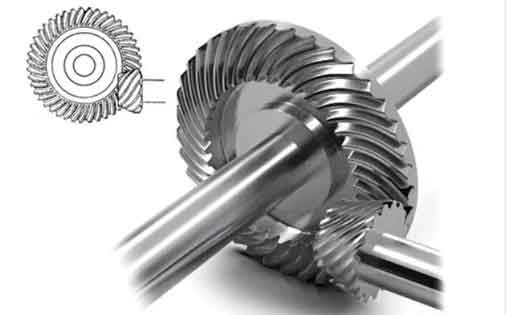
In the field of power transmission between intersecting axes, spiral bevel gears are widely recognized for their superior performance, including high overlap ratio, smooth operation, and low noise. These advantages make them indispensable in critical applications such as automotive axle drives. However, the traditional manufacturing of spiral bevel gears often relies on expensive five-axis computer numerical control (CNC) machines, which, while offering excellent tooth surface modification capabilities, significantly increase production costs. To address this economic challenge, I propose a four-axis CNC milling machine method for machining spiral bevel gears. This approach aims to develop a more economical and practical milling solution without compromising the essential啮合性能 of the gears. By focusing on ordinary non-offset spiral bevel gears designed via local synthesis methods with pre-controlled contact characteristics, the need for complex tool tilting motions can be eliminated, allowing for a simplified four-axis configuration. In this article, I will detail the mathematical modeling, motion position calculation, virtual simulation, and experimental validation of this four-axis generative machining process for spiral bevel gears, emphasizing the关键词 spiral bevel gears throughout.
The core innovation lies in reducing the machine axes from five to four by eliminating the swing motion associated with the root cone angle. This simplification not only lowers the machine’s structural complexity and cost but also maintains adequate加工 flexibility for spiral bevel gears. The four-axis machine primarily comprises a tool spindle assembly, a workpiece spindle assembly, and three linear slides (X, Y, Z axes) along with one rotational axis (B-axis) for the workpiece. The cutter head, driven by a frequency-controlled motor, rotates at a constant speed during machining without参与联动, while the workpiece, driven by a servo motor through a worm gear reducer, performs both the generating motion and indexing. The relative motion between the cutter and workpiece during tooth surface generation is precisely controlled by the coordinated movements of the X, Y, and B axes, ensuring accurate conjugate action.
To mathematically describe this four-axis machining system, I establish a kinematic model. Let the machine-fixed coordinate system be denoted as $S_m (X_m, Y_m, Z_m)$, where the $X_mO_mY_m$ plane coincides with the cutter tip plane. The cutter coordinate system $S_t (X_t, Y_t, Z_t)$ is attached to the cutter head, rotating by an angle $CA$. The workpiece coordinate system $S_w (X_w, Y_w, Z_w)$ is fixed to the gear blank, rotating about the B-axis by an angle $CB$. The workpiece installation angle is $C\gamma$. The cutter center position in the machine coordinates is given by $(CX, CY, CZ)$, and the axial workpiece correction is $\Delta L$. Additional auxiliary coordinate systems $S_b$, $S_a$, and $S_n$ are used for transformation clarity. The machine center point $O_0$ and design crossing point $O_2$ are defined relative to the workpiece base rotation center $OC$, with distance $L$ and correction $\Delta L$.
The tooth surface equation in the workpiece coordinate system is derived through sequential coordinate transformations:
$$ \mathbf{r}_w = \mathbf{M}_{wa} \mathbf{M}_{an} \mathbf{M}_{nm} \mathbf{M}_{mt} \mathbf{M}_{tb} \mathbf{r}_b $$
where $\mathbf{r}_b$ is the position vector in the cutter coordinate system, and the total transformation matrix $\mathbf{M}_C$ is:
$$ \mathbf{M}_C = \mathbf{M}_{wa} \mathbf{M}_{an} \mathbf{M}_{nm} \mathbf{M}_{mt} \mathbf{M}_{tb} = \begin{bmatrix}
c_{11} & c_{12} & c_{13} & c_{14} \\
c_{21} & c_{22} & c_{23} & c_{24} \\
c_{31} & c_{32} & c_{33} & c_{34} \\
0 & 0 & 0 & 1
\end{bmatrix} $$
The elements of $\mathbf{M}_C$ are expressed as:
$$ \begin{aligned}
c_{11} &= \cos(C\gamma) \cdot \cos(CA), \\
c_{12} &= -\cos(C\gamma) \cdot \sin(CA), \\
c_{13} &= \sin(C\gamma), \\
c_{14} &= CX \cdot \cos(C\gamma) – CZ \cdot \sin(C\gamma) – \Delta L, \\
c_{21} &= \sin(CB) \cdot \sin(C\gamma) \cdot \cos(CA) + \cos(CB) \cdot \sin(CA), \\
c_{22} &= -\sin(CB) \cdot \sin(C\gamma) \cdot \sin(CA) + \cos(CB) \cdot \cos(CA), \\
c_{23} &= -\sin(CB) \cdot \cos(C\gamma), \\
c_{24} &= CX \cdot \sin(CB) \cdot \sin(C\gamma) + CY \cdot \cos(CB) + CZ \cdot \sin(CB) \cdot \cos(C\gamma), \\
c_{31} &= -\cos(CB) \cdot \sin(C\gamma) \cdot \cos(CA) + \sin(CB) \cdot \sin(CA), \\
c_{32} &= \cos(CB) \cdot \sin(C\gamma) \cdot \sin(CA) + \sin(CB) \cdot \cos(CA), \\
c_{33} &= \cos(CB) \cdot \cos(C\gamma), \\
c_{34} &= -CX \cdot \cos(CB) \cdot \sin(C\gamma) + CY \cdot \sin(CB) – CZ \cdot \cos(CB) \cdot \cos(C\gamma).
\end{aligned} $$
This matrix encapsulates the kinematic relationship of the four-axis machine for spiral bevel gears. To ensure the machined tooth surface matches the designed one, I establish the basic generative machining mathematical model, which mimics traditional mechanical cradle-style machines. In this model, the cradle rotation angle is $\phi_g$, the workpiece rotation angle is $\phi_w = R_b \phi_g$ (where $R_b$ is the gear ratio), radial cutter distance is $S_r$, angular cutter position is $q$, workpiece installation angle is $\delta_M$, vertical workpiece offset is $E_m$, horizontal workpiece correction is $X_g$, and axial床位 is $X_b$. The corresponding transformation matrix $\mathbf{M}_G$ is:
$$ \mathbf{M}_G = \begin{bmatrix}
g_{11} & g_{12} & g_{13} & g_{14} \\
g_{21} & g_{22} & g_{23} & g_{24} \\
g_{31} & g_{32} & g_{33} & g_{34} \\
0 & 0 & 0 & 1
\end{bmatrix} $$
with elements:
$$ \begin{aligned}
g_{11} &= \cos(\delta_M) \cdot \cos(\phi_g) \cdot \cos(\phi_c) – \cos(\delta_M) \cdot \sin(\phi_g) \cdot \sin(\phi_c), \\
g_{12} &= -\cos(\delta_M) \cdot \cos(\phi_g) \cdot \sin(\phi_c) – \cos(\delta_M) \cdot \sin(\phi_g) \cdot \cos(\phi_c), \\
g_{13} &= \sin(\delta_M), \\
g_{14} &= S_r \cdot \cos(\delta_M) \cdot \cos(\phi_g) \cdot \cos(q) – S_r \cdot \cos(\delta_M) \cdot \sin(\phi_g) \cdot \sin(q) – X_b \cdot \sin(\delta_M) – X_g, \\
g_{21} &= (-\sin(\phi_w) \cdot \sin(\delta_M) \cdot \cos(\phi_g) + \cos(\phi_w) \cdot \sin(\phi_g)) \cdot \cos(\phi_c) \\
&\quad + (\sin(\phi_w) \cdot \sin(\delta_M) \cdot \sin(\phi_g) + \cos(\phi_w) \cdot \cos(\phi_g)) \cdot \sin(\phi_c), \\
g_{22} &= -(-\sin(\phi_w) \cdot \sin(\delta_M) \cdot \cos(\phi_g) + \cos(\phi_w) \cdot \sin(\phi_g)) \cdot \sin(\phi_c) \\
&\quad + (\sin(\phi_w) \cdot \sin(\delta_M) \cdot \sin(\phi_g) + \cos(\phi_w) \cdot \cos(\phi_g)) \cdot \cos(\phi_c), \\
g_{23} &= \sin(\phi_w) \cdot \cos(\delta_M), \\
g_{24} &= (-\sin(\phi_w) \cdot \sin(\delta_M) \cdot \cos(\phi_g) + \cos(\phi_w) \cdot \sin(\phi_g)) \cdot S_r \cdot \cos(q) \\
&\quad + (\sin(\phi_w) \cdot \sin(\delta_M) \cdot \sin(\phi_g) + \cos(\phi_w) \cdot \cos(\phi_g)) \cdot S_r \cdot \sin(q) + \cos(\phi_w) \cdot E_m – \sin(\phi_w) \cdot \cos(\delta_M) \cdot X_b, \\
g_{31} &= (-\cos(\phi_w) \cdot \sin(\delta_M) \cdot \cos(\phi_g) – \sin(\phi_w) \cdot \sin(\phi_g)) \cdot \cos(\phi_c) \\
&\quad + (\cos(\phi_w) \cdot \sin(\delta_M) \cdot \sin(\phi_g) – \sin(\phi_w) \cdot \cos(\phi_g)) \cdot \sin(\phi_c), \\
g_{32} &= -(-\cos(\phi_w) \cdot \sin(\delta_M) \cdot \cos(\phi_g) – \sin(\phi_w) \cdot \sin(\phi_g)) \cdot \sin(\phi_c) \\
&\quad + (\cos(\phi_w) \cdot \sin(\delta_M) \cdot \sin(\phi_g) – \sin(\phi_w) \cdot \cos(\phi_g)) \cdot \cos(\phi_c), \\
g_{33} &= \cos(\phi_w) \cdot \cos(\delta_M), \\
g_{34} &= (-\cos(\phi_w) \cdot \sin(\delta_M) \cdot \cos(\phi_g) – \sin(\phi_w) \cdot \sin(\phi_g)) \cdot S_r \cdot \cos(q) \\
&\quad + (\cos(\phi_w) \cdot \sin(\delta_M) \cdot \sin(\phi_g) – \sin(\phi_w) \cdot \cos(\phi_g)) \cdot S_r \cdot \sin(q) – \sin(\phi_w) \cdot E_m – \cos(\phi_w) \cdot \cos(\delta_M) \cdot X_b.
\end{aligned} $$
By equating the two transformation matrices, $\mathbf{M}_C = \mathbf{M}_G$, and setting $C\gamma = \delta_M$, $CA = \phi_c$, and $\Delta L = X_g$, I solve for the four-axis machine motion coordinates:
$$ \begin{cases}
CX = X_g \cdot \cos(\delta_M) + g_{14} \cdot \cos(\delta_M) – g_{34} \cdot \sin(\delta_M), \\
CY = g_{24}, \\
CZ = -X_g \cdot \sin(\delta_M) – g_{14} \cdot \sin(\delta_M) – g_{34} \cdot \cos(\delta_M), \\
CB = \phi_w = R_b \cdot \phi_g.
\end{cases} $$
These equations provide the necessary coordinates for the X, Y, Z, and B axes during the generative machining of spiral bevel gears. To illustrate, consider a specific example of machining a right-hand spiral bevel gear. The gear blank parameters and machining settings are summarized in the following tables, which are essential for calculating the motion positions.
| Parameter Name | Value for Large Gear | Value for Pinion |
|---|---|---|
| Number of Teeth | 28 | 17 |
| Module (mm) | 10.3572 | 10.3572 |
| Pressure Angle (°) | 20 | 20 |
| Midpoint Spiral Angle (°) | 35 | 35 |
| Face Width (mm) | 50 | 50 |
| Large End Pitch Diameter (mm) | 290 | 176.07 |
| Whole Depth (mm) | 17.9487 | 17.9487 |
| Pitch Cone Angle (°) | 58.7363 | 31.2637 |
| Face Cone Angle (°) | 62.0664 | 34.5938 |
| Root Cone Angle (°) | 55.4062 | 27.9336 |
For the machining parameters of the large gear’s concave and convex sides:
| Parameter Name | Concave Side | Convex Side |
|---|---|---|
| Cutter Radius (mm) | 143.902 | 137.902 |
| Cutter Blade Angle (°) | -18 | 22 |
| Workpiece Installation Angle (°) | 55.4062 | 55.4062 |
| Radial Cutter Distance (mm) | 131.7678 | 131.7678 |
| Angular Cutter Position (°) | 61.1561 | 61.1561 |
| Horizontal Workpiece Correction (mm) | 0 | 0 |
| Vertical Workpiece Offset (mm) | 0 | 0 |
| Axial床位 (mm) | 0 | 0 |
| Gear Ratio | 1.167906 | 1.167906 |
Using these parameters, I compute the motion axis coordinates for a range of cradle rotation angles $\phi_g$. A subset of the calculated positions is shown below, demonstrating the coordinated movement required for spiral bevel gears machining.
| $\phi_g$ (°) | CX (mm) | CY (mm) | CZ (mm) | CB (°) |
|---|---|---|---|---|
| -30.00 | 111.7235 | 79.6475 | -71.3250 | 35.0262 |
| -29.85 | 111.5146 | 79.9397 | -71.3250 | 34.8510 |
| -29.70 | 111.3049 | 80.2314 | -71.3250 | 34.6759 |
| … | … | … | … | … |
| 30.60 | -14.5445 | 136.4343 | -71.3250 | -35.7267 |
| 30.75 | -14.9016 | 136.3563 | -71.3250 | -35.9018 |
| 30.90 | -15.2586 | 136.3563 | -71.3250 | -36.0769 |
To validate the correctness of these motion position calculations before actual cutting, I perform a virtual machining simulation using VERICUT CNC simulation software. First, I construct an equivalent four-axis machine model within VERICUT, incorporating the linear X, Y, Z axes and rotational B-axis. The cutter model is created based on the specified tool geometry, and the gear blank is modeled according to the parameters. The computed axis coordinates are imported into the CNC system of the virtual machine. The simulation process includes steps such as workpiece clamping, machine homing, safe positioning, and the generative cutting cycle for each tooth slot.
The virtual machining simulation successfully generates the tooth surfaces of the spiral bevel gear. To assess accuracy, I compare the simulated gear with a theoretical 3D model derived from the design齿面 data. The deviation analysis shows that the maximum error between the simulated and theoretical tooth surfaces is less than 0.02 mm, which is within acceptable tolerances for spiral bevel gears. This confirms that the mathematical model and motion position solution are correct and feasible for practical applications.
Following the virtual validation, I proceed to actual cutting experiments on a four-axis CNC milling machine configured according to the model. The machining process follows the simulated steps, using the same gear blank and cutter parameters. The cutting experiment for the large spiral bevel gear is conducted, and the machined tooth surfaces are measured using a coordinate measuring machine (CMM) or similar metrology equipment. The measurement results indicate that the actual tooth surfaces exhibit minor deviations from the theoretical ones, primarily due to factors such as tool wear, fixture errors, and machine inaccuracies. However, these deviations are within the permissible range, further verifying the effectiveness of the proposed four-axis method for spiral bevel gears.
In conclusion, the four-axis generative machining approach for spiral bevel gears offers a cost-effective alternative to traditional five-axis methods. By establishing a precise kinematic model and solving for motion axis positions through equivalence with mechanical cradle-style machines, I ensure accurate tooth surface generation. The virtual simulation in VERICUT provides a reliable pre-validation tool, reducing the risk of scrapped workpieces and tool collisions. Experimental results corroborate the theoretical findings, demonstrating that the four-axis CNC milling machine can produce spiral bevel gears with satisfactory quality. This research contributes to the development of economical manufacturing solutions for spiral bevel gears, potentially lowering production costs in industries like automotive and aerospace. Future work may focus on optimizing cutter paths, integrating real-time error compensation, and extending the method to more complex gear types, all while maintaining the emphasis on the关键词 spiral bevel gears.