
In the complex ecosystem of mechanical power transmission, the gear shaft stands as a fundamental and critical component. Its role in transmitting torque, modifying speed, and supporting rotational elements is indispensable across industries from automotive to heavy machinery. The performance, reliability, and longevity of an entire mechanical system can be directly traced to the quality of its gear shafts. Therefore, a deep, first-principles understanding and continuous refinement of their manufacturing process is not merely an engineering task but a necessity for advancing mechanical design. This article delves into a comprehensive analysis of gear shaft processing, exploring material science, machining techniques, thermal treatments, and precision finishing, with a constant focus on process optimization to achieve superior quality and efficiency.
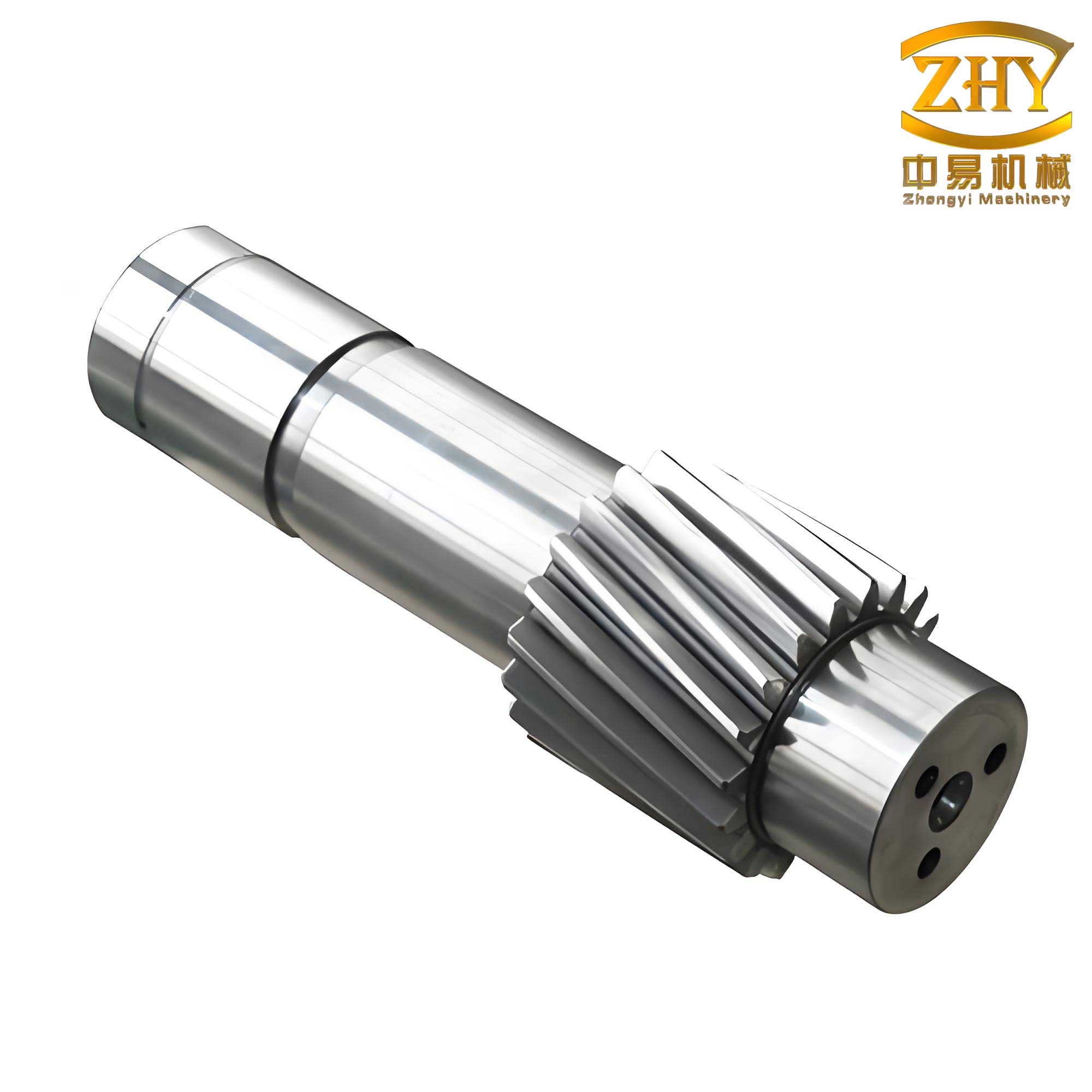
The anatomy of a typical gear shaft is a symphony of geometric features: integral gear teeth, splines (often involute), bearing journals, shoulders, grooves, and keyways. This integration places extraordinary demands on the manufacturing process. Achieving the concentricity, runout tolerance, surface finish, and hardness profile across these diverse features requires a meticulously planned sequence of operations. Any compromise in the processing of gear shafts can lead to catastrophic failures like pitting, scuffing, tooth breakage, or excessive vibration.
1. Foundational Decisions: Material and Preform
The journey of a high-performance gear shaft begins long before the first cut is made. The selection of material is paramount, dictated by the required balance of core toughness, surface hardness, fatigue strength, and manufacturability.
| Material Class | Specific Grades | Key Characteristics | Typical Applications | Heat Treatment |
|---|---|---|---|---|
| Medium Carbon Steel | AISI 1045, 1050 (Equivalent to 45 Steel) | Good strength & toughness, cost-effective, readily machinable. | General industrial machinery, agricultural equipment shafts with moderate loads. | Through-hardening (quench & temper), Induction hardening. |
| Low-Alloy Case-Hardening Steel | AISI 8620, 4320, 20MnCr5 | Excellent core toughness with a hard, wear-resistant case after carburizing. | High-load automotive transmissions, heavy-duty工程机械 gear shafts. | Carburizing (Case Hardening) followed by quenching. |
| Alloy Steel for Through-Hardening | AISI 4140, 4340 | High strength and good fatigue resistance through the entire cross-section. | Large diameter gear shafts where deep hardness is needed. | Quench and temper to required hardness depth. |
The choice of preform is equally strategic. Forging is the predominant method for creating gear shaft blanks, especially for critical applications. The forging process aligns the grain flow with the contour of the part, significantly enhancing fatigue strength and impact resistance compared to a simple bar stock. It also provides a near-net-shape form, reducing material waste and subsequent machining time. The forging process itself can be modeled for optimization, considering parameters like die geometry, billet temperature $T_b$, and strain rate $\dot{\epsilon}$ to achieve optimal microstructure:
$$ \sigma_f = f(\epsilon, \dot{\epsilon}, T) $$
where $\sigma_f$ is the flow stress during forging.
2. Shaping the Core: Turning and Preliminary Heat Treatment
With a forged blank in hand, the first machining step is turning. This stage is divided into roughing and finishing, but a crucial intermediate step often involves heat treatment.
Pre-Turning Heat Treatment (Normalizing): For low-carbon alloy steels destined for carburizing, a normalizing treatment is typically applied to the blank. This homogenous treatment refines the grain structure inherited from forging, eliminates internal stresses, and ensures a uniform, fine-pearlitic structure that is ideal for subsequent machining and final case hardening. The process involves heating the steel to approximately $50-100^\circ C$ above its upper critical temperature ($A_{c3}$), holding, and then air cooling. The governing equation for austenite grain growth during heating can be described as:
$$ D^n – D_0^n = k t \exp\left(-\frac{Q}{RT}\right) $$
where $D$ is the final grain size, $D_0$ is the initial grain size, $k$ is a constant, $t$ is time, $Q$ is the activation energy for grain growth, $R$ is the gas constant, and $T$ is the absolute temperature.
Rough and Finish Turning: Rough turning aggressively removes the bulk of the material to establish the basic shaft geometry. The focus here is on productivity. Establishing a reliable datum system is critical. Often, the future bearing journals are used as primary datums. The tolerance on these datum features must be tightly controlled, typically to within 1/5 to 1/3 of the final part tolerance, to ensure all subsequent operations build accuracy upon a stable foundation. Finish turning, increasingly performed on CNC lathes, achieves the final dimensions and surface finish for non-critical diameters before heat treatment. The optimization of turning parameters like cutting speed ($V_c$), feed ($f$), and depth of cut ($a_p$) is crucial for productivity and surface integrity. The classic Taylor’s Tool Life equation provides a guide:
$$ V_c T^n = C $$
where $T$ is tool life, and $n$ and $C$ are constants determined by tool-workpiece material pairing.
Core Strengthening (Quenching & Tempering): Before the final hardening of functional surfaces like gear teeth, the entire gear shaft often undergoes a quench and temper (Q&T) process. This through-hardening treatment develops the required core strength and toughness. For carburizing steels, this step might be an intermediate treatment after rough machining to prevent distortion during the final high-temperature carburizing cycle.
3. Creating the Functional Geometry: Gear and Spline Manufacturing
This phase defines the power-transmitting features of the gear shaft.
Gear Tooth Generation: The two primary methods are hobbing and shaping (or broaching for internal gears). For external spur and helical gears on shafts, hobbing is dominant due to its high productivity and good accuracy (typically up to ISO Class 7-9). Hobbing is a continuous generating process. The relationship between the hob rotation, workpiece rotation, and axial feed is fundamental. The basic kinematics for a spur gear hob can be simplified as the synchronized rotation of the workpiece ($N_w$) and the hob ($N_h$):
$$ \frac{N_w}{N_h} = \frac{K}{Z} $$
where $Z$ is the number of teeth on the workpiece gear, and $K$ is the number of starts on the hob. For high-volume production of hardened gears, the process chain often follows: Rough Hob → Finish Hob (or Shave) → Heat Treat → Final Grind/Hone. Pre-heat treat finishing operations like shaving are used to improve tooth profile and lead accuracy, which minimizes the stock left for the final hard-finishing operation.
Gear Accuracy: The quality of gear shafts is quantified by international standards (ISO, AGMA). Key error components include profile error ($f_{H\alpha}$), helix error ($f_{H\beta}$), and pitch error ($f_p$). The overall single pitch error is given by:
$$ f_{p} = p_{actual} – p_{theoretical} $$
The transmission error, a critical source of noise, is influenced by these manufacturing inaccuracies.
Spline Machining: Involute splines are commonly machined using dedicated spline hobbing or milling machines. The process is analogous to gear hobbing but tailored for the specific pressure angle (commonly 30° or 37.5°) and tooth thickness of the spline.
4. Surface Engineering: Case Hardening
To achieve a hard, wear-resistant surface while maintaining a ductile, shock-absorbing core, gear shafts are frequently case hardened, most commonly via gas carburizing. The process involves diffusing carbon into the surface of the low-carbon steel at high temperatures (e.g., $925-950^\circ C$) in a carbon-rich atmosphere, followed by a controlled quench to form a hard martensitic case.
The depth of the carburized case (Case Depth) is a critical design parameter, often specified as Effective Case Depth (ECD) to a hardness of $550$ HV. The diffusion of carbon follows Fick’s second law. A simplified approximation for case depth ($d$) as a function of time ($t$) and temperature ($T$) is given by the Harris formula:
$$ d = k \sqrt{t} $$
where the diffusion coefficient $k$ is exponentially dependent on temperature:
$$ k = k_0 \exp\left(-\frac{Q}{RT}\right) $$
Typical ECD values for heavy-duty gear shafts range from $1.0$ to $2.0$ mm.
Selective Hardening & Protection: Areas like splines, threads, or seal surfaces may not require a hard case. These are protected during carburizing by copper plating or the application of proprietary stop-off paints, which prevent carbon diffusion.
5. The Pursuit of Precision: Final Grinding and Finishing
Heat treatment invariably induces slight distortions. The final machining operations are dedicated to correcting these deviations and achieving the micron-level tolerances required for smooth, quiet, and efficient operation.
Center Hole Refinement: The center holes, used as datums for all cylindrical grinding, are first meticulously re-ground or lapped. This re-establishes a geometrically perfect axis for all subsequent finishing.
External Grinding: Critical diameters, especially bearing journals and seal surfaces, are precision ground. This ensures exact size, roundness, and surface finish (often $R_a < 0.4 \mu m$).
Hard Gear Finishing: For high-precision gear shafts (ISO Class 6 or better), the carburized and hardened gear teeth are finished by grinding or honing. Gear grinding (using threaded-wheel, profile, or generating methods) is the most accurate technique for correcting heat treat distortion and achieving excellent tooth geometry. The final quality is verified on a gear measuring center, assessing parameters like profile, helix, pitch, and runout.
6. Process Synthesis and Optimization Pathways
The traditional process flow for a carburized gear shaft is robust but offers multiple avenues for optimization aimed at reducing cost, lead time, and energy consumption while improving quality.
| Processing Stage | Traditional Route | Potential Optimization Strategy | Key Benefit |
|---|---|---|---|
| Material & Preform | Standard alloy steel forgings. | Use of microalloyed steels that eliminate the need for separate Q&T Adoption of near-net-shape forging/sintering. | Eliminates a furnace cycle, reduces machining. |
| Soft Machining | Separate rough and finish turning on different set-ups. | High-precision hard turning in a single set-up, replacing some grinding operations. | Reduced cycle time, elimination of grinding wheel costs. |
| Gear Cutting | Hobbing followed by shaving. | Power Skiving for gear and spline generation – a high-speed, dry, and precise finishing cut. | Dramatically faster than hobbing, excellent surface finish, single-step process. |
| Heat Treatment | Atmospheric gas carburizing. | Low-pressure carburizing (LPC) in a vacuum furnace followed by high-pressure gas quenching (HPGQ). | No intergranular oxidation, minimal distortion, repeatable case depth, cleaner parts. |
| Hard Finishing | Gear grinding after carburizing. | Implement CBN (Cubic Boron Nitride) plated honing tools or innovative gear skiving for hard finishing. | Higher material removal rates, longer tool life, improved surface integrity. |
| Quality Control | Final inspection on CMM and gear checker. | In-process monitoring and adaptive control using sensors (force, acoustic emission, vision). | Real-time correction, prevents scrap, builds digital twin for predictive quality. |
Optimization is also driven by failure mode analysis. Understanding the root cause of defects allows for targeted improvements in the process chain.
| Defect/Observation | Potential Root Cause in Manufacturing Process | Corrective/Optimization Action |
|---|---|---|
| Premature tooth bending fatigue failure. | Insufficient core hardness/toughness; Grinding burns inducing tensile stresses. | Review Q&T parameters; Optimize grinding feed/coolant (use CBN wheels). |
| Pitting and spalling on tooth flanks. | Insufficient or non-uniform case depth; Inadequate surface hardness. | Improve carburizing atmosphere control (use LPC); Ensure proper quench agitation. |
| Excessive noise and vibration. | Poor tooth profile/lead accuracy; Excessive runout of gear element. | Implement more precise hard-finishing (grinding/skiving); Improve datum consistency throughout process. |
| Cracking in fillet or spline root. | Inadequate root radius machining; Carburization of protected areas (spline) due to coating failure. |
The manufacturing of high-performance gear shafts is a testament to interdisciplinary engineering, blending metallurgy, mechanics, thermodynamics, and precision metrology. Each step, from the choice of alloy to the final micron-level grind, is a link in a chain that defines the component’s ultimate capability. The relentless pursuit of optimization—through advanced materials, innovative processes like power skiving and LPC, and the integration of digital monitoring—ensures that the humble gear shaft continues to evolve. This evolution directly translates into more efficient, durable, and reliable machinery, pushing the boundaries of what is possible in mechanical power transmission. The future lies in fully integrated, digitalized process chains where data from every operation feeds a predictive model, enabling the creation of gear shafts that are not just manufactured, but engineered to perfection.