
This article details a comprehensive methodology for establishing a precise three-dimensional geometric model of spiral bevel gears. The process is grounded in the generating principle of gear manufacturing and fundamental gear meshing theory. I will derive the mathematical equations governing the tooth surfaces, describe the computational procedures for data point acquisition, and outline the steps for constructing the solid model. The resulting high-fidelity model is foundational for advanced computer-aided engineering (CAE) tasks such as assembly simulation, interference checking, dynamic meshing analysis, and finite element analysis, thereby supporting the optimization design, manufacturing, and analytical verification of spiral bevel gears.
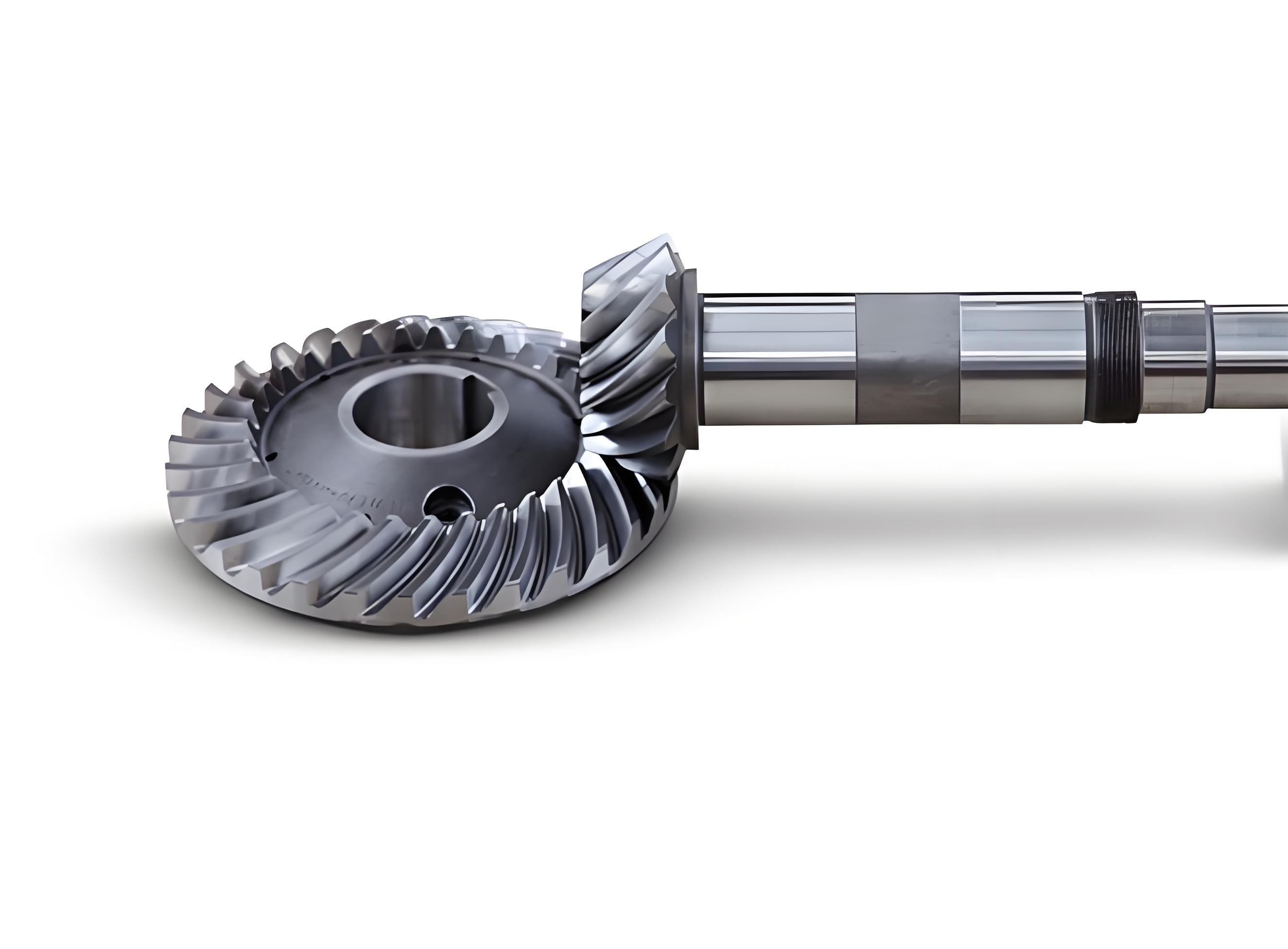
The accurate geometric modeling of spiral bevel gears presents a significant challenge due to their complex, spatially curved tooth surfaces designed for point contact between intersecting axes. This complexity renders conventional CAD modeling techniques inadequate. My approach leverages the theoretical foundation of the gear generation process to achieve high precision. Essentially, the manufacturing machine simulates a phantom gear (the generating gear or cradle), whose “teeth” are represented by the cutting edges of a rotating cutter head. As the workpiece and this phantom gear rotate in a timed relationship, the cutter sweeps out the desired tooth form on the gear blank. Therefore, mathematically modeling the tooth surface of spiral bevel gears translates into determining the envelope of the family of cutter surfaces relative to the coordinate system of the workpiece gear.
Theoretical Foundation and Surface Equation Derivation
The core of precise modeling lies in deriving the mathematical representation, or the tooth surface equation, for both the gear (typically the larger member) and the pinion (the smaller member). The derivation involves defining the cutter surface, establishing a series of coordinate transformations that describe the relative positions and motions between the cutter, the machine cradle, and the workpiece, and finally applying the gear meshing condition.
Coordinate Systems and Transformation Matrices
The machining process is analyzed using multiple coordinate systems. The key systems include: the cutter coordinate system \( S_d(X_d, Y_d, Z_d) \) attached to the rotating cutter head; the cradle coordinate system \( S_y(X_y, Y_y, Z_y) \) representing the phantom gear; the machine fixed coordinate system \( S_g(X_g, Y_g, Z_g) \); the workpiece fixed coordinate system \( S_{lg}(X_{lg}, Y_{lg}, Z_{lg}) \); and the workpiece rotating coordinate system \( S_l(X_l, Y_l, Z_l) \) attached to the gear blank. The transformation between these systems is achieved through homogeneous coordinate transformation matrices. For the gear, the fundamental transformation chain from the cutter to the final gear surface is:
$$
\mathbf{r}_g^{(2)} = \mathbf{M}_{2d,2lg} \cdot \mathbf{M}_{2lg,2g} \cdot \mathbf{M}_{2g,2y} \cdot \mathbf{M}_{2y,2d} \cdot \mathbf{r}_d^{(2)}
$$
Where \( \mathbf{r}_d^{(2)} \) is the cutter surface vector in the cutter system, \( \mathbf{r}_g^{(2)} \) is the generated gear tooth surface vector in its own system, and \( \mathbf{M}_{a,b} \) denotes the transformation matrix from system \( b \) to system \( a \).
Gear (Large Wheel) Tooth Surface Derivation
Spiral bevel gears are commonly cut using a double-sided cutter head with separate blades for convex and concave sides. The surface of the straight-lined cutting blade in its local coordinate system can be described as a conical surface. For the gear, the cutter surface equation is:
$$
\mathbf{r}_d^{(2)}(u_2, \theta_2) = \begin{bmatrix}
(r_2 – u_2 \sin\alpha_2) \sin\theta_2 \\
(r_2 – u_2 \sin\alpha_2) \cos\theta_2 \\
u_2 \cos\alpha_2 \\
1
\end{bmatrix}
$$
Here, \( u_2 \) is the distance parameter along the blade edge, and \( \theta_2 \) is the rotational parameter around the cutter axis. The parameter \( r_2 = r_{2d} \pm 0.5w_2 \), where \( r_{2d} \) is the nominal cutter radius and \( w_2 \) is the point width. The sign is positive for the concave-side blade and negative for the convex-side blade. Similarly, \( \alpha_2 \) takes the value of the blade angle for the concave side \( \alpha_{2wd} \) or convex side \( \alpha_{2nd} \).
The transformation matrix \( \mathbf{M}_{2y,2d} \) accounts for the fixed installation of the cutter on the cradle. The matrix \( \mathbf{M}_{2g,2y} \) involves the rotation of the cradle (phantom gear) about its axis with angle \( \phi_{2y} \). The matrix \( \mathbf{M}_{2lg,2g} \) represents the fixed offset and tilt of the workpiece setup relative to the machine center. Finally, \( \mathbf{M}_{2d,2lg} \) incorporates the rotation of the workpiece gear about its own axis with angle \( \phi_{2g} \), which is kinematically linked to the cradle rotation via the machine ratio \( m_{2c} \) (\( \phi_{2g} = m_{2c} \phi_{2y} \)).
The meshing condition requires that the relative velocity vector at the contact point between the generating surface (cutter on cradle) and the generated surface (gear) is orthogonal to their common normal vector. This condition is expressed as:
$$
\mathbf{n}^{(2y)} \cdot \mathbf{v}^{(2y, 2g)} = 0
$$
Where \( \mathbf{n}^{(2y)} \) is the unit normal vector of the cutter surface on the cradle, and \( \mathbf{v}^{(2y, 2g)} \) is the relative velocity of the cradle surface relative to the gear. This equation, known as the equation of meshing, establishes a functional relationship between the surface parameters \( u_2 \) and \( \theta_2 \), and the motion parameter \( \phi_{2y} \): \( f_2(u_2, \theta_2, \phi_{2y}) = 0 \). Solving this allows the elimination of one parameter, typically expressing \( u_2 \) in terms of \( \theta_2 \) and \( \phi_{2y} \). Substituting this back into the transformed surface equation \( \mathbf{r}_g^{(2)} \) yields the final gear tooth surface as a function of two independent parameters:
$$
\mathbf{r}_g^{(2)} = \mathbf{r}_g^{(2)}(\theta_2, \phi_{2y})
$$
Pinion (Small Wheel) Tooth Surface Derivation
The derivation for the pinion tooth surface follows a similar logical path but incorporates additional machine settings crucial for achieving localized bearing contact, such as the ratio-of-roll (velocity variation) and the swivel angle (tilt) of the cutter head. The fundamental equation is:
$$
\mathbf{r}_g^{(1)} = \mathbf{M}_{1d,1lg} \cdot \mathbf{M}_{1lg,1g} \cdot \mathbf{M}_{1g,1y} \cdot \mathbf{M}_{1y,1d} \cdot \mathbf{r}_d^{(1)}
$$
The pinion cutter surface \( \mathbf{r}_d^{(1)}(u_1, \theta_1) \) has an identical form to the gear cutter equation but with its own parameters \( r_1 \), \( u_1 \), \( \theta_1 \), and \( \alpha_1 \). The transformation matrices now include terms for the pinion’s specific machine settings: its positional offsets \( \Delta X_{p1}, \Delta Y_{p1}, \Delta Z_{p1} \), the swivel angle \( i_1 \), and the variable ratio-of-roll relationship \( m_{1c}(\phi_{1y}) \). The meshing condition for the pinion is \( f_1(u_1, \theta_1, \phi_{1y}) = 0 \). After applying this condition, the pinion tooth surface is obtained as:
$$
\mathbf{r}_g^{(1)} = \mathbf{r}_g^{(1)}(\theta_1, \phi_{1y})
$$
Determination of Solution Boundaries
The mathematical surface defined by \( \mathbf{r}_g(\theta, \phi_y) \) is extensive and unbounded. The actual tooth flank is only a finite portion of this surface, confined within the gear blank’s physical boundaries: the face cone (outer limit), the root cone (inner limit), the toe (inner diameter), and the heel (outer diameter). Therefore, it is critical to determine the valid range of the parameters \( \theta \) and \( \phi_y \) that correspond to points lying within this bounded region. This is achieved by imposing geometric constraints. For any calculated point \( (x, y, z) \), its projection and radial position must satisfy conditions defined by the blank dimensions, such as back cone distance, pitch angle, face angle, root angle, and dedendum. The following table summarizes key blank parameters used to establish these boundaries for a sample gear set.
| Blank Parameter | Symbol | Role in Boundary Definition |
|---|---|---|
| Pitch Circle Radius | \( R \) | Reference for radial extent. |
| Face Angle | \( \delta_a \) | Defines the outer (face) cone surface limit. |
| Root Angle | \( \delta_f \) | Defines the inner (root) cone surface limit. |
| Pitch Angle | \( \delta \) | Reference for angular orientation. |
| Tooth Depth at Heel | \( h_f \) | Defines the radial depth from face cone to root cone. |
| Outer Cone Distance | \( R_e \) | Radial distance to the heel (outer edge). |
| Inner Cone Distance | \( R_i \) | Radial distance to the toe (inner edge). |
In practice, the parameter ranges \( (\theta_{min}, \theta_{max}) \) and \( (\phi_{y,min}, \phi_{y,max}) \) are solved iteratively by checking the calculated point coordinates against equations describing the bounding cones and faces. For subsequent solid modeling, these ranges are often slightly expanded to ensure a clean Boolean subtraction operation during the 3D modeling phase.
Computational Implementation and Data Acquisition
With the surface equations and boundary conditions defined, the next step is the numerical computation of discrete points representing the tooth flanks. I implement the derived equations in a computational environment like MATLAB. The process involves the following steps:
- Parameter Initialization: Input all geometric and machine setting parameters for a specific gear pair. These are often provided in a machine setting sheet (e.g., an SGM adjustment card).
- Nested Looping: Create nested loops to iterate over the bounded ranges of the parameters \( \theta \) and \( \phi_y \) with a defined step size. The step size determines the point cloud density and directly affects the final model’s accuracy and smoothness.
- Point Calculation: For each \( (\theta, \phi_y) \) pair, solve the equation of meshing (often numerically using methods like Newton-Raphson) to find the corresponding \( u \) value. Then, substitute \( \theta, \phi_y, u \) into the full transformation chain to compute the 3D coordinates \( (x, y, z) \) of the point on the tooth surface in the gear’s coordinate system.
- Data Separation and Storage: Separate calculations are performed for the convex and concave flanks by using the appropriate cutter parameters (inner vs. outer blade). The calculated point clouds for each surface are stored in a structured text file format (e.g., columns for X, Y, Z coordinates).
The following table presents an example set of basic design and setup parameters for a spiral bevel gear pair, which serve as input for the calculation program.
| Parameter | Gear (Large Wheel) | Pinion (Small Wheel) |
|---|---|---|
| Number of Teeth | 36 | 18 |
| Module (mm) | 6 | 6 |
| Pressure Angle | 20° | 20° |
| Shaft Angle | 90° | 90° |
| Hand of Spiral | Right Hand | Left Hand |
| Mean Spiral Angle | 35° | 35° |
| Pitch Angle | 63° 26′ | 26° 34′ |
| Face Angle | 65° 33′ | 30° 21′ |
| Root Angle | 59° 39′ | 24° 27′ |
| Cutter Radius (mm) | 114.3 | 114.3 |
| Point Width (mm) | 12.7 | 12.7 |
Geometric Model Construction in CAD
The computed point clouds are the seeds for building the solid 3D model in a professional CAD system, such as PTC Creo (Pro/ENGINEER). The workflow is as follows:
1. Data Import and Preliminary Surface Fitting
The text files containing the point data are imported into the CAD software. The software typically generates a “facet” or “mesh” feature by connecting the points into a dense network of small triangular planar facets. This initial facet model often contains noise and irregularities due to discrete sampling and numerical rounding. Therefore, refinement tools are applied:
- Mesh Denoising and Smoothing: Filtering algorithms are used to reduce high-frequency noise while preserving the overall curvature of the spiral bevel gear tooth surfaces.
- Mesh Optimization: Tools like “3X Subdivision” are used to increase the facet density and improve the topology of the triangular mesh, leading to a smoother base for surface creation.
2. Creation of Parametric Curves and Surfaces
The refined facet model serves as a reference for constructing high-quality, mathematically smooth surfaces.
- Curve Fitting: Using the “Style” or “Freeform” surfacing module, I fit parametric curves (often called “U-V curves”) through the point cloud data. These curves run along the longitudinal (profile) and lateral (lengthwise) directions of the tooth flank.
- Boundary Blended Surface Creation: The fitted curves are used as boundaries and internal guides to create a single, smooth, parametric “boundary blend” surface for each tooth flank (convex and concave). This surface is a NURBS (Non-Uniform Rational B-Spline) representation, which is the standard for high-quality CAD.
The quality of these constructed surfaces can be verified by analyzing their Gaussian curvature distribution. A smooth, continuous curvature map without sharp discontinuities indicates a high-quality surface suitable for accurate analysis.
3. Solid Model Generation
The surface models are transformed into a solid gear through a series of Boolean operations.
- Surface Trimming and Stitching: The individual convex and concave flank surfaces are trimmed using the geometric surfaces of the gear blank: the face cone, root cone, and the front and back face planes (toe and heel). The trimmed surfaces are then stitched together along their common edges to form a closed, quilted surface representing one tooth slot’s void volume.
- Solid Creation for Tooth Space: The closed quilt is solidified into a protrusion, which actually represents the volume of material to be removed from the gear blank. This solid “cutting tool” shape accurately mirrors the swept volume of the generating cutter head.
- Pattern and Boolean Subtraction: The solid tooth-space volume is patterned around the gear axis according to the number of teeth. This creates a circular array of all tooth spaces. A solid cylinder (or cone) representing the initial gear blank is then created based on the blank dimensions. The final solid model of the spiral bevel gear is generated by subtracting the patterned tooth-space volumes from the blank cylinder using a Boolean “Cut” operation.
- Assembly: Following the same procedure for the pinion yields its precise solid model. The gear pair can then be assembled in the CAD environment using the designed shaft angle and proper meshing position, allowing for visual interference checks and kinematic simulation.
Conclusion and Applications
The methodology described provides a rigorous and accurate pipeline for generating precise 3D geometric models of spiral bevel gears directly from their machine generation parameters. By deriving the tooth surface equations from first principles of gear meshing theory and simulating the exact generating motions, this approach captures the true geometric essence of spiral bevel gears, free from the approximations inherent in simplified CAD modeling techniques. The resulting digital models exhibit high geometric fidelity, as evidenced by continuous curvature analysis.
The availability of such precise models unlocks significant potential for advanced engineering analysis. They serve as the essential foundation for several critical applications:
- Finite Element Analysis (FEA): The accurate geometry can be directly meshed for structural, contact, and thermal finite element analysis to assess stress distribution, load capacity, transmission error, and thermal behavior under operating conditions.
- Dynamic Simulation: The models can be imported into multi-body dynamics software to simulate the actual meshing process, calculate dynamic loads, and analyze system vibration.
- Manufacturing Simulation and Verification: The model can be used to simulate CNC machining paths for grinding or hard cutting, enabling virtual verification and optimization of manufacturing processes.
- Design Optimization: Parametric links can be established between the machine settings and the final model, allowing for automated design exploration and optimization of tooth contact patterns and gear performance.
Furthermore, this theoretical framework is extensible. It can be augmented to include manufacturing errors, such as cutter misalignment or machine kinematic errors, by introducing corresponding perturbations into the coordinate transformations. This allows for the creation of “as-manufactured” digital twins of spiral bevel gears, facilitating quality prediction, root cause analysis of performance issues, and the development of corrective manufacturing strategies. In summary, this precise geometry modeling workflow is a cornerstone technology that bridges design, manufacturing, and analysis, forming a robust digital thread for the advanced development of high-performance spiral bevel gears.