
In modern industrial applications, spiral bevel gears are critical components due to their high load capacity, smooth transmission, and efficiency, especially in automotive systems. The machining of spiral bevel gears requires precise control, and traditional mechanical methods often involve complex gear trains and adjustments. With the advancement of numerical control (NC) technology, there is a growing trend to retrofit conventional gear generators with CNC systems to enhance flexibility and accuracy. In this article, I will elaborate on the macro programming technique for NC spiral bevel gear machining, based on a practical retrofit project of a No. 527 gear generator. I will focus on the principles, implementation, and key issues, incorporating tables and formulas to summarize the methodology. The goal is to provide a comprehensive guide for developing macro-based programs that simplify the machining process for spiral bevel gears.
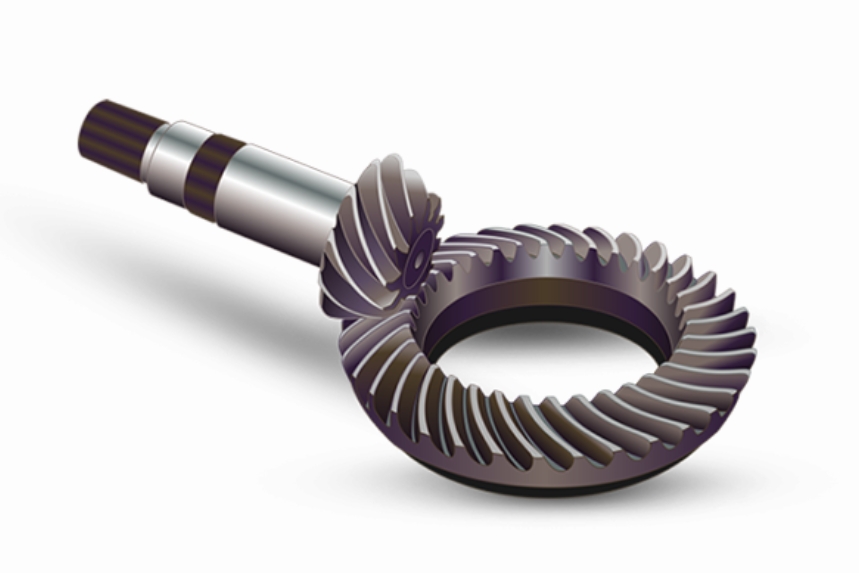
The machining of spiral bevel gears typically involves two primary methods: the generating (or rolling) method and the forming method. The generating method simulates the meshing of a pair of spiral bevel gears, where a cutter head, representing a tooth of an imaginary generating gear (or crown gear), rotates relative to the workpiece. This process ensures the creation of a conjugate tooth surface. In contrast, the forming method is used for higher productivity, especially for large gears, where the cutter directly plunges into the workpiece without relative rolling motion. The mathematical foundation for these methods relies on the kinematics of gear generation. For the generating method, the relationship between the cradle (simulating the generating gear) and the workpiece axis is defined by the roll ratio, which determines the relative angular positions. This can be expressed using the following formula for the cradle angle (A) and workpiece angle (C):
$$ \Delta C = \Delta A \times R $$
where \( R \) is the roll ratio, a key parameter derived from the gear design. For a spiral bevel gear, the roll ratio depends on factors such as the number of teeth, pitch angle, and spiral angle. In macro programming, this ratio is stored as a variable to synchronize the motions. The cradle and workpiece must follow a specific path during machining, as illustrated in the motion diagram. The starting, middle, and ending angles of the cradle are critical, and the corresponding workpiece positions are calculated accordingly. To achieve high precision, the roll ratio must be accurate to at least five decimal places, as even minor errors can accumulate and affect the gear quality. For instance, if the roll ratio is off by 0.00001, over 100 teeth, the cumulative error in the workpiece rotation could reach 0.001 degrees, which might be acceptable per standards like GB 11365-8, but tighter tolerances are often desired for high-performance spiral bevel gears.
Retrofitting a mechanical spiral bevel gear generator with a CNC system involves replacing the complex mechanical transmission chains with servo motors and digital controls. In the case of the No. 527 machine, the roll ratio gear train and index gear train were eliminated, retaining only the final worm gear pairs. Three AC servo motors were installed to drive the cradle (A-axis), workpiece (C-axis), and saddle (Z-axis), respectively. This simplification reduces maintenance and allows for flexible parameter adjustments through software. The cutter head is also driven by a variable-frequency motor for speed control. The NC system uses macro programming to handle the machining logic, where adjustment parameters are input via a process card, eliminating the need for writing G-code manually for each gear. The parameters include machine settings (e.g., cutter position, horizontal and vertical workpiece offsets, bed position, installation angle) and process card data (e.g., gear parameters, roll ratio, motion speeds). A summary of key macro variables used in the program is provided in Table 1.
| Variable | Description | Typical Range/Example |
|---|---|---|
| #52 | Number of teeth on the gear | 33 |
| #59 | Single-tooth machining mode (1=on, 0=off) | 0 |
| #60 | Machining method (0=generating, 1=forming) | 0 |
| #63 | Cradle start angle (degrees) | -30.00000 |
| #64 | Cradle end angle (degrees) | 30.00000 |
| #65 | Cradle middle angle (degrees) | 0.00000 |
| #69 | Cradle speed during generating (degrees/min) | 600.00000 |
| #70 | Cradle return speed (degrees/min) | 1000.00000 |
| #73 | Workpiece initial angle (degrees) | 0.00000 |
| #76 | Tooth depth position (mm) | -60.00000 |
| #77 | Relative tooth depth for indexing (mm) | 20.00000 |
| #86 | Roll ratio | 1.41986 |
| #97 | Plunge feed rate (mm/min) | 300.00000 |
The macro program implements the machining sequence for spiral bevel gears. After setting the machine parameters, the operator inputs the process card values, which are compiled and checked for validity. The program then automatically executes generating, forming, or modified generating methods, with options for single-tooth or continuous machining. The core logic involves positioning the cradle and workpiece at the middle angle for tool setting, moving to the start angle, plunging to depth, and performing the generating motion while synchronizing the axes. A snippet of the macro code for generating machining is shown below, with explanations. Note that the code uses global macro variables (prefixed with #) and standard G-codes, but auxiliary M and S commands are omitted for brevity.
The program begins with file naming and variable assignments. For generating machining (#60=0), it first moves the cradle and workpiece to the middle angle position for tool setting. Then, it returns to the start angle, with the workpiece rotating proportionally based on the roll ratio. The saddle advances to a safe position before plunging to the tooth depth. Inside a WHILE loop, each tooth is cut by linearly interpolating the cradle and workpiece from the start to end angles, maintaining synchronization via the roll ratio. After cutting, the saddle retracts, and the cradle returns to the start angle while the workpiece indexes to the next tooth. The loop continues until all teeth are machined. Finally, the saddle returns to zero, and the axes move back to the middle position. This approach ensures precise control over the spiral bevel gear generation process.
One critical aspect is the synchronization of the A and C axes during manual adjustments. In conventional NC systems, this feature is not inherently available, but through secondary development, the roll ratio macro variable is passed to the PLC in real-time. This enables synchronized motion in manual mode, allowing operators to adjust positions without losing alignment. The implementation involves calculating the relative angles using the formula:
$$ \theta_C = \theta_A \times R $$
where \( \theta_A \) is the cradle angle change, and \( \theta_C \) is the corresponding workpiece angle change. This synchronization is vital for tool setting and debugging, as it preserves the relationship established during machining.
Another issue addressed is the input precision of machine parameters. For spiral bevel gears, the roll ratio typically ranges below 10, and to meet high啮合 standards, it must be specified with five decimal places. This precision reduces the need for jump indexing, where teeth are skipped to avoid cumulative errors. With five-decimal-place accuracy, continuous indexing can be used without significant error buildup. The indexing angle per tooth is computed as:
$$ \Delta I = \frac{360^\circ}{Z} $$
where \( Z \) is the number of teeth. For example, with Z=33, \( \Delta I \approx 10.90909^\circ \). If stored with five decimals, the error per tooth is negligible, and over 100 teeth, the total error remains within 0.001 degrees, conforming to spiral bevel gear accuracy requirements. This eliminates the complexity of jump indexing algorithms, streamlining the macro program.
To adjust the tooth width during single-side generating, a macro variable for “tooth thickness adjustment” is incorporated. By inputting a width value, the program automatically modifies the workpiece initial angle (#73) through internal calculations. This allows fine-tuning of the tooth profile without manual reprogramming. The adjustment formula involves the tooth thickness parameter and the roll ratio, but for brevity, it can be summarized as a linear offset in the workpiece angle.
For deeper insight, let’s explore the mathematical models underlying spiral bevel gear machining. The tooth surface generation can be described using differential geometry and kinematics. The cutter head profile is represented as a surface, and its motion relative to the workpiece is modeled as a series of transformations. The basic equation for the generating method is:
$$ \mathbf{r}_w = \mathbf{T} \cdot \mathbf{r}_c $$
where \( \mathbf{r}_w \) is the workpiece surface point, \( \mathbf{r}_c \) is the cutter surface point, and \( \mathbf{T} \) is a transformation matrix accounting for cradle rotation, workpiece rotation, and machine settings. This matrix depends on parameters like the machine root angle, cutter tilt, and swivel angle. In macro programming, these are encapsulated in the adjustment parameters. For instance, the roll ratio R is derived from the gear geometry:
$$ R = \frac{\sin \beta}{\sin \alpha} $$
where \( \beta \) is the pitch angle of the workpiece, and \( \alpha \) is the pitch angle of the generating gear. However, in practice, R is often calculated using specialized software and input directly into the macro. To facilitate this, Table 2 lists common geometric parameters for spiral bevel gears and their influence on machining.
| Parameter | Symbol | Description | Effect on Machining |
|---|---|---|---|
| Number of Teeth | Z | Count of gear teeth | Determines index angle and roll ratio |
| Module | m | Size parameter | Affects cutter selection and depth |
| Spiral Angle | ψ | Angle of tooth curve | Influences roll ratio and cutting path |
| Pressure Angle | φ | Angle between tooth faces | Impacts tooth profile and cutter design |
| Pitch Angle | δ | Angle of pitch cone | Key for machine setup and alignment |
| Face Width | b | Width of gear tooth | Determines machining travel and time |
The macro program also handles variations like modified generating methods, where the roll ratio is varied during cutting to produce non-standard tooth surfaces for noise reduction or load distribution. This is achieved by dynamically updating the roll ratio variable within the interpolation loop. For example, a parabolic modification can be implemented using:
$$ R(t) = R_0 + k \cdot t^2 $$
where \( R_0 \) is the base roll ratio, \( k \) is a modification coefficient, and \( t \) is the normalized time or cradle angle position. Such advanced features demonstrate the flexibility of macro programming for spiral bevel gear machining.
In terms of implementation, the NC system used in this project is an open architecture platform, allowing for custom macro expansions. The program structure includes initialization, parameter validation, motion cycles, and error handling. For instance, if an invalid parameter is detected, the program halts and displays a message. Additionally, tool life management is integrated by counting the number of gears machined and alerting for cutter replacement. This enhances productivity in industrial settings where spiral bevel gears are produced in batches.
To further optimize the process, simulation and verification techniques can be employed. Using the macro parameters, a virtual model of the gear generation can be constructed to predict tooth contact patterns and identify potential issues before actual machining. The simulation relies on the same kinematic equations, such as:
$$ \mathbf{P} = f(A, C, Z, \mathbf{M}) $$
where \( \mathbf{P} \) is the tooth surface point cloud, and \( \mathbf{M} \) represents the machine adjustment matrix. By comparing simulated results with design specifications, adjustments can be made to the macro variables, reducing trial-and-error on the shop floor.
Another important consideration is the thermal and dynamic effects during machining. High-speed cutting of spiral bevel gears can induce vibrations and heat, affecting accuracy. The macro program can include adaptive feed rate control based on real-time sensor data, but this requires additional hardware integration. For simplicity, the current implementation uses constant feed rates as per the process card, but future enhancements could incorporate dynamic adjustments.
In conclusion, the macro programming technique for NC spiral bevel gear machining offers a robust and flexible solution for retrofitting conventional gear generators. By using process card inputs and global variables, the method simplifies the setup for different gears, eliminates complex G-code programming, and ensures high precision through fine parameter control. Key innovations include synchronized axis motion in manual mode, high-precision roll ratio handling, and continuous indexing without jump teeth. This approach has been validated in practical applications, showing improved efficiency and reliability. As industries demand higher-quality spiral bevel gears for automotive and aerospace applications, such NC macro systems provide a viable pathway for modernizing legacy equipment and embracing digital manufacturing trends.
The development of this technology underscores the importance of integrating mechanical knowledge with software tools. For spiral bevel gears, the interplay between geometry, kinematics, and control is complex, but macro programming bridges the gap by encapsulating expertise into reusable code. Moving forward, advancements in AI and IoT could further enhance these systems, enabling predictive maintenance and autonomous optimization for spiral bevel gear production. Ultimately, the goal is to achieve seamless, accurate, and efficient machining of spiral bevel gears, supporting the evolving needs of global industries.