
The dynamic evolution of the automotive industry has placed an unprecedented emphasis on Noise, Vibration, and Harshness (NVH) performance. Within the drivetrain of rear-wheel-drive vehicles, the hypoid or hyperboloidal gear pair in the final drive assembly is a critical component. The quality and stability of its meshing contact pattern are paramount, directly influencing power transmission efficiency, gear noise, and overall vehicle durability. A persistent and significant challenge in the manufacturing of these complex gears is the distortion incurred during heat treatment processes such as carburizing and quenching. This distortion alters the meticulously designed tooth surface geometry, leading to a shifted, and often sub-optimal, contact pattern after heat treatment, which traditional grinding processes are costly and inefficient to correct. Therefore, developing a robust methodology to predict and compensate for this distortion at the cutting stage is vital for quality control and cost-effective production.
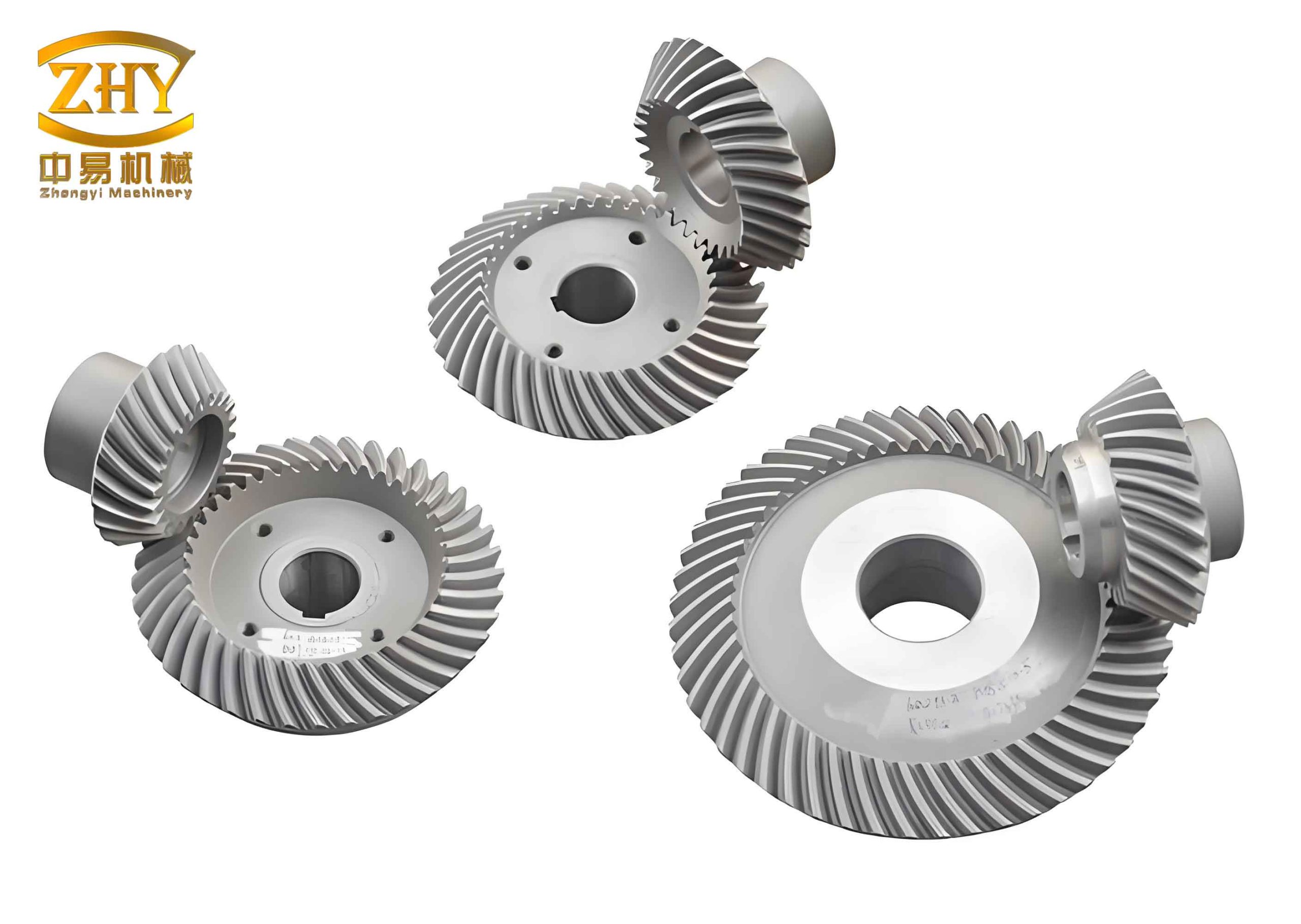
The core of the problem lies in the non-uniform thermal and phase transformation stresses generated during the heating and cooling cycles of heat treatment. While the absolute distortion of each individual hyperboloidal gear is complex and seemingly random, empirical evidence suggests that for gears produced under identical conditions and subjected to the same heat treatment cycle, the change in tooth surface error from before to after treatment follows a consistent statistical pattern. To elucidate this pattern, a batch of 27 sets of production hyperboloidal gears was analyzed. The pressure angle and spiral angle errors for both the drive (pinion) and driven (gear) members were measured before and after heat treatment. The key observations are summarized below.
The data clearly indicates a systematic shift. For the drive gear convex side (drive side) and the driven gear concave side (coast side), the pressure angle error increased by a nearly constant amount. Conversely, the spiral angle error decreased. The critical finding is the different behavior of these errors: the post-treatment pressure angle error stabilized around a specific mean value with low variance, while the post-treatment spiral angle error, though having a distinct mean shift, exhibited a much wider, less predictable scatter. This leads to the primary conclusion that for controlling the post-heat-treatment contact pattern, the predictable mean shift in pressure angle is less consequential than the variable shift in spiral angle. The relative spiral angle error between the mating flanks becomes the dominant factor influencing contact pattern location.
| Surface | Error Type | Mean Change (arc-min) | Variance (arc-min²) | Post-HT Mean (arc-min) |
|---|---|---|---|---|
| Drive Gear Convex | Pressure Angle | +5.0 | Low | ~ +8.0 |
| Driven Gear Concave | Pressure Angle | +7.0 | Low | ~ +5.0 |
| Drive Gear Convex | Spiral Angle | -2.14 | 0.14 | -2.14 ± scatter |
| Driven Gear Concave | Spiral Angle | -7.25 | 0.55 | -7.25 ± scatter |
To analytically understand how these relative errors govern contact pattern shift, a first-order relative tooth surface error model is employed. The relative errors are defined as the difference between the errors of the drive and driven gear flanks that will be in contact. For a given mesh (e.g., drive convex with driven concave), we define the relative pressure angle error $$\alpha$$ and relative spiral angle error $$\beta$$ as:
$$\alpha = \Delta \alpha_{drive} – \Delta \alpha_{driven}, \quad \beta = \Delta \beta_{drive} – \Delta \beta_{driven}$$
where $$\Delta \alpha$$ and $$\Delta \beta$$ represent the measured pressure angle and spiral angle errors, respectively.
The effect of these relative errors can be visualized by considering the resultant change in clearance between the theoretical conjugate surfaces and the actual distorted surfaces. The tooth surface is discretized into a grid (e.g., 5 points along the profile height and 9 points along the length). The average clearance at critical zones—the toe (T), heel (H), top (F), and root (R)—determines the initial contact point. For the coast side mesh (drive convex / driven concave), the analysis proceeds as follows. A positive relative spiral angle error $$\beta$$ implies the drive gear convex spiral angle error is algebraically greater than the driven gear concave spiral angle error. This creates a larger clearance ($$L’_H$$) at the heel and a smaller clearance ($$L’_T$$) at the toe compared to the nominal designed clearance ($$L_H, L_T$$). Consequently, contact initiates more easily where the clearance is reduced, causing the pattern to shift toward the toe. The governing relationship can be expressed as:
$$\Delta \text{Pattern Length} \propto -k_{\beta} \cdot \beta$$
where $$k_{\beta}$$ is a positive proportionality constant, and a larger positive $$\beta$$ creates a larger toe-ward shift.
Similarly, a positive relative pressure angle error $$\alpha$$ leads to increased clearance at the root ($$L’_{T-F}$$) and decreased clearance at the top ($$L’_{F-T}$$), prompting a shift of the contact pattern toward the root. The relationship is:
$$\Delta \text{Pattern Height} \propto -k_{\alpha} \cdot \alpha$$
where $$k_{\alpha}$$ is a positive constant. Applying this logic to all meshing flanks yields a comprehensive set of rules for hyperboloidal gear contact pattern prediction:
| Relative Error | Flank Pair (Working Side) | Contact Pattern Shift Direction |
|---|---|---|
| $$\beta_a$$ increases | Drive Convex / Driven Concave (Coast) | Toe |
| $$\beta_t$$ increases | Drive Concave / Driven Convex (Drive) | Heel |
| $$\alpha_a$$ increases | Drive Convex / Driven Concave (Coast) | Root |
| $$\alpha_t$$ increases | Drive Concave / Driven Convex (Drive) | Top |
To validate this analytical principle and quantify the influence of relative spiral angle error—identified as the key variable—a controlled experiment was conducted. A single drive gear with a post-heat-treatment convex spiral angle error of approximately -2 arc-min was selected. Three groups of driven gears from the same production batch, with post-heat-treatment concave spiral angle errors averaging around -6, -7, and -8 arc-min, were paired with it. These pairs were run on a Gleason 600HTT rolling tester under standardized conditions (5 N·m load, 0.1 mm backlash, 200 rpm). The resulting contact patterns on the driven gear concave flank were recorded. The standard acceptable pattern is an elliptical shape located slightly toward the toe, covering 30-50% of the face width and 40-60% of the tooth height.
The experimental results provided clear and compelling evidence. The measured relative spiral angle errors for the three groups were approximately +4, +5, and +6 arc-min, respectively. As predicted by the model, the contact pattern systematically shifted further toward the toe as the relative error $$\beta_a$$ increased. The first group ($$\beta_a \approx +4’$$) showed a pattern in the acceptable “mid-toe” region. The second and third groups ($$\beta_a \approx +5’$$ and $$+6’$$) exhibited patterns progressively shifted further toe-ward, with the last group being dangerously close to or at the edge. This trial conclusively verified the derived contact pattern offset principle. Furthermore, it established a critical quality threshold for this specific gearset and heat treatment process: to maintain the contact pattern within the acceptable mid-toe region, the post-heat-treatment driven gear concave spiral angle error must be controlled to be greater than -6 arc-min (i.e., less negative) to keep $$\beta_a$$ sufficiently small.
| Test Group | Avg. Driven Concave Spiral Error [‘] | Relative Error $$\beta_a$$ [‘] | Observed Contact Pattern Location |
|---|---|---|---|
| 1 | -6.0 | +4.0 | Mid-toe (Acceptable) |
| 2 | -7.0 | +5.0 | Toe-ward |
| 3 | -8.0 | +6.0 | At/Over Toe Edge |
Armed with the understanding of the distortion law and the validated offset principle, a proactive compensation strategy was implemented. Instead of accepting the post-heat-treatment distortion, the goal was to pre-compensate for it during the gear cutting phase. The stable mean shift in spiral angle error (around -7 arc-min for the driven concave flank) provided a compensable target. The cutting machine settings for the driven gear were deliberately adjusted (“anti-adjusted”) in the opposite direction. The nominal spiral angle on the cut tooth was increased so that after the predictable heat treatment shrinkage, the final spiral angle error would land within the desired range (greater than -6 arc-min). Several trial cutting and heat treatment cycles were performed to iteratively refine the new “compensated” cutting machine program.
The efficacy of this new compensated cutting model was rigorously validated in two stages. First, a production batch of 360 gear sets was manufactured using the new program. A systematic sample of 27 drive and 27 driven gears was tracked through heat treatment and then measured on a Gleason 350GMM coordinate measuring machine. The statistical results for the critical spiral angle errors are shown below. The data confirms that the compensation was successful: the mean post-heat-treatment spiral angle error for the driven gear concave flank was brought to -5.33 arc-min, well within the target of > -6 arc-min, with its variance also showing improvement.
| Gear & Flank | Mean Spiral Error [‘] | Variance [‘]² |
|---|---|---|
| Drive Gear Concave | -2.12 | 0.12 |
| Drive Gear Convex | -2.14 | 0.09 |
| Driven Gear Concave | -5.33 | 0.53 |
| Driven Gear Convex | -1.12 | 0.22 |
The second and most important validation was the functional rolling test. Drive gears were paired with driven gears from the compensated batch having post-treatment concave spiral errors of approximately -4, -5, and -6 arc-min. Rolling tests confirmed that all resulting contact patterns were now satisfactorily located in the mid-toe region, a significant improvement over the uncompensated parts. This two-fold validation—metrological and functional—proved that the method of pre-compensating for heat treatment distortion at the cutting stage is both feasible and highly effective for controlling the final quality of hyperboloidal gears.
| Validation Sample Group | Driven Concave Spiral Error [‘] | Resultant Contact Pattern |
|---|---|---|
| A | -6.0 ± 0.2 | Stable Mid-toe |
| B | -5.1 ± 0.1 | Stable Mid-toe |
| C | -4.1 ± 0.1 | Stable Mid-toe |
In conclusion, this research establishes a systematic framework for controlling the post-heat-treatment contact pattern in hyperboloidal gears. The primary driver of pattern shift was identified as the relative spiral angle error between mating flanks, stemming from the variable component of heat treatment distortion. A first-order relative error model was developed and experimentally verified to accurately predict the direction and magnitude of contact pattern offset. Most significantly, by leveraging the consistent mean distortion behavior, a practical pre-compensation strategy was implemented at the cutting stage. This method successfully produced hyperboloidal gears whose post-heat-treatment tooth geometry consistently resulted in contact patterns within the specified quality zone, eliminating the need for costly corrective grinding and enhancing the NVH performance and reliability of the final gearset. This approach provides a valuable and generalizable methodology for quality assurance in the high-volume manufacturing of precision hyperboloidal gears.