
In the transmission systems of large petroleum drilling and workover machinery, power is primarily transmitted through large-modulus (above 20 mm) and large-diameter (above 1500 mm) spiral bevel gears. The manufacturing process of these large spiral bevel gears encompasses both heat treatment and machining stages, with significant challenges in precision control. The quality of spiral bevel gear加工 directly affects the transmission efficiency and service life of the gear system. Based on the structural and process characteristics of large spiral bevel gears and existing machining equipment, this article delves into the heat treatment and manufacturing processes, aiming to provide a comprehensive reference for precision control. The spiral bevel gear is a critical component in heavy-duty applications, and its design and fabrication require meticulous attention to detail.
The spiral bevel gear features curved teeth that are cut at an angle, allowing for smooth and efficient power transmission between non-parallel shafts. This geometry reduces noise and vibration, making it ideal for high-load scenarios. However, the complexity of the tooth profile, especially in large sizes, poses substantial manufacturing hurdles. We will explore these aspects in depth, incorporating tables and formulas to summarize key points. The importance of the spiral bevel gear in industrial machinery cannot be overstated, as it enables reliable operation under variable loads and harsh conditions.
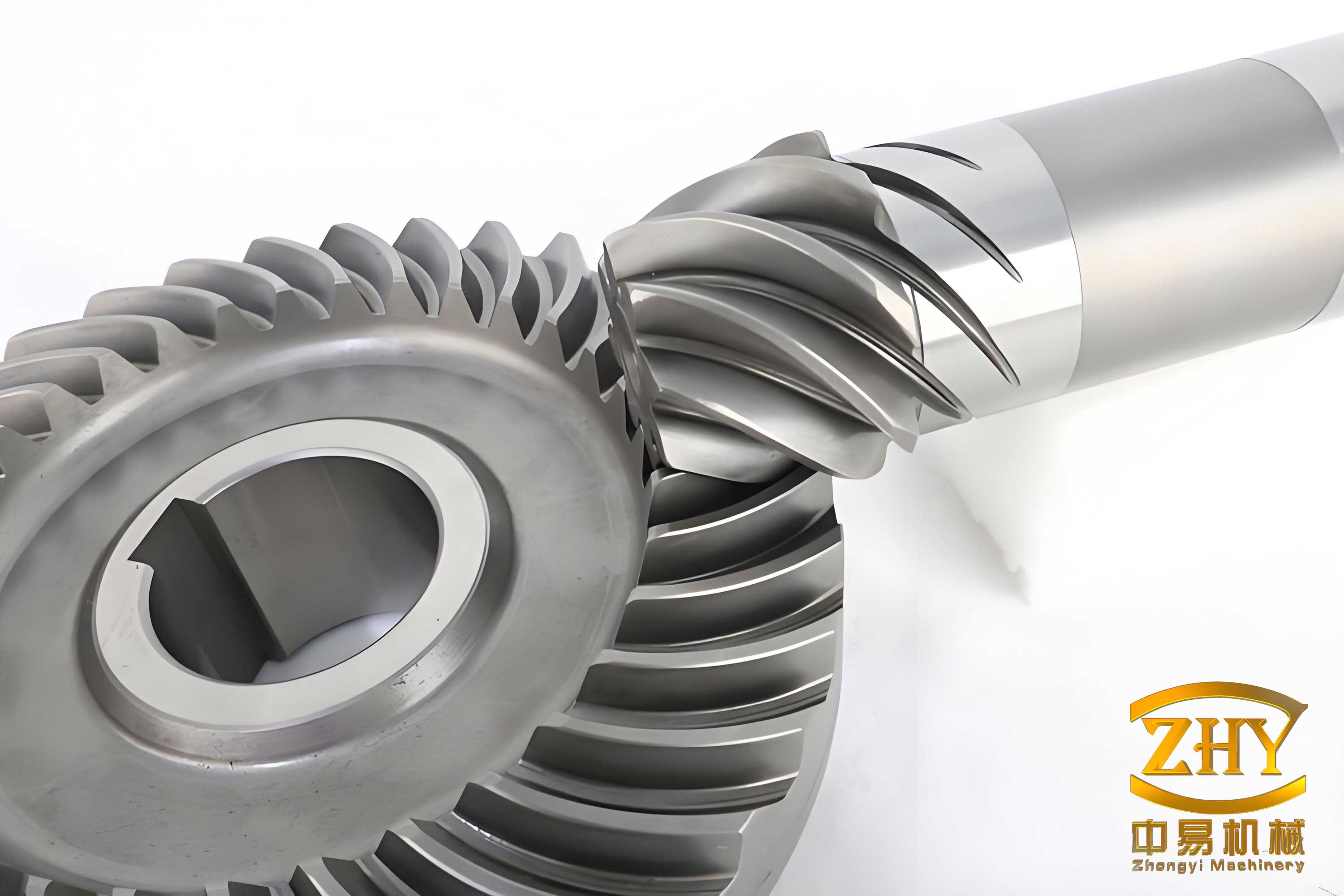
In terms of structural analysis, the primary parameters of a large spiral bevel gear include a gear ring thickness of 129.9 mm, a modulus greater than 20 mm, 76 teeth, a rough machining inner diameter of 1252 mm, and an outer diameter of 1548 mm. The pinion has 21 teeth with a full tooth height exceeding 8 mm. Considering the operational conditions—such as drilling depths over 7000 meters and variable loads—the spiral bevel gear must exhibit high load-bearing capacity and transmission accuracy to ensure safe, stable, and reliable performance of the配套 equipment. Therefore, the process route for the gear ring can be designed as: blank forging → normalizing heat treatment (Brinell hardness controlled between 200–245 HB) → rough machining of the gear blank → rough milling of the tooth profile → quenching and tempering heat treatment of the gear blank (Brinell hardness controlled above 300 HB to enhance fatigue and bending strength) → finish machining of the gear blank → finish milling of the tooth profile. This sequence is crucial for achieving the desired mechanical properties in the spiral bevel gear.
The geometry of a spiral bevel gear can be described using fundamental formulas. For instance, the pitch diameter \(d\) is related to the modulus \(m\) and the number of teeth \(z\) by: $$d = m \times z$$ In large spiral bevel gears, additional parameters like the spiral angle \(\beta\) and pressure angle \(\alpha\) play vital roles in tooth engagement and strength. The spiral angle typically ranges from 25° to 35° for optimal performance, and it influences the contact pattern and noise levels. The formula for the tooth thickness \(s\) at the pitch circle can be approximated as: $$s = \frac{\pi m}{2}$$ However, due to the curved nature, more complex equations derived from Gleason or Klingelnberg systems are often used in design. For example, the tooth profile modification to avoid edge contact involves calculating the ease-off topography, which can be expressed as: $$\Delta E = f(\theta, \phi)$$ where \(\theta\) and \(\phi\) are angular coordinates on the tooth surface. These mathematical models ensure that the spiral bevel gear operates smoothly under load.
| Parameter | Value | Unit |
|---|---|---|
| Modulus (m) | >20 | mm |
| Number of Teeth (z) | 76 | – |
| Outer Diameter | 1548 | mm |
| Inner Diameter | 1252 | mm |
| Gear Ring Thickness | 129.9 | mm |
| Pinion Teeth | 21 | – |
| Full Tooth Height | >8 | mm |
Rough turning of the gear blank is the initial machining step. The blank, after normalizing with a hardness of 200–245 HB, offers good machinability and can be processed on vertical or horizontal lathes. As shown in the rough turning operation, the back cone is turned into a cylindrical shape with a diameter of 1545 mm, and a machining allowance greater than 10 mm is reserved in the thickness direction to accommodate significant deformation from heat treatment. This ensures tooth integrity and reduces the milling allowance. If heat treatment deformation is well-controlled, the unilateral allowance for finish turning is typically 3–5 mm. The material removal rate during rough turning can be estimated using the formula: $$Q = v \times f \times a_p$$ where \(v\) is the cutting speed, \(f\) is the feed rate, and \(a_p\) is the depth of cut. For large spiral bevel gears, conservative parameters are used to avoid inducing stresses that could exacerbate distortion.
Rough milling of the tooth profile is performed using a spiral bevel gear milling machine with a duplex method. This method involves machining both sides of the tooth slot in a single setup with a double-sided cutter head, offering high productivity and minimal error. Due to the large tooth depth of spiral bevel gears, the process is completed in multiple passes. The first and second passes create the tooth slot width, leaving allowances for rough and finish cutting; the third pass achieves the full tooth depth; and the fourth and fifth passes remove the roughing allowances from previous passes, forming the complete convex and concave tooth profiles. A unilateral finish milling allowance of 2–3 mm is reserved on the tooth thickness, while no allowance is left in the tooth depth direction (as the gear blank thickness has excess). The cutting forces during milling can be modeled as: $$F_c = K_c \times a_e \times f_z \times z$$ where \(F_c\) is the cutting force, \(K_c\) is the specific cutting force, \(a_e\) is the width of cut, \(f_z\) is the feed per tooth, and \(z\) is the number of teeth engaged. This helps in selecting appropriate machine tool rigidity for the spiral bevel gear.
| Pass Number | Objective | Allowance (mm) |
|---|---|---|
| 1 & 2 | Tooth slot width | Roughing allowance |
| 3 | Full tooth depth | None |
| 4 & 5 | Convex/concave profile | Finish allowance (2-3 mm unilateral) |
Gear quenching and tempering heat treatment is critical after rough milling. The gear blank is prone to deformation during heat treatment, so controlling distortion is essential to reduce subsequent machining难度. Measures to minimize deformation include: (1) When using a box furnace, place the gear ring blank with the tooth profile facing upward, supported at six equidistant points around the circumference at 60° intervals to ensure uniform axial support; (2) Since the blank is ring-shaped, radial deformation can occur during handling and tempering—adding radial supports reduces this, and during lifting, align the hoisting points with the radial supports. The material, typically a medium-carbon alloy steel, requires tailored tempering parameters to achieve the desired hardness, microstructure, and mechanical properties. The tempering temperature \(T\) and time \(t\) influence the final hardness \(H\), often described by empirical relations like: $$H = H_0 – k \log(t)$$ where \(H_0\) is the initial hardness and \(k\) is a material constant. This ensures the spiral bevel gear meets machining requirements and withstands complex operational stresses.
The heat treatment process involves phase transformations that can be analyzed using the Avrami equation for kinetics: $$X = 1 – \exp(-kt^n)$$ where \(X\) is the transformed fraction, \(k\) is the rate constant, \(t\) is time, and \(n\) is the Avrami exponent. For the spiral bevel gear material, controlling the cooling rate is vital to avoid cracks and excessive distortion. Table 3 summarizes typical heat treatment parameters for large spiral bevel gears, emphasizing the importance of precision in this stage to maintain the integrity of the spiral bevel gear.
| Stage | Temperature (°C) | Time (hours) | Hardness (HB) |
|---|---|---|---|
| Normalizing | 850-900 | 2-4 | 200-245 |
| Quenching | 820-850 | 1-2 | >50 HRC |
| Tempering | 500-600 | 3-6 | >300 |
Finish machining of the large spiral bevel gear involves several steps. First, finish turning is performed on a horizontal lathe. Based on measured tempering deformation results (e.g., Table 4), the inner hole and tooth surface are aligned within the deformation range, ensuring the distortion is evenly distributed. After clamping, the tooth surface, inner hole, inner cone, and back cone are machined in sequence. The tooth surface is machined to remove all deformation, reducing the load for finish milling and improving efficiency. If the heat treatment deformation exceeds 1 mm, finish turning should be done in multiple passes to minimize cutting stresses. The relationship between cutting parameters and surface roughness \(R_a\) can be expressed as: $$R_a = \frac{f^2}{8r}$$ where \(f\) is the feed and \(r\) is the tool nose radius. Optimizing these parameters is key for the spiral bevel gear’s final quality.
| Location | Radial Deformation (mm) | Axial Deformation (mm) |
|---|---|---|
| Tooth Surface | 0.5-1.2 | 0.3-0.8 |
| Inner Hole | 0.4-1.0 | 0.2-0.6 |
| Back Cone | 0.3-0.9 | 0.1-0.5 |
Finish milling of the tooth profile and lapping are subsequent steps. Finish milling removes the allowances left during rough milling and corrects tempering deformation. On a spiral bevel gear milling machine, the generating method is used to finish mill the full tooth depth and the convex and concave tooth profiles. Due to the complexity of machining the convex profile, an appropriate tool blade tip distance is selected to ensure complete cutting before proceeding to the concave side, which helps in achieving the full tooth depth and ensures high yield for the spiral bevel gear. The tooth profile deviation \(\delta\) can be calculated using the formula: $$\delta = \sqrt{\delta_x^2 + \delta_y^2}$$ where \(\delta_x\) and \(\delta_y\) are errors in the transverse and longitudinal directions. Minimizing this deviation is critical for the spiral bevel gear’s performance.
Tooth profile lapping is conducted to achieve high mating accuracy and ensure smooth transmission. This can be done on专用 machines or通用 machines with rotary fixtures. After lapping, the contact area on the gear ring and pinion convex side should be near the small end, covering about 50% of the tooth surface, with a similar area on the concave side. The noise during lapping is 64–65 dB, and under no-load running, it is 82–84 dB, meeting design requirements. The contact pattern optimization involves adjusting the machine settings based on the equation of meshing: $$\mathbf{n} \cdot \mathbf{v} = 0$$ where \(\mathbf{n}\) is the normal vector and \(\mathbf{v}\) is the relative velocity at the contact point. This ensures optimal performance of the spiral bevel gear pair.
In conclusion, the process route designed here employs the generating method for rough cutting of the tooth profile. Given the large modulus of spiral bevel gears, rough milling is completed in five passes to achieve the full tooth depth. By designing appropriate tempering parameters, heat treatment deformation is controlled, ensuring后续 machining performance and mechanical properties. This approach enhances加工 efficiency and quality for large spiral bevel gears. The integration of advanced machining techniques and rigorous quality checks, including the use of coordinate measuring machines (CMM) for verification, further solidifies the reliability of these components. The spiral bevel gear is thus a testament to precision engineering, and ongoing research into additive manufacturing and digital twins may revolutionize its production in the future.
Moreover, the economic impact of optimizing spiral bevel gear manufacturing cannot be overlooked. Reduced scrap rates and extended service life contribute to lower total cost of ownership for industrial machinery. We recommend continuous monitoring of process variables using statistical process control (SPC) charts, where control limits are defined as: $$\text{UCL} = \bar{x} + A_2 \bar{R}, \quad \text{LCL} = \bar{x} – A_2 \bar{R}$$ with \(\bar{x}\) as the sample mean and \(\bar{R}\) as the average range. This ensures consistency in producing high-quality spiral bevel gears. Additionally, finite element analysis (FEA) simulations can predict stress distributions under load, using equations like the von Mises stress criterion: $$\sigma_v = \sqrt{\frac{(\sigma_1 – \sigma_2)^2 + (\sigma_2 – \sigma_3)^2 + (\sigma_3 – \sigma_1)^2}{2}}$$ where \(\sigma_1, \sigma_2, \sigma_3\) are principal stresses. Such analyses validate the design and manufacturing choices for spiral bevel gears.
Finally, environmental considerations are increasingly important in manufacturing. The use of sustainable cutting fluids and energy-efficient heat treatment furnaces can reduce the carbon footprint of producing spiral bevel gears. Lifecycle assessment (LCA) models, incorporating factors like energy consumption \(E\) and emissions \(C\), can be expressed as: $$\text{LCA score} = \sum_{i} w_i \cdot \text{impact}_i$$ where \(w_i\) are weighting factors. By adopting green practices, the spiral bevel gear industry can align with global sustainability goals while maintaining technical excellence. This holistic approach ensures that spiral bevel gears continue to be pivotal in advancing mechanical transmission systems worldwide.