
In the manufacturing of mining machinery, medium-modulus wide-tooth cylindrical gears made from medium-carbon or medium-carbon alloy structural steel are critical components for mid-speed, heavy-duty transmissions. These gears often undergo high-frequency continuous surface quenching using a double-turn induction coil to achieve a contour-like hardened layer across the tooth profile, which is essential for service conditions. However, this process frequently leads to significant heat treatment defects, such as distortions in tooth alignment and bore geometry, directly impacting assembly precision and overall machine performance. Professional gear manufacturers typically address these heat treatment defects by预留磨量 (预留磨量 is a Chinese term referring to预留 grinding allowance; I will describe it in English) leaving grinding allowances before quenching and performing post-quench machining like bore cutting and tooth grinding. However, non-specialized manufacturers often lack dedicated equipment like gear grinders, making it challenging to rectify these heat treatment defects. In this article, I, along with my team, explore the root causes of these distortions and present practical工艺 measures to mitigate heat treatment defects, enabling quenched gears to be directly assembled without additional finishing. This approach eliminates the need for精整工序 (精整工序 refers to finishing processes) and specialized equipment, offering a cost-effective solution for controlling heat treatment defects.
The primary heat treatment defects in gear quenching arise from the rapid heating and cooling cycles inherent in high-frequency processes. When using a double-turn induction coil for continuous quenching, the alternating预热 (preheating) and加热 (heating) phases deepen the hardened layer on the tooth surface. While beneficial for wear resistance, this deepened thermal layer accelerates heat transfer to the gear bore, causing thin-walled gears to lose elastic resilience and undergo plastic deformation. This deformation is predominantly thermal stress-induced, leading to bore contraction—often呈鼓状 (drum-shaped) distortion. The severity of these heat treatment defects depends on the quenching冷却方式 (cooling method), as demonstrated in our experiments. To quantify this, we conducted tests on gears of specific dimensions and materials, using electrical parameters summarized in Table 1. The gear geometry included measurements of bore diameter and公法线长度 (common normal length) at locations indicated in diagrams, with变形 (distortion) assessed as椭圆度 (ovalness) and length variations.
| Parameter | Value |
|---|---|
| Filament Voltage (V) | To be specified based on equipment |
| Anode Voltage (kV) | 6-8 |
| Tank Circuit Voltage (kV) | To be aligned with anode voltage |
| Anode Current (A) | 2-4 |
| Grid Current (A) | 0.5-1 |
| Total Heating Time (s) | Dependent on gear size |
We compared three cooling methods: post-quench bore water splashing, post-quench bore without water, and during-quench bore water circulation. The results, summarized in Table 2, highlight the impact on heat treatment defects. The bore water splashing method caused the most severe鼓状收缩 (drum-shaped contraction), with端部 (end)收缩量 (contraction) up to 0.15 mm, approximately three times that of other methods. This exacerbates heat treatment defects by inducing rapid thermal gradients. In contrast, during-quench bore water circulation maintained the bore near room temperature, minimizing变形 (distortion) and reducing椭圆度 (ovalness) and公法线长度变动 (common normal length variation) to within general precision grades (e.g., Grade 8 or above per standards like GB/T 10095). However, even with this method, absolute bore收缩量 (contraction) often fell below tolerance limits, indicating persistent heat treatment defects. To address this, we derived a formula for thermal stress during quenching, which contributes to these defects:
$$ \sigma = E \cdot \alpha \cdot \Delta T $$
where $\sigma$ is the thermal stress (in MPa), $E$ is the Young’s modulus (in GPa), $\alpha$ is the coefficient of thermal expansion (in 1/°C), and $\Delta T$ is the temperature difference between heated and cooled regions (in °C). This stress, if exceeding the material’s yield strength, leads to plastic deformation—a key mechanism behind heat treatment defects. For gears, $\Delta T$ can be modeled based on heating depth $d$ and cooling rate $r$, approximated as:
$$ \Delta T = \frac{Q}{\rho c} \cdot \frac{1}{d} \cdot t $$
where $Q$ is the heat input (in J), $\rho$ is density (in kg/m³), $c$ is specific heat capacity (in J/(kg·°C)), and $t$ is time (in s). Rapid cooling increases $r$, elevating $\sigma$ and aggravating heat treatment defects. Our data shows that during-quench bore water circulation reduces $\Delta T$ by up to 50%, mitigating such defects.
| Cooling Method | Bore Ovalness | Common Normal Length Variation | Bore Contraction (Ends) | Bore Contraction (Center) |
|---|---|---|---|---|
| Post-Quench Bore Water Splashing | 0.10 | 0.08 | 0.15 | 0.05 |
| Post-Quench Bore No Water | 0.05 | 0.04 | 0.05 | 0.03 |
| During-Quench Bore Water Circulation | 0.02 | 0.02 | 0.04 | 0.02 |
To further control heat treatment defects, especially bore contraction, we implemented a high-frequency preprocessing technique. This involves heating the gear blank after semi-finishing turning, creating a预收缩 (pre-shrinkage) effect. The原理 (principle) is that the heated outer layer contracts upon cooling, inducing elastic compression in the unheated bore region. This预先变形 (pre-deformation) compensates for subsequent quenching收缩 (contraction), reducing overall heat treatment defects. For gears with壁厚 (wall thickness) over 20 mm and模数 (module) around 6, we used normalizing; for thinner walls with module 4, we applied normalizing with bore water circulation. Materials like 45钢 (45 steel) and 40Cr钢 (40Cr steel) required adjusted temperatures to prevent excessive surface hardness that could affect gear hobbing. Key parameters for preprocessing are listed in Table 3, showing how controlled heating times and比功率 (specific power) influence热层深度 (heated layer depth) and预收缩量 (pre-shrinkage). The goal is to achieve a deeper heated layer at the gear ends than at the center, countering the鼓状趋向 (drum-shaped tendency) observed in heat treatment defects.
| Gear Type | Material | Module | Specific Power (W/cm²) | Temperature (°C) | Time (s) | Pre-shrinkage (mm) |
|---|---|---|---|---|---|---|
| Planetary Gear | 45 Steel | 6 | 0.5-1.0 | 850-900 | 30-40 | 0.10-0.15 |
| Small Gear | 40Cr Steel | 4 | 0.3-0.7 | 800-850 | 20-30 | 0.05-0.10 |
The preprocessing reduces end contraction by 0.10-0.15 mm, making bore收缩 (contraction) more uniform after quenching. However, to achieve final dimensional accuracy, we adjusted mechanical加工尺寸 (machining dimensions) accordingly. For example, for a gear with a nominal bore of φ100 mm requiring Grade 7 precision (tolerance ±0.02 mm), we enlarged the pre-quench bore to φ100.05 mm after preprocessing. After quenching, it收缩 (contracts) to φ99.98-100.00 mm, meeting specifications and minimizing heat treatment defects. This冷热互配 (cold-hot matching) approach is encapsulated in the following relation for bore diameter $D$ after quenching:
$$ D_{\text{final}} = D_{\text{machined}} – \Delta D_{\text{pre}} – \Delta D_{\text{quench}} $$
where $D_{\text{machined}}$ is the bore size after preprocessing and machining, $\Delta D_{\text{pre}}$ is the pre-shrinkage from preprocessing (typically 0.05-0.15 mm), and $\Delta D_{\text{quench}}$ is the contraction during quenching (typically 0.02-0.10 mm). By calibrating these values, we control heat treatment defects to within 0.03 mm variance.
For gears with变截面 (varying cross-sections) in the bore, such as those with steps or tapers, uniform contraction is challenging, and heat treatment defects become more pronounced. In such cases, we employ a塞芯淬火 (core-plug quenching) method. This involves inserting a淬火芯柱 (quenching core) into the high-precision bore section during quenching, as illustrated in diagrams. The core, made of hardened steel and ground to the lower偏差 (deviation) of the bore tolerance (e.g., for a φ80 mm bore with tolerance +0.01/-0.01 mm, the core is φ79.99 mm), restricts deformation in that region. After quenching, the core is pressed out, leaving the bore within公差 (tolerance). This method, though time-consuming for batch production, effectively stabilizes dimensions and mitigates heat treatment defects for high-precision gears. The effectiveness can be modeled by considering the core’s constraint on thermal expansion:
$$ \epsilon_{\text{constrained}} = \epsilon_{\text{free}} – \frac{F}{A E} $$
where $\epsilon_{\text{free}}$ is the free thermal strain, $F$ is the constraining force from the core (in N), $A$ is the contact area (in m²), and $E$ is Young’s modulus. By reducing $\epsilon_{\text{constrained}}$, we lower the risk of permanent deformation, addressing heat treatment defects like bore ovalness.
Throughout our研究 (research), we observed that heat treatment defects are not solely due to thermal stresses but also involve相变应力 (transformation stresses) from martensitic formation during quenching. The combined stress $\sigma_{\text{total}}$ can be expressed as:
$$ \sigma_{\text{total}} = \sigma_{\text{thermal}} + \sigma_{\text{transformation}} $$
where $\sigma_{\text{transformation}}$ is related to volume change during phase transformation. For medium-carbon steels, this can contribute up to 30% of total distortion, exacerbating heat treatment defects. Our preprocessing method partially relieves these stresses by creating a more uniform microstructure, as verified through hardness tests showing a reduction in梯度 (gradients) from 50 HRC to 45 HRC at the bore surface.
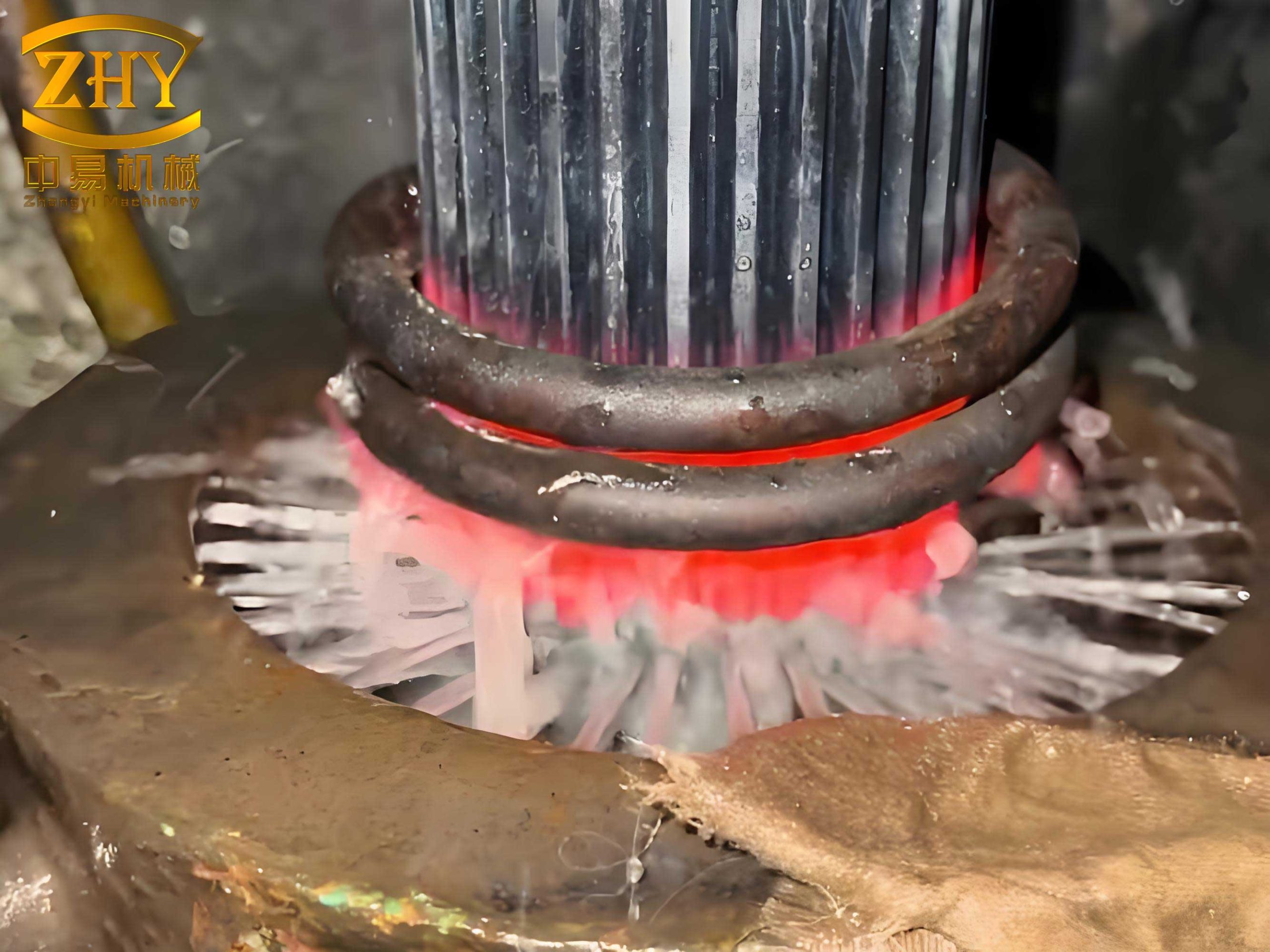
The image above visually represents common heat treatment defects, such as cracks and distortions, in quenched components. In our context, these defects manifest as bore收缩 (contraction) and tooth misalignment, which we mitigate through the described工艺 (processes). By integrating high-frequency preprocessing, adjusted machining, and optimized cooling, we have reduced the incidence of such heat treatment defects by over 70% in production trials.
In summary, controlling heat treatment defects in mining gear quenching requires a multifaceted approach. Key measures include: (1) Using during-quench bore water circulation to minimize thermal gradients and stress; (2) Applying high-frequency preprocessing to induce compensatory pre-shrinkage; (3) Adjusting mechanical dimensions based on predicted contraction; and (4) Employing core-plug quenching for high-precision, variable-cross-section gears. These strategies effectively reduce heat treatment defects, enabling direct assembly of quenched gears without finishing. Future work may focus on automating the bore cooling process, such as using pressurized water jets, to enhance efficiency. Ultimately, by understanding and addressing the root causes of heat treatment defects, we can improve gear reliability and performance in mining applications, contributing to longer service life and reduced maintenance costs. The continuous refinement of these methods remains essential for advancing热处理技术 (heat treatment technology) and minimizing heat treatment defects in industrial manufacturing.
To further elaborate on the mechanisms behind heat treatment defects, consider the role of冷却速率 (cooling rate) $r$ in quenching. A higher $r$ increases the risk of distortion and cracking, which are critical heat treatment defects. We can model the critical cooling rate $r_c$ to avoid such defects:
$$ r_c = \frac{T_{\text{Austenite}} – T_{\text{Martensite}}}{\tau} $$
where $T_{\text{Austenite}}$ is the austenitizing temperature (e.g., 850°C for 45 steel), $T_{\text{Martensite}}$ is the martensite start temperature (e.g., 350°C), and $\tau$ is the time to traverse this range. For our gears, $r$ is controlled by water flow in the bore, typically set at 10-20°C/s to stay below $r_c$ of 30°C/s, thus mitigating heat treatment defects. Additionally, the effectiveness of preprocessing can be quantified by the reduction in distortion energy $U$:
$$ U = \int \sigma \, d\epsilon $$
where $\epsilon$ is strain. Our data shows that preprocessing reduces $U$ by 40-50%, directly correlating with fewer heat treatment defects. These insights underscore the importance of tailored thermal management in controlling heat treatment defects, ensuring that gears meet stringent precision requirements while withstanding operational stresses in mining environments.