
In the field of mechanical transmission, spiral bevel gears play a critical role due to their ability to transmit power between intersecting shafts smoothly and efficiently. However, heat treatment processes, particularly quenching, often induce deformation in these gears, which can severely impact their precision and operational performance. The control of such distortion is a significant challenge, with substantial economic implications for post-treatment machining. In this study, we focus on the spiral bevel gear made of 18Cr2Ni4WA alloy carburizing steel, a material known for its high strength, toughness, and hardenability. Our objective is to systematically investigate the influence of quenching process parameters—specifically quenching temperature, quenching time, and quenching oil temperature—on the deformation and surface hardness of spiral bevel gears. By employing numerical simulation, orthogonal experimental design, and advanced data analysis techniques, we aim to identify the optimal combination of parameters that minimizes deformation while maximizing hardness, thereby enhancing the overall quality and reliability of spiral bevel gears in demanding applications.
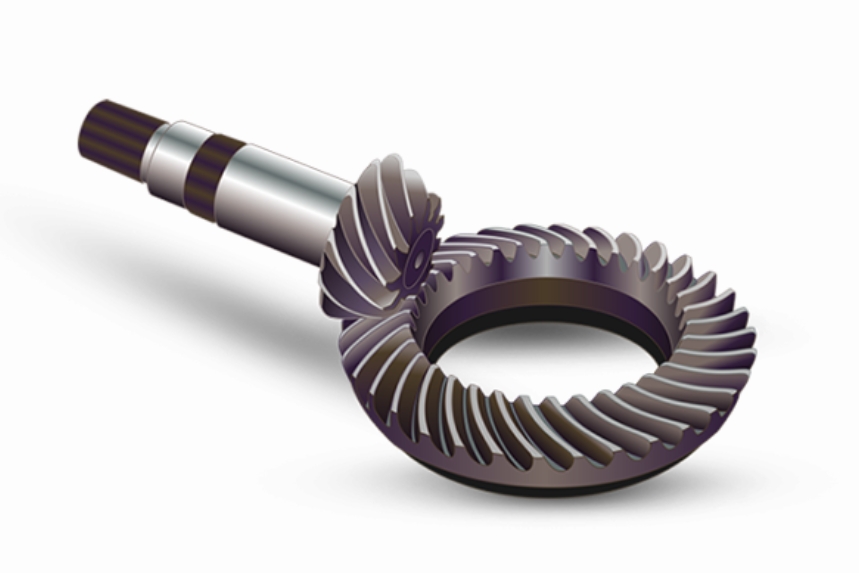
The importance of spiral bevel gears in various industrial sectors, such as automotive, aerospace, and heavy machinery, cannot be overstated. Their complex geometry and high load-bearing requirements necessitate precise manufacturing and treatment processes. Heat treatment, especially carburizing followed by quenching, is essential to achieve a hard, wear-resistant surface while maintaining a tough core. However, the thermal and phase transformation stresses during quenching often lead to undesirable distortions, affecting gear meshing and noise levels. Therefore, optimizing the quenching process for spiral bevel gears is paramount to reduce scrap rates and improve product performance. In this work, we adopt a comprehensive approach combining finite element simulation, statistical methods, and grey system theory to address this multi-objective optimization problem.
We begin by detailing the geometric model and material properties of the spiral bevel gear under investigation. The gear has a module of 3 mm, 44 teeth, a pressure angle of 20°, a face width of 20.2 mm, and an addendum coefficient of 0.85. The material, 18Cr2Ni4WA steel, is selected for its excellent mechanical characteristics, including high tensile strength and good impact toughness. The chemical composition and mechanical properties of this steel are summarized in Tables 1 and 2, respectively. These properties form the basis for the simulation inputs and analysis.
| C | Si | Mn | S | P | Cr | Ni | Cu | W |
|---|---|---|---|---|---|---|---|---|
| 0.13-0.19 | 0.17-0.37 | 0.30-0.60 | ≤0.025 | ≤0.025 | 1.35-1.65 | 4.00-4.50 | ≤0.025 | 0.80-1.20 |
| Property | Value |
|---|---|
| Reduction of Area, ψ | ≥45% |
| Poisson’s Ratio | 0.3 |
| Tensile Strength | ≥1180 MPa |
| Yield Strength | ≥835 MPa |
| Impact Toughness, αk | ≥98 J/cm² |
The heat treatment process route for the spiral bevel gear is designed to achieve a surface hardness in the range of 58-63 HRC, which is typical for carburized gears. The route consists of several stages: normalizing at 900°C, carburizing at 927°C with varying carbon potentials (initial at 0.35%C, strong carburizing at 0.9%C, and diffusion at 0.95%C), holding at 880°C, and finally quenching. The quenching stage is the focal point of our study, as it directly influences the final distortion and hardness. To simulate this process, we use the Deform finite element analysis software, specifically the Deform-Mo module for heat treatment simulation. The simulation involves solving the three-dimensional heat conduction differential equation, which governs the temperature distribution during quenching. The general form of this equation is derived from Fourier’s law and energy conservation, expressed as:
$$ \lambda \left( \frac{\partial^2 T}{\partial r^2} + \frac{1}{r} \frac{\partial T}{\partial r} + \frac{\partial^2 T}{\partial x^2} \right) + Q = \rho c_p \frac{\partial T}{\partial t} $$
Here, \( \lambda \) is the thermal conductivity, \( T \) is the instantaneous temperature, \( r \) and \( x \) are radial and axial coordinates, \( Q \) represents internal heat sources such as plastic work and phase transformation latent heat, \( \rho \) is density, \( c_p \) is specific heat capacity, and \( t \) is time. For the quenching simulation, we define initial and boundary conditions. The initial condition assumes a uniform temperature distribution at the start of quenching, given by \( T|_{\Gamma_1} = T_0 \), where \( T_0 \) is the initial temperature. The boundary condition follows Newton’s law of cooling, a convection-type condition:
$$ -\lambda \frac{\partial T}{\partial n} = H_k (T – T_f) $$
In this equation, \( n \) is the surface normal direction, \( H_k \) is the convection heat transfer coefficient between the gear and the quenching oil, and \( T_f \) is the oil temperature. The heat transfer coefficient for the quenching oil, which varies with temperature, is a critical input for accurate simulation. The values used in our study are based on established literature and are presented in Table 3.
| Temperature (°C) | Heat Transfer Coefficient, \( h \) (W/(m²·°C)) |
|---|---|
| 100 | 140 |
| 200 | 210 |
| 300 | 495 |
| 350 | 1000 |
| 400 | 1875 |
| 470 | 3375 |
| 500 | 3200 |
| 600 | 1525 |
| 700 | 950 |
| 800 | 700 |
| 850 | 560 |
In the Deform software, the material is selected from the library as BS655M13, corresponding to 18Cr2Ni4WA steel. The gear model is meshed with 18,218 nodes and 77,031 elements. Constraints are applied to the inner ring to simulate the hanging setup during heat treatment. The carburizing process is modeled to achieve a carbon-rich surface layer, and the hardness of martensite is defined as a function of carbon content, based on empirical relationships. After simulation, we extract results such as carbon distribution, hardness distribution, and deformation. For instance, the carbon content at the gear surface can reach up to 0.957%, decreasing towards the core. The surface hardness, primarily due to martensitic transformation, can achieve values above 61 HRC, while the core hardness remains lower, around 34.6 HRC, ensuring good toughness. The deformation, however, shows an expansion trend, with maximum distortion occurring at the gear’s large end, reaching up to 0.249 mm in some cases.
To systematically study the effects of quenching parameters, we design an orthogonal experiment with three factors and four levels. The factors are quenching temperature (A), quenching time (B), and quenching oil temperature (C). The levels for each factor are detailed in Table 4. This orthogonal array allows us to efficiently explore the parameter space with a reduced number of simulations, saving computational resources while providing comprehensive data.
| Level | Quenching Temperature, A (°C) | Quenching Time, B (s) | Quenching Oil Temperature, C (°C) |
|---|---|---|---|
| 1 | 820 | 1200 | 20 |
| 2 | 840 | 1500 | 40 |
| 3 | 860 | 1800 | 60 |
| 4 | 880 | 2100 | 80 |
The orthogonal experiment consists of 16 simulation runs, and the results for total deformation (D) and surface hardness (H) are recorded in Table 5. Deformation is measured as the maximum displacement after quenching, while hardness is taken as the surface hardness in HRC. These responses are critical for evaluating the performance of the spiral bevel gear after heat treatment.
| Run No. | A (°C) | B (s) | C (°C) | Total Deformation, D (mm) | Hardness, H (HRC) |
|---|---|---|---|---|---|
| 1 | 820 | 1200 | 20 | 0.205 | 61.6 |
| 2 | 820 | 1500 | 40 | 0.211 | 60.9 |
| 3 | 820 | 1800 | 60 | 0.211 | 60.0 |
| 4 | 820 | 2100 | 80 | 0.205 | 58.9 |
| 5 | 840 | 1200 | 40 | 0.212 | 61.0 |
| 6 | 840 | 1500 | 20 | 0.219 | 61.6 |
| 7 | 840 | 1800 | 80 | 0.209 | 59.1 |
| 8 | 840 | 2100 | 60 | 0.223 | 60.1 |
| 9 | 860 | 1200 | 60 | 0.217 | 60.3 |
| 10 | 860 | 1500 | 80 | 0.213 | 59.2 |
| 11 | 860 | 1800 | 20 | 0.233 | 61.7 |
| 12 | 860 | 2100 | 40 | 0.237 | 60.9 |
| 13 | 880 | 1200 | 80 | 0.217 | 59.3 |
| 14 | 880 | 1500 | 60 | 0.234 | 60.3 |
| 15 | 880 | 1800 | 40 | 0.244 | 61.0 |
| 16 | 880 | 2100 | 20 | 0.249 | 61.7 |
From the simulation results, we observe that the spiral bevel gear exhibits varying degrees of deformation and hardness depending on the quenching parameters. For example, higher quenching temperatures tend to increase deformation, while lower oil temperatures generally lead to higher hardness. However, to quantitatively analyze these trends and optimize the parameters, we employ grey relational analysis. This method is particularly useful for multi-objective optimization, as it converts multiple responses into a single grey relational grade. The process involves several steps: data preprocessing, calculation of grey relational coefficients, and computation of grey relational grades.
First, we preprocess the experimental data to normalize the responses, since deformation and hardness have different units and scales. Deformation is a “smaller-the-better” characteristic, while hardness is “larger-the-better”. The normalization formulas are as follows for deformation and hardness, respectively:
$$ x_i^*(k) = \frac{\max x_i^0(k) – x_i^0(k)}{\max x_i^0(k) – \min x_i^0(k)} $$
$$ x_i^*(k) = \frac{x_i^0(k) – \min x_i^0(k)}{\max x_i^0(k) – \min x_i^0(k)} $$
Here, \( x_i^0(k) \) is the original data for the \( k \)-th response in the \( i \)-th experiment, \( \max x_i^0(k) \) and \( \min x_i^0(k) \) are the maximum and minimum values across all experiments for that response, and \( x_i^*(k) \) is the normalized value. After normalization, all values range between 0 and 1, with 1 representing the best performance for each response. The normalized data for deformation and hardness are shown in Table 6.
| Run No. | Normalized Deformation | Normalized Hardness |
|---|---|---|
| 1 | 1.0000 | 0.9643 |
| 2 | 0.8636 | 0.7143 |
| 3 | 0.8636 | 0.3629 |
| 4 | 1.0000 | 0.0000 |
| 5 | 0.8409 | 0.7500 |
| 6 | 0.6818 | 0.9643 |
| 7 | 0.9091 | 0.0714 |
| 8 | 0.5909 | 0.4286 |
| 9 | 0.7273 | 0.5000 |
| 10 | 0.8182 | 0.1071 |
| 11 | 0.3636 | 1.0000 |
| 12 | 0.2727 | 0.7143 |
| 13 | 0.7273 | 0.1429 |
| 14 | 0.3409 | 0.5000 |
| 15 | 0.1136 | 0.7500 |
| 16 | 0.0000 | 1.0000 |
Next, we calculate the grey relational coefficient for each response in each experiment. The grey relational coefficient measures the proximity between the normalized value and the ideal value (which is 1 for both responses after normalization). The formula for the grey relational coefficient is:
$$ \gamma(x_i^0(k), x_i^*(k)) = \frac{\Delta_{\min} + \xi \Delta_{\max}}{\Delta_{0i}(k) + \xi \Delta_{\max}} $$
In this equation, \( \Delta_{0i}(k) = |x_i^0(k) – x_i^*(k)| \) is the absolute difference between the reference sequence (ideal) and the comparative sequence (normalized), \( \Delta_{\min} \) and \( \Delta_{\max} \) are the minimum and maximum of these differences across all responses and experiments, and \( \xi \) is the distinguishing coefficient, typically set to 0.5. The calculated grey relational coefficients for deformation and hardness are listed in Table 7.
| Run No. | Grey Relational Coefficient for Deformation | Grey Relational Coefficient for Hardness |
|---|---|---|
| 1 | 1.0000 | 0.9334 |
| 2 | 0.7857 | 0.6364 |
| 3 | 0.7857 | 0.4397 |
| 4 | 1.0000 | 0.3333 |
| 5 | 0.7586 | 0.6667 |
| 6 | 0.8462 | 0.9334 |
| 7 | 0.6471 | 0.3500 |
| 8 | 0.5500 | 0.4667 |
| 9 | 0.6471 | 0.5000 |
| 10 | 0.7334 | 0.3590 |
| 11 | 0.4400 | 1.0000 |
| 12 | 0.4074 | 0.6364 |
| 13 | 0.6471 | 0.3684 |
| 14 | 0.4314 | 0.5000 |
| 15 | 0.3606 | 0.6667 |
| 16 | 0.3333 | 1.0000 |
Then, the grey relational grade for each experiment is computed by averaging the grey relational coefficients across all responses. The formula is:
$$ G_i = \frac{1}{m} \sum_{k=1}^{j} \gamma(x_i^0(k), x_i^*(k)) $$
Here, \( m \) is the number of responses (2 in our case), and \( j \) is the index for responses. The grey relational grades for all 16 experiments are presented in Table 8. A higher grey relational grade indicates better overall performance, meaning that the corresponding parameter combination yields lower deformation and higher hardness simultaneously.
| Run No. | Grey Relational Grade, \( G \) |
|---|---|
| 1 | 0.9667 |
| 2 | 0.7111 |
| 3 | 0.6127 |
| 4 | 0.6667 |
| 5 | 0.7127 |
| 6 | 0.8898 |
| 7 | 0.4986 |
| 8 | 0.5084 |
| 9 | 0.5736 |
| 10 | 0.5462 |
| 11 | 0.7200 |
| 12 | 0.5219 |
| 13 | 0.5078 |
| 14 | 0.4657 |
| 15 | 0.5137 |
| 16 | 0.6667 |
To determine the optimal levels for each quenching parameter, we calculate the average grey relational grade for each level of factors A, B, and C. The results are summarized in Table 9. The level with the highest average grey relational grade is considered optimal for that factor. From Table 9, we see that for factor A (quenching temperature), level 1 (820°C) has the highest average grade; for factor B (quenching time), level 1 (1200 s) is best; and for factor C (quenching oil temperature), level 1 (20°C) is superior. Therefore, the optimal parameter combination within the tested range is A1B1C1: quenching temperature of 820°C, quenching time of 1200 s, and quenching oil temperature of 20°C.
| Factor | Level 1 | Level 2 | Level 3 | Level 4 | Range |
|---|---|---|---|---|---|
| A (Quenching Temperature) | 0.7393 | 0.6524 | 0.5904 | 0.5385 | 0.2008 |
| B (Quenching Time) | 0.6902 | 0.6532 | 0.5863 | 0.5909 | 0.1039 |
| C (Quenching Oil Temperature) | 0.8108 | 0.6149 | 0.5424 | 0.5548 | 0.2684 |
The range values in Table 9 indicate the influence magnitude of each factor on the grey relational grade. A larger range means the factor has a more significant effect. Here, factor C (quenching oil temperature) has the largest range (0.2684), followed by factor A (quenching temperature, 0.2008), and factor B (quenching time, 0.1039). This suggests that quenching oil temperature is the most influential parameter on the combined response of deformation and hardness for the spiral bevel gear, while quenching time has the least influence.
To further understand the individual effects of the parameters on deformation and hardness, we perform main effect analysis. The main effect plots visually represent how each factor level affects the responses. Based on the data, we observe that for deformation, quenching temperature has the steepest slope, meaning it is the most significant factor. Deformation tends to increase with higher quenching temperatures. For hardness, quenching oil temperature shows the steepest slope, indicating its dominant effect; hardness decreases as oil temperature increases. These insights align with the grey relational analysis results and provide a deeper understanding of the process behavior.
To predict the grey relational grade as a function of the quenching parameters, we develop a regression model using response surface methodology. The model is a second-order polynomial fitted to the experimental data. After eliminating insignificant terms based on statistical analysis (e.g., p-values > 0.05), the final regression equation is:
$$ \hat{y} = 4.129 – 0.003322A – 0.000122B – 0.01738C + 0.000132C^2 $$
In this equation, \( \hat{y} \) is the predicted grey relational grade, and A, B, C are the coded or actual values of quenching temperature (°C), quenching time (s), and quenching oil temperature (°C), respectively. The model’s adequacy is verified through analysis of variance (ANOVA). The high F-value and low p-value (p < 0.0001) confirm that the model is statistically significant. The coefficient of determination (R²) is 95.72%, and the adjusted R² is 94.17%, indicating a good fit between the predicted and actual grey relational grades. The residuals are randomly distributed around zero, further validating the model’s accuracy.
We use this regression model to predict the grey relational grade for the optimal parameter combination (A=820°C, B=1200 s, C=20°C). The predicted value is compared with the actual calculated grade from the orthogonal experiment. The close agreement between predicted and actual values confirms the model’s reliability. Additionally, we conduct confirmation experiments with the optimal parameters and compare them with other candidate combinations to validate the optimization results. The comparison, shown in Table 10, demonstrates that the optimal combination indeed yields the best balance of low deformation and high hardness for the spiral bevel gear.
| Combination | A (°C) | B (s) | C (°C) | Total Deformation (mm) | Hardness (HRC) | Grey Relational Grade |
|---|---|---|---|---|---|---|
| Optimal (A1B1C1) | 820 | 1200 | 20 | 0.205 | 61.6 | 0.9667 |
| Alternative 1 | 840 | 1200 | 20 | 0.210 | 61.6 | 0.7127 |
| Alternative 2 | 820 | 1500 | 20 | 0.211 | 61.5 | 0.7111 |
| Alternative 3 | 820 | 1200 | 40 | 0.203 | 61.0 | 0.6127 |
| Alternative 4 | 820 | 1200 | 80 | 0.192 | 58.9 | 0.6667 |
| Alternative 5 | 880 | 1200 | 20 | 0.232 | 61.7 | 0.7200 |
The results clearly show that the optimal parameters (820°C, 1200 s, 20°C) achieve the highest grey relational grade, indicating superior overall performance. While some alternative combinations may yield slightly lower deformation or slightly higher hardness individually, they fail to match the optimal combination in terms of the combined objective. This underscores the effectiveness of grey relational analysis in handling multi-objective optimization for complex processes like heat treatment of spiral bevel gears.
In conclusion, our study provides a comprehensive framework for optimizing the quenching process parameters of spiral bevel gears made from 18Cr2Ni4WA steel. Through numerical simulation, orthogonal experimentation, and grey relational analysis, we have identified the optimal parameter combination that minimizes deformation and maximizes hardness. The key findings are: quenching oil temperature has the most significant impact on the combined response, followed by quenching temperature and then quenching time. The optimal parameters—quenching temperature of 820°C, quenching time of 1200 s, and quenching oil temperature of 20°C—result in a spiral bevel gear with a deformation of 0.205 mm and a surface hardness of 61.6 HRC, which represents the best trade-off within the tested range. The regression model developed offers a predictive tool for further process refinement. This research contributes to the better control of heat treatment distortions in spiral bevel gears, potentially reducing manufacturing costs and improving gear performance in practical applications. Future work could explore additional factors such as cooling rates or gear geometry variations to further enhance the optimization for spiral bevel gears.