
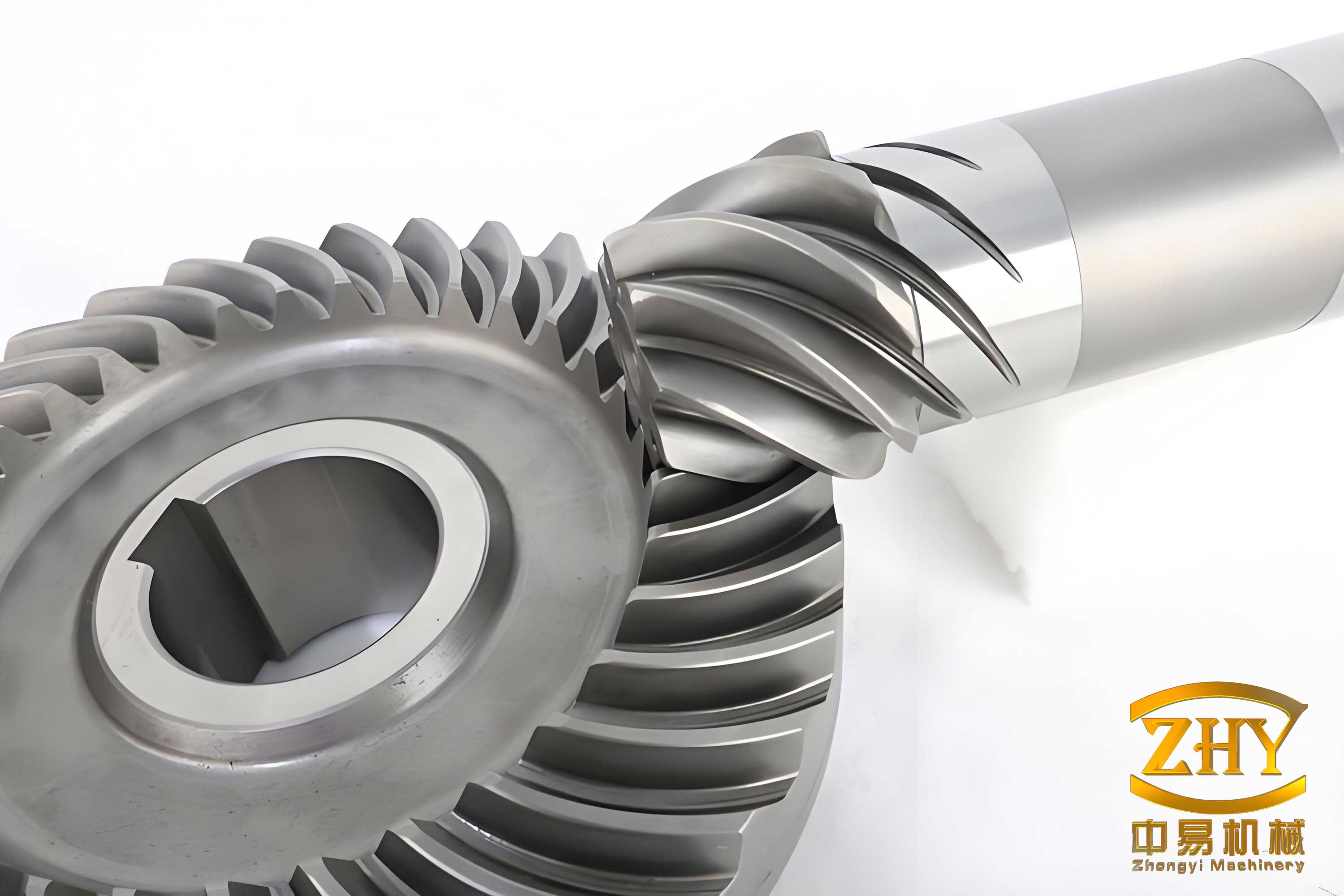
The spiral bevel gear is a critical component in power transmission systems for helicopters, marine vessels, and automotive drivetrains, particularly under heavy-load conditions. Its tribological performance, specifically the friction characteristics at the tooth mesh interface, is a primary factor governing power losses, vibration, noise generation, and operational lifespan. Consequently, a profound investigation into the friction behavior and meshing efficiency of spiral bevel gears is of paramount engineering significance for enhancing transmission reliability and energy economy. The analysis is inherently complex due to the intricate conjugate geometry, the presence of combined rolling and sliding motions, and the elliptical contact footprint with an arbitrary entrainment angle—the angle between the entrainment velocity vector and the minor axis of the contact ellipse. This complexity has often led to simplified analytical models in prior studies. This article presents a comprehensive, first-principles analysis of the instantaneous friction coefficient and meshing efficiency of spiral bevel gears, integrating loaded tooth contact analysis with a mixed elastohydrodynamic lubrication (EHL) model that accounts for real surface roughness, non-Newtonian rheology, and thermal effects.
Fundamentals of Gear Contact and Lubrication Regimes
The tribological performance of spiral bevel gears cannot be understood without first establishing the fundamentals of the contact mechanics and the prevailing lubrication regime. The contact between two teeth is not a single point but an elliptical area, the dimensions and orientation of which change dynamically throughout the mesh cycle. The pressure within this contact can reach extremely high values, often exceeding 1.5 GPa, significantly altering the lubricant’s viscosity and density. The motion at the contact is defined by two key velocity vectors: the entrainment velocity $U_e$, which is the average surface velocity responsible for dragging lubricant into the contact zone, and the sliding velocity $V_s$, which is the difference between the surface velocities and is the primary source of frictional energy dissipation.
The ratio of the lubricant film thickness to the composite surface roughness determines the lubrication regime. The Stribeck curve elegantly describes the transition between these regimes as a function of operating conditions. For spiral bevel gears, this translates to:
- Boundary Lubrication: Occurs at very low speeds or high loads. The film thickness is negligible compared to surface roughness. Contact is primarily through asperity interactions, leading to high friction coefficients (typically 0.1–0.15) and significant wear.
- Mixed Lubrication: The most common regime for many operating conditions. The load is shared between a thin, pressurized fluid film and contacting asperities. Friction is intermediate and highly dependent on surface topography and lubricant rheology.
- Full-Film Elastohydrodynamic Lubrication (EHL): Achieved at high speeds or with very smooth surfaces. A coherent lubricant film fully separates the surfaces, leading to low friction (primarily from fluid shearing) and negligible wear. The friction coefficient here is often in the range of 0.02–0.08.
The spiral bevel gear operates across these regimes during a single mesh cycle and across its speed range, making a mixed lubrication modeling approach essential for accurate prediction.
Mathematical Modeling Framework
1. Loaded Tooth Contact Analysis (LTCA)
The first step is to determine the instantaneous operating conditions at each point along the path of contact. This involves solving the complex geometry of spiral bevel gear mating to find, for a given pinion rotation angle $\phi_p$, the following key parameters:
$$ \text{Contact Load: } W(\phi_p) $$
$$ \text{Maximum Hertzian Pressure: } p_h(\phi_p) $$
$$ \text{Entrainment Velocity Magnitude & Angle: } U_e(\phi_p), \theta_e(\phi_p) $$
$$ \text{Sliding Velocity Magnitude & Angle: } V_s(\phi_p), \theta_s(\phi_p) $$
$$ \text{Principal Curvatures & Ellipse Dimensions: } R_x(\phi_p), R_y(\phi_p), a(\phi_p), b(\phi_p) $$
These parameters are derived from the gear’s machine settings, tool geometry, and kinematic motion during generation. The load distribution across multiple tooth pairs, due to the contact ratio being greater than one, is crucial and must be accounted for in $W(\phi_p)$. A typical result for a spiral bevel gear pair shows that the maximum Hertzian pressure is highest at the initial contact (engaging-in) and gradually decreases towards the end of contact (engaging-out).
| Parameter | Pinion | Gear (Wheel) |
|---|---|---|
| Number of Teeth | 15 | 44 |
| Module (mm) | 5.8 | 5.8 |
| Mean Spiral Angle | 30° | 30° |
| Shaft Angle | 90° | |
| Hand of Spiral | Left | Right |
2. Mixed Elastohydrodynamic Lubrication (EHL) Model
With the instantaneous contact conditions from LTCA, the pressure and film thickness distribution within the elliptical contact area are solved. The governing equation is the Reynolds equation modified for an arbitrary entrainment angle $\theta_e$:
$$ \frac{\partial}{\partial x} \left( \frac{\rho h^3}{12 \eta} \frac{\partial p}{\partial x} \right) + \frac{\partial}{\partial y} \left( \frac{\rho h^3}{12 \eta} \frac{\partial p}{\partial y} \right) = U_e \cos(\theta_e) \frac{\partial (\rho h)}{\partial x} + U_e \sin(\theta_e) \frac{\partial (\rho h)}{\partial y} + \frac{\partial (\rho h)}{\partial t} $$
where $p$ is pressure, $h$ is film thickness, $\rho$ is density, and $\eta$ is viscosity.
The film thickness equation accounts for geometry, elastic deformation, and measured surface roughness:
$$ h(x,y,\phi_p) = h_0(\phi_p) + \frac{x^2}{2R_x} + \frac{y^2}{2R_y} + \delta_1(x,y) + \delta_2(x,y) + v(x,y,\phi_p) $$
Here, $h_0$ is the central offset, the quadratic terms define the nominal gap, $\delta_1$ and $\delta_2$ are the measured roughness profiles of the two spiral bevel gear surfaces, and $v$ is the elastic deformation calculated via the Boussinesq integral:
$$ v(x,y,\phi_p) = \frac{2}{\pi E’} \iint_{\Omega} \frac{p(\xi,\zeta)}{\sqrt{(x-\xi)^2+(y-\zeta)^2}} d\xi d\zeta $$
The pressure-viscosity and pressure-density relationships for the lubricant are given by:
$$ \eta(p) = \eta_0 \exp\left\{ (\ln(\eta_0) + 9.67) \left[ (1 + 5.1 \times 10^{-9}p)^Z – 1 \right] \right\} $$
$$ \rho(p) = \rho_0 \left( 1 + \frac{0.6 \times 10^{-9}p}{1 + 1.7 \times 10^{-9}p} \right) $$
The system is closed by the force balance equation:
$$ W(\phi_p) = \iint_{\Omega} p(x,y,\phi_p) \, dx \, dy $$
3. Friction and Efficiency Calculation
The total friction force arises from shearing the lubricant in the full-film regions and from asperity interactions in the boundary contact zones. For the fluid film, a non-Newtonian, viscoelastic model is used to calculate the shear stress $\tau$, accounting for thermal effects:
$$ \dot{\gamma} = \frac{\dot{\tau}}{G_{\infty}} – \frac{\tau_L}{\eta} \ln\left(1 – \frac{\tau}{\tau_L}\right) = \frac{|V_s|}{h} $$
where $G_{\infty}$ is the limiting shear modulus and $\tau_L$ is the limiting shear stress, both functions of pressure and temperature. The temperature rise in the contact is solved iteratively with the friction calculation. The total friction force $F_f$ is the integral of shear stress over the contact domain $\Omega$:
$$ F_f(\phi_p) = \iint_{\Omega} \tau(x,y,\phi_p) \, dx \, dy $$
The instantaneous friction coefficient for the spiral bevel gear pair is then:
$$ \mu(\phi_p) = \frac{F_f(\phi_p)}{W(\phi_p)} $$
The instantaneous meshing efficiency $\eta_e$, considering only friction losses, is derived from the power balance:
$$ \eta_e(\phi_p) = 1 – \frac{P_{loss}}{P_{in}} = 1 – \frac{|F_f \cdot V_s| + |2 F_{r} \cdot U_e|}{T_p \omega_p} $$
where $F_r$ represents the rolling friction force, which is typically much smaller than the sliding friction force $F_f$ for spiral bevel gears due to their high sliding ratios. $T_p$ and $\omega_p$ are the input torque and angular velocity of the pinion.
Analysis of Friction and Efficiency Characteristics
Variation During a Mesh Cycle
Solving the coupled LTCA-Mixed EHL model throughout the engagement of a single tooth pair reveals distinct trends. The friction coefficient does not remain constant; it exhibits a clear parabolic trend. Starting from the engage-in point, $\mu$ increases, reaches a maximum near the pitch point, and then decreases towards the engage-out point. This behavior is inversely correlated with the relative sliding velocity $V_s$, which is minimum at the pitch point. At the pitch point, although sliding is minimal, the contact conditions (high load, specific film thickness) and the direction of entrainment lead to a peak in the friction coefficient. The meshing efficiency follows a similar but phase-shifted trend: it is lowest at engage-in, rises to a maximum at the pitch point where sliding losses are minimal, and then decreases. Notably, near the engage-out point, efficiency may show a slight increase as the next tooth pair begins to share the load, reducing the pressure and losses on the exiting pair.
| Method | Basis | Key Considered Parameters | Accuracy & Limitations |
|---|---|---|---|
| Present Mixed EHL Model | Numerical solution of point-contact EHL with real roughness. | Full geometry, arbitrary $\theta_e$, non-Newtonian rheology, thermal effects, measured roughness. | Most accurate but computationally intensive. Captures all regimes. |
| Xu & Kahraman (2007) Fit | Multivariate regression from line-contact EHL results. | $p_h$, $R_x$, SRR, $\eta_0$, $\sigma$, $U_e$. | Fast. Reasonable in mixed/full-film regime. Poor near pitch point due to line-contact assumption. |
| Benedict & Kelley (1961) Formula | Empirical fit from gear rig tests. | $W$, $\eta_0$, $V_s$, $U_e$, $a$. | Simple. Often inaccurate, especially at low $V_s$ (pitch point → $\mu \rightarrow \infty$) and boundary regime. |
Influence of Rotational Speed
The operational speed of the spiral bevel gear is a dominant factor. As pinion speed $\omega_p$ increases from near-zero to its nominal high-speed value, the system transitions through all lubrication regimes. At extremely low speeds, the contact is in the boundary regime. The calculated friction coefficient is high (≈0.13) and the contact load ratio (the proportion of load carried by asperities) is close to 100%. As speed increases, the entrainment velocity $U_e$ builds a more substantial lubricant film, shifting the contact into the mixed and then the full-film EHL regime. Consequently, both the friction coefficient and the contact load ratio decrease monotonically. In the full-film regime for this spiral bevel gear, $\mu$ can drop to approximately 0.05. This trend is a classic manifestation of the Stribeck curve. Correspondingly, the meshing efficiency increases with speed, as the reduction in friction losses outweighs any increase in fluid churning or windage losses (which are not modeled here).
The performance of simplified friction formulas varies significantly across this speed range. The empirical Benedict & Kelley formula tends to overpredict friction, especially in the boundary regime where it can yield values over 0.2, which is unrealistic. The Xu & Kahraman regression, based on line-contact EHL, shows much better agreement with the full mixed-EHL model in the mixed and full-film regimes but fails to capture the nuances near the pitch point during a mesh cycle.
Comparative Assessment of Simplified Methods
Applying the simplified methods to calculate the friction coefficient and efficiency over a mesh cycle provides critical insight into their utility and errors. The table above summarizes the comparison. The core finding is that while simplified methods may show large relative errors in predicting the instantaneous friction coefficient—particularly around the pitch point where their underlying assumptions break down—their error in predicting the overall meshing efficiency for a cycle is often smaller. This is because the friction power loss is the product $\mu \cdot V_s$. At the pitch point, where $\mu$ prediction error is largest, $V_s$ is near zero, minimizing the impact on the integrated power loss. Therefore, for system-level efficiency estimation of a spiral bevel gear drive under mixed or full-film conditions, a well-constructed simplified method like the Xu & Kahraman regression can be a useful engineering tool. However, for detailed analysis of surface distress, wear, or micro-pitting initiation, which are highly sensitive to the exact pressure and shear stress cycles, the full mixed-EHL model is indispensable.
Key Findings and Conclusion
This comprehensive analysis of spiral bevel gear tribology, integrating precise loaded tooth contact analysis with a mixed elastohydrodynamic lubrication model, yields several critical conclusions for the design and analysis of these complex components:
- The friction coefficient in a spiral bevel gear mesh is not constant. It varies significantly during a single tooth engagement, following a trend opposite to the relative sliding velocity and peaking near the pitch point.
- The meshing efficiency of a spiral bevel gear pair also varies cyclically, reaching its maximum at the pitch point. The double-tooth contact regions at the beginning and end of engagement influence the efficiency curve, causing a local recovery near the engage-out point.
- The operational speed is a primary determinant of the lubrication regime and, consequently, the friction and efficiency. Increasing speed moves the spiral bevel gear contact from high-friction boundary lubrication to low-friction full-film EHL, thereby increasing transmission efficiency. This relationship is fundamental for optimizing gearbox operation.
- Simplified friction prediction methods, while computationally efficient, must be used with caution. Empirical formulas can be highly inaccurate, especially at low speeds or near the pitch point. Regression models based on line-contact EHL offer a reasonable compromise for efficiency prediction under mixed/full-film conditions but fail to capture the detailed friction transients critical for surface durability analysis.
- For accurate prediction of performance metrics that are sensitive to the detailed pressure and shear stress history—such as contact fatigue life, wear, and scuffing resistance—a full mixed-EHL analysis that incorporates real surface topography, non-Newtonian lubricant behavior, thermal effects, and the precise kinematics (including entrainment angle) of the spiral bevel gear contact is essential.
In summary, the tribological performance of spiral bevel gears is governed by a complex interplay of geometry, kinematics, load, material properties, and lubricant rheology. A holistic modeling approach that respects this complexity is necessary to unlock advancements in efficiency, durability, and reliability for these indispensable mechanical components.