
The pursuit of lightweight and compact design in modern mechanical systems, particularly in demanding applications like aero-engine accessory drives, has led to the widespread adoption of thin-rimmed and thin-webbed spur gears. While offering significant weight savings, this architectural shift renders the gear structure more compliant, thereby accentuating vibration-related challenges. The dynamic behavior of a spur gear pair during meshing is a complex interplay of time-varying stiffness, contact-impact events, and structural elasticity. Understanding these dynamic meshing characteristics is paramount for diagnosing vibration mechanisms, predicting fatigue life, and guiding the design of high-performance, quiet gear transmissions.
Traditional analytical models often rely on lumped-parameter methods with simplified mesh stiffness calculations, which may not fully capture the three-dimensional, continuous elastic contact process and its interaction with flexible gear body dynamics. The advent of high-fidelity computational techniques, specifically explicit dynamic finite element analysis (FEA) coupled with robust contact algorithms, provides a powerful tool to simulate the actual meshing process with remarkable fidelity. This study employs the LS-DYNA explicit solver to construct a precise, elastic, dynamic, and contact-based simulation model for a spur gear pair. The primary objective is to dissect the time-domain and frequency-domain vibration characteristics inherent to the dynamic meshing process, with a focused investigation on the effects of rim/web flexibility and the conditions leading to gear resonance.
The core of any dynamic analysis is governed by the fundamental equation of motion:
$$ \mathbf{M}\ddot{\mathbf{U}} + \mathbf{C}\dot{\mathbf{U}} + \mathbf{K}\mathbf{U} = \mathbf{F} $$
where $\mathbf{M}$, $\mathbf{C}$, and $\mathbf{K}$ are the global mass, damping, and stiffness matrices, respectively; $\mathbf{U}$ is the nodal displacement vector; and $\mathbf{F}$ is the external force vector. LS-DYNA employs an explicit central difference method for temporal integration. This scheme approximates acceleration and velocity at time $t$ using displacements from neighboring time steps:
$$ \ddot{\mathbf{U}}_t = \frac{1}{\Delta t^2} (\mathbf{U}_{t-\Delta t} – 2\mathbf{U}_t + \mathbf{U}_{t+\Delta t}) $$
$$ \dot{\mathbf{U}}_t = \frac{1}{2\Delta t} (-\mathbf{U}_{t-\Delta t} + \mathbf{U}_{t+\Delta t}) $$
Substituting these into the equation of motion yields a system that can be solved for displacements at the next time step $\mathbf{U}_{t+\Delta t}$ directly:
$$ \hat{\mathbf{M}} \mathbf{U}_{t+\Delta t} = \hat{\mathbf{R}}_t $$
Here, $\hat{\mathbf{M}} = \frac{1}{\Delta t^2}\mathbf{M} + \frac{1}{2\Delta t}\mathbf{C}$ is the effective mass matrix, and $\hat{\mathbf{R}}_t = \mathbf{F}_t – \left(\mathbf{K} – \frac{2}{\Delta t^2}\mathbf{M}\right)\mathbf{U}_t – \left( \frac{1}{\Delta t^2}\mathbf{M} – \frac{1}{2\Delta t}\mathbf{C} \right) \mathbf{U}_{t-\Delta t}$ is the effective load vector. This explicit approach is conditionally stable, with the time step $\Delta t$ limited by the smallest element size in the mesh according to the Courant–Friedrichs–Lewy (CFL) condition, making model discretization crucial for efficiency and accuracy.
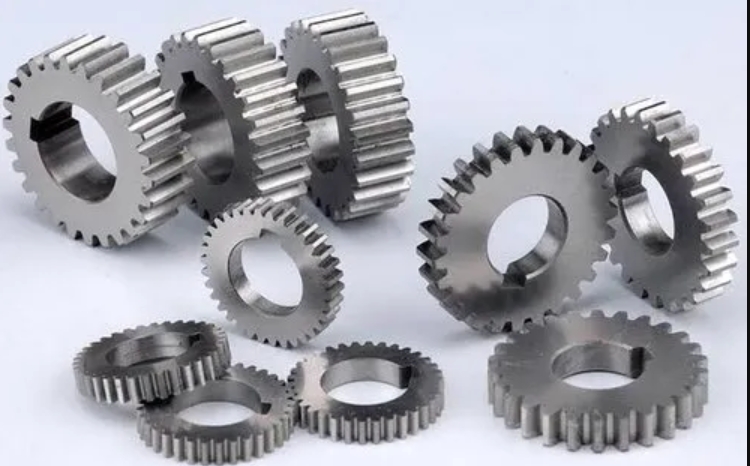
The foundation of this study is a high-fidelity finite element model of a spur gear pair, with parameters representative of gears used in experimental vibration studies. The driving spur gear (Gear A) features a robust, thick-rimmed design, while the driven spur gear (Gear B) is a classic thin-walled spur gear with a slender rim and a thin, offset web. Key geometrical parameters are: number of teeth $z_A = z_B = 50$, module $m = 4$ mm, face width $W = 40$ mm, pressure angle $\alpha = 20^\circ$. The thin-walled spur gear B has a web thickness $T_1 = 4$ mm, rim thickness $T_2 = 5$ mm, and a web offset $L = 11$ mm from the face width center. Both spur gears are modeled from steel (SCM415) with density $\rho = 7850$ kg/m³, Young’s modulus $E = 210$ GPa, and Poisson’s ratio $\nu = 0.3$.
The three-dimensional geometry of both spur gears is discretized primarily using hexahedral solid elements (SOLID186 type) to ensure accuracy in stress and deformation prediction. A finely meshed sector around the tooth contact zone is integrated with a coarser mesh in the hub region to balance computational cost and result fidelity. The final assembled mesh of the spur gear pair contains approximately 92,200 elements. To facilitate the application of boundary conditions and loads, a ring of shell elements is created and rigidly constrained at the inner bore of each spur gear. The contact between the potentially interacting tooth flanks of the spur gears is defined using a surface-to-surface automatic contact algorithm in LS-DYNA, with a Coulomb friction coefficient of 0.1 and a viscous damping coefficient of 20 N·s/mm to stabilize the contact response.
Boundary conditions simulate a simplified test rig. The inner shell ring of the driving thick-rimmed spur gear (A) is subjected to a prescribed rotational velocity, ramped from 0 to the target value (ranging from 500 to 3000 rpm in this study) over 0.01 s to avoid impulsive loading. The inner shell ring of the driven thin-walled spur gear (B) is constrained to carry a constant load torque of 297 N·m, also applied with a 0.01 s ramp. All translational degrees of freedom at the inner rings are constrained, allowing only rotation about the gear axis, mimicking a setup with rigid, frictionless bearings.
Prior to dynamic analysis, the modal characteristics of the standalone thin-walled spur gear B under a nominal “meshed” condition were evaluated using a node coupling technique to simulate the stiffness imparted by the mating teeth. The computed natural frequencies for various rim and web-dominated modes showed excellent agreement with published experimental data, with errors consistently below 5%. This validation confirms the accuracy of the finite element model in capturing the structural dynamics of the flexible spur gear body.
| Mode Description | Calculated Freq. (Hz) | Experimental Freq. (Hz) | Error (%) |
|---|---|---|---|
| Rim 1st Bending | 694.7 | 663 | 4.8 |
| Rim 2nd Bending | 1062.7 | 1088 | -2.3 |
| Rim 3rd Bending | 2752.9 | 2700 | 2.0 |
| Rim 4th Bending | 4483.8 | 4425 | 1.3 |
| Web 2 Nodal Diameter | 5936.8 | 5950 | -0.2 |
| Web 3 Nodal Diameter | 7693.1 | 7625 | 0.9 |
The dynamic meshing process was simulated at various rotational speeds. A representative case at 2500 rpm (driver spur gear speed) is analyzed in detail. The output angular velocity of the driven thin-walled spur gear exhibits fluctuations around its theoretical mean value, a direct manifestation of the transmission error caused by tooth deflections, time-varying mesh stiffness, and contact loss/regain during the meshing cycle of the spur gear pair.
To probe the structural vibration, dynamic strain responses were extracted from three critical locations on the thin-walled spur gear B: the root fillet of a tooth, the inner surface of the rim, and the center of the web. For comparison, responses from analogous points on the thick-rimmed driving spur gear A were also examined. The time-domain signals, captured during steady-state operation, reveal pronounced differences. Peaks in root strain are synchronized with the meshing event for both spur gears. However, the thin-walled spur gear B shows significant strain fluctuations at its rim and web locations even when the monitored tooth is not in contact, indicating persistent structural vibration. In contrast, the rim and web strains of the thick-rimmed spur gear A are negligible and show no clear meshing-related excitation.
This contrast leads to several key observations regarding spur gear dynamics. First, a thicker rim and web in a spur gear act as a more effective damper and load distributor, isolating the gear body from the oscillating tooth forces. Consequently, the thin-walled spur gear is inherently more susceptible to structural vibration. Second, the load-sharing mechanism changes: in the thin-walled spur gear, the flexible rim and web carry a larger portion of the meshing load, reducing the peak stress at the tooth root compared to the thick-walled spur gear. Third, vibration amplitudes, particularly at the rim, are substantially higher in the thin-walled spur gear, underscoring the rim’s role as a primary vibration component in such designs.
A critical and somewhat non-intuitive finding for a spur gear pair is the presence of a non-zero dynamic meshing force component along the axial direction (Z-axis). The mean value, though small relative to the tangential and radial components, is persistent. This axial excitation force arises primarily because the web of the thin-walled spur gear B is offset from the face width centerline. This geometrical asymmetry leads to an uneven distribution of contact load across the tooth face, generating a net axial thrust. Furthermore, any axial vibration mode of the spur gear bodies, once excited, can interact with the contact process and modulate this axial force, indicating a two-way coupling between gear body dynamics and meshing forces.
The frequency-domain characteristics offer deeper insight into the vibration mechanics. The Fourier transform of the three dynamic meshing force components reveals that the excitation is dominated by the gear mesh frequency $f_z$ and its harmonics ($2f_z$, $3f_z$, etc.), superimposed with other frequency content related to the spur gears’ structural resonances. The mesh frequency for the 2500 rpm case is $f_z = (z \times \text{rpm}) / 60 = 2083.3$ Hz.
The spectral analysis of the rim strain for both spur gears is particularly illuminating. The thin-walled spur gear B’s spectrum is rich, containing multiple peaks corresponding to its natural frequencies (e.g., rim bending modes) as well as combination frequencies, signifying a complex, coupled vibration state. In stark contrast, the thick-rimmed spur gear A’s rim strain spectrum at 2500 rpm is dominated by a single, sharp peak at approximately 4110 Hz. This frequency is nearly identical to the second harmonic of the mesh frequency ($2f_z = 4166.7$ Hz).
This coincidence suggests a resonance condition. Modal analysis of the gear pair system identified a mode at 4165.4 Hz involving a 2-nodal-diameter (2ND) deformation pattern of spur gear A’s rim and web. The dynamic response contour plot of spur gear A’s axial displacement at the operational instant clearly exhibits this 2ND pattern. Therefore, it is conclusively demonstrated that at 2500 rpm, the $2f_z$ excitation component directly excites the 2ND mode of spur gear A, leading to a resonant state. This resonance is clearly visible in a Campbell diagram constructed from simulations at multiple speeds, where the $2f_z$ excitation line intersects the 2ND modal frequency line at the 2500 rpm point.
| Parameter Variation | Effect on Root Stress | Effect on Rim/Web Vibration | Effect on Axial Force | Susceptibility to Resonance |
|---|---|---|---|---|
| Decreased Rim Thickness ($T_2 \downarrow$) | Decreases | Significantly Increases | Minor Change | Increases (shifts modes) |
| Decreased Web Thickness ($T_1 \downarrow$) | Decreases | Increases | Minor Change | Increases (shifts modes) |
| Web Offset from Center ($L > 0$) | Negligible | Slightly Modifies | Generates Mean Force | Can Introduce New Modes |
From this analysis, the necessary conditions for resonance in a spur gear pair can be formulated. Resonance occurs when a frequency component of the dynamic meshing force (mesh frequency or its harmonic $n \cdot f_z$) coincides with, or is very close to, a natural frequency of a spur gear’s structural mode that can be excited by the spatial pattern of that force component. The force component must have the proper direction and spatial distribution to effectively couple with the target mode shape. For instance, an axial force component can excite axial (web/rim) modes, while a radial/tangential force can excite in-plane bending or torsional modes.
The explicit finite element method, as implemented in LS-DYNA, proves to be an exceptionally powerful tool for simulating the high-fidelity, non-linear dynamics of spur gear meshing. It inherently accounts for the continuous elastic contact, time-varying geometry, and dynamic coupling between tooth contact and flexible body vibration that are characteristic of spur gear operation. The method successfully replicates experimental trends, confirming that thin-rimmed spur gears are prone to significant structural vibration, with the rim being a primary contributor.
The study establishes a clear link between spur gear geometry and dynamic response. Reducing rim and web thickness increases the compliance of the spur gear body, altering the load-sharing between teeth and structure, amplifying rim vibrations, and modifying the system’s natural frequencies. The offset of the web from the centerline in a spur gear is a non-negligible design feature that induces axial dynamic forces, which can potentially excite axial vibration modes.
Finally, the research provides a clear framework for analyzing and predicting resonance in spur gear systems. By combining modal analysis (to find natural frequencies and mode shapes) with dynamic meshing simulation (to identify the frequency content and direction of meshing forces), engineers can proactively identify critical speeds and modify spur gear design or system parameters to avoid resonant conditions, thereby enhancing the reliability and acoustic performance of gear drives.
| Component | Dominant Source | Typical Frequencies | Resonance Indicator |
|---|---|---|---|
| Dynamic Meshing Force | TVMS, Impact, Errors | $f_z$, $2f_z$, $3f_z$, … | Excitation source |
| Spur Gear Structural Response | Forced Vibration | $f_z$, $n \cdot f_z$, $f_{nat}$, $f_{comb}$ | Response spectrum |
| Condition for Resonance | Frequency Coincidence | $n \cdot f_z \approx f_{nat, i}$ | Peak in Campbell diagram; Pure tone in response spectrum |
In conclusion, the explicit dynamic FEA approach offers a comprehensive virtual platform for investigating the multifaceted dynamics of spur gears. It moves beyond simplified models to capture the integrated phenomena of contact, impact, and flexible body dynamics in a spur gear mesh, providing critical insights for the design of quieter, more durable, and high-performance spur gear transmissions across various industries.