
In my investigation of a failure case involving spiral bevel gears used in reducers, I encountered a significant issue where multiple spiral bevel gears developed extensive cracks after heat treatment. The spiral bevel gears were forged from 18CrNiMo7-6 steel and subjected to a standard heat treatment process: carburizing at 925°C for 15 hours, diffusion for 5.5 hours, quenching at 820°C, and tempering at 180°C for 8 hours. During the carburizing stage, a malfunction in the oxygen probe led to uncontrolled carbon potential for approximately 3 hours, after which the gears were cooled, re-treated with a new probe, and subsequently found to have cracks during rough machining. This analysis aims to detail the macro- and micro-morphology of the cracks, identify the root cause, and propose corrective measures to prevent similar failures in spiral bevel gears.
The spiral bevel gears are critical components in transmission systems, and their failure can lead to costly downtime. Understanding the heat treatment dynamics is essential for ensuring the durability of spiral bevel gears. Below, I present a comprehensive examination of the failure, incorporating tables and formulas to summarize key findings.
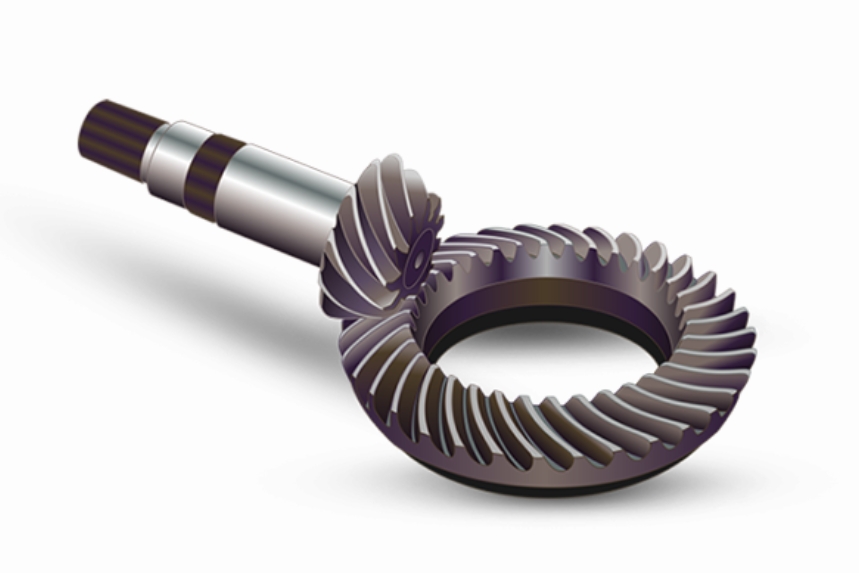
The macroscopic examination revealed three distinct crack morphologies in the spiral bevel gears, all originating from stress concentration zones. These observations are summarized in Table 1, which categorizes the crack types based on their location and extent. The spiral bevel gears exhibited cracks at tooth roots and threaded holes, indicating susceptibility to thermal and transformational stresses.
| Crack Type | Location | Description | Stress Concentration Factor |
|---|---|---|---|
| Type I | Tooth root fillet | Small cracks along the root | High due to geometric discontinuity |
| Type II | Tooth root extending outward | Large cracks propagating from roots | Very high, with primary and secondary cracks |
| Type III | Threaded hole area | Cracks radiating from holes | Moderate to high from machining defects |
Microscopic analysis was conducted on samples extracted from the main cracks. At 100× magnification, cracks at tooth roots showed depths of approximately 0.94 mm, with oxidation observed on both crack surfaces and gear surfaces. The oxidation depth was measured as 25.27 μm on crack surfaces versus 31.65 μm on the gear surface, suggesting that cracking occurred prior to the final heat treatment cycle. After mechanically opening the crack fracture, SEM examination revealed a porous, “tofu-dreg” like morphology in the heat-affected zones, distinct from fatigue or static fracture features. This indicates that the spiral bevel gears experienced abnormal thermal cycles.
To quantify the microstructural characteristics, I performed metallographic examinations on the carburized layer of the spiral bevel gears. The results, summarized in Table 2, show that martensite, carbide, and retained austenite levels were within acceptable ranges, confirming that the base material and standard heat treatment parameters were suitable for spiral bevel gears. However, the effective case depth was found to be anomalous.
| Microstructural Feature | Required Standard | Actual Measurement | Assessment |
|---|---|---|---|
| Martensite Level | Grade 1-4 | Grade 2 | Qualified |
| Carbide Level | Grade 1-3 | Grade 1 | Qualified |
| Retained Austenite Level | ≤20% | 15% | Qualified |
| Effective Case Depth | 1.7-2.1 mm | 2.8 mm | Excessive by 0.7 mm |
The effective case depth was measured using microhardness testing, with results plotted in Figure 1 (implied from data). The required depth for spiral bevel gears was 1.8 mm, but the actual depth reached 2.8 mm, indicating over-carburization during the uncontrolled period. This excessive depth contributed to high residual stresses. The relationship between case depth and carburizing time can be described by the diffusion equation, where carbon concentration \( C \) varies with time \( t \) and depth \( x \):
$$ \frac{\partial C}{\partial t} = D \frac{\partial^2 C}{\partial x^2} $$
Here, \( D \) is the diffusion coefficient of carbon in steel. For spiral bevel gears made of 18CrNiMo7-6, \( D \) is temperature-dependent, and during the 3-hour uncontrolled period, the high carbon potential led to deeper carbon penetration. The effective case depth \( \delta \) can be approximated by:
$$ \delta = k \sqrt{t} $$
where \( k \) is a constant dependent on material and temperature. Given the standard process aimed for 1.8 mm over 15 hours, the additional 3 hours at high carbon potential significantly increased \( \delta \), as observed.
The residual stress \( \sigma_r \) in spiral bevel gears after heat treatment arises from thermal gradients and phase transformations. It can be estimated using the formula:
$$ \sigma_r = E \alpha \Delta T + \Delta V_m $$
where \( E \) is Young’s modulus, \( \alpha \) is the thermal expansion coefficient, \( \Delta T \) is the temperature difference, and \( \Delta V_m \) is the volume change due to martensitic transformation. For spiral bevel gears, the combination of over-carburization and re-heating created excessive tensile stresses at stress concentrators like tooth roots. The stress intensity factor \( K_I \) at a crack tip in a spiral bevel gear can be expressed as:
$$ K_I = \sigma \sqrt{\pi a} $$
where \( \sigma \) is the applied stress and \( a \) is the crack length. In this case, the residual stress from heat treatment acted as \( \sigma \), propagating cracks once critical stress intensity was exceeded.
My analysis indicates that the cracks in spiral bevel gears were not quench cracks but resulted from residual stresses induced by improper heat treatment sequencing. During the first carburizing cycle, the oxygen probe failure caused uncontrolled high carbon potential, leading to a thicker case depth and coarse martensite with high retained austenite. Upon re-heating for the second treatment, thermal and transformational stresses concentrated at geometric discontinuities, initiating cracks. This is supported by the oxidation depths, which show cracks formed before the final cycle.
To prevent similar failures in spiral bevel gears, I recommend the following improved measures, summarized in Table 3. These steps focus on process control and monitoring for spiral bevel gears.
| Measure | Description | Expected Outcome for Spiral Bevel Gears |
|---|---|---|
| Real-time Oxygen Probe Validation | Implement redundant sensors and regular calibration checks during carburizing of spiral bevel gears. | Prevents uncontrolled carbon potential fluctuations. |
| Pre-treatment Sample Analysis | After any process interruption, test witness samples for case depth and microstructure before proceeding with spiral bevel gears. | Allows adjustment of parameters to avoid over-carburization. |
| Controlled Re-heating Protocol | For re-treatment, use a slow heating rate and intermediate tempering to relieve stresses in spiral bevel gears. | Reduces thermal shock and residual stress buildup. |
| Finite Element Analysis (FEA) Simulation | Model heat treatment stresses in spiral bevel gears to identify high-risk areas and optimize geometry. | Minimizes stress concentrations in spiral bevel gears. |
| Enhanced Non-destructive Testing | Use ultrasonic or magnetic particle inspection on spiral bevel gears after heat treatment to detect early cracks. | Ensures quality control before machining spiral bevel gears. |
In conclusion, the failure of spiral bevel gears was directly attributable to residual stresses from a defective heat treatment process, exacerbated by the uncontrolled carburizing period. The spiral bevel gears developed cracks due to stress concentrations at tooth roots and threaded holes, with microstructural evidence confirming the sequence of events. By implementing the improved measures, such as rigorous process monitoring and sample validation, similar incidents can be avoided in the production of spiral bevel gears. Future work should focus on optimizing heat treatment parameters for spiral bevel gears to balance case depth and residual stress, ensuring reliability in service. The spiral bevel gear is a precision component, and its performance hinges on meticulous thermal processing; thus, continuous improvement in these areas is paramount for the longevity of spiral bevel gears in mechanical systems.
To further elucidate the technical aspects, I derive a simplified model for residual stress calculation in spiral bevel gears. The total stress \( \sigma_{total} \) can be decomposed into thermal stress \( \sigma_{th} \) and transformation stress \( \sigma_{tr} \):
$$ \sigma_{total} = \sigma_{th} + \sigma_{tr} $$
For a spiral bevel gear during cooling, the thermal stress component is given by:
$$ \sigma_{th} = \frac{E \alpha}{1 – \nu} (T_c – T_s) $$
where \( \nu \) is Poisson’s ratio, \( T_c \) is the core temperature, and \( T_s \) is the surface temperature. In spiral bevel gears, the temperature gradient is steep due to geometry, leading to high \( \sigma_{th} \). The transformation stress arises from volume expansion during martensite formation, approximated as:
$$ \sigma_{tr} = \beta \Delta V $$
with \( \beta \) as a material constant and \( \Delta V \) the volume change. For spiral bevel gears made of 18CrNiMo7-6, the high alloy content increases hardenability, but also susceptibility to cracking if stresses are not managed. Additionally, the carbon profile \( C(x) \) in spiral bevel gears after carburizing can be modeled using the error function solution to Fick’s law:
$$ C(x) = C_s – (C_s – C_0) \text{erf}\left( \frac{x}{2\sqrt{Dt}} \right) $$
where \( C_s \) is the surface carbon concentration, \( C_0 \) is the initial carbon content, and erf is the error function. In the faulty process for spiral bevel gears, \( C_s \) was higher than intended, deepening the profile and increasing case depth. This contributed to a mismatch in properties between case and core, elevating residual stress.
Finally, I emphasize that spiral bevel gears require tailored heat treatment protocols. The lessons from this failure underscore the importance of process stability for spiral bevel gears, and future designs should incorporate stress-relief steps to mitigate risks. Through diligent application of these principles, the integrity of spiral bevel gears can be assured in demanding applications.