
In the rapidly evolving landscape of mechanical engineering and global manufacturing competition, particularly after China’s accession to the WTO, the gear manufacturing industry faces unprecedented challenges and opportunities. Spiral bevel gears, renowned for their high重合度, smooth transmission, and low noise, are extensively used in critical sectors such as automotive, marine, engineering machinery, industrial sewing machines, and power tools. The rise in living standards and the booming garment and decoration industries have spurred a dramatic increase in the demand for small-module spiral bevel gears, especially in industrial sewing machines and power tools. Notably, international power tool giants are actively seeking Chinese partners for processing these gears, scrutinizing their manufacturing and inspection equipment. Currently, most domestic producers of small-module spiral bevel gears are concentrated in the Jiangsu-Zhejiang region, relying predominantly on mechanically driven milling machines. These enterprises express a strong desire to scale up operations. Given this market dynamic, our institute recognized the imperative not only to continue producing mechanically driven milling machines but also to pioneer the development of CNC-based models to enhance competitiveness in this field. As national industrialization advances, the demands on spiral bevel gear transmission escalate, making the digital integrated manufacturing of spiral bevel gears and the application of CNC technology crucial for improving transmission quality and meeting market expansion needs. The CNC spiral bevel gear milling machine represents a high-tech product involving multidisciplinary knowledge—automatic control, computer technology, mathematics, gear meshing theory, and mechanical design and manufacturing—posing significant technical challenges and containing substantial scientific and technological value.
The production of spiral bevel gears in China has traditionally been dominated by enterprises using mechanically driven milling machines, which, while stable, lack the flexibility for rapid product changeovers. The gear market, particularly for small-module spiral bevel gears used in power tools, has diversified in specifications and varieties. Mechanically driven machines often require numerous auxiliary components like bevel gear plates and indexing plates for different gear specifications, increasing user investment and limiting adaptability. This situation underscores the necessity for CNC spiral bevel gear milling machines, which offer greater flexibility and are better suited for small-batch, multi-variety production. Our institute, building on extensive experience, initiated the design and development of the YKHS2210 CNC spiral bevel gear milling machine in August 2003. This initiative aims to provide users with a more versatile machine capable of handling diverse production needs, promising significant social and economic benefits and a bright development prospect.
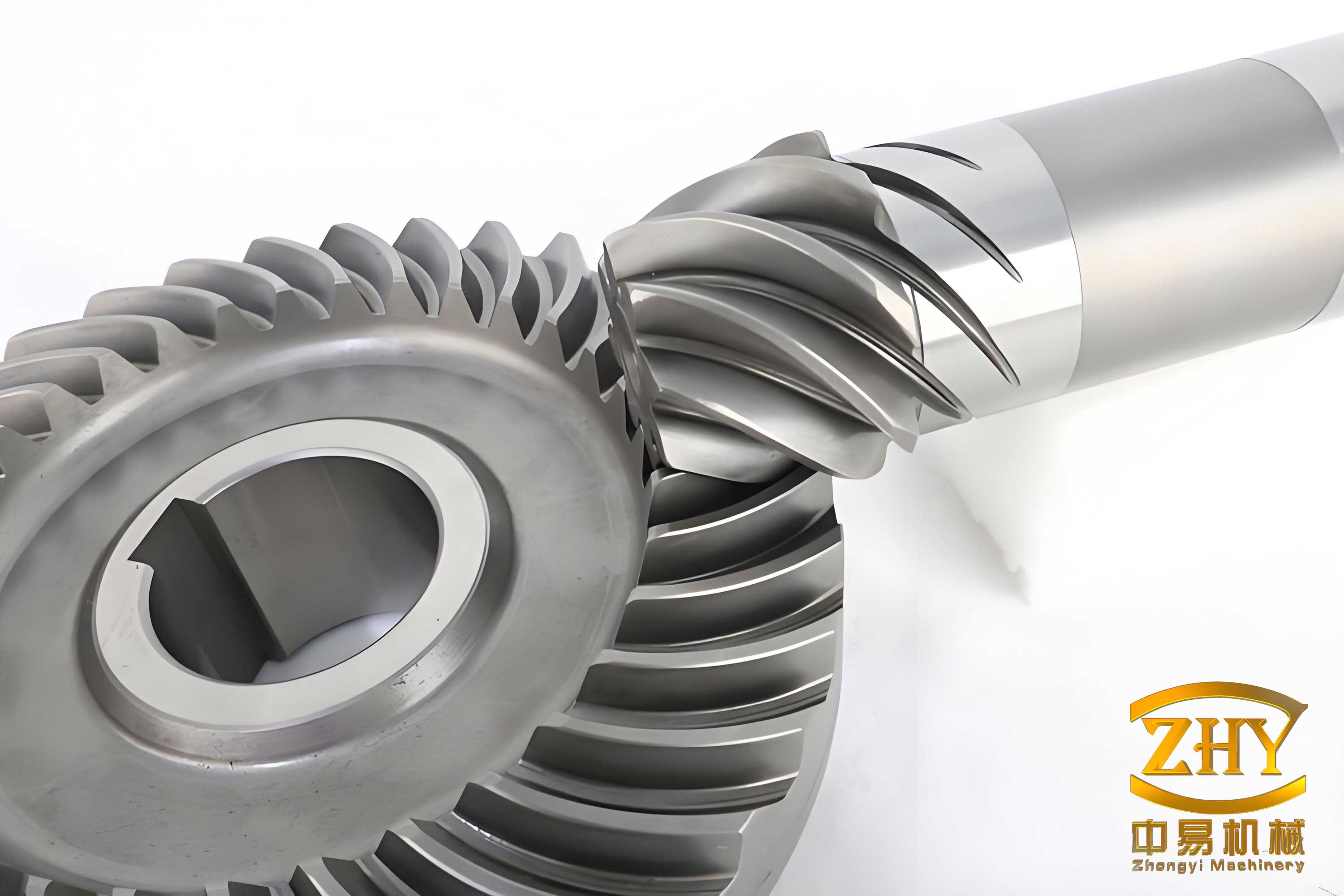
The YKHS2210 CNC spiral bevel gear milling machine is engineered for processing small-module spiral bevel gears following the Gleason system. It comprises several key components: the bed unit, column unit, cutter spindle unit, workpiece spindle unit, workpiece spindle carriage unit, hydraulic unit, control system (including the CNC system and electrical components), as well as auxiliary systems like cooling and chip removal, and lubrication. The working principle involves the relative motion between the cutting tool and the workpiece to generate the complex spatial surface of a spiral bevel gear tooth. Specifically, a dedicated high-speed steel forming cutter is mounted on the cutter spindle’s front end. The gear blank is fixed on the workpiece spindle via a fixture, secured by a hydraulically driven pull rod. The cutter spindle axis and workpiece spindle axis form an angle equal to the root angle. During cutting, the following motions are coordinated under CNC command: rotation of the cutter spindle, translational movements of the cutter spindle in the horizontal (X-axis) and vertical (Y-axis) directions, rotation of the workpiece spindle (A-axis), and translational movement of the workpiece spindle along the feed direction (Z-axis). This synchronized motion completes one cutting cycle, producing a full tooth space. Subsequently, the workpiece spindle retracts a set distance, indexes by rotating a specific angle, and initiates the next cutting cycle until the entire spiral bevel gear is machined.
The control system utilizes a Mitsubishi 50M CNC system imported from Japan. The cutter spindle speed and rotation direction are controlled via commands from the system executed by a frequency converter. The CNC system can simultaneously drive the X, Y, Z, and A servo axes based on programmed instructions. Operation panel buttons and the program itself, through the system’s PLC, issue start/stop commands to various machine actuators. This integration ensures precise control over the machining process for spiral bevel gears.
The technical specifications and parameters of the YKHS2210 machine are summarized in the table below, highlighting its capability to produce high-precision spiral bevel gears.
| Parameter | Specification |
|---|---|
| Maximum Cone Distance | 70 mm |
| Maximum Tooth Width | 25 mm |
| Maximum Module | 2.5 mm |
| Maximum Workpiece Diameter (Ratio 1:4) | Ø140 mm |
| Maximum Workpiece Diameter (Ratio 1:1) | Ø100 mm |
| Maximum Number of Teeth (Ratio 1:4) | 72 |
| Minimum Number of Teeth (Ratio 1:1) | 12 |
| Workpiece Mounting Hole | Morse Taper No. 4 |
| Machine Dimensions (L × W × H) | 2900 mm × 1900 mm × 2050 mm |
| Hydraulic System Pressure | 2 MPa |
| Cutter Spindle Speed Range | 200 – 800 rpm |
| Cutting Feed Rate Range | 0 – 1000 mm/min |
| Rapid Traverse Rate | 3000 mm/min |
| Cutter Spindle Horizontal Travel (X-axis) | ±75 mm |
| Cutter Spindle Vertical Travel (Y-axis) | ±75 mm |
| Workpiece Spindle Feed Travel (Z-axis) | 120 mm |
| Motor Power – Cutter Spindle | 1.1 kW |
| Motor Power – Hydraulic System | 0.75 kW |
| Motor Power – Coolant Pump | 0.12 kW |
| Motor Power – Magnetic Conveyor | 0.18 kW |
| Motor Power – Centralized Lubrication Station | 0.035 kW |
| Servo Motor Power – X-axis | 1 kW |
| Servo Motor Power – Y-axis | 1 kW |
| Servo Motor Power – Z-axis | 1 kW |
| Servo Motor Power – A-axis | 1 kW |
| Machine Weight (including electrical cabinet) | 4000 kg |
The development of key components was critical to the machine’s performance. The workpiece spindle unit, the core mechanical component, must exhibit low speed, high rotational and indexing accuracy, and withstand mild cutting impacts. Its design employs sliding bearings for radial and axial support, ensuring excellent contact stiffness and shock absorption. High-precision worm gear pairs facilitate precise indexing. Critical parts like the spindle housing, workpiece spindle, worm wheel, and worm are manufactured to tight tolerances to achieve gear accuracy up to AGMA Class 7. This precision is essential for producing high-quality spiral bevel gears.
Another innovative component is the digital display device for the rotary carriage angle. Traditional methods using graduated scales and verniers are prone to errors in machining, installation, and reading, typically offering a resolution of 1-2 arcminutes and accuracy of ±2 arcminutes. To overcome this, we integrated a 3600-line incremental rotary encoder coupled to the carriage’s pivot shaft via a flexible coupling. The encoder’s output connects to a single-axis digital readout with interpolation circuitry, displaying the carriage’s angular position. Replacing the sliding bearing with a needle roller bearing achieves zero-clearance assembly, enhancing accuracy and repeatability. This device, patented as a utility model, significantly improves the setup precision for machining spiral bevel gears with different root angles.
The CNC system and programming environment were developed to simplify operation while embedding advanced technology. The Mitsubishi 50M system uses a hybrid programming method combining standard G-codes with parametric programming. We created a user-open template program (parameter-setting subroutine) and user-hidden subroutines (machining programs) called by the template. Users only need to input gear parameters, tool parameters, and fixture data into the template; the system automatically generates the machining program. This system incorporates several intelligent features: automatic calculation of the minimal machining range to reduce idle travel, optimization of the jump tooth count for unidirectional workpiece rotation to improve indexing accuracy, and automatic computation of the roll ratio—the speed ratio between workpiece rotation and the cutter center’s circular motion—based on spiral bevel gear meshing theory and generating cutting principles. The mathematical foundation for roll ratio calculation can be expressed as:
$$ R = \frac{\omega_w}{\omega_c} = f(N, \beta, \alpha, \ldots) $$
where \( R \) is the roll ratio, \( \omega_w \) is the workpiece angular velocity, \( \omega_c \) is the effective angular velocity of the cutter center, \( N \) is the number of teeth, \( \beta \) is the spiral angle, and \( \alpha \) is the pressure angle. The exact function depends on the specific gear geometry of the spiral bevel gear.
Furthermore, the programming system includes parameters for tools and fixtures, allowing automatic workpiece zero-point setting after changes. It offers machining mode selection for balancing quantity and quality, dedicated contact pattern adjustment parameters, and data validity checks to prevent errors like machine over-travel or component interference. Hiding critical subroutines prevents user tampering, ensuring system safety and reliability. This comprehensive approach lowers the technical threshold for operators while maintaining high precision in spiral bevel gear production.
The development process involved rigorous analysis of spiral bevel gear geometry. The tooth surface of a spiral bevel gear is a complex spatial曲面 generated via the relative motion between the cutter and workpiece. For a Gleason system spiral bevel gear, the basic geometry can be described by parameters such as module \( m \), number of teeth \( z \), pitch cone angle \( \delta \), spiral angle \( \beta \), and pressure angle \( \alpha \). The machine’s kinematic chain must replicate the generating motion. In a CNC machine, this is achieved through coordinated axis movements. The relationship between cutter path and workpiece rotation for a generating cut can be modeled. For instance, the cutter center trajectory in the machine plane relative to the workpiece rotation angle \( \theta \) might follow:
$$ X_c = R_g \cos(\phi(\theta)) + C_x $$
$$ Y_c = R_g \sin(\phi(\theta)) + C_y $$
$$ \phi(\theta) = K \theta + \phi_0 $$
where \( X_c, Y_c \) are cutter center coordinates, \( R_g \) is the generating radius, \( \phi \) is the phase angle, \( K \) is the roll ratio factor, and \( C_x, C_y \) are offsets. The CNC system interpolates these paths in real-time.
To further elucidate the machine’s capabilities, consider the following table comparing key aspects of mechanical versus CNC spiral bevel gear milling machines, emphasizing the advantages for producing spiral bevel gears.
| Aspect | Mechanical Milling Machine | YKHS2210 CNC Milling Machine |
|---|---|---|
| Flexibility for Different Gear Specifications | Low (requires changing gear plates) | High (programmable, no physical plates) |
| Setup Time for New Gear | Long (mechanical adjustments) | Short (parameter input) |
| Accuracy and Consistency | Subject to mechanical wear and backlash | High (closed-loop servo control) |
| Suitability for Small Batch Production | Poor (high setup cost) | Excellent (quick changeover) |
| Ability to Optimize Cutting Paths | Limited (fixed cam patterns) | High (CNC path optimization) |
| Integration with CAD/CAM | Difficult | Straightforward (digital data flow) |
| Maintenance of Spiral Bevel Gear Quality | Dependent on operator skill | Consistent (program-controlled) |
The YKHS2210 CNC spiral bevel gear milling machine has undergone thorough evaluation. A scientific and technological novelty search conducted by the Shanghai Center for Scientific and Technological Information Consulting concluded that the project’s overall level is leading domestically and comparable to advanced international counterparts. On January 23, 2004, the machine passed appraisal and acceptance by an expert panel organized by the Shanghai Municipal Economic Commission. Furthermore, the project was recognized as a high-tech achievement transformation project in Shanghai. These accolades affirm the machine’s innovation and market readiness for manufacturing precision spiral bevel gears.
Looking ahead, as global manufacturing重心 shifts towards China and demand for spiral bevel gears continues to grow, the need for advanced milling machines will increase in tandem. CNC spiral bevel gear milling machines, with their advantages in adjustment convenience, high efficiency, and stable performance, are becoming the trend. Market research confirms this trajectory. We are committed to seizing this opportunity by continuously improving and perfecting the YKHS2210 model. Future developments may include expanding the machine’s规格 to cover a wider range of spiral bevel gear sizes and modules, incorporating more advanced sensors for real-time monitoring, and enhancing the CNC system with AI-driven optimization for tooth contact pattern correction. The integration of IoT for predictive maintenance and data analytics could further elevate productivity. The ongoing digital transformation in manufacturing underscores the importance of such CNC solutions for spiral bevel gear production, ensuring that manufacturers can meet stringent quality standards while remaining agile in a competitive global market.
In conclusion, the successful development of the YKHS2210 CNC spiral bevel gear milling machine represents a significant advancement in gear manufacturing technology. By leveraging CNC precision, innovative component design, and user-friendly programming, it addresses the evolving needs of industries reliant on high-quality spiral bevel gears. As we continue to refine this technology, we aim to contribute substantially to the advancement of precision engineering and the global supply chain for critical mechanical components like spiral bevel gears.