
In mechanical engineering, the transmission of motion and power between non-parallel shafts is often achieved using spiral gears, which are essentially helical gears with a non-zero sum of helix angles. Unlike parallel helical gears where the helix angles sum to zero, spiral gears operate with intersecting or skewed axes, typically at an angle of 90 degrees. While this configuration enables flexible design, it introduces point contact between tooth surfaces, leading to high localized stresses. In this article, I will delve into the calculation and analysis of contact stress in spiral gear pairs, drawing from a real-world case study of abnormal wear in an engine-driven oil pump. My goal is to provide a comprehensive understanding of the factors influencing spiral gear performance and offer practical insights for mitigating wear issues. Through detailed theoretical explanations, mathematical formulations, and empirical data, I aim to highlight the critical role of accurate stress computation in spiral gear design.
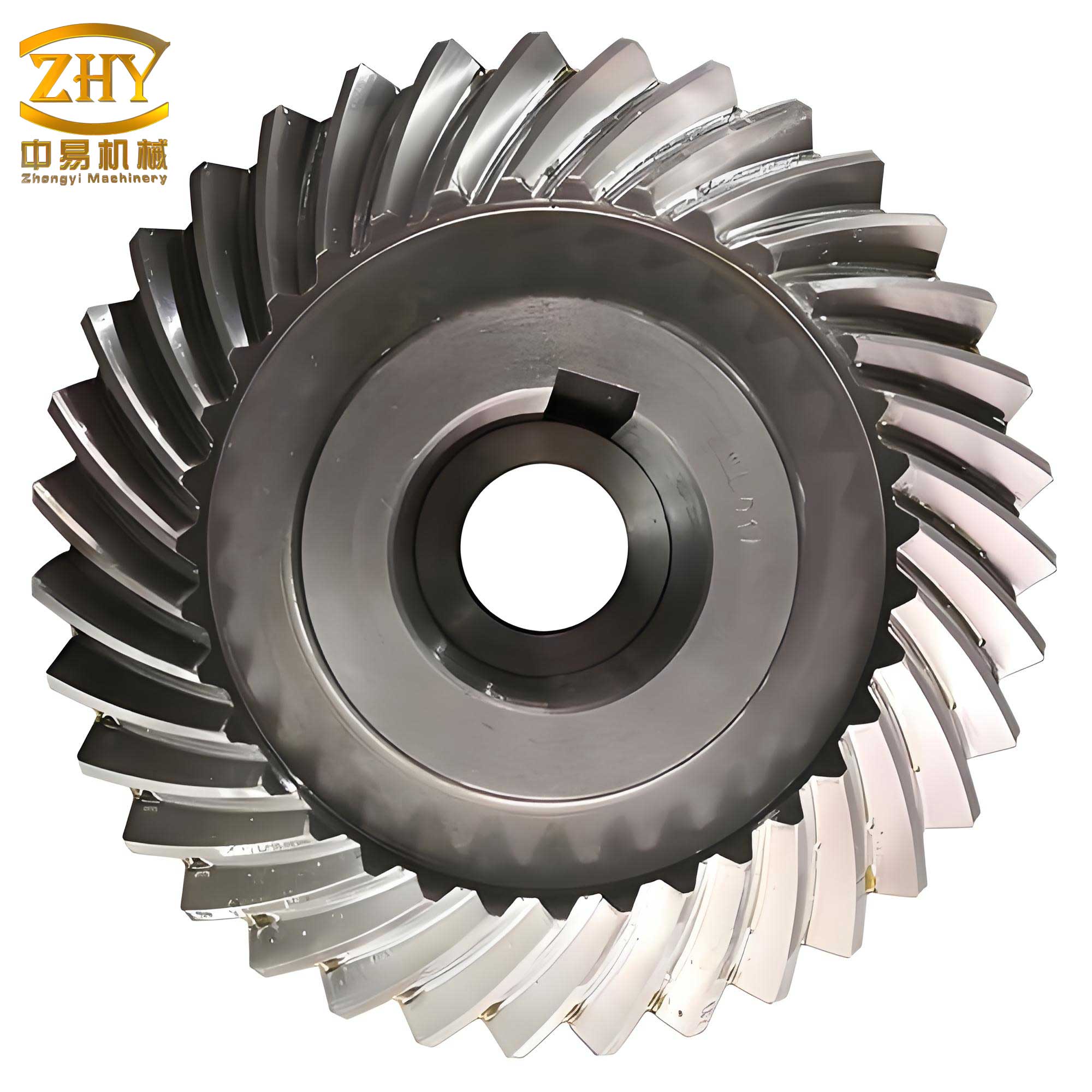
The fundamental distinction between spiral gears and helical gears lies in the helix angle relationship. For a helical gear pair, the sum of helix angles is zero (i.e., $\beta_1 + \beta_2 = 0$), resulting in line contact and smoother operation. In contrast, spiral gears have $\beta_1 + \beta_2 \neq 0$, often set to 90 degrees for orthogonal shafts, leading to point contact. This point contact concentrates loads, making spiral gears susceptible to high Hertzian stress and accelerated wear if not properly designed. In my analysis, I will explore how this geometric characteristic impacts stress distribution and longevity. The spiral gear pair in question exhibited severe wear after only a few hours of operation, prompting an investigation into the underlying causes. By treating the contact as an ellipsoidal model with dual curvatures, I will demonstrate that traditional simplifications in stress calculation can lead to significant underestimations, ultimately compromising gear reliability.
To set the stage, let me outline the basic geometry of spiral gears. The tooth surface of a spiral gear is generated as an involute helicoid, defined by parameters such as module, pressure angle, and helix angle. For a pair with shaft angle $\Sigma = 90^\circ$, the effective contact area is minimal, and the stress state becomes complex. The normal module $m_n$ and normal pressure angle $\alpha_n$ must be equal for proper meshing, but the helix angles $\beta_1$ and $\beta_2$ differ. Key geometric parameters include pitch diameters, base circle diameters, and transverse pressure angles, which influence the curvature radii at the contact point. I will use the following formulas to compute these parameters, essential for subsequent stress analysis:
Pitch diameter: $d_i = \frac{m_n z_i}{\cos \beta_i}$, where $z_i$ is the number of teeth.
Base circle diameter: $d_{bi} = d_i \cos \alpha_{ti}$, with transverse pressure angle $\alpha_{ti}$ given by $\tan \alpha_{ti} = \frac{\tan \alpha_n}{\cos \beta_i}$.
Helix angle on base cylinder: $\beta_{bi} = \arctan(\tan \beta_i \cos \alpha_{ti})$.
These equations form the basis for determining the principal curvatures required for Hertz stress calculation. In practice, the spiral gear pair is often designed with imperial standards, such as diametral pitch $D_p$, which converts to metric module as $m_n = \frac{25.4}{D_p}$. For instance, in the case study, $D_p = 16$ yields $m_n = 1.5875 \text{ mm}$. With $z_1 = z_2 = 13$, $\alpha_n = 14.5^\circ$, and $\beta_1 = 30^\circ$, $\beta_2 = 60^\circ$, we can derive the dimensions. However, manufacturing tolerances may alter actual helix angles, affecting the meshing condition and stress levels.
The core of this analysis lies in computing the contact stress at the pitch point. According to Hertz theory, when two elastic bodies with curved surfaces come into contact under load, the pressure distribution is elliptical, and the maximum stress occurs at the center. For spiral gears, the contact can be approximated as two ellipsoids with principal radii of curvature $R_1$, $R_1’$ for gear 1 and $R_2$, $R_2’$ for gear 2. The traditional approach often simplifies by setting $R_i’ = \infty$, assuming the curvature in the direction perpendicular to the tooth trace is negligible. However, this simplification can lead to inaccurate stress estimates, as I will show through detailed computation. The general formula for maximum Hertz contact stress is:
$$\sigma_H = C_a C_b \sqrt{\frac{K F_n (A+B)}{\pi}}$$
where $K$ is the load factor, $F_n$ is the normal load, and $A$ and $B$ are geometric parameters related to curvatures. The coefficients $C_a$ and $C_b$ depend on the ratio $B/A$, which is derived from the curvature radii. To accurately determine $R_i’$, one must consider the intersection of the involute helicoid surface with the tangent plane at the pitch point. The involute helicoid equation in parametric form is:
$$x_i = r_{bi}[\cos(\theta_i + \phi_i) + \phi_i \sin(\theta_i + \phi_i)]$$
$$y_i = r_{bi}[\sin(\theta_i + \phi_i) – \phi_i \cos(\theta_i + \phi_i)]$$
$$z_i = \frac{P_i}{2\pi} \theta_i$$
where $r_{bi}$ is the base radius, $P_i$ is the lead, $\theta_i$ is the angular parameter along the helix, and $\phi_i$ is the involute angle. The tangent plane equation is $a_i x_i + b_i y_i + c_i z_i + d_i = 0$. By solving these equations numerically, one can find the curvature radius $R_i’$ of the intersection curve at the pitch point. This process involves steps like selecting a point on the curve, computing derivatives using numerical methods, and applying the curvature formula:
$$R_i’ = \frac{(\dot{x}_i^2 + \dot{y}_i^2 + \dot{z}_i^2)^{3/2}}{\sqrt{(\dot{x}_i^2 + \dot{y}_i^2 + \dot{z}_i^2)(\ddot{x}_i^2 + \ddot{y}_i^2 + \ddot{z}_i^2) – (\dot{x}_i \ddot{x}_i + \dot{y}_i \ddot{y}_i + \dot{z}_i \ddot{z}_i)^2}}$$
This meticulous approach ensures higher precision in stress evaluation. For the case study spiral gear pair, using material properties of alloy steel ($E_1 = 2 \times 10^5 \text{ MPa}$, $\nu_1 = 0.3$) and gray cast iron ($E_2 = 1.4 \times 10^5 \text{ MPa}$, $\nu_2 = 0.25$), the normal load $F_n$ is calculated from the transmitted torque. With an oil pump power of $P = 0.20 \text{ kW}$ at $n = 2300 \text{ rpm}$, torque $T = 830 \text{ N·mm}$, and efficiency $\eta = 0.86$, the tangential force at the pitch circle is $F_t = \frac{2T}{d_1}$. The normal force is then $F_n = \frac{F_t}{\cos \alpha_n \cos \beta}$. Substituting values yields $F_n = 83.1 \text{ N}$.
Next, I compute the principal curvatures. From geometric formulas, the radius in the tooth profile direction is $R_i = \frac{d_{bi} \sin \alpha_{ti}}{2 \cos \beta_{bi}}$. For the spiral gears, this gives $R_1 = 3.90 \text{ mm}$ and $R_2 = 17.10 \text{ mm}$. The perpendicular curvature radii $R_1’$ and $R_2’$ are obtained via the numerical method described earlier, resulting in $R_1′ = 352.2 \text{ mm}$ and $R_2′ = 211 \text{ mm}$. These values are significantly finite, contradicting the simplification $R_i’ = \infty$. The geometric parameters $A$ and $B$ are given by:
$$A + B = \frac{1}{2} \left( \frac{1}{R_1} + \frac{1}{R_1′} + \frac{1}{R_2} + \frac{1}{R_2′} \right)$$
$$B/A = \left( \frac{1}{R_1} + \frac{1}{R_2} \right) / \left( \frac{1}{R_1′} + \frac{1}{R_2′} \right) \quad \text{for } \alpha = 0^\circ$$
where $\alpha$ is the angle between the planes of principal curvatures. For spiral gears with $\Sigma = 90^\circ$, $\alpha = 0^\circ$ is typical. Plugging in numbers, $A+B = 0.16073 \text{ mm}^{-1}$ and $B/A = 41.43$. From Hertz theory tables, interpolation yields $C_a = 0.9957$ and $C_b = 0.3629$. Assuming a load factor $K = 1.8$ to account for dynamic effects, the maximum contact stress is:
$$\sigma_H = 0.9957 \times 0.3629 \times \sqrt{\frac{1.8 \times 83.1 \times 0.16073}{\pi}} \approx 1130 \text{ MPa}$$
This value substantially exceeds the endurance limit for alloy steel–gray cast iron pairs, which is typically around 860 MPa. If we had simplified with $R_i’ = \infty$, the stress would be only 769 MPa, misleadingly suggesting adequacy. This discrepancy underscores the importance of accurate curvature assessment in spiral gear design.
To further illustrate, I present a table summarizing key parameters and results for the spiral gear pair:
| Parameter | Symbol | Gear 1 (Steel) | Gear 2 (Cast Iron) |
|---|---|---|---|
| Number of Teeth | $z_i$ | 13 | 13 |
| Normal Module (mm) | $m_n$ | 1.5875 | 1.5875 |
| Helix Angle (deg) | $\beta_i$ | 30 | 60 |
| Pitch Diameter (mm) | $d_i$ | 23.83 | 41.28 |
| Base Helix Angle (deg) | $\beta_{bi}$ | 28.95 | 56.98 |
| Profile Curvature Radius (mm) | $R_i$ | 3.90 | 17.10 |
| Perpendicular Curvature Radius (mm) | $R_i’$ | 352.2 | 211 |
| Young’s Modulus (MPa) | $E_i$ | 2e5 | 1.4e5 |
| Poisson’s Ratio | $\nu_i$ | 0.3 | 0.25 |
Another table compares stress calculations under different assumptions:
| Calculation Method | $R_i’$ Assumption | Contact Stress $\sigma_H$ (MPa) | Remark |
|---|---|---|---|
| Simplified | $\infty$ | 769 | Underestimates stress |
| Detailed | Finite values | 1130 | Reflects actual condition |
| With Friction | Finite values | 1240–1470 (estimated) | Includes 10–30% increase |
The high stress of 1130 MPa explains the abnormal wear observed in the engine spiral gear pair. Wear mechanisms in spiral gears are exacerbated by sliding velocities along both tooth profile and length directions. At low pitch line speeds (e.g., 5 m/min for gear 1 and 3 m/min for gear 2), boundary lubrication may prevail, increasing friction and adhesive wear. The point contact nature concentrates stresses, leading to pitting, scuffing, and rapid material removal. In the case study, wear was evident after only 5 hours of bench testing or 2000 km of vehicle operation, indicating inadequate design margins.
Several factors contribute to this issue. First, manufacturing errors in helix angles can deviate from the nominal 90° shaft angle. For instance, if $\beta_1$ and $\beta_2$ are both machined with negative tolerances, $\Sigma = \beta_1 + \beta_2 < 90^\circ$, altering the contact pattern and increasing sliding. Second, material pairing plays a crucial role. Alloy steel and gray cast iron have limited wear resistance under high stress. Alternative materials like borided steel pairs or hardened steel combinations offer higher surface hardness and fatigue strength. Third, lubrication is often overlooked in spiral gear applications. Proper lubricant selection and delivery can reduce friction, lower flash temperatures, and mitigate wear.
To address these challenges, I propose the following recommendations for spiral gear design and maintenance:
- Accurate Curvature Calculation: Always compute finite $R_i’$ values using numerical methods, as simplified approaches risk underestimating stress. Incorporate this into standard design procedures for spiral gears.
- Material Selection: Opt for material pairs with high surface endurance, such as case-hardened steels or specialized coatings. For example, borided steel pairs can withstand stresses up to 1500 MPa, providing a safety margin.
- Manufacturing Control: Tighten tolerances on helix angles and implement selective assembly to ensure $\Sigma$ is close to 90°. Use quality control measures like gear rolling tests to verify meshing.
- Lubrication Enhancement: Employ high-pressure lubricants with extreme pressure (EP) additives. Consider forced lubrication systems to ensure adequate oil film thickness at the contact point.
- Load Reduction: Redesign to increase tooth size or reduce transmitted torque if possible. For instance, increasing module or number of teeth can lower contact stress.
- Monitoring and Maintenance: Implement wear debris analysis in oil for early detection. Regular inspection of spiral gear pairs in critical applications can prevent catastrophic failures.
Expanding on the theoretical aspect, the contact stress in spiral gears can be modeled using advanced simulations like finite element analysis (FEA). However, analytical methods remain valuable for quick assessments. The Hertz formula derivation assumes isotropic, homogeneous materials and small deformations. For spiral gears, additional factors such as misalignment, thermal effects, and surface roughness may influence stress. Empirical corrections can be applied, such as the load factor $K$, which accounts for dynamic loads from vibrations or shocks. In practice, $K$ ranges from 1.5 to 2.5 depending on application severity. For the oil pump drive, $K=1.8$ is reasonable, but higher values might be needed in more demanding environments.
Moreover, the sliding velocities in spiral gears contribute to wear. The relative sliding velocity $v_s$ at the pitch point has components along the profile and lead directions. It can be expressed as:
$$v_s = \sqrt{ (v_{t1} – v_{t2})^2 + (v_{a1} – v_{a2})^2 }$$
where $v_{ti}$ are tangential velocities and $v_{ai}$ are axial velocities. For $\Sigma = 90^\circ$, sliding is significant, generating heat and accelerating wear. The wear rate $W$ can be estimated using Archard’s equation: $W = k \frac{F_n v_s}{H}$, where $k$ is a wear coefficient and $H$ is material hardness. Reducing $v_s$ through design modifications, such as optimizing helix angles, can prolong spiral gear life.
In terms of geometric optimization, one approach is to use non-standard helix angles to improve contact patterns. For example, adjusting $\beta_1$ and $\beta_2$ to achieve a larger effective contact area without compromising shaft angle. Computer-aided design (CAD) tools can simulate tooth contact analysis (TCA) to visualize pressure distribution. Additionally, profile modifications like tip relief or crowning can reduce edge loading and stress concentrations.
To put this into perspective, I will discuss a comparative analysis of spiral gear pairs in different applications. In automotive transmissions, spiral gears are used in differentials for low-noise operation, but stress levels are kept below 800 MPa through careful material selection. In industrial machinery, such as conveyors, spiral gears endure higher loads, often requiring alloy steel pairs. The table below summarizes typical stress ranges:
| Application | Material Pair | Typical $\sigma_H$ (MPa) | Wear Performance |
|---|---|---|---|
| Oil Pump Drives | Steel–Cast Iron | 1000–1200 | Poor (rapid wear) |
| Automotive Differentials | Hardened Steel–Hardened Steel | 600–800 | Excellent |
| Industrial Gearboxes | Case-Hardened Steel | 900–1100 | Good (with lubrication) |
| Aerospace Actuators | Titanium Alloy–Steel | 800–1000 | Moderate |
From a practical standpoint, the engine manufacturer in the case study implemented some of these suggestions. By improving initial lubrication and selectively assembling spiral gear pairs based on measured helix angles, they reduced failure rates significantly. However, further gains could be achieved by upgrading to borided steel materials. This highlights the importance of a holistic design approach.
In conclusion, spiral gears are vital components in non-parallel shaft transmissions, but their point contact nature necessitates rigorous stress analysis. Through this article, I have demonstrated that accurate calculation of Hertz contact stress, considering finite perpendicular curvatures, is essential for reliable design. The case study spiral gear pair exhibited abnormal wear due to stress exceeding material limits, compounded by sliding and potential manufacturing errors. By adopting precise computational methods, selecting appropriate materials, controlling manufacturing tolerances, and enhancing lubrication, engineers can mitigate wear and extend spiral gear life. Future work could involve developing standardized calculation software for spiral gears or exploring advanced materials like composites. As technology evolves, spiral gears will continue to play a key role in mechanical systems, and understanding their contact mechanics remains paramount for innovation and durability.
To reinforce the concepts, let me summarize key formulas used in spiral gear contact stress analysis:
Normal load: $F_n = \frac{2T}{d_1 \cos \alpha_n \cos \beta_1}$
Principal curvatures: $R_i = \frac{d_{bi} \sin \alpha_{ti}}{2 \cos \beta_{bi}}$, $R_i’$ from numerical solution
Geometric parameters: $A+B = \frac{1}{2} \sum \left( \frac{1}{R_i} + \frac{1}{R_i’} \right)$, $B/A = \left( \frac{1}{R_1} + \frac{1}{R_2} \right) / \left( \frac{1}{R_1′} + \frac{1}{R_2′} \right)$
Hertz stress: $\sigma_H = C_a C_b \sqrt{ \frac{K F_n (A+B)}{\pi} }$
These equations, combined with practical insights, form a comprehensive framework for spiral gear design. I hope this analysis aids engineers in tackling similar challenges and advancing the reliability of spiral gear systems across industries.