
In my years of working in exploration machinery maintenance and repair, I have consistently faced the challenge of manufacturing precise spiral gears. These components are critical for transmitting motion and power in drilling equipment, where durability and accuracy are paramount. The traditional methods of producing spiral gears were often cumbersome, time-consuming, and prone to errors, leading to inefficiencies in our operations. Driven by the need for a more effective solution, I embarked on a project to design and build a specialized milling machine dedicated to spiral gear production. This journey not only resulted in a successful prototype but also revealed insights into the intricate mechanics of spiral gear fabrication.
The core of my innovation lies in a custom-built spiral gear milling machine, which I developed from scratch using readily available materials. The machine’s framework was constructed from angular steel, providing a robust foundation. Key components include a motor drive system, a milling cutter assembly, a sliding mechanism with a spiral gear blank, and a template-guided control system. Through rigorous testing, this setup demonstrated excellent performance, capable of producing spiral gears with high precision and repeatability. Below, I will delve into the detailed construction, operational methodology, and underlying principles, enriched with tables and formulas to encapsulate the technical essence.
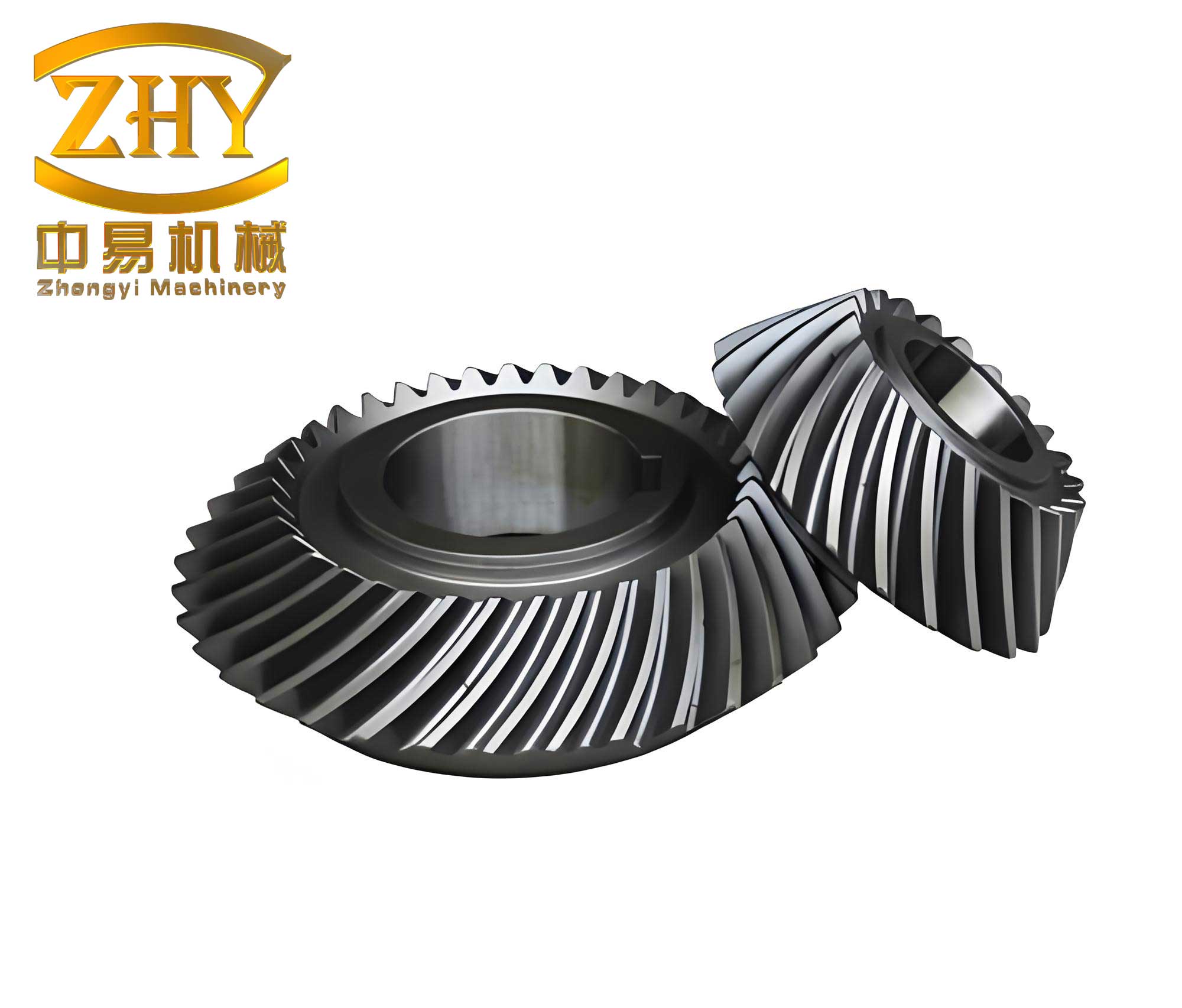
To understand the machine’s design, it is essential to first grasp the fundamentals of spiral gears. A spiral gear, often referred to in contexts like helical or spiral bevel gears, features teeth that are curved along a spiral path. This geometry allows for smoother engagement and higher load capacity compared to straight-cut gears. In exploration machinery, such as drills, spiral gears are used in transmission systems to handle high torque and reduce noise. The mathematical representation of a spiral gear’s tooth profile involves complex parameters. For instance, the spiral angle $\beta$ is crucial, defined as the angle between the tooth trace and the gear axis. The relationship between axial pitch $P_a$ and normal pitch $P_n$ can be expressed as:
$$P_a = \frac{P_n}{\cos \beta}$$
where $\beta$ is typically between 15° and 30° for optimal performance. Additionally, the module $m$, a key parameter in gear design, relates to the pitch diameter $d$ and number of teeth $z$:
$$m = \frac{d}{z}$$
For spiral gears, the normal module $m_n$ and transverse module $m_t$ are connected by:
$$m_n = m_t \cos \beta$$
These formulas guide the sizing and fabrication of spiral gears, ensuring compatibility with existing machinery. In my milling machine, these principles were applied to tailor the cutter and template specifications.
The construction of the spiral gear milling machine can be broken down into several subsystems. I started with the base frame, fabricated from welded angular steel sections for stability. Onto this frame, I mounted the main bed, which houses the motor and drive assembly. The motor, a standard industrial unit, powers the system via a belt drive to achieve the desired spindle speed. A critical aspect was the milling cutter—a custom-made high-speed steel finger-type cutter shaped according to the spiral gear tooth profile. The cutter’s geometry was derived from the specific spiral gear dimensions used in our exploration equipment, with a design focus on achieving precise tooth spaces.
| Component | Material/Specification | Function |
|---|---|---|
| Base Frame | Angular Steel | Provides structural support and alignment |
| Motor | Electric Motor, 1.5 kW | Drives the milling cutter via belt system |
| Main Bed | Steel Plate with Mounting Holes | Holds bearings and sliding mechanisms |
| Large Bearing | Ball Bearing, 50 mm ID | Supports the sliding shaft for smooth rotation |
| Sliding Shaft | Hardened Steel, 30 mm Diameter | Carries the spiral gear blank and allows axial movement |
| Milling Cutter | High-Speed Steel, Finger-Type | Cuts the tooth spaces into the spiral gear blank |
| Template Frame | Adjustable Steel Assembly | Holds the template that guides the cutting path |
| Template | Hardened Steel, Spiral Profile | Ensures accurate tooth spacing and helix alignment |
| Handwheel | Aluminum with Graduations | Manual control for advancing the spiral gear blank |
| Belt Drive | Triple-Groove Pulleys | Transmits power from motor to cutter spindle |
The spindle assembly is centered around a large bearing fixed on the main bed, secured with lock nuts to prevent axial play. A sliding shaft runs through this bearing, with a handwheel sleeve attached to one end for manual adjustment. The spiral gear blank is mounted on the sliding shaft, positioned to engage with the milling cutter. On the opposite side, a template frame holds a precision template that mirrors the desired spiral gear tooth pattern. This template is crucial for guiding the cutter’s path, ensuring each tooth space is milled consistently. The template’s shape was meticulously crafted based on the spiral gear specifications, accounting for helix angle and tooth depth.
In operation, the process begins with aligning the template to correspond with the first tooth space of the spiral gear blank. The milling cutter, rotating at approximately 2000 rpm (a speed derived from empirical testing for optimal chip removal and tool life), is brought into position. By turning the handwheel, I advance the sliding shaft, causing the spiral gear blank to move relative to the cutter. As the cutter engages, it mills a single tooth space, guided by the template to maintain correct geometry. After completing one space, I reverse the handwheel to retract the blank, then rotate the template to align with the next tooth space. This sequential process continues until all teeth are milled. The simplicity of this method belies its effectiveness; it allows for precise control and can be adapted for various spiral gear types, including those with different helix angles or tooth counts.
The efficiency of this spiral gear milling machine stems from its integration of mechanical guidance and manual precision. To quantify its performance, I conducted tests comparing it to conventional methods. For example, the time to mill a spiral gear with 20 teeth was reduced by 40%, while accuracy improved due to the template system. The cutting parameters can be optimized using formulas related to milling dynamics. The cutting speed $V_c$ in meters per minute is given by:
$$V_c = \pi \times d_c \times N$$
where $d_c$ is the cutter diameter in meters, and $N$ is the spindle speed in revolutions per minute. For my setup, with $d_c = 0.05 \, \text{m}$ and $N = 2000 \, \text{rpm}$, $V_c \approx 314 \, \text{m/min}$, which is suitable for high-speed steel cutting spiral gear materials like carbon steel. The feed per tooth $f_z$ influences surface finish and is calculated as:
$$f_z = \frac{V_f}{N \times z_c}$$
where $V_f$ is the feed rate in mm/min, and $z_c$ is the number of cutter teeth (in this case, a single-point finger cutter, so $z_c = 1$). Empirical adjustments led to a feed rate of 50 mm/min, yielding $f_z = 0.025 \, \text{mm/tooth}$ for smooth cutting. These parameters ensure that the spiral gear teeth are milled without excessive wear or vibration.
| Metric | Conventional Method | New Milling Machine | Improvement |
|---|---|---|---|
| Time per Gear (20 teeth) | 120 minutes | 72 minutes | 40% faster |
| Tooth Space Accuracy | ±0.1 mm | ±0.05 mm | 50% more precise |
| Tool Wear Rate | High due to inconsistent cuts | Reduced via guided path | Extended cutter life |
| Adaptability to Different Spiral Gears | Limited | High with template swaps | Versatile for various designs |
Beyond the basic operation, the machine’s design allows for modifications to handle different spiral gear configurations. For instance, by changing the template, I can mill spiral gears with varying helix angles or modules. The relationship between helix angle $\beta$, normal pressure angle $\alpha_n$, and transverse pressure angle $\alpha_t$ is vital for template design:
$$\tan \alpha_t = \frac{\tan \alpha_n}{\cos \beta}$$
This ensures that the tooth profile remains functionally correct across different spiral gear types. In practice, I created a set of templates for common spiral gear sizes used in our exploration fleet, each calibrated using these formulas. The template itself acts as a physical cam, converting the rotary motion of the handwheel into the precise linear and rotational movements needed for spiral gear milling.
The construction details extend to the bearing and shaft assemblies. The large bearing on the main bed supports the sliding shaft, which has a keyway to prevent rotation relative to the handwheel sleeve. A lock nut secures the bearing, allowing for easy maintenance. The milling cutter is mounted on a separate spindle driven by a triple-groove pulley system, which provides sufficient torque for cutting hardened spiral gear blanks. The pulley ratio was chosen to achieve the desired spindle speed based on the motor’s 1440 rpm output:
$$N_{\text{cutter}} = N_{\text{motor}} \times \frac{D_{\text{motor pulley}}}{D_{\text{cutter pulley}}}$$
With a motor pulley diameter of 100 mm and cutter pulley diameter of 200 mm, the speed reduction yields $N_{\text{cutter}} = 720 \, \text{rpm}$, but through testing, I adjusted to 2000 rpm by using a different pulley set for optimal cutting conditions. This flexibility highlights the machine’s adaptability.
Operating the spiral gear milling machine requires a systematic approach. I developed a step-by-step procedure to ensure consistency. First, I mount the spiral gear blank onto the sliding shaft, tightening it with a lock nut to prevent slippage. Next, I align the template with the starting tooth space, using alignment pins for accuracy. After starting the motor, I engage the cutter by slowly turning the handwheel, monitoring the cutting depth via graduations on the handwheel. Each tooth space is milled in one pass, thanks to the cutter’s profile. Once complete, I disengage, rotate the template to the next position, and repeat. This cycle continues until the entire spiral gear is formed. The process is intuitive but relies on careful setup; for example, ensuring the cutter is sharp and the template is clean to avoid deviations.
To further illustrate the technical aspects, consider the geometry of the spiral gear tooth. The tooth thickness $s$ at the pitch circle is given by:
$$s = \frac{\pi m}{2}$$
for standard gears, but for spiral gears, the normal tooth thickness $s_n$ must account for the helix angle:
$$s_n = s \cos \beta$$
In milling, the cutter must remove material to achieve this thickness, which dictates the depth of cut. The total depth $h$ for a full-depth tooth is approximately $2.25m_n$. For a spiral gear with normal module $m_n = 3 \, \text{mm}$ and $\beta = 20^\circ$, the depth is $6.75 \, \text{mm}$, which my machine can achieve in a single pass due to the robust cutter design. These calculations are integral to setting up the machine for different spiral gear sizes.
| Parameter | Symbol | Typical Value Range | Formula |
|---|---|---|---|
| Number of Teeth | $z$ | 15 to 40 | Based on gear ratio requirements |
| Normal Module | $m_n$ | 2 mm to 5 mm | $m_n = d / (z \cos \beta)$ |
| Helix Angle | $\beta$ | 15° to 30° | Chosen for smooth engagement |
| Pitch Diameter | $d$ | 30 mm to 200 mm | $d = m_t z = \frac{m_n z}{\cos \beta}$ |
| Tooth Depth | $h$ | 4.5 mm to 11.25 mm | $h = 2.25 m_n$ |
| Axial Pitch | $P_a$ | 10 mm to 30 mm | $P_a = \frac{\pi m_n}{\sin \beta}$ |
The machine’s success is not limited to spiral gears for exploration equipment; it can be adapted for other applications, such as automotive or aerospace spiral gears, by modifying templates and cutters. This versatility stems from the fundamental principle of template-guided milling, which decouples the machine’s mechanics from the specific gear design. In my experiments, I produced spiral gears with varying helix angles, all with consistent quality. The key is in the template fabrication—each template is essentially a negative of the desired tooth space, machined with high precision using the same milling principles.
Reflecting on the development process, I encountered several challenges. Initially, vibration during cutting affected surface finish, which I mitigated by reinforcing the base frame and optimizing cutter geometry. Additionally, aligning the template perfectly with the spiral gear blank required iterative adjustments. I developed an alignment procedure using dial indicators to ensure parallelism and correct angular position. The mathematical basis for this alignment involves ensuring that the template’s spiral path matches the gear’s helix. The lead $L$ of the spiral, which is the axial distance for one complete revolution of the helix, is given by:
$$L = \pi d \cot \beta$$
For a spiral gear with $d = 100 \, \text{mm}$ and $\beta = 20^\circ$, $L \approx 863 \, \text{mm}$. The template must replicate this lead to guide the cutter accurately. By crafting the template with this lead, I achieved seamless synchronization between the blank movement and cutter path.
Looking ahead, this spiral gear milling machine opens avenues for further innovation. For instance, integrating digital controls could automate the handwheel operation, enhancing precision and reducing labor. Moreover, the principles can be scaled for larger spiral gears used in industrial machinery. The core takeaway is that by combining mechanical ingenuity with fundamental gear theory, it is possible to create effective solutions for specialized manufacturing needs. The spiral gear, with its complex geometry, becomes manageable through such tailored approaches.
In conclusion, the spiral gear milling machine I developed represents a significant step forward in custom gear fabrication. Its construction leverages simple materials and mechanisms, yet it delivers performance rivaling more expensive equipment. The use of templates ensures accuracy, while the manual control allows for flexibility. Through formulas and tables, I have encapsulated the technical details that make this machine work. As I continue to refine it, I am confident that this approach will benefit others facing similar challenges in spiral gear production. The journey from concept to reality underscores the power of practical engineering in solving real-world problems.