
In the field of high-precision robotics, the rotary vector reducer stands as a cornerstone technology for joint actuation. Its exceptional combination of compact size, high torque density, large reduction ratio, and excellent torsional stiffness makes it indispensable. The core of its performance lies in the secondary reduction stage, the cycloidal-pin gear drive. The geometry and meshing characteristics of the cycloidal gear directly dictate the reducer’s transmission accuracy, efficiency, backlash, load distribution, and ultimately, its operational lifespan. Therefore, the precise design and optimization of the cycloidal gear profile is paramount for advancing rotary vector reducer technology. This article delves into a multi-objective optimization strategy for cycloidal gear modification, employing a Genetic Algorithm to refine the profile for superior performance.
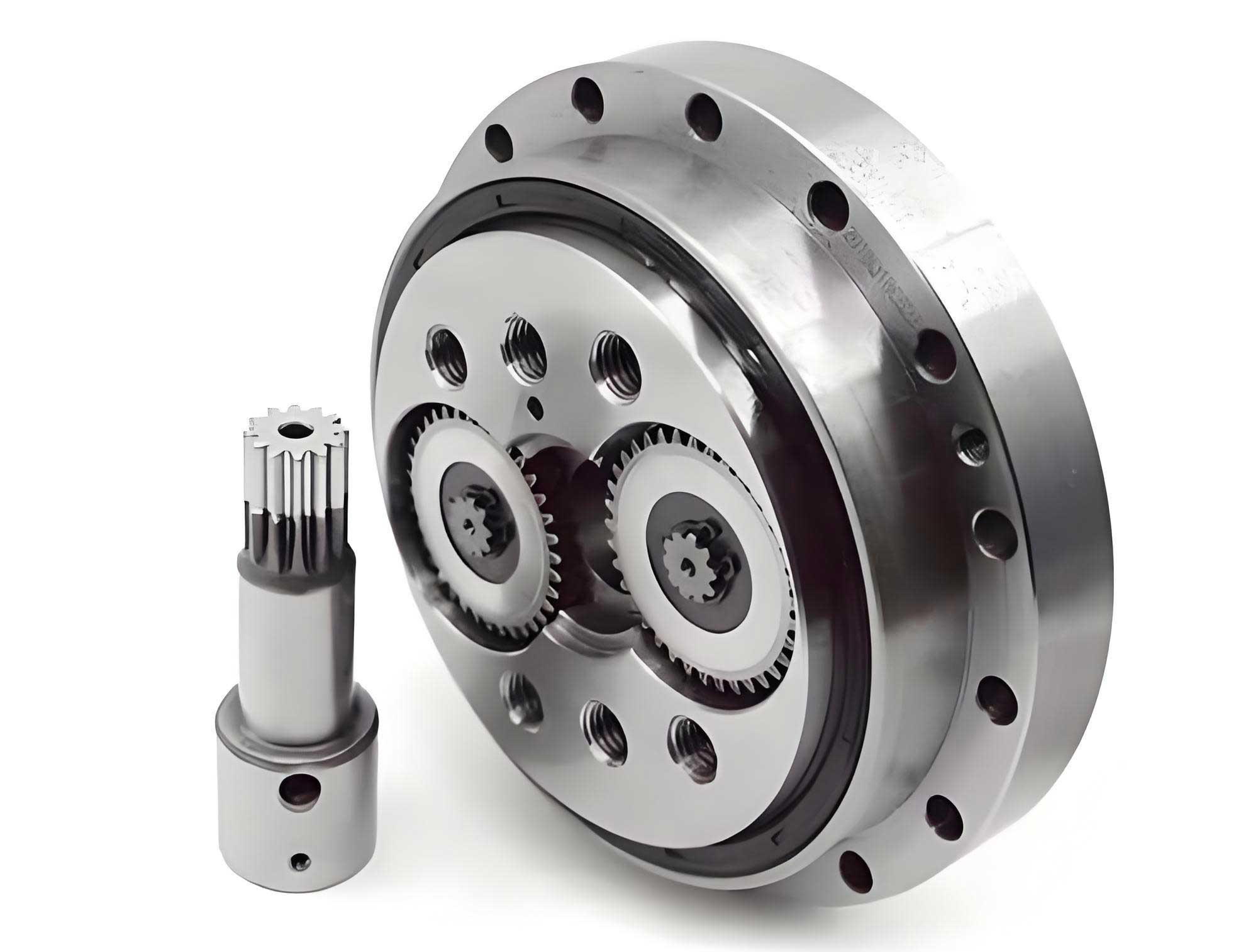
The standard cycloidal gear profile is derived from a pure rolling circle generating a curve on another circle. However, the theoretical profile is unsuitable for a practical rotary vector reducer. Without modification, assembly and smooth operation would be impossible due to interference and the lack of lubrication space. The primary goals of profile modification are to introduce controlled clearance for lubrication, prevent jamming under load and manufacturing tolerances, optimize the load distribution across multiple teeth, and minimize transmission error and backlash to enhance positioning accuracy. Various modification methods exist, including equidistant modification, shift-distance modification, and their combinations, each affecting the gear’s performance parameters differently.
Mathematical Foundation of the Standard and Modified Cycloidal Profile
The standard profile of a cycloidal gear, relative to its own center, is defined by the following parametric equations derived from the trochoidal generation principle:
$$ x_c = (r_p – r_{rp} \cdot S) \cos[(1 – i_H)\theta] – (a – k r_{rp} \cdot S) \cos(i_H \theta) $$
$$ y_c = (r_p – r_{rp} \cdot S) \sin[(1 – i_H)\theta] + (a – k r_{rp} \cdot S) \sin(i_H \theta) $$
Where the auxiliary variables are defined as:
$$ S = (1 + k^2 – 2k \cos \theta)^{-0.5}, \quad k = \frac{a z_p}{r_p} $$
The key geometric parameters are defined in the following table:
| Symbol | Description |
|---|---|
| $$ r_p $$ | Radius of the pin circle (pitch circle of the pin gear). |
| $$ r_{rp} $$ | Radius of the cylindrical pins. |
| $$ a $$ | Eccentricity (crank offset). |
| $$ z_p $$ | Number of pins (teeth of the pin gear). |
| $$ z_c $$ | Number of lobes (teeth) on the cycloidal gear ($$ z_c = z_p – 1 $$). |
| $$ \theta $$ | Generation angle parameter ($$ \theta \in [0, 2\pi] $$). |
| $$ i_H $$ | Transmission ratio of the cycloid stage ($$ i_H = \frac{z_p}{z_p – 1} $$). |
| $$ k $$ | Short-width coefficient. |
For a functional rotary vector reducer, the theoretical profile must be altered. Among the various techniques, the combined method of positive equidistant modification and negative shift-distance modification is widely regarded as effective. This approach introduces necessary clearances while optimizing the contact pattern. Positive equidistant modification ($$ \Delta r_{rp} > 0 $$) effectively increases the pin radius, creating a uniform gap around the entire profile. Negative shift-distance modification ($$ \Delta r_p < 0 $$) reduces the pin circle radius, which can help adjust the meshing clearance in the working zone and improve force distribution. The modified profile equations become:
$$ x_{c1} = \left[ (r_p + \Delta r_p) – (r_{rp} + \Delta r_{rp}) \cdot S_1 \right] \cos[(1 – i_H)\theta] – \left[ \frac{a (r_p + \Delta r_p)}{r_p} – k_1 (r_{rp} + \Delta r_{rp}) \cdot S_1 \right] \cos(i_H \theta) $$
$$ y_{c1} = \left[ (r_p + \Delta r_p) – (r_{rp} + \Delta r_{rp}) \cdot S_1 \right] \sin[(1 – i_H)\theta] + \left[ \frac{a (r_p + \Delta r_p)}{r_p} – k_1 (r_{rp} + \Delta r_{rp}) \cdot S_1 \right] \sin(i_H \theta) $$
Where the modified coefficients are:
$$ S_1 = (1 + k_1^2 – 2k_1 \cos \theta)^{-0.5}, \quad k_1 = \frac{a z_p}{r_p + \Delta r_p} $$
The challenge lies in determining the optimal values for $$ \Delta r_{rp} $$ and $$ \Delta r_p $$. Traditional methods rely heavily on empirical knowledge and iterative prototyping, which is time-consuming and may not guarantee a globally optimal solution. This is where computational optimization techniques, specifically multi-objective genetic algorithms, offer a powerful alternative for the design of rotary vector reducer components.
Multi-Objective Optimization Framework using a Genetic Algorithm
A Genetic Algorithm (GA) is a robust, population-based metaheuristic inspired by natural selection. It is particularly suited for complex, non-linear, multi-modal optimization problems where traditional gradient-based methods struggle. The process involves creating a population of potential solutions (individuals), encoding them typically as chromosomes (strings of numbers), and iteratively improving them through selection, crossover, and mutation operations.
For our rotary vector reducer cycloid gear problem, we define the optimization as follows:
1. Design Variables: The two modification values are our variables.
$$ \mathbf{X} = [\Delta r_p,\ \Delta r_{rp}]^T $$
We adopt the combined positive equidistant and negative shift-distance strategy, implying:
$$ \Delta r_{rp} > 0 \quad \text{(Positive equidistant)} $$
$$ \Delta r_p < 0 \quad \text{(Negative shift-distance)} $$
2. Objective Functions: We aim to achieve two primary goals simultaneously.
- Objective 1: Backlash Minimization. Transmission backlash is critical for the precision of a rotary vector reducer. An approximate expression for the circumferential backlash, $$ J_t $$, induced by the modifications can be derived:
$$ J_t \approx \frac{2\pi}{z_p} \left( \Delta r_{rp} – \frac{\Delta r_p}{1 – k_1^2} \right) $$
We want to minimize this backlash. Thus, our first objective function is:
$$ f_1(\mathbf{X}) = \min \left| \Delta r_{rp} – \frac{\Delta r_p}{1 – k_1^2} \right| $$ - Objective 2: Proximity to an Ideal Contact Pattern. We often desire the modified profile to approximate a specific “ideal” modified profile, often one that ensures a certain number of tooth pairs are in contact simultaneously for optimal load sharing. Let $$ L_{id}(\theta) $$ represent the normal deviation of this ideal profile from the standard one, and $$ L_{mod}(\theta, \mathbf{X}) $$ represent the deviation of our design profile. We sample these over the expected contact range (e.g., $$ \theta \in [\theta_{start}, \theta_{end}] $$). The second objective is to minimize the root mean square error between them:
$$ f_2(\mathbf{X}) = \min \sqrt{ \frac{1}{N} \sum_{i=1}^{N} \left[ L_{mod}(\theta_i, \mathbf{X}) – L_{id}(\theta_i) \right]^2 } $$
where N is the number of sample points.
Therefore, our multi-objective optimization problem is formally stated as:
$$ \text{Minimize} \quad \mathbf{F}(\mathbf{X}) = [f_1(\mathbf{X}),\ f_2(\mathbf{X})]^T $$
3. Constraints: Practical design imposes several constraints on the rotary vector reducer.
- Tooth Interference Avoidance: The modification must guarantee a positive clearance along the entire non-contact flank to prevent rubbing. This can be expressed as a minimum normal clearance condition: $$ d_{min}(\theta, \mathbf{X}) \ge c_{allowable} $$ where $$ c_{allowable} $$ is a small positive manufacturing/lubrication clearance.
- Strength and Contact Stress: The effective contact ratio and the pressure angle should remain within acceptable limits to ensure durability of the rotary vector reducer.
- Manufacturing Feasibility: The modification values should be within practical grinding or honing limits.
These constraints $$ g_j(\mathbf{X}) \le 0 $$ are handled within the GA using penalty functions, which degrade the fitness of solutions that violate them.
4. Genetic Algorithm Setup: The following parameters are typically configured for solving this rotary vector reducer optimization:
| Parameter | Typical Setting / Description |
|---|---|
| Encoding | Real-valued encoding for $$ \Delta r_p $$ and $$ \Delta r_{rp} $$. |
| Population Size | 50 to 200 individuals. |
| Selection Method | Tournament selection or Pareto-based selection (e.g., NSGA-II). |
| Crossover | Simulated Binary Crossover (SBX). |
| Mutation | Polynomial mutation. |
| Fitness Assignment | Non-dominated sorting and crowding distance calculation (for NSGA-II). |
| Stopping Criterion | Maximum number of generations (e.g., 200-500) or convergence stability. |
Case Study: Optimizing an RV-40E Type Rotary Vector Reducer
To demonstrate the methodology, we apply it to a model analogous to an RV-40E rotary vector reducer. The key geometric parameters are:
| Parameter | Symbol | Value (mm) |
|---|---|---|
| Pin Circle Radius | $$ r_p $$ | 67.5 |
| Pin Radius | $$ r_{rp} $$ | 3.0 |
| Eccentricity | $$ a $$ | 1.5 |
| Number of Pins | $$ z_p $$ | 40 |
The optimization was run with the objectives and constraints defined previously. After convergence, the Genetic Algorithm produces a Pareto Front – a set of non-dominated optimal solutions representing the best trade-offs between minimizing backlash ($$ f_1 $$) and approximating the ideal profile ($$ f_2 $$). An engineer can then select a final design point from this front based on higher-level priorities. For instance, a solution favoring extremely low backlash might be chosen for high-precision applications, even if it deviates slightly more from the ideal contact pattern.
A representative optimal solution from the Pareto set might yield modification values such as:
| Modification Type | Optimal Value (mm) |
|---|---|
| Positive Equidistant Modification ($$ \Delta r_{rp} $$) | +0.052 |
| Negative Shift-Distance Modification ($$ \Delta r_p $$) | -0.082 |
The effectiveness of this optimized profile can be evaluated by analyzing the resulting clearance distribution. The plot of normal clearance versus the roll angle $$ \theta $$ shows a smooth, positive clearance outside the main contact region, with a near-zero clearance in the load-bearing zone—a hallmark of a well-designed rotary vector reducer profile that ensures multiple tooth contact without interference.
Validation and Comparative Analysis
Theoretical optimization must be validated against real-world performance. The optimized profile data is used to manufacture a prototype cycloidal gear. Performance is then evaluated through:
1. Transmission Error Measurement: The rotary vector reducer’s input and output angles are measured under light load. The optimized gear set should exhibit significantly lower cyclic transmission error compared to one designed with empirical modifications.
2. Backlash Measurement: Standard static backlash measurement techniques confirm that the physical backlash aligns with the theoretically minimized value predicted by the GA optimization.
3. Efficiency Testing: The reducer’s mechanical efficiency across different torque levels is measured. An optimized contact pattern reduces sliding friction and improves efficiency, especially at rated torque.
4. Durability and Stress Analysis: Finite Element Analysis (FEA) of the meshing gears under load shows a more uniform distribution of contact stresses across 6-8 tooth pairs for the optimized profile, compared to a more concentrated stress pattern in a sub-optimally modified gear. This directly translates to improved fatigue life for the rotary vector reducer.
The comparative results can be summarized as follows:
| Performance Metric | Empirical Design | GA-Optimized Design | Improvement |
|---|---|---|---|
| Static Backlash (arcmin) | ~1.5 | ~0.8 | ≈ 47% reduction |
| Peak-to-Peak Transmission Error (arcsec) | ~45 | ~25 | ≈ 44% reduction |
| Mechanical Efficiency at rated torque | ~81% | ~84% | ≈ 3 percentage points |
| Maximum Contact Stress (FEA, MPa) | ~1250 | ~1050 | ≈ 16% reduction |
Conclusion and Future Perspectives
This article has presented a comprehensive framework for the multi-objective optimization of cycloidal gear profiles in rotary vector reducers using a Genetic Algorithm. By mathematically defining the modification problem, establishing dual objectives of backlash minimization and contact pattern control, and incorporating practical design constraints, the GA efficiently navigates the complex design space to find optimal trade-off solutions. The case study demonstrates tangible improvements in key performance indicators, validating the methodology’s superiority over traditional trial-and-error approaches.
The application of advanced computational optimization techniques like GAs represents a significant step forward in the design and manufacturing of high-performance rotary vector reducers. It enables a systematic, performance-driven design process that directly contributes to achieving the high precision, durability, and efficiency demanded by modern robotics and precision machinery. Future work may integrate the GA with high-fidelity dynamic simulation models or thermo-mechanical analyses to optimize for additional objectives like noise, vibration, or thermal deformation, further pushing the boundaries of rotary vector reducer technology.