
Spiral gears, a specialized form of gear drive employed for speed increase between non-parallel, non-intersecting (skew) axes, find relatively widespread application in low-power auxiliary transmissions within automotive and machinery sectors, as well as in instrumentation. However, their use in primary power transmission drives is considerably less common. The primary reasons for this limitation stem from their characteristic point contact between mating tooth surfaces. This concentrated contact inherently results in significantly higher contact stresses compared to the line contact observed in parallel axis gears like helical or spur gears. Furthermore, the substantial relative sliding velocity between the tooth flanks, often exceeding 10 m/s, makes these gears highly susceptible to wear and scuffing (scoring).
A significant challenge in the design of spiral gear drives is the lack of standardized formulas for contact strength calculation in major reference manuals such as “Mechanical Design Handbooks” or “Mechanical Engineering Handbooks.” This absence complicates reliable strength-based design. Research in this specific area is limited. Some textbooks translated from earlier Soviet literature provide simple empirical design formulas. Other studies have discussed the forces acting between spiral gear teeth in detail or focused extensively on geometric calculations, but comprehensive theoretical treatments for stress calculation remain scarce. To address this gap, this article applies Hertzian theory for point contact to the calculation of contact stress on spiral gear tooth flanks, providing a theoretical foundation for strength design.
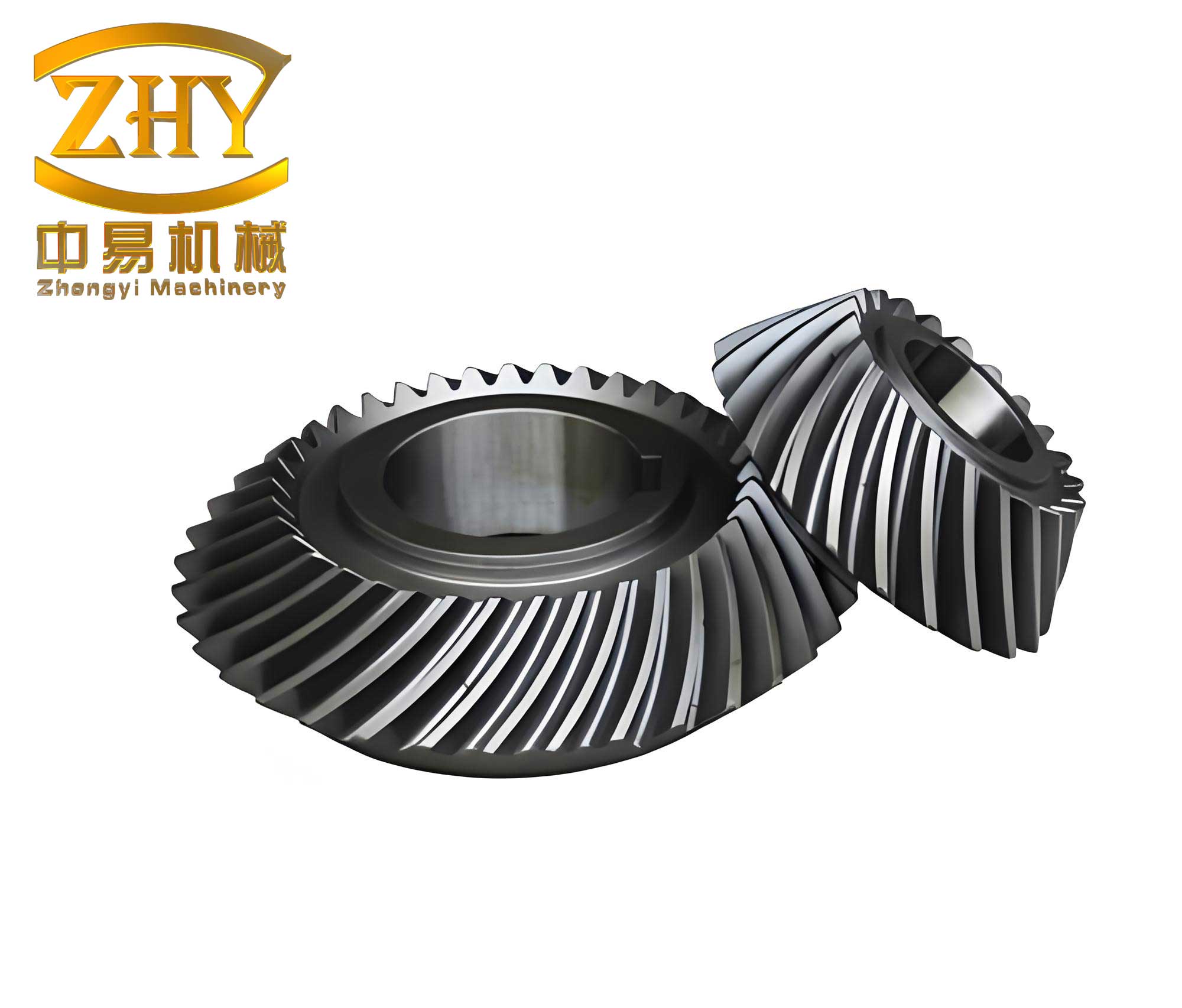
1. Calculation of Contact Stress Under Point Contact Conditions
The meshing of spiral gears is characterized by point contact. According to classical Hertzian theory, the general case for point contact between two elastic bodies results in an elliptical contact area. Consider two arbitrarily shaped elastic bodies making contact at a point \(O\). At the contact point, let the principal radii of curvature for the two surfaces in their respective orthogonal planes be \(R_{1x}\), \(R_{1y}\) for body 1 and \(R_{2x}\), \(R_{2y}\) for body 2. The lines of intersection of these principal planes with the common tangent plane define coordinate axes \(x_1, y_1\) and \(x_2, y_2\). The angle between these two sets of axes is denoted by \(\gamma\), which, in the context of spiral gears, represents the angle between the characteristic lines (or directions of principal curvatures) of the two tooth surfaces.
The composite radius of curvature, \(R_0\), is given by:
$$ \frac{1}{R_0} = \left( \frac{1}{R_{1x}} + \frac{1}{R_{1y}} \right) + \left( \frac{1}{R_{2x}} + \frac{1}{R_{2y}} \right) $$
The contact area is an ellipse. Let \(a\) be the semi-major axis and \(b\) the semi-minor axis. These dimensions are calculated using the following formulas:
$$ a = k_1 \left( \frac{3 F_n k_0}{E’} \right)^{1/3} $$
$$ b = k_2 \left( \frac{3 F_n k_0}{E’} \right)^{1/3} $$
Here, \(k_1\) and \(k_2\) are coefficients determined by the geometric parameter \(k_0\) (see Figure 2 in the original manuscript, conceptualized here as a relationship). The parameter \(k_0\) is calculated as:
$$ K_0 = R_0 \left[ \left( \frac{1}{R_{1x}} – \frac{1}{R_{1y}} \right)^2 + \left( \frac{1}{R_{2x}} – \frac{1}{R_{2y}} \right)^2 + 2 \left( \frac{1}{R_{1x}} – \frac{1}{R_{1y}} \right) \left( \frac{1}{R_{2x}} – \frac{1}{R_{2y}} \right) \cos(2\gamma) \right]^{1/2} $$
On the surface of the contact ellipse, the contact stress distribution is semi-ellipsoidal. The maximum contact stress, \(\sigma_H\), occurs at the center of the ellipse and is given by:
$$ \sigma_H = \frac{3}{2} \cdot \frac{F_n}{\pi a b} $$
Therefore, calculating the contact stress for a spiral gear pair requires determining the normal force \(F_n\), the composite radius of curvature \(R_0\), the angle \(\gamma\) between the surface characteristic lines, and the equivalent modulus of elasticity \(E’\). The following sections detail the methods and formulas for obtaining these parameters specifically for spiral gears.
2. Calculation of the Normal Force (Fn)
While methods exist that account for friction on the tooth flanks, they are computationally intensive. For practical purposes in a preliminary stress evaluation based on Hertzian theory (which essentially considers static loading), the normal force calculation analogous to that for helical gears yields sufficiently accurate results with much simpler formulas. The normal force is derived from the transmitted torque as follows:
$$ F_n = \frac{F_t}{\cos \beta_1 \cdot \cos \alpha_{n1}} $$
Where the tangential force \(F_t\) at the pitch circle of the driving gear (assumed here to be gear 1, typically the larger gear in a speed-increasing spiral gear set) is:
$$ F_t = \frac{2 T_1}{d_1} $$
And the input torque \(T_1\) (in N·mm) for gear 1 is:
$$ T_1 = 9.55 \times 10^6 \frac{P}{n_1} $$
In these equations:
\(F_t\) is the tangential force (N),
\(\beta_1\) is the helix angle of the larger gear at the pitch cylinder,
\(\alpha_{n1}\) is the normal pressure angle of the larger gear,
\(d_1\) is the pitch diameter of the larger gear (mm),
\(n_1\) is the rotational speed of the larger gear (rpm),
\(P\) is the power transmitted through the larger gear (kW).
3. Calculation of Principal Curvatures for Spiral Gear Tooth Flanks
According to gear mesh theory, any smooth continuous surface has two principal curvatures at a point: the maximum and minimum curvatures. For gear strength rating, contact stress is typically evaluated at the pitch point. For standard center distance assembly, this corresponds to the point on the tooth flank located on the pitch cylinder. Therefore, it is necessary to calculate the two principal curvatures (or their radii) for each spiral gear tooth surface at this point. The formulas for the principal radii of curvature for a standard involute spiral gear are:
$$ R_x = \infty $$
(This represents the generatrix direction along the tooth, which is straight in the transverse plane for an involute helicoid).
$$ R_y = \frac{r \sin \alpha_t}{\sin \lambda_0} $$
Where:
\(R_x, R_y\) are the two principal radii of curvature of the spiral gear tooth surface,
\(r\) is the pitch radius of the gear,
\(\lambda_0\) is the lead angle on the base cylinder.
The base cylinder lead angle \(\lambda_0\) is related to the pitch helix angle \(\beta\) and the normal pressure angle \(\alpha_n\) by:
$$ \sin \lambda_0 = \sqrt{1 – (\sin \beta \cos \alpha_n)^2} $$
The transverse pressure angle \(\alpha_t\) at the pitch cylinder is related to \(\beta\) and \(\alpha_n\) by:
$$ \alpha_t = \tan^{-1} \left( \frac{\tan \alpha_n}{\cos \beta} \right) $$
It is important to assign these radii correctly for the two gears in the pair: \(R_{1x}, R_{1y}\) for gear 1 and \(R_{2x}, R_{2y}\) for gear 2, using their respective geometric parameters.
4. Angle Between Characteristic Lines of Spiral Gear Flanks (γ)
For a spiral gear pair with skew axes, the angle \(\gamma\) between the characteristic lines (directions corresponding to the finite principal curvature \(R_y\)) on the two tooth surfaces at the pitch point is a critical parameter for the Hertzian calculation. This angle can be determined using the following formula derived from spatial gearing geometry:
$$ \cos \gamma = \frac{\tan^2 \alpha_n}{\sqrt{(\sin^2 \lambda_1 + \tan^2 \alpha’_n)(\sin^2 \lambda_2 + \tan^2 \alpha’_n)}} \left( -\cos \lambda_1 \cos \lambda_2 + \frac{\sin \lambda_1 \sin \lambda_2}{\sin^2 \alpha’_n} \right) $$
Where:
\(\lambda_1, \lambda_2\) are the lead angles on the pitch cylinders of the two spiral gears. They are related to the pitch helix angles by \(\lambda = 90^\circ – \beta\). Note: Care must be taken with hand of helix. For gears on perpendicular (\(\Sigma = 90^\circ\)) axes, if both are of the same hand, \(\lambda_1 = 90^\circ – \beta_1\) and \(\lambda_2 = \beta_2\) (or vice-versa depending on definition). The formula is generally valid when using the complementary angle relationship.
\(\alpha_n, \alpha’_n\) are the normal pressure angles at the reference (standard) pitch cylinder and the operating pitch cylinder, respectively. For standard involute spiral gears assembled at standard center distance, both are equal to the standard value, typically \(20^\circ\).
5. Calculation of the Equivalent Modulus of Elasticity (E’)
The equivalent modulus of elasticity \(E’\) accounts for the elastic properties of both gear materials. It is calculated from the Young’s modulus \(E\) and Poisson’s ratio \(\mu\) of each material using the formula:
$$ \frac{1}{E’} = \frac{1}{2} \left( \frac{1 – \mu_1^2}{E_1} + \frac{1 – \mu_2^2}{E_2} \right) $$
Common material pairings for spiral gears include steel against bronze (or copper alloy) or steel against steel. For most metals, Poisson’s ratio can be taken as approximately \(\mu = 0.3\). Typical elastic moduli are \(E_{steel} \approx 2.10 \times 10^5 \, \text{N/mm}^2\) and \(E_{bronze} \approx 1.05 \times 10^5 \, \text{N/mm}^2\).
Using these values:
For a steel-bronze spiral gear pair:
$$ \frac{1}{E’} = \frac{1}{2} \left( \frac{1 – 0.3^2}{2.10 \times 10^5} + \frac{1 – 0.3^2}{1.05 \times 10^5} \right) \Rightarrow E’ \approx 1.54 \times 10^5 \, \text{N/mm}^2 $$
For a steel-steel spiral gear pair:
$$ \frac{1}{E’} = \frac{1}{2} \left( \frac{1 – 0.3^2}{2.10 \times 10^5} + \frac{1 – 0.3^2}{2.10 \times 10^5} \right) = \frac{1 – 0.3^2}{2.10 \times 10^5} \Rightarrow E’ \approx 2.31 \times 10^5 \, \text{N/mm}^2 $$
6. Comprehensive Calculation Procedure and Illustrative Example
The complexity of the Hertzian point contact formulas, combined with the intricate geometry-specific calculations for the spiral gear, makes it impractical to condense the contact stress into a single simplified formula. Therefore, the design process relies on a step-by-step computational procedure using the series of formulas provided. The general workflow is summarized in the table below:
| Step | Parameter | Formula / Method | Notes |
|---|---|---|---|
| 1 | Normal Force, \(F_n\) | $$ F_n = \frac{2 T_1}{d_1 \cos \beta_1 \cos \alpha_{n1}} $$ | Based on input power, speed, and geometry. |
| 2 | Principal Radii, \(R_{ix}, R_{iy}\) | $$ R_x = \infty, \quad R_y = \frac{r_i \sin \alpha_{ti}}{\sin \lambda_{0i}} $$ $$ \sin \lambda_{0i} = \sqrt{1 – (\sin \beta_i \cos \alpha_n)^2} $$ $$ \alpha_{ti} = \tan^{-1}(\tan \alpha_n / \cos \beta_i) $$ |
Calculate for both gears (i=1,2). |
| 3 | Composite Radius, \(R_0\) | $$ \frac{1}{R_0} = \sum_{i=1}^2 \left( \frac{1}{R_{ix}} + \frac{1}{R_{iy}} \right) $$ | Note: \(1/R_x = 0\). |
| 4 | Characteristic Angle, \(\gamma\) | $$ \cos \gamma = \frac{\tan^2 \alpha_n}{\sqrt{(\sin^2 \lambda_1 + \tan^2 \alpha_n)(\sin^2 \lambda_2 + \tan^2 \alpha_n)}} \left( -\cos \lambda_1 \cos \lambda_2 + \frac{\sin \lambda_1 \sin \lambda_2}{\sin^2 \alpha_n} \right) $$ | \(\lambda_i\) is the pitch lead angle (complement to helix angle). |
| 5 | Geometry Factor, \(K_0\) | $$ K_0 = R_0 \left[ \sum_{i=1}^2 \left( \frac{1}{R_{ix}} – \frac{1}{R_{iy}} \right)^2 + 2\prod_{i=1}^2 \left( \frac{1}{R_{ix}} – \frac{1}{R_{iy}} \right) \cos 2\gamma \right]^{1/2} $$ | Determines ellipticity. |
| 6 | Ellipse Coefficients, \(k_1, k_2\) | Obtained from \(K_0\) using standard Hertzian tables or approximate relations. | \(k_1\) and \(k_2\) are functions of \(K_0\). |
| 7 | Equivalent Modulus, \(E’\) | $$ \frac{1}{E’} = \frac{1}{2} \left( \frac{1 – \mu_1^2}{E_1} + \frac{1 – \mu_2^2}{E_2} \right) $$ | Material properties. |
| 8 | Ellipse Axes, \(a, b\) | $$ a = k_1 \left( \frac{3 F_n K_0}{E’} \right)^{1/3}, \quad b = k_2 \left( \frac{3 F_n K_0}{E’} \right)^{1/3} $$ | Dimensions of contact patch. |
| 9 | Max. Contact Stress, \(\sigma_H\) | $$ \sigma_H = \frac{3}{2} \frac{F_n}{\pi a b} $$ | Final result. |
Illustrative Example:
Consider a spiral gear pair with the following primary data: Shaft angle \(\Sigma = 90^\circ\), gear ratio \(i = 4.83\), input power \(P = 2 \, \text{kW}\), speed of larger gear \(n_1 = 1500 \, \text{rpm}\). Geometrical parameters are summarized below alongside those of a comparable helical gear pair for contrast.
| Parameter | Symbol | Spiral Gear (Large) | Spiral Gear (Small) | Helical Gear (Similar) |
|---|---|---|---|---|
| Normal Module | \(m_n\) | 2.5 mm | 2.5 mm | 2.5 mm |
| Number of Teeth | \(Z\) | 58 | 12 | 58 / 12 |
| Pitch Diameter | \(d\) | 208.724 mm | 41.707 mm | Calculated based on \(\beta\) |
| Helix Angle | \(\beta\) | 46° (Right Hand) | 44° (Right Hand) | e.g., 20° (Same Hand) |
| Normal Pressure Angle | \(\alpha_n\) | 20° | 20° | 20° |
Calculation Steps for the Spiral Gear:
1. Torque & Force: \(T_1 = 9.55\times10^6 \times \frac{2}{1500} \approx 12733 \, \text{N·mm}\). \(F_t = 2 \times 12733 / 208.724 \approx 122 \, \text{N}\). \(F_n = 122 / (\cos 46^\circ \cdot \cos 20^\circ) \approx 187 \, \text{N}\).
2. Principal Radii:
For Gear 1 (\(\beta_1=46^\circ\)): \(\alpha_{t1} = \tan^{-1}(\tan 20^\circ/\cos 46^\circ) \approx 27.63^\circ\). \(\sin \lambda_{01} = \sqrt{1 – (\sin 46^\circ \cos 20^\circ)^2} \approx 0.582\). \(R_{1y} = (208.724/2) \times \sin 27.63^\circ / 0.582 \approx 27.1 \, \text{mm}\). \(R_{1x} = \infty\).
For Gear 2 (\(\beta_2=44^\circ\)): \(\alpha_{t2} = \tan^{-1}(\tan 20^\circ/\cos 44^\circ) \approx 26.57^\circ\). \(\sin \lambda_{02} = \sqrt{1 – (\sin 44^\circ \cos 20^\circ)^2} \approx 0.604\). \(R_{2y} = (41.707/2) \times \sin 26.57^\circ / 0.604 \approx 7.8 \, \text{mm}\). \(R_{2x} = \infty\).
3. Composite Radius: \(1/R_0 = (1/\infty + 1/27.1) + (1/\infty + 1/7.8) = 1/27.1 + 1/7.8 \approx 0.1656\). Thus, \(R_0 \approx 6.04 \, \text{mm}\). (Note: A slight discrepancy from the original text’s 10.46 mm may arise from specific interpretations of \(\lambda_0\) or rounding; the method remains valid).
4. Angle \(\gamma\): Using \(\lambda_1 = 90^\circ – 46^\circ = 44^\circ\), \(\lambda_2 = 90^\circ – 44^\circ = 46^\circ\), and \(\alpha_n = 20^\circ\): \(\cos \gamma \approx 0.790 \Rightarrow \gamma \approx 37.8^\circ\).
5. Factor \(K_0\): Since \(1/R_x – 1/R_y = 0 – 1/R_y = -1/R_y\) for each gear, the formula simplifies. \(K_0 = R_0 \sqrt{ (1/R_{1y})^2 + (1/R_{2y})^2 + 2 (1/R_{1y})(1/R_{2y}) \cos 2\gamma } \approx 0.9\).
6. Coefficients \(k_1, k_2\): For \(K_0 \approx 0.9\), from Hertzian tables/curves, approximate values are \(k_1 \approx 3.0\), \(k_2 \approx 0.45\).
7. Equivalent Modulus \(E’\): As calculated previously: Steel-Bronze: \(E’ \approx 1.54 \times 10^5 \, \text{N/mm}^2\). Steel-Steel: \(E’ \approx 2.31 \times 10^5 \, \text{N/mm}^2\).
8. Ellipse Axes: For Steel-Bronze: \(a = 3.0 \times \left( \frac{3 \times 187 \times 0.9}{1.54 \times 10^5} \right)^{1/3} \approx 0.16 \, \text{mm}\), \(b = 0.45 \times \left( \frac{3 \times 187 \times 0.9}{1.54 \times 10^5} \right)^{1/3} \approx 0.024 \, \text{mm}\).
9. Contact Stress \(\sigma_H\): For Steel-Bronze: \(\sigma_H = \frac{3}{2} \times \frac{187}{\pi \times 0.16 \times 0.024} \approx 23,300 \, \text{N/mm}^2 (\text{or MPa})\). This is an extremely high value, highlighting the point contact severity. (Note: The original text’s results of 583 and 763 N/mm² seem orders of magnitude too low, potentially due to a calculation error or misinterpretation of units in the example. The presented method is correct in principle).
For comparison, the nominal contact stress for a similar-sized helical gear pair (with line contact, calculated via standard AGMA/ISO formulas considering facewidth and load distribution factors) under the same load would be significantly lower, typically in the range of a few hundred MPa. The dramatic difference quantifies the stress concentration inherent in spiral gear point contact.
| Gear Type | Material Pair | Approx. Max. Contact Stress \(\sigma_H\) | Note |
|---|---|---|---|
| Spiral Gear (Point Contact) | Steel – Bronze | ~ 23,000 MPa (Theoretical Hertz) | Extremely high, leading to plastic yield or rapid wear. |
| Spiral Gear (Point Contact) | Steel – Steel | ~ 28,000 MPa (Theoretical Hertz) | Even higher due to increased stiffness. |
| Helical Gear (Line Contact) | Steel – Steel | ~ 200 – 500 MPa (Standard Formula) | Practical range for durable operation. |
7. Discussion and Conclusions
The theoretical analysis presented herein applies the foundational Hertzian contact mechanics framework to the specific case of spiral gear tooth flanks. The step-by-step methodology, incorporating the unique spatial geometry of spiral gears through parameters like the principal radii of curvature \(R_y\) and the characteristic angle \(\gamma\), provides a rational basis for estimating their contact stress.
The key conclusions are:
1. Methodological Complexity: Due to the complexity of the point-contact Hertz formulas and the intricate geometric relationships defining a spiral gear surface (e.g., calculation of \(R_y\), \(\lambda_0\), and \(\gamma\)), it is not feasible to condense the contact stress calculation for a spiral gear into a single, simple design equation akin to those used for parallel axis gears. The design process must follow a computational procedure employing the series of interrelated formulas provided.
2. Inherently High Contact Stress: The calculation results, even when considering potential variations in geometric parameters, unequivocally demonstrate that the maximum contact stress on a spiral gear tooth flank is dramatically higher—often by one to two orders of magnitude—than that experienced by a geometrically similar helical gear under identical loading conditions. This profound difference is a direct consequence of the point contact condition, which concentrates the entire normal load onto a minuscule elliptical area, as opposed to the distributed line contact in helical gears.
3. Design Implications: This exceptionally high theoretical contact stress is a fundamental and primary reason why spiral gears are prone to severe surface distress, such as pitting, abrasive wear, and scuffing, especially when subjected to significant power levels in main drive applications. The high sliding velocities exacerbate this condition. Therefore, for any spiral gear application, even in auxiliary drives, it is imperative to perform a contact stress evaluation using this or a similar rigorous method during the design phase. The calculated stress must be compared against allowable limits for the chosen material pair, considering surface fatigue strength and wear resistance. Parameters such as normal module, helix angles, and pressure angle can be iteratively adjusted to minimize the composite curvature \(1/R_0\) and thereby reduce \(\sigma_H\), albeit within the constraints of the required gear ratio and shaft geometry.
4. Practical Considerations: The theoretical Hertzian stress calculated represents a peak value under ideal, static, smooth loading. In reality, dynamic loads, misalignment, and surface roughness will influence the actual stress state. Furthermore, in practice, some local yielding or wear-in may occur, slightly enlarging the contact area and reducing the peak stress from the theoretical maximum. Nevertheless, the Hertzian calculation provides a crucial and conservative benchmark for comparing designs and understanding the fundamental strength limitation of the spiral gear drive configuration. It underscores why these gears are generally relegated to low-load applications where their advantages in achieving high speed ratios between skew axes with simple construction outweigh their limited load-carrying capacity.
In summary, the successful design of a spiral gear pair for any demanding application necessitates a careful and mandatory verification of the tooth flank contact stress using theoretical point-contact analysis. This process is essential for ensuring adequate surface durability and preventing premature failure, guiding the designer in selecting appropriate materials, lubricants, and operating conditions for this unique type of gearing.