
The transition towards more efficient, quieter, and environmentally friendly automotive systems has consistently driven innovation in component design and manufacturing. Among these critical components, the compressor in an automotive air conditioning system plays a pivotal role. For years, the core technology for high-performance compressors, particularly the sophisticated spiral gear pairs within them, was closely guarded by a few international manufacturers, leading to significant reliance on imports. This situation presented a substantial challenge and an opportunity. Our mission was to achieve complete domestic capability in designing and mass-producing these precision spiral gears, thereby breaking the technological monopoly, securing the supply chain, and contributing to the national industrial advancement. This document details the comprehensive journey, from reverse engineering and theoretical analysis to the pioneering manufacturing solutions developed to overcome the formidable challenges associated with high-volume production of miniature, high-precision spiral gears.
The target component was a matched pair of spiral gears for a new generation of swashplate-type compressors. Compared to their straight-tooth predecessors, these spiral gears offered markedly superior performance, including smoother operation and significantly reduced noise and vibration—critical factors for passenger comfort. However, this performance came at the cost of immense manufacturing complexity. The primary technical hurdles are summarized in the table below, which formed our foundational quality benchmark.
| Technical Parameter | Specification / Tolerance | Standard/Remarks |
|---|---|---|
| Module | 2.0 | – |
| Tooth Form Accuracy | Grade 4 | JSB1704-1978 |
| Single Pitch Error ($f_{pt}$) | ≤ 0.045 mm | – |
| Adjacent Pitch Error ($f_{pu}$) | ≤ 0.058 mm | – |
| Total Cumulative Pitch Error ($F_p$) | ≤ 0.190 mm | – |
| Runout of the Gear Ring ($F_r$) | ≤ 0.071 mm | – |
| Runout of Sphere Center to Cone Center | ≤ Ø 0.15 mm | – |
| Surface Roughness of Sphere | Ra ≤ 0.4 µm | – |
These specifications demanded a level of precision typically associated with finishing processes, yet our goal was to achieve the tooth geometry net-shape through forging, eliminating post-forge machining on the tooth flanks. This ambition set the stage for a multi-disciplinary development effort encompassing design, metallurgy, precision forging, and heat treatment.
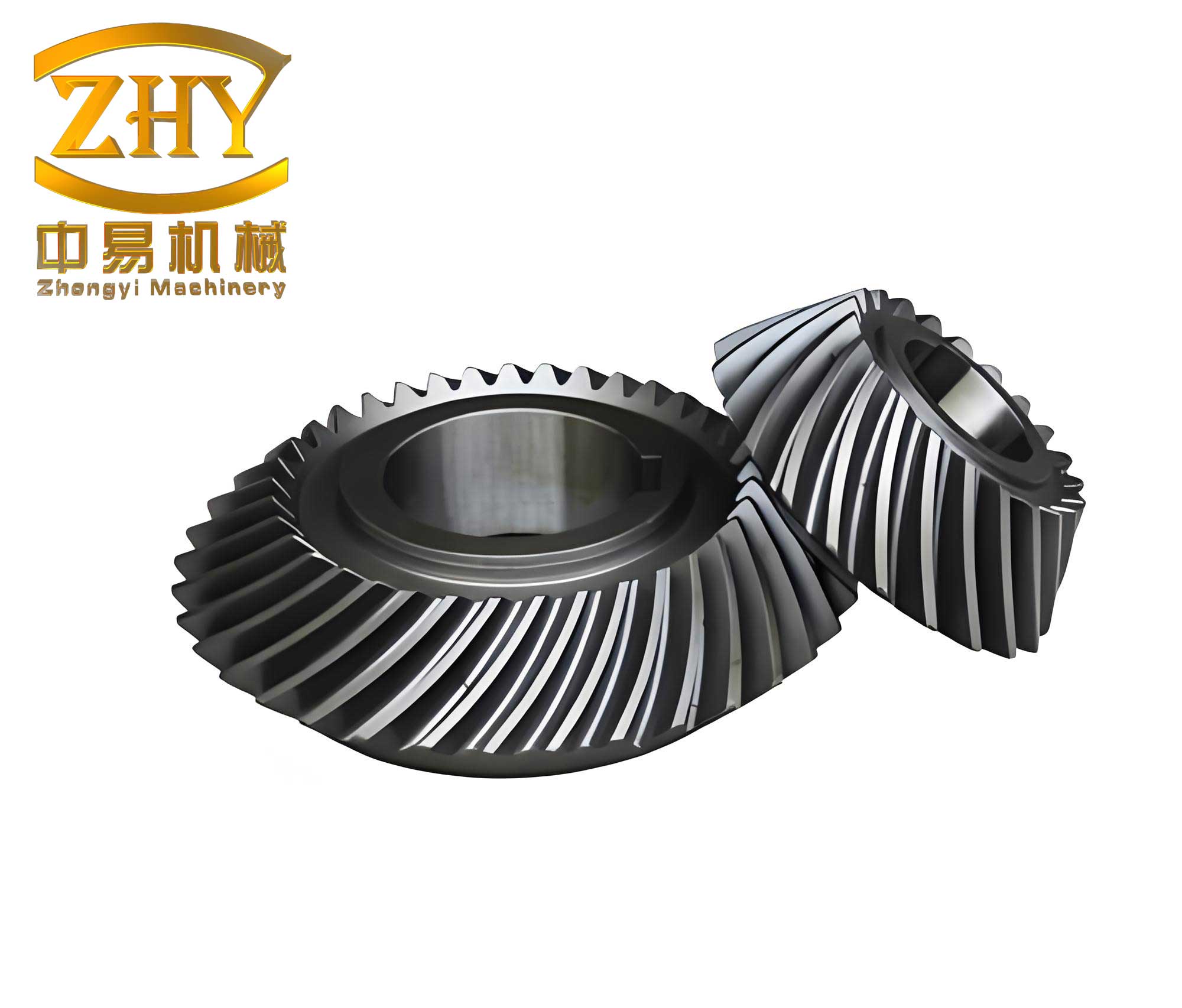
Theoretical Foundation and Design Challenges of the Spiral Gear
The fundamental advantage of a spiral gear over a straight bevel gear lies in its gradual tooth engagement. The tooth trace is curved, ensuring that contact between mating teeth begins at one end and progresses smoothly across the face width. This results in multiple teeth being in contact at any given time, which drastically reduces noise and increases load capacity. The geometry is defined by parameters beyond standard bevel gears, primarily the spiral angle ($\beta$). For a given pitch diameter ($d$) and face width ($b$), the mean spiral angle is crucial for determining contact patterns and bending strength. The kinematic relationship and force vectors are also more complex. The separating force ($F_s$), thrust force ($F_t$), and radial force ($F_r$) on a spiral gear tooth can be approximated as functions of the transmitted tangential force ($F_u$), pressure angle ($\alpha$), and spiral angle ($\beta$):
$$
F_s \approx F_u \cdot \tan(\alpha) \cdot \cos(\beta)
$$
$$
F_t \approx F_u \cdot \tan(\beta)
$$
This complex force distribution necessitates exceptional dimensional stability and core strength from the gear material and manufacturing process. Any deviation in the forged spiral angle or tooth profile would not only increase noise but also create localized stress concentrations, leading to premature pitting or fracture under the compressor’s high-cycle fatigue conditions.
Material Science and Forging Electrode Creation
The choice of material was the first critical decision. The selected steel had to fulfill contradictory requirements: it must be malleable enough to flow intricately into the fine, helical tooth cavities during forging, yet after heat treatment, it must possess the high surface hardness for wear resistance and a tough core to withstand impact and bending stresses. After extensive testing of various alloy steels, a specialized case-hardening steel with a carefully balanced composition of chromium, nickel, and molybdenum was chosen for its superior hardenability and fine-grained structure post-forging.
The precision of the final forged spiral gear is fundamentally limited by the precision of the forging die. The die, in turn, is manufactured using an electrode that is a perfect negative of the desired tooth form. Creating this electrode was a monumental challenge. We utilized a state-of-the-art Gleason hypoid generator to machine the electrode. This machine’s ability to precisely control the cradle rotation and cutter head tilt was essential for generating the correct localized tooth geometry and spiral angle. The electrode’s accuracy was verified to be within a 0.04 mm envelope, establishing the absolute ceiling for the forged gear’s potential accuracy.
Precision Forging: The Core Innovation
Conventional forging processes were incapable of producing a net-shape spiral gear with a module of 2.0. The initial trials using standard single-cavity dies resulted in catastrophic failure—the thin, helical teeth either failed to fill completely or exhibited severe twisting and springback upon ejection from the die. The root cause was uncontrolled metal flow and excessive friction. The solution required innovations in both die material and process design.
The die material itself had to be upgraded. Standard hot-work tool steels lacked the necessary combination of high-temperature strength, thermal fatigue resistance, and polishability to achieve the required surface finish on the forged teeth. A premium grade of martensitic stainless hot-work tool steel, characterized by high tungsten and vanadium content, was selected. Its key properties are summarized below:
| Property | Value/Range | Significance for Spiral Gear Forging |
|---|---|---|
| High-Temperature Yield Strength | > 1000 MPa @ 600°C | Resists deformation under forging pressure, maintaining tooth profile. |
| Thermal Conductivity | Moderate | Balances heat extraction to prevent die surface overheating. |
| Polished Surface Finish | Can achieve Ra < 0.1 µm | Directly imparts a smooth surface to the forged spiral gear teeth. |
| Toughness (KIC) | High | Resists crack initiation from thermal cycling and high stress. |
Even with the superior die material, the initial multi-step process (preform, pre-forge, trim, reheat, finish-forge, trim) was inefficient for mass production. The breakthrough was the conceptualization and implementation of a “Two-Station” forging system. This innovative die holder integrated both the pre-forging and finish-forging cavities into a single, indexable upper die assembly. The process flow was revolutionized:
- Old Process: Cut → Heat → Preform → Pre-forge → Trim → Clean → Reheat → Finish-forge → Trim.
- New Two-Station Process: Cut → Heat → Preform/Pre-forge (Station 1) → Index → Finish-forge (Station 2) → Trim.
This innovation eliminated one entire heating cycle, reduced handling, minimized scale formation, and dramatically increased production rate while improving dimensional consistency between pre-form and final forge. The schematic of this concept, though simplified, illustrates the principle of sequential forming within a single press stroke cycle.
Precision Heat Treatment: Balancing Hardness and Toughness
Heat treatment is where the spiral gear acquires its final service properties. The goal is a hard, wear-resistant case enveloping a tough, ductile core. For straight-tooth gears, established parameters sufficed. However, the thin web and delicate teeth of the spiral gear made it extraordinarily sensitive to heat treatment parameters. Initial batches, treated with protocols for larger gears, passed standard hardness tests but failed dramatically in endurance testing, exhibiting tooth core fracture after several hundred hours.
Metallurgical analysis revealed the issue: excessive case depth. While the surface hardness was correct, the deep carburization had turned a significant portion of the thin tooth cross-section into brittle, high-carbon martensite, eliminating the crucial tough core. The heat treatment parameters had to be meticulously recalibrated. The optimized parameters are defined by the following equations and targets:
The effective case depth (ECD) is defined as the depth from the surface to the point where hardness drops to 550 HV. For the tooth flank at the pitch line:
$$
ECD_{pitch} = 0.60 \text{ to } 0.85 \text{ mm}
$$
For the critical spherical bearing surface, a shallower case was specified to maintain subsurface ductility:
$$
ECD_{sphere} \geq 0.30 \text{ mm}
$$
The final hardness gradient and microstructural requirements were strictly defined, as shown in the table below, ensuring optimal performance for the spiral gear.
| Location | Hardness / Microstructure Requirement | Purpose |
|---|---|---|
| Tooth Flank (Surface) | 664 – 766 HV1 (58 – 62 HRC) | Maximum wear resistance and contact fatigue strength. |
| Tooth Core (at centerline) | 290 – 436 HV1 (30 – 42 HRC) | High toughness to absorb impact and resist bending fracture. |
| Microstructure at Pitch Line | Martensite & Retained Austenite ≤ Grade 3 | Controls brittleness and dimensional stability. |
| Microstructure at Tooth Tip | Carbides ≤ Grade 3 | Prevents brittle networks of carbides that initiate cracks. |
A controlled atmosphere carburizing process followed by a direct quench and low-temperature tempering was perfected to achieve this precise gradient consistently, batch after batch.
Quality Assurance and Performance Validation
Every lot of spiral gears undergoes rigorous inspection. Dimensional checks for critical features like the keyway symmetry (≤ 0.05 mm) and bore diameter are performed using CMMs. The tooth geometry is verified on specialized gear inspection equipment against the $f_{pt}$, $f_{pu}$, $F_p$, and $F_r$ parameters defined initially. Surface hardness and case depth are confirmed using micro-hardness testers. Finally, the gears are subjected to a full spectrum of performance tests in a compressor test bench, simulating real-world conditions. The acceptance criteria for noise and durability, derived from international standards, are stringent:
| Test Type | Conditions | Acceptance Criterion |
|---|---|---|
| Noise Test | @ 1,000 rpm | ≤ 77 dB(A) |
| Noise Test | @ 2,000 rpm | ≤ 82 dB(A) |
| Noise Test | @ 3,000 rpm | ≤ 88 dB(A) |
| Endurance Test | 400h @ 900 rpm + 500h @ 5500 rpm + 800h @ 7000 rpm | No functional failure, abnormal wear, or noise escalation. |
The successful passage of these tests is the ultimate validation of the entire development and manufacturing process for the spiral gear.
Conclusion and Broader Impact
The successful development and industrialization of this high-precision spiral gear represents a significant technological achievement. It involved overcoming a series of interconnected challenges: mastering the complex geometry, pioneering net-shape precision forging of miniature helical teeth, developing specialized die materials and a novel two-station forging process, and calibrating a heat treatment protocol that balances extreme surface hardness with vital core toughness. This end-to-end capability has not only rendered the import of these specific parts obsolete but has also established a foundational knowledge base and manufacturing platform. The technologies refined here—particularly in precision forging of complex geometries—are directly transferable to other automotive and industrial applications requiring high-strength, quiet-running gearing solutions. The project stands as a testament to the viability and competitiveness of advanced domestic manufacturing, turning a critical dependency into a core strength and paving the way for future innovations in powertrain and auxiliary system components.