
In my extensive work on automotive transmission systems, I have focused on enhancing the performance of critical components like the drive cylindrical gear shaft. This gear shaft serves as the power input shaft in heavy-duty through-drive axles, transmitting torque to both intermediate and rear axles. Under high-speed and high-torque conditions, its reliability directly impacts the overall axle assembly. Traditionally, carburizing and quenching have been the standard hardening process for this gear shaft. However, with increasing design loads, the torque capacity of carburized parts is nearing its limit, leading to premature failures in the field. To address this, I explored induction hardening as an alternative, aiming to boost torsional strength without altering the gear shaft’s geometry. Induction hardening can achieve deeper effective case depths compared to carburizing, potentially improving strength significantly. But it also poses challenges in controlling distortion due to deeper hardening. In this article, I detail my research on induction hardening techniques, comparing them with carburizing, and present findings on process methods, inductor design, parameters, distortion behavior, and torsional strength for the gear shaft.
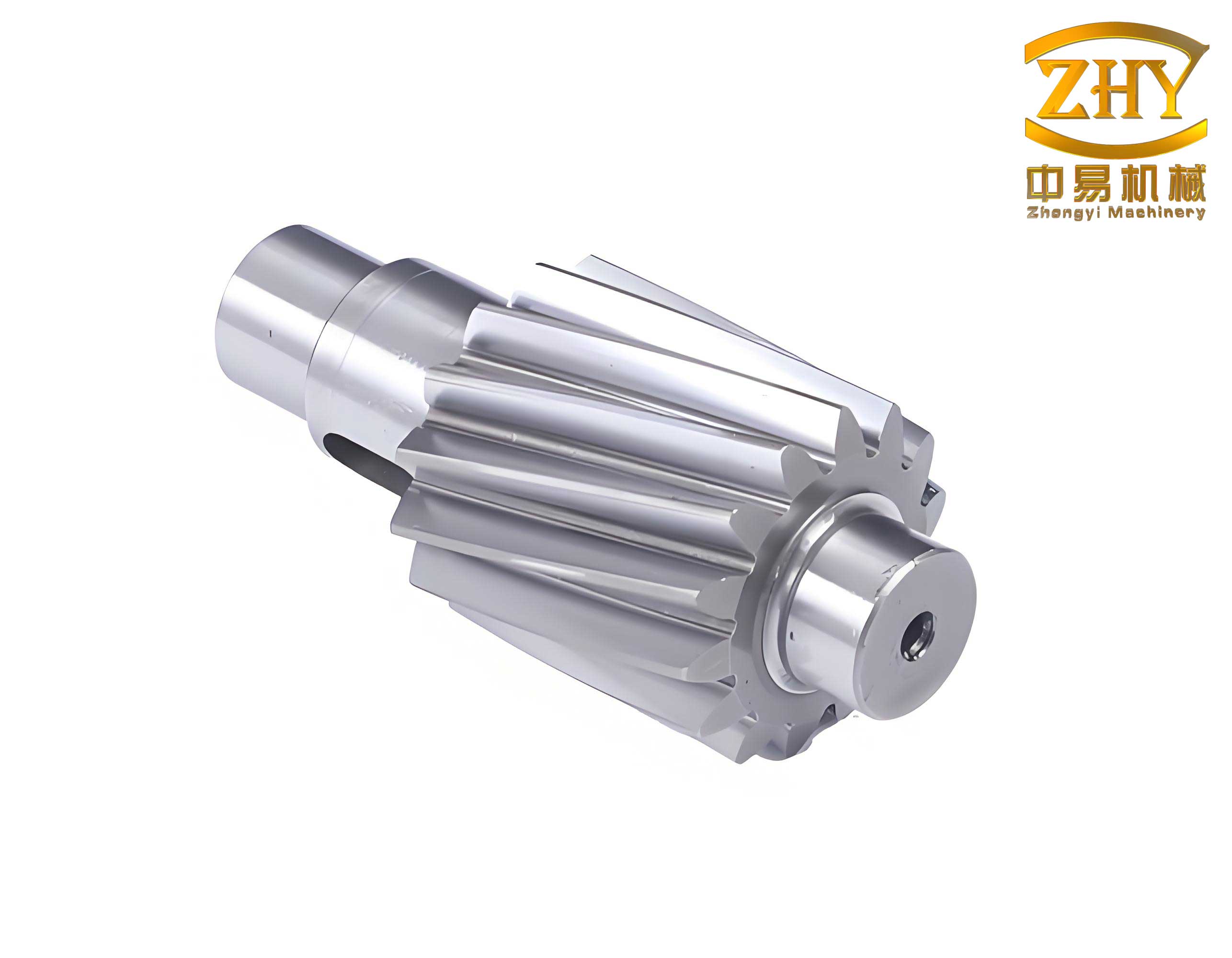
The gear shaft in question features a stepped-axis structure with multiple fillets and shoulders, as illustrated in the image above. Key dimensions include journal diameters of Φ75 mm and a design requirement for a strength safety factor ≥1.8 and rated input torque ≥67,700 N·m. My investigation involved testing two medium-carbon low-alloy steels, 42CrMoH and 40CrH, for induction hardening, with a comparison to the traditional material 20CrMnTiH used for carburizing. The chemical compositions of these materials are summarized in Table 1. Prior to hardening, the induction hardening samples underwent quenching and tempering to achieve a core hardness of 285–321 HBW, while the carburizing samples were normalized. Microstructural analysis confirmed that all materials met standard requirements, with core structures consisting of tempered sorbite for induction hardening grades and low-carbon martensite for the carburizing grade.
| Material | C (%) | Si (%) | Mn (%) | Cr (%) | Mo (%) | Other |
|---|---|---|---|---|---|---|
| 42CrMoH | 0.42 | 0.30 | 0.65 | 1.04 | 0.19 | Ti: 0.015 |
| 40CrH | 0.41 | 0.26 | 0.69 | 1.01 | – | – |
| 20CrMnTiH | 0.21 | 0.32 | 0.99 | 1.15 | – | Ti: 0.064 |
To evaluate induction hardening, I designed two process methods: overall single-shot heating and quenching, and segmented double-shot heating and quenching. The overall method uses a full-coverage hardening layer, while the segmented method splits the hardening layer into two sections along the gear shaft, disconnected at a midpoint. Table 2 outlines the basic conditions for these methods. The overall approach employed a 4 kHz, 450 kW SCR thyristor power supply with horizontal quenching equipment, targeting effective case depths of 5–8 mm at journals, 4–6 mm at splines, and ≥3.0 mm at fillets. The segmented method used a 10 kHz, 250 kW IGBT transistor power supply with vertical equipment, aiming for similar depth ranges. After quenching, all samples were tempered in a furnace at 180–190°C for 1.5–2 hours. I found that the overall method posed challenges in balancing heating at fillets and shoulders due to inductor design constraints, leading to shallow fillet hardening and potential overheating at steps. In contrast, the segmented method, with the split point set away from fillets on an outer journal, avoided tempering effects and allowed more flexible inductor design for better fillet heating. This made the segmented process more viable for the gear shaft.
| Process Method | Equipment | Frequency (kHz) | Power (kW) | Hardening Requirements |
|---|---|---|---|---|
| Overall Single-shot | SCR电源, Horizontal | 4 | 450 | Full coverage; journal: 5–8 mm, spline: 4–6 mm, fillet: ≥3.0 mm |
| Segmented Double-shot | IGBT电源, Vertical | 10 | 250 | Two segments; similar depth ranges |
The inductor structure is critical for achieving uniform heating in a stepped gear shaft. Fillets, especially small ones with radii as low as 2 mm, are shielded by adjacent journals and shoulders, reducing magnetic flux penetration and self-eddy current heating. To address this, I designed dedicated heating coils for each fillet, optimizing cross-sectional shape, angle relative to the gear shaft axis, and gap with the part. For the input end of the gear shaft, which has dual fillets and shoulders, I used a fully series-connected coil. The coil for the larger fillet (R1) had a symmetric cross-section at a 45° angle, while that for the smaller fillet (R2) had an asymmetric cross-section at 15°. By adjusting coil length ratios and simplifying the overall structure, I improved heating balance. On the output end, similar adjustments were made: moving longitudinal coils away from sharp edges to reduce corner overheating, and using a parallelogram-shaped coil at a 15° angle for a 2 mm fillet (R4) to enhance heating efficiency. These designs ensured synchronized temperature rise across the gear shaft, as shown by thermal imaging results.
In terms of process parameters, I conducted tests with an IGBT power supply, varying frequency, power, and time to assess the suitability of 42CrMoH and 40CrH. Table 3 summarizes three parameter sets. Set 1, with higher frequency (8.2–9.6 kHz) and shorter heating time (20 s), led to poor heating balance. Set 2, with moderate frequency (7.3–8.6 kHz) and longer heating (22–26 s), still resulted in insufficient fillet hardening for 40CrH. Set 3, with lower frequency (6.5–7.9 kHz) and adjusted times, proved optimal: it provided adequate austenitization, minimized crack risk with a 10% quenchant concentration, and met quality standards. The effective case depths achieved were 5–8 mm at journals, 4–7 mm at splines, and 3–4 mm at fillets for both materials. Surface hardness ranged from 53–58 HRC after tempering, with microstructures rated acceptable per standards. This parameter range ensures robust induction hardening for the gear shaft.
| Parameter Set | Frequency (kHz) | Power (kW) | Heating Time (s) | Quenchant Concentration (%) | Remarks |
|---|---|---|---|---|---|
| Set 1 | 8.2–9.6 | 150–180 | 20 | 6.0 | Poor balance; not suitable |
| Set 2 | 7.3–8.6 | 125–160 | 22–26 | 8.0 | Insufficient for 40CrH fillets |
| Set 3 | 6.5–7.9 | 120–150 | 23–31 | 10.0 | Optimal; meets all criteria |
Distortion in induction hardening is influenced by effective case depth, process parameters, and material. I analyzed this for the gear shaft, focusing on 42CrMoH due to its better hardenability than 40CrH. Under identical conditions, 42CrMoH achieved fillet case depths meeting specs, while 40CrH fell short unless parameters were adjusted—but that increased distortion beyond tolerances. I measured radial runout, tooth alignment, and tooth thickness at key locations (e.g., journals at Φ75 mm and splines) before and after hardening. Table 4 shows data for 42CrMoH with varying case depths. As depth increased from 4.9–5.8 mm to 8.4–9.1 mm, radial runout and tooth alignment deviations grew, while tooth thickness decreased slightly. For depths below 5.5 mm, runout was under 0.077 mm, eliminating the need for straightening. At 5.5–7.7 mm, about 20% of parts required straightening, and above 8.4 mm, runout exceeded 0.100 mm, necessitating straightening for 40% of parts. I compared distortion across processes in Table 5. Carburizing yielded lower runout (0.054–0.093 mm) than induction hardening, and segmented induction had less runout than overall induction. 42CrMoH exhibited lower distortion than 40CrH, making it preferable for the gear shaft when controlling dimensional accuracy.
| Case Depth Range (mm) | Radial Runout Range (mm) | Tooth Alignment Range (度) | Tooth Thickness Change (mm) | Straightening Need |
|---|---|---|---|---|
| 4.9–5.8 | 0.051–0.077 | 0.033–0.053 | ≈ -0.02 | None |
| 6.8–7.7 | 0.086–0.106 | 0.045–0.068 | ≈ -0.04 | 20% |
| 8.4–9.1 | 0.115–0.156 | 0.064–0.096 | ≈ -0.06 | 40% |
| Process | Material | Radial Runout Range (mm) | Notes |
|---|---|---|---|
| Carburizing | 20CrMnTiH | 0.054–0.093 | Low distortion |
| Overall Induction | 42CrMoH | 0.127–0.230 | High distortion |
| Segmented Induction | 42CrMoH | 0.083–0.130 | Moderate distortion |
| Segmented Induction | 40CrH | 0.136–0.197 | Higher than 42CrMoH |
Torsional strength was evaluated via static torsion tests on individual gear shafts. I compared carburized parts with induction-hardened ones using both overall and segmented methods. Table 6 presents the results. Carburized 20CrMnTiH parts had a maximum torque of around 64 kN·m, failing at splines or the shaft body. In contrast, induction-hardened parts showed significantly higher strength: 40CrH segmented parts reached 85–87 kN·m, and 42CrMoH segmented parts achieved 89–91 kN·m, with overall induction parts similar. All induction parts failed via spline deformation rather than fracture, indicating better ductility. The strength improvement over carburizing was about 20% for induction hardening, meeting the safety factor requirement of >2.0. This underscores the advantage of induction hardening for enhancing the gear shaft’s load capacity. The relationship between case depth and torsional strength can be approximated by a formula like $$ T_{max} = k \cdot \sqrt{CHD} $$ where \( T_{max} \) is maximum torque, \( k \) is a material constant, and \( CHD \) is case depth, but empirical data from my tests show a more linear trend for the gear shaft.
| Process | Material | Max Torque (kN·m) | Failure Mode | Strength Gain vs. Carburizing |
|---|---|---|---|---|
| Carburizing | 20CrMnTiH | 61.5–64.7 | Fracture | – |
| Segmented Induction | 40CrH | 84.6–86.7 | Spline deformation | ~30% |
| Segmented Induction | 42CrMoH | 89.9–91.2 | Spline deformation | ~40% |
| Overall Induction | 42CrMoH | 89.7–91.2 | Spline deformation | ~40% |
Based on my research, I conclude that segmented double-shot induction hardening is superior to overall single-shot for the drive cylindrical gear shaft. It offers better inductor design flexibility, improved heating balance at fillets, and lower distortion. The material 42CrMoH outperforms 40CrH in processability, distortion control, and torsional strength, making it the recommended choice for this gear shaft. Induction hardening can increase torsional strength by over 15% compared to carburizing, with a safety factor exceeding 2.0, thus meeting performance demands. However, case depth should be limited to below 8 mm to keep distortion manageable; depths above 8 mm require straightening, adding cost. The optimal parameters involve frequencies of 6.5–7.9 kHz, heating times of 23–31 s, and a quenchant concentration of 10%. This work provides a foundation for applying induction hardening to heavy-duty gear shafts, ensuring reliability under high torque. Future studies could explore advanced simulation models to predict distortion or test other alloy steels for further optimization.
In summary, the gear shaft is a pivotal component in automotive axles, and my investigation demonstrates that induction hardening is a viable enhancement over traditional carburizing. By carefully designing inductors and tuning parameters, I achieved deeper hardening layers, higher strength, and acceptable distortion for the gear shaft. This technology not only addresses current performance gaps but also opens avenues for lightweighting or higher-load designs. The repeated focus on the gear shaft throughout this research highlights its critical role, and the findings underscore the importance of material and process selection in achieving durable transmission systems.