
In my extensive experience with automotive and agricultural machinery maintenance, I have observed that the failure of rear axle driven spiral gears and bevel gears is a predominant factor limiting the service life of tractors and vehicles. Through systematic surveys and failure analyses, it became evident that distortions such as dimensional changes, out-of-roundness, and warping introduced during heat treatment are critical contributors to premature gear failure. These defects not only compromise gear meshing and load distribution but also lead to excessive noise, vibration, and ultimately, catastrophic breakdowns. This article presents a comprehensive experimental study conducted from a first-person perspective, focusing on optimizing the heat treatment process for these critical components. The core objective was to replace the conventional carburizing, pit cooling, and re-heating press quenching sequence with a direct quenching after carburizing process. This shift aims to minimize thermo-mechanical distortions by reducing the number of heating and cooling cycles and promoting more uniform cooling.
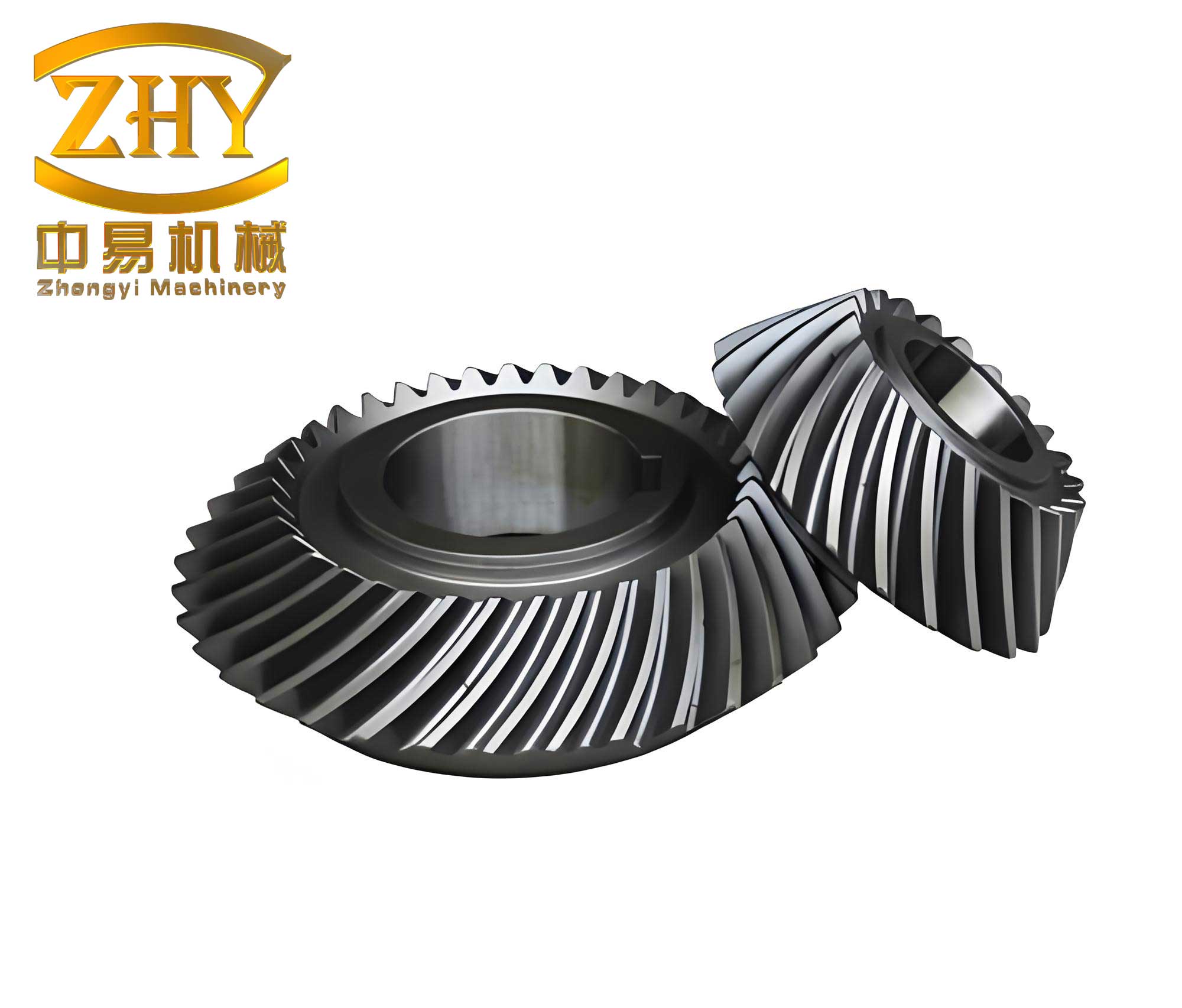
The driven spiral gears, often referred to as ring gears, possess a relatively simple and symmetric geometry. However, their large inner and outer diameters combined with a relatively thin cross-section make them highly susceptible to distortion during heat treatment. The typical distortion modes include diameter increase, loss of circularity (ovality), planar warping, and occasionally, the development of an axial taper. The original process involved carburizing followed by slow cooling in a pit. The gears were then re-heated in a protective atmosphere and quenched on a pulsating press. During this press quenching, the contact between the gear’s inner plane and the press head created a region with high thermal mass and poor cooling conditions. In contrast, the tooth sections cooled rapidly under oil spray. This drastic disparity in cooling rates, exacerbated by the significant variation in section thickness, generated severe thermal stresses and led to taper formation. Furthermore, the pulsating pressure application, while intended to control distortion, often unevenly restrained the gear’s contraction during cooling, contributing to diameter growth and non-uniform shrinkage, thereby inducing out-of-roundness.
To address these issues, I hypothesized that consolidating the two heating/cooling cycles into a single direct quenching process and replacing forced, uneven press cooling with a more controlled, free-quenching method could significantly reduce distortion. The key was to design a fixture that allowed for uniform support and oil flow. The fixture for the spiral gears was conceptualized and fabricated as shown in the schematic below. It accommodated multiple gears stacked vertically, ensuring they were held in a stable position without imposing asymmetric constraints during the quench.
The direct quenching trials were conducted in a 35 kW gas carburizing furnace. The process cycle, meticulously developed and refined, is summarized in Table 1 and represented by the temperature-time profile. The process begins with a loading and排气 (air purging) stage. To establish the correct atmosphere, alcohol was initially dripped at a rate of 80-100 drops per minute. Once the furnace temperature recovered to 930°C, the proper carburizing phase commenced.
| Process Stage | Temperature (°C) | Time (hours) | Atmosphere (Drops/Min, 20 drops/mL) | Pressure (Pa) | Objective |
|---|---|---|---|---|---|
| Loading & Purging | ~850 to 930 | ~1.0 | Alcohol: 80-100 | Ambient | Remove air, establish base atmosphere |
| Strong Carburizing | 930 | 4.0 | Alcohol: 40, Kerosene: 40 | Ambient | Achieve high surface carbon potential |
| Diffusion | 930 | 2.0 | Alcohol: 20-25, Kerosene: 20-25 | Ambient | Graduate carbon concentration profile |
| Temperature Equalization | ~850 to 860 | ~1.0 | Alcohol: 20-25, Kerosene: 20-25 | Ambient | Homogenize temperature before quench |
| Direct Quench | ~850 (Furnace) to Ambient (Quench Oil) | Instantaneous | N/A (Rapid transfer to oil tank) | N/A | Martensite transformation in diesel oil |
The carbon diffusion during the carburizing and diffusion stages can be modeled using Fick’s second law. For a semi-infinite solid with a constant surface carbon concentration \(C_s\) and initial concentration \(C_0\), the carbon profile \(C(x,t)\) as a function of depth \(x\) and time \(t\) is given by:
$$ C(x,t) = C_s – (C_s – C_0) \, \text{erf}\left( \frac{x}{2\sqrt{D t}} \right) $$
where \(D\) is the diffusion coefficient of carbon in austenite, which is highly temperature-dependent:
$$ D = D_0 \exp\left( -\frac{Q}{RT} \right) $$
Here, \(D_0\) is a pre-exponential factor, \(Q\) is the activation energy for diffusion, \(R\) is the gas constant, and \(T\) is the absolute temperature. For the spiral gears, targeting a case depth of 1.2-1.6 mm required precise control over the product \(\sqrt{D t}\). The direct quench into diesel oil at approximately 850°C provided a cooling rate sufficient to form martensite while managing thermal gradients.
The results were systematically evaluated. The distortion parameters—outer diameter growth (\(\Delta OD\)), out-of-roundness (\(\Delta OOR\)), and flatness warpage (\(\Delta Flat\))—were measured for gears treated with the new direct quench process and compared statistically with historical data from the old two-step process. The improvement was quantified using a distortion reduction factor \(\eta\) for each parameter:
$$ \eta_{param} = \left(1 – \frac{\text{Mean}_{new}}{\text{Mean}_{old}}\right) \times 100\% $$
The measurement data is consolidated in Table 2.
| Process | Sample Size (n) | Mean \(\Delta OD\) | Std Dev \(\Delta OD\) | Mean \(\Delta OOR\) | Std Dev \(\Delta OOR\) | Mean \(\Delta Flat\) | Std Dev \(\Delta Flat\) |
|---|---|---|---|---|---|---|---|
| Old (2-Step) | 50 | +0.25 | 0.08 | 0.18 | 0.06 | 0.22 | 0.07 |
| New (Direct Quench) | 50 | +0.08 | 0.04 | 0.07 | 0.03 | 0.06 | 0.02 |
| Improvement \(\eta\) | – | 68.0% | – | 61.1% | – | 72.7% | – |
Microstructural analysis confirmed the quality of the direct-quenched spiral gears. Surface hardness ranged from 58-62 HRC, and core hardness was 38-42 HRC, both within specification. The microstructure consisted of fine carbides (1-2级), martensite, and retained austenite (3-4级). A minor amount of ferrite was present. For the few gears where out-of-roundness slightly exceeded tolerance, a unique corrective measure was employed. Leveraging the presence of higher retained austenite and complex residual stresses post-quench, these gears were subjected to a cold straightening process on a press. Pressure was applied strategically on the larger diameter axis, with the force vector avoiding bolt holes. This successfully restored all gears to within acceptable limits.
The investigation then turned to the driven bevel gears (盆齿). These gears have a large outer diameter and a geometry where the conical tooth surface area vastly exceeds that of the back (mounting) face. In the original press quenching process, the back face was in full contact with the lower press platen, which had limited oil channels, resulting in very slow cooling. The tooth faces, however, were exposed to abundant oil flow through the tooth gaps. This created an extreme cooling gradient. The thermal stress from this gradient caused deformation convex towards the teeth, while transformation stresses from martensite formation in the carburized case acted in the opposite direction. The net effect was often a severe warp that was difficult to correct by pressing. The underlying mechanics can be approximated by considering the bending moment \(M\) induced by differential thermal contraction:
$$ M \approx \int_A E \alpha \Delta T(y) \, y \, dA $$
where \(E\) is Young’s modulus, \(\alpha\) is the thermal expansion coefficient, \(\Delta T(y)\) is the temperature difference across the section, and \(y\) is the distance from the neutral axis. For the bevel gear, the asymmetry in cooling made \(\Delta T(y)\) highly non-linear, leading to a large, uncontrollable moment.
To counteract this, the new process was designed to reverse the cooling gradient. The goal was to make the back face cool faster than the tooth root section. This would align the thermal stress deformation more closely with, or even counteract, the transformation stress deformation. A specialized fixture was engineered for direct quenching. As illustrated in Figure 2, the fixture consisted of a base support ring (a scrap gear) with vertical hangers welded to it. A complete scrap gear was placed on top as a spacer, with its tooth face upward. The production bevel gears were then stacked sequentially, also with their tooth faces upward. This ingenious arrangement created an open central channel for oil circulation during quenching. The hot diesel oil, after flowing through the tooth gaps of a lower gear, would impinge directly onto the back face of the gear above it, dramatically enhancing its cooling rate.
The process parameters for the bevel gears required slight modification, particularly concerning furnace pressure during certain stages to ensure atmosphere integrity and carbon transfer. The detailed cycle is presented in Table 3.
| Process Stage | Temperature (°C) | Time (hours) | Atmosphere (Drops/Min) | Pressure (Pa) |
|---|---|---|---|---|
| Purging | 850 to 930 | ~1 | Alcohol: 80-100 | Ambient |
| Carburizing | 930 (Upper), 920 (Lower) | 4 | Alcohol: 40, Kerosene: 40 | 200 – 300 |
| Diffusion | 930 (Upper), 920 (Lower) | 2 | Alcohol: 20-25, Kerosene: 20-25 | 150 – 200 |
| Equalization & Quench | ~850 to Diesel Oil | ~1 (Equalization) | Alcohol: 20-25, Kerosene: 20-25 | Ambient |
The effectiveness of this approach for bevel gears was unequivocal. Multiple batches, with approximately 15 gears per batch, were processed. Every single gear met the stringent flatness and roundness specifications without the need for post-quench straightening. The microstructural and hardness results were consistent with requirements: case hardness of 58-62 HRC, core hardness of 35-40 HRC, and a controlled case depth of 1.2-1.6 mm. The successful treatment of these spiral gears and bevel gears underscores the importance of fixture design in heat treatment. The fixture acts as a thermal management tool, dictating the heat extraction path and thus the final stress state. The relationship between cooling rate \(q\) and distortion \(\delta\) can be complex, but for these axisymmetric components, a simplified linear dependency was observed experimentally for the major distortion modes:
$$ \delta \propto \int_{t_0}^{t_f} |q_{face}(t) – q_{root}(t)| \, dt $$
where \(q_{face}\) and \(q_{root}\) are the cooling rates at the back face and tooth root fillet, respectively. The new fixture minimized this integral by bringing the cooling rates closer together for spiral gears and strategically creating a favorable difference for bevel gears.
Beyond dimensional stability, the direct quenching process offers substantial economic and operational advantages. Eliminating the intermediate pit cooling, re-heating, and press quenching steps results in significant energy savings. The total process time is reduced by approximately 30-40%. Furthermore, it frees up press equipment for other tasks and reduces handling, lowering the risk of damage. The consistency of the direct quench process also improves product quality uniformity, a critical factor in high-volume production of spiral gears for automotive differentials.
In conclusion, this first-person experimental investigation demonstrates that the direct quenching after carburizing process is a superior alternative to the traditional two-step method for heat treating driven spiral gears and bevel gears. The key to success lies in the design of purpose-built fixtures that promote controlled and favorable cooling patterns. For spiral gears, the fixture enables symmetrical, free contraction quenching, drastically reducing diameter growth, out-of-roundness, and warpage. For bevel gears, the inverted stacking fixture creates a deliberate cooling gradient that counteracts the distortion caused by geometric and metallurgical asymmetry. The process validation through multiple production-scale trials confirms that all mechanical and metallurgical properties are maintained or improved while achieving dramatic reductions in distortion. This advancement not only enhances the reliability and service life of these critical spiral gears in automotive transmissions and axles but also contributes to manufacturing efficiency and sustainability. Future work could involve finite element modeling to further optimize fixture design and quenching parameters for even more complex gear geometries, solidifying the role of direct quenching as a cornerstone technology for high-performance spiral gears.