
In modern mechanical power transmission, especially within the constrained and demanding environments of automotive engines, the selection of gear types is critical. Among the available options, spiral gears—often encompassing helical and cross-axis helical geometries—are frequently chosen for their notable advantages. These include high transmission efficiency, smooth and quiet operation due to overlapping contact ratios, substantial load-carrying capacity, and a compact structural design that minimizes energy loss. These attributes make spiral gears a cornerstone in precision drivetrains. However, their application is not without significant challenges. The fundamental point contact nature of crossed-axis spiral gears, combined with high sliding velocities along the tooth flank, generates concentrated contact stresses. This often leads to premature surface wear, pitting, and in severe cases, tooth breakage, imposing stringent requirements on their design, manufacturing, and lubrication.
This discussion originates from a persistent failure observed in a production engine model, where a pair of spiral gears used to drive an oil pump from the camshaft suffered catastrophic early wear. This case highlights the severe consequences of overlooking critical design parameters and material science in spiral gear applications.
Case Study: Problem Description
During reliability testing of a commercial vehicle engine (a model analogous to the EQ3126), a critical failure was identified in the auxiliary drive system. The spiral gear pair connecting the camshaft to the oil pump drive shaft exhibited severe surface degradation in a remarkably short operational period. When deployed in vehicles, this issue manifested after only a few thousand kilometers of driving. The observed damage was asymmetric and severe on the camshaft gear. Early operation showed deep scoring and gouging along the direction of tooth engagement. As cumulative mileage approached 5,000 km, approximately 70-80% of the working tooth height on the camshaft gear was worn away. In contrast, the mating oil pump drive shaft gear, while also showing signs of wear, remained in a significantly better state of preservation.
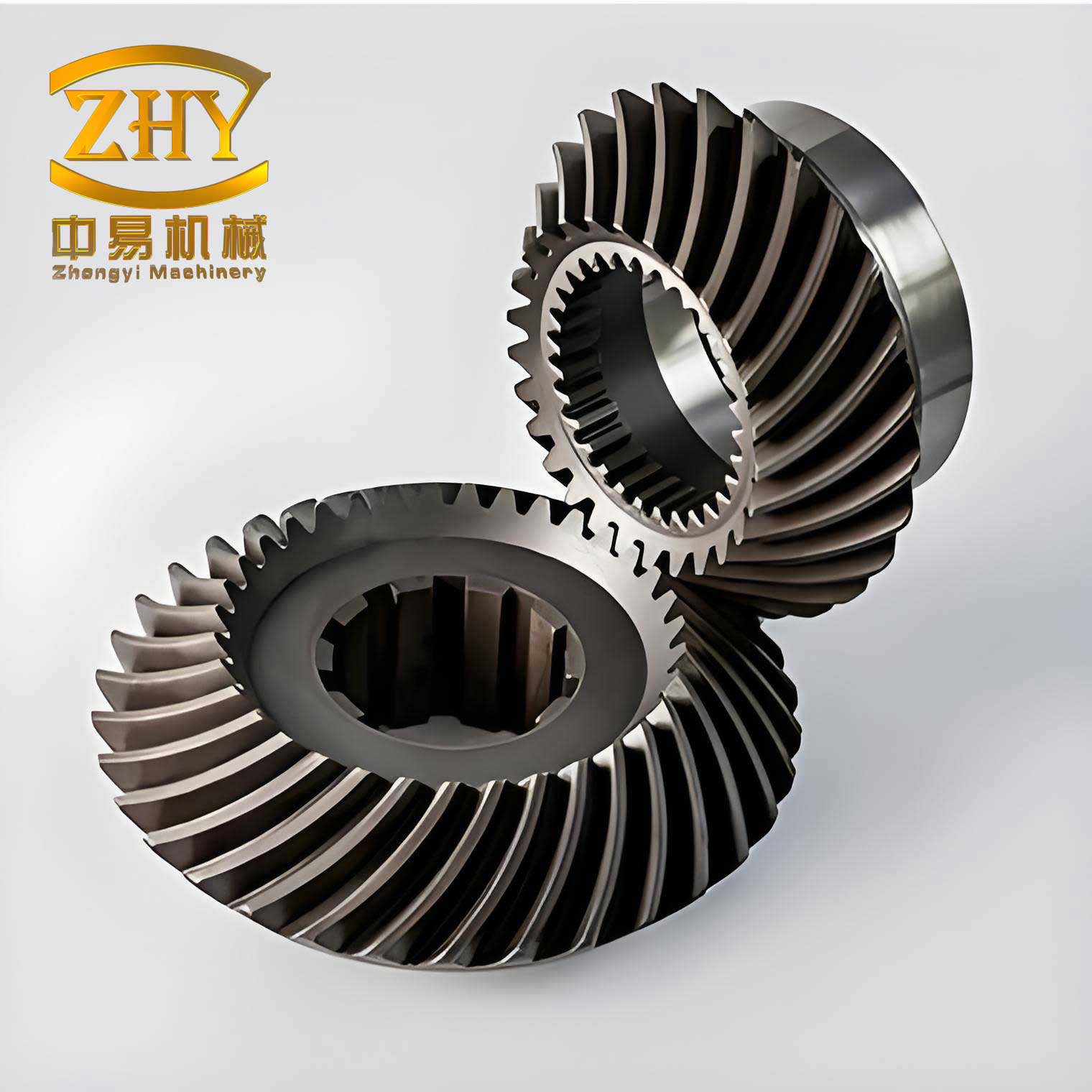
The immediate functional consequence was dire. The wear on these spiral gears compromised the oil pump’s drive integrity, leading to a drop in oil pressure. This, in turn, caused insufficient lubrication for critical engine components like bearings and the valve train, resulting in accelerated wear and potential catastrophic engine seizure. The system parameters were identified as follows:
- Gear Parameters: Non-standard module (converted from 16 DP), $m_n = 1.58 \text{ mm}$, normal pressure angle $\alpha_n = 14.5^\circ$, number of teeth $z_1 = z_2 = 13$, helix angles $\beta_1 = 60^\circ$ (camshaft), $\beta_2 = 30^\circ$ (pump shaft). Calculated pitch diameters were $d_1 = 41.28 \text{ mm}$ and $d_2 = 23.83 \text{ mm}$ with a center distance $a = 32.5 \text{ mm}$.
- Material Pairing: Camshaft gear: Grey/Nodular Cast Iron. Pump drive gear: Case-hardened alloy steel (e.g., 20Cr) with a surface hardness of approximately 62 HRC.
- Load Conditions: Oil pump operating at $n = 2300 \text{ rpm}$, with an outlet pressure $p = 490 \text{ kPa}$ and flow $Q = 21 \text{ L/min}$. The resulting torque on the pump shaft was calculated as $T_2 = 830 \text{ N·mm}$.
Root Cause Analysis
The failure is attributed to a combination of fundamental design flaws in the spiral gear pair and suboptimal material selection.
1. Geometric Design Deficiency
While the gear pair was intended for a 90° crossed-axis configuration with a unity transmission ratio ($i=1$), the chosen helix angles ($\beta_1=60^\circ$, $\beta_2=30^\circ$) created a significant imbalance. The resulting pitch diameters differed dramatically. This effectively created a theoretical speed-increasing configuration from the camshaft (larger gear) to the pump shaft (smaller gear). For a given output torque, the force on the driving gear teeth in a speed-increasing arrangement is higher than in a speed-reducing one, as per the principle of power conservation ($P = T \omega$). The normal force at the pitch point can be calculated using the formula for helical gears, adapted for the crossed-axis scenario. The tangential force on the pump gear is:
$$ F_{t2} = \frac{2 T_2}{d_2} $$
The normal force acting on the tooth flank, which is crucial for contact stress calculation, is then:
$$ F_n = \frac{F_{t2}}{\cos \alpha_{t} \cos \beta_{b}} \approx \frac{2 T_2}{d_2 \cos \alpha_{t} \cos \beta_{b}} $$
Where $\alpha_t$ is the transverse pressure angle and $\beta_b$ is the base helix angle. For the given parameters, this force was calculated to be approximately 83 N. This force, acting over a minimal contact area (point contact), sets the stage for high stress.
The primary geometric issue with these spiral gears is summarized in the table below, comparing the ill-fated design with a more balanced theoretical alternative.
| Parameter | Original Problematic Design | Principle of Balanced Design |
|---|---|---|
| Transmission Ratio | 1 (Theoretical) | 1 |
| Helix Angles | $\beta_1=60^\circ$, $\beta_2=30^\circ$ | $\beta_1 \approx \beta_2$ (e.g., $45^\circ$ each) |
| Pitch Diameters | $d_1 \gg d_2$ (41.28 mm vs. 23.83 mm) | $d_1 \approx d_2$ |
| Effective Configuration | Speed-increasing (low efficiency side) | Pure motion transfer (higher efficiency) |
| Consequence | Higher tooth load on driver, severe sliding | More even load and wear distribution |
2. Inadequate Material Selection
The material pairing was fundamentally unsuited for the high-stress, high-slip conditions of this spiral gear drive. The camshaft gear, made of relatively soft cast iron, was paired against a very hard, case-hardened steel pump gear. In a sliding-contact scenario like this, the harder material will typically abrade the softer one. This explains the disproportionate wear on the cast iron camshaft gear. A proper material pairing for such a demanding spiral gear application requires both gears to have high surface hardness to resist wear and pitting.
3. Quantitative Stress Analysis
The catastrophic wear is directly correlated to contact stresses that far exceeded the endurance limit of the camshaft gear material. The contact between two spiral gear teeth at the pitch point can be modeled as the contact of two ellipsoidal bodies. The maximum Hertzian contact stress $\sigma_{H}$ is given by:
$$ \sigma_{H} = \sqrt{ \frac{F_n}{\pi \zeta} \cdot \frac{\frac{1}{R_1} + \frac{1}{R_2} + \frac{1}{R_1′} + \frac{1}{R_2′}}{\frac{1-\mu_1^2}{E_1} + \frac{1-\mu_2^2}{E_2}} } $$
where:
- $F_n$ is the normal load (83 N).
- $R_i$ and $R_i’$ are the principal radii of curvature of tooth $i$ at the contact point.
- $E_i$ and $\mu_i$ are the modulus of elasticity and Poisson’s ratio for material $i$.
- $\zeta$ is a factor related to the ellipticity of the contact area.
Step 1: Determining Principal Curvatures. For spiral gears, the radii of curvature in the transverse plane ($R_i$) and the perpendicular direction ($R_i’$) must be calculated. $R_i$ is derived from gear geometry:
$$ R_i = \frac{d_i \sin \alpha_{ti}}{2 \cos \beta_{bi}} \quad \text{for } i=1,2 $$
The calculation of $R_i’$ is more complex, requiring analysis of the generated involute helicoid surface of the spiral gear. The surface equation is:
$$
\begin{aligned}
x_i &= r_{bi}[\cos(\theta_i + \phi_i) + \phi_i \sin(\theta_i + \phi_i)] \\
y_i &= r_{bi}[\sin(\theta_i + \phi_i) – \phi_i \cos(\theta_i + \phi_i)] \\
z_i &= \frac{h_i}{2\pi}\theta_i
\end{aligned}
$$
where $r_b$ is the base radius, $h$ is the lead of the helix, and $\theta$ and $\phi$ are surface parameters. The curvature in the direction perpendicular to the tooth trace is found by intersecting this surface with a plane tangent to the base cylinder at the pitch point and applying numerical differentiation (e.g., a five-point formula) to the curve of intersection to find the radius of curvature $R_i’$ at that specific point.
Step 2: Material Properties.
Cast Iron (Gear 1): $E_1 = 1.4 \times 10^5 \text{ MPa}$, $\mu_1 = 0.25$.
Alloy Steel (Gear 2): $E_2 = 2.0 \times 10^5 \text{ MPa}$, $\mu_2 = 0.30$.
Step 3: Calculated Values and Result. Performing the calculations for the original gear geometry yields the following principal curvatures at the pitch point:
| Gear | $R_i$ (mm) | $R_i’$ (mm) |
|---|---|---|
| Camshaft (1) | 17.4 | 352.5 |
| Pump Shaft (2) | 3.9 | 211.0 |
Substituting these values, the normal load, and material properties into the Hertz stress formula gives a calculated maximum contact stress:
$$ \sigma_{Hmax} \approx 1128 \text{ MPa} $$
This is a conservative estimate. In reality, the presence of friction, which can increase the effective normal force by 25% or more, and dynamic loads would push the actual stress even higher. A stress of 1128 MPa is far beyond the allowable contact fatigue strength (typically 300-600 MPa range) for grey cast iron, confirming that surface failure was inevitable.
Comprehensive Improvement Strategy
To rectify the issues and ensure reliable operation of the spiral gear drive, a multi-faceted improvement plan is required, addressing design, material, manufacturing, and lubrication.
1. Redesign of Gear Parameters
The goal is to achieve a balanced design with near-equal pitch diameters and optimal pressure angles. Two viable redesign paths are proposed, both using standard metric modules.
Option A: Symmetric Helix Angles. Use $\beta_1 = \beta_2 = 45^\circ$. To maintain the center distance $a=32.5$ mm with $z_1=z_2=13$, a profile shift (positive addendum modification) is required. Using a standard module $m_n=1.75$ mm:
$$ d_1 = d_2 = \frac{m_n z}{\cos \beta} = \frac{1.75 \times 13}{\cos 45^\circ} \approx 32.17 \text{ mm} $$
The sum $d_1+d_2 = 64.34$ mm, requiring a profile shift to achieve the needed center distance of 32.5 mm (sum of 65.0 mm). This option provides perfectly balanced geometry.
Option B: Complementary Helix Angles. Select helix angles that satisfy the center distance equation without profile shift:
$$ a = \frac{m_n}{2} \left( \frac{z_1}{\cos\beta_1} + \frac{z_2}{\cos\beta_2} \right) $$
For $m_n=1.75$ mm, $a=32.5$ mm, and $\beta_1 + \beta_2 = 90^\circ$, solving yields angles like $\beta_1 \approx 49^\circ 41’$ and $\beta_2 \approx 40^\circ 19’$. The pitch diameters are:
$$ d_1 \approx 35.17 \text{ mm}, \quad d_2 \approx 29.83 \text{ mm} $$
This results in a much smaller size disparity than the original design, promoting more even wear.
| Design Parameter | Original Design | Improved Option A | Improved Option B |
|---|---|---|---|
| Module $m_n$ (mm) | 1.58 (Non-std) | 1.75 (Std) | 1.75 (Std) |
| Pressure Angle $\alpha_n$ | 14.5° | 20° | 20° |
| Helix Angles $\beta_1 / \beta_2$ | 60° / 30° | 45° / 45° | ~49.7° / ~40.3° |
| Pitch Diameters $d_1 / d_2$ (mm) | 41.28 / 23.83 | ~32.17 / ~32.17* | 35.17 / 29.83 |
| Key Advantage | – | Perfectly balanced sizes & loads | Balanced, no profile shift needed |
*With required profile shift to meet center distance.
2. Correct Material Selection and Heat Treatment
The soft cast iron must be replaced. For a durable spiral gear pair, both gears should have high surface hardness. Recommended pairings include:
- Through-Hardened Alloy Steels: Both gears hardened to a similar high hardness (e.g., >50 HRC). Suitable for Option A where sizes are equal.
- Case-Hardened Steels: Both gears case-hardened (e.g., 20CrMnTi). The camshaft gear can be specified with a slightly higher surface hardness (e.g., 58-62 HRC) than the pump gear (55-60 HRC) if using Option B, to equalize service life.
This ensures the contact stress calculated for the new geometry remains well below the fatigue strength of the materials.
3. Enhanced Manufacturing and Quality Control
Precision is paramount for spiral gears.
- Matched Pair Manufacturing: The two gears should be cut as a matched set from the same machine setup to guarantee the theoretical sum of helix angles ($\Sigma\beta = \beta_1 + \beta_2$) is exactly 90°, minimizing “mismatch” wear.
- Selective Assembly: Gears should be measured and paired based on actual helix angle and lead measurements to achieve the optimal combined angle.
- Surface Finish: A superior surface finish (low $R_a$ value) on the tooth flanks is essential to reduce stress concentrations and initial wear-in severity.
4. Optimized Lubrication Strategy
Given the high sliding velocities in spiral gear meshes, lubrication is not merely ancillary but a critical design factor. The lubricant must:
- Have adequate viscosity and extreme pressure (EP) additives to form a protective film under high contact pressure.
- Effectively remove heat generated by friction and churning.
- Be delivered reliably to the mesh entry point. Considering splash lubrication may be insufficient, a dedicated oil jet directed at the engaging teeth of the spiral gears should be evaluated.
Conclusion
The failure analysis of the engine’s oil pump drive spiral gears underscores the sensitivity of these components to integrated design. The primary causes were an unbalanced geometric design leading to unfavorable force transmission and excessive sliding, coupled with a completely unsuitable soft-hard material pairing. The calculated Hertzian contact stress of approximately 1128 MPa for the original design unequivocally explains the rapid, severe wear of the cast iron gear.
The proposed improvements form a systematic solution: redesigning the spiral gear pair with balanced helix angles and standard parameters; selecting matched, high-hardness material pairs; enforcing tight manufacturing tolerances and paired production; and implementing a robust lubrication plan. These steps collectively transform the spiral gear drive from a reliability liability into a durable and efficient component. This case serves as a critical reference for engineers, highlighting that the successful application of spiral gears hinges not just on their theoretical advantages, but on meticulous attention to the synergy between geometry, materials, and operating conditions.