
In the field of mechanical engineering, gear transmission systems play a pivotal role in transferring motion and power between intersecting shafts. Among these, straight bevel gears are widely used due to their efficiency and reliability. Particularly, miter gears, which are a type of bevel gear with a shaft angle of 90 degrees, are essential in applications requiring right-angle drives. With the advancement of manufacturing informatization, the development of accurate mathematical models for gears has become crucial, as these models serve as the foundation for analyzing gear mesh performance, optimizing design, and ensuring manufacturing consistency. In this paper, I explore a modeling approach for straight bevel gears based on the back cone tangent plane method, which simplifies the process by approximating the theoretical spherical involute profile with a planar involute on the tangent plane. This method aligns with actual manufacturing practices, such as gear planning, where the tooth profile is treated as that of a cylindrical gear on the back cone. I will derive parametric equations for the involute curves on both the large and small end tangent planes, demonstrate the modeling process using CAD software, and analyze the accuracy of the resulting models. Throughout this discussion, I will frequently reference miter gears as a key application, emphasizing their importance in various mechanical systems.
The concept of the back cone tangent plane method stems from the challenge of designing and manufacturing straight bevel gears. Theoretically, the tooth profile of a straight bevel gear at the large end is a spherical involute lying on a sphere with a radius equal to the cone distance. However, since a sphere cannot be developed into a plane, this complicates design and production. To overcome this, the industry commonly uses an equivalent cylindrical gear on the tangent plane of the back cone at the large end. This equivalent gear, often referred to as the “virtual gear” or “forming gear,” has teeth that correspond to the unfolded back cone tooth profile. For a straight bevel gear, the back cone is defined as the cone tangent to the sphere at the pitch circle, and its tangent plane provides a planar surface where the tooth profile can be represented as a standard involute. This approach is especially relevant for miter gears, where precise modeling is critical for smooth operation in right-angle transmissions. The relationship between the bevel gear and its equivalent gear is given by:
$$ r_v = \frac{r}{\cos \delta}, \quad z_v = \frac{z}{\cos \delta} $$
where \( r \) is the pitch radius of the bevel gear, \( r_v \) is the pitch radius of the equivalent gear, \( \delta \) is the pitch cone angle, \( z \) is the number of teeth on the bevel gear, and \( z_v \) is the number of teeth on the equivalent gear. This transformation allows us to apply standard cylindrical gear theory to bevel gears, simplifying the modeling process. In the context of miter gears, where \( \delta = 45^\circ \) for equal-size gears, the equivalent tooth count increases, affecting the tooth geometry and modeling parameters.
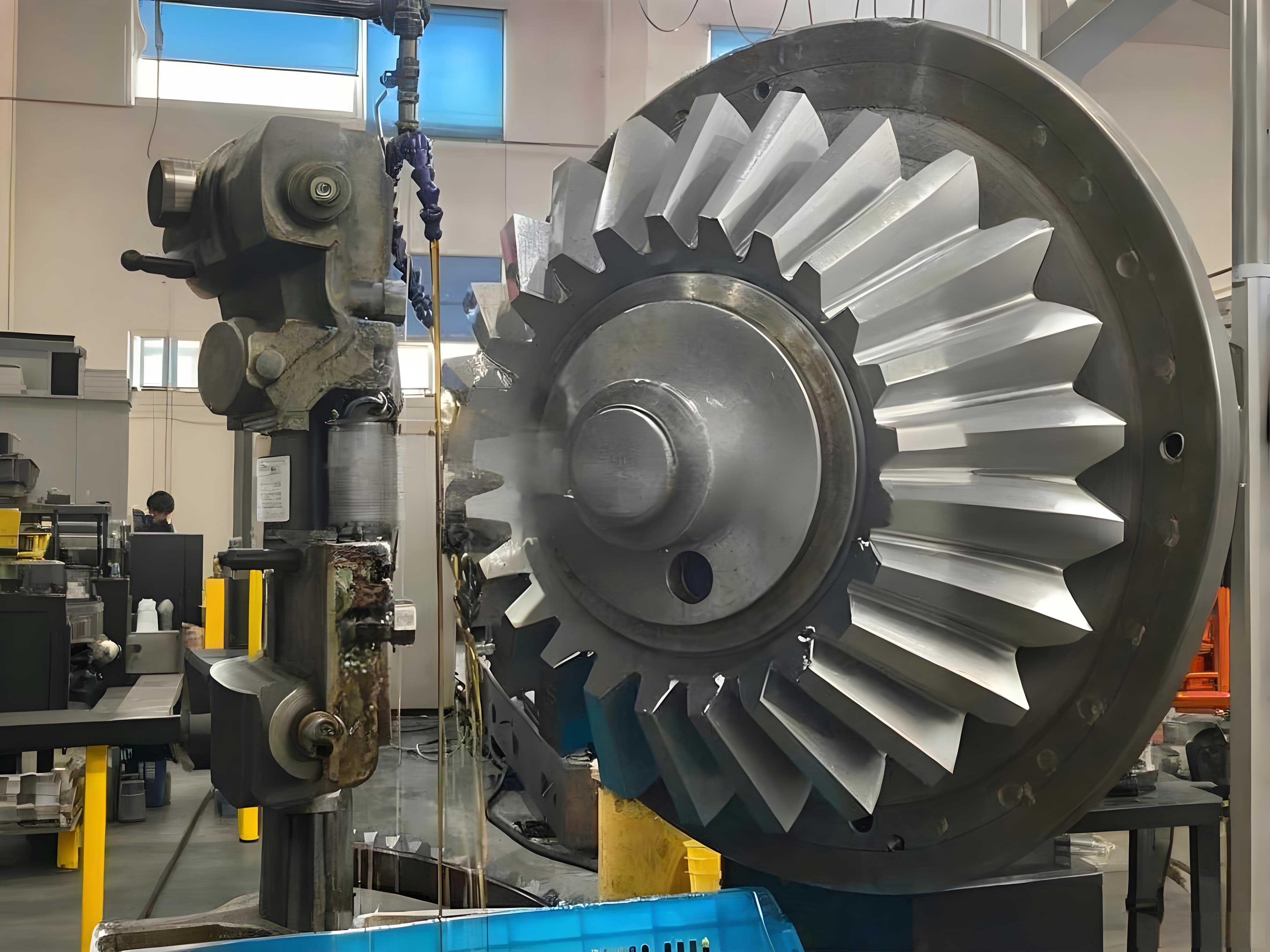
To establish the tooth profile on the back cone tangent plane, I start with the standard parametric equation of a planar involute in a Cartesian coordinate system Oxyz. The involute curve is generated from a base circle, and its equations are:
$$ x = r_b (\cos \varphi + \varphi \sin \varphi) $$
$$ y = r_b (\sin \varphi – \varphi \cos \varphi) $$
$$ z = 0 $$
Here, \( r_b \) is the base radius of the equivalent gear, \( \varphi \) is the roll angle (the angle through which the generating line has rolled), and the pressure angle \( \alpha \) is related to \( \varphi \) by \( \varphi = \alpha + \theta \), where \( \theta \) is the involute function \( \theta = \tan \alpha – \alpha \). For a gear tooth, the involute typically starts at the base circle and extends to the addendum circle. However, for bevel gears, this planar involute must be transformed onto the back cone tangent plane, which is oriented at an angle equal to the pitch cone angle \( \delta \). Additionally, the tooth profile on the tangent plane should be symmetric about the ZX plane to ensure proper meshing. This requires a series of coordinate transformations: first, rotating the involute in the XY plane to achieve symmetry about the X-axis, and then rotating it onto the tangent plane. These transformations are essential for accurate modeling of straight bevel gears and miter gears.
I will now derive the parametric equations for the involute on the large end back cone tangent plane. Let the original involute in the Oxyz system be given by Equation (1). To make it symmetric about the X-axis, I apply a rotation around the Z-axis by an angle \( \beta \). The rotation matrix is:
$$ T_{11} = \begin{bmatrix} \cos \beta & \sin \beta & 0 & 0 \\ -\sin \beta & \cos \beta & 0 & 0 \\ 0 & 0 & 1 & 0 \\ 0 & 0 & 0 & 1 \end{bmatrix} $$
The angle \( \beta \) is determined based on the tooth geometry. For a tooth symmetric about the X-axis, the involute segment corresponding to one-quarter of the tooth space angle on the pitch circle must be aligned. The tooth space angle \( \gamma \) on the equivalent gear is:
$$ \gamma = \frac{360^\circ}{4 z_v} = \frac{90^\circ}{z_v} $$
If the involute point on the pitch circle has a pressure angle \( \alpha \) (typically \( 20^\circ \)) and an involute function value \( \theta \), then the required rotation angle is:
$$ \beta = -(\gamma + \theta) $$
After rotation, the coordinates become:
$$ x’ = x \cos \beta – y \sin \beta $$
$$ y’ = x \sin \beta + y \cos \beta $$
$$ z’ = z $$
Substituting the original involute equations, I get:
$$ x’ = r_b [(\cos \varphi + \varphi \sin \varphi) \cos \beta – (\sin \varphi – \varphi \cos \varphi) \sin \beta] $$
$$ y’ = r_b [(\cos \varphi + \varphi \sin \varphi) \sin \beta + (\sin \varphi – \varphi \cos \varphi) \cos \beta] $$
$$ z’ = 0 $$
Next, to map this onto the back cone tangent plane, I perform a rotation around the Y-axis by an angle \( -\delta \). The rotation matrix is:
$$ T_{12} = \begin{bmatrix} \cos \delta & 0 & \sin \delta & 0 \\ 0 & 1 & 0 & 0 \\ -\sin \delta & 0 & \cos \delta & 0 \\ 0 & 0 & 0 & 1 \end{bmatrix} $$
The final coordinates on the large end tangent plane are:
$$ x_1 = x’ \cos \delta $$
$$ y_1 = y’ $$
$$ z_1 = x’ \sin \delta $$
Thus, the parametric equations for the involute on the large end back cone tangent plane are:
$$ x_1 = r_b [(\cos \varphi + \varphi \sin \varphi) \cos \beta – (\sin \varphi – \varphi \cos \varphi) \sin \beta] \cos \delta $$
$$ y_1 = r_b [(\cos \varphi + \varphi \sin \varphi) \sin \beta + (\sin \varphi – \varphi \cos \varphi) \cos \beta] $$
$$ z_1 = r_b [(\cos \varphi + \varphi \sin \varphi) \cos \beta – (\sin \varphi – \varphi \cos \varphi) \sin \beta] \sin \delta $$
These equations define the tooth profile at the large end of a straight bevel gear. For miter gears, where \( \delta = 45^\circ \), the equations simplify, but the same derivation applies. Similarly, for the small end of the gear, the involute profile can be derived by applying an additional translation along the Z-axis to account for the gear width. The small end tangent plane is parallel to the large end one but offset by a distance \( b / \cos \delta \), where \( b \) is the face width of the gear. The transformation includes the same rotations plus a translation matrix:
$$ T_{23} = \begin{bmatrix} 1 & 0 & 0 & 0 \\ 0 & 1 & 0 & 0 \\ 0 & 0 & 1 & 0 \\ 0 & 0 & \frac{b}{\cos \delta} & 1 \end{bmatrix} $$
After applying the rotations \( T_{11} \) and \( T_{12} \), followed by translation \( T_{23} \), the parametric equations for the small end back cone tangent plane involute are:
$$ x_2 = r_b [(\cos \varphi + \varphi \sin \varphi) \cos \beta – (\sin \varphi – \varphi \cos \varphi) \sin \beta] \cos \delta $$
$$ y_2 = r_b [(\cos \varphi + \varphi \sin \varphi) \sin \beta + (\sin \varphi – \varphi \cos \varphi) \cos \beta] $$
$$ z_2 = r_b [(\cos \varphi + \varphi \sin \varphi) \cos \beta – (\sin \varphi – \varphi \cos \varphi) \sin \beta] \sin \delta + \frac{b}{\cos \delta} $$
In these equations, \( \varphi \) is the roll angle parameter, which varies typically from 0 to \( \pi \) radians to cover the active involute segment. For practical modeling, I can let \( \varphi = \pi t \) where \( 0 \leq t \leq 1 \), so that \( t \) serves as a normalized parameter. This parameterization facilitates the creation of points along the involute curve in CAD software. The base radius \( r_b \) is calculated from the equivalent gear parameters: \( r_b = r_v \cos \alpha \), where \( r_v \) is the pitch radius of the equivalent gear and \( \alpha \) is the pressure angle. These equations provide a mathematical foundation for modeling straight bevel gears and miter gears using the back cone tangent plane method.
To implement this modeling approach, I use a parametric CAD system such as CATIA, which allows for the creation of curves based on equations and the generation of solid models through feature-based operations. The process begins with defining a design parameter table that includes all relevant gear dimensions and coefficients. This table is essential for parameterization, enabling quick modifications for different gear specifications, including miter gears. Below is an example of such a parameter table, which I have expanded to include additional parameters for clarity and flexibility.
| Parameter | Symbol | Value | Formula | Description |
|---|---|---|---|---|
| Large end module | \( m_1 \) | 3 mm | Input | Module at large end |
| Number of teeth | \( z \) | 30 | Input | Teeth count on bevel gear |
| Pressure angle | \( \alpha \) | 20° | Input | Standard pressure angle |
| Addendum coefficient | \( h_{ax} \) | 1.0 | Input | Addendum height factor |
| Dedendum coefficient | \( h_{fx} \) | 1.2 | Input | Dedendum height factor |
| Face width | \( b \) | 20 mm | Input | Width of gear tooth |
| Pitch cone angle | \( \delta \) | 56.3017° | Calculated | Angle of pitch cone |
| Cone distance | \( R \) | 0 mm | \( \frac{m_1 z}{2 \sin \delta} \) | Distance from apex to pitch circle |
| Equivalent teeth count | \( z_v \) | 0.00000 | \( \frac{z}{\cos \delta} \) | Teeth on equivalent gear |
| Large end equivalent pitch radius | \( r_1 \) | 0 mm | \( \frac{m_1 z_v}{2} \) | Pitch radius of equivalent gear at large end |
| Large end equivalent base radius | \( r_{b1} \) | 0 mm | \( r_1 \cos \alpha \) | Base radius for large end involute |
| Large end equivalent addendum radius | \( r_{a1} \) | 0 mm | \( r_1 + h_{ax} m_1 \) | Addendum circle radius at large end |
| Large end equivalent dedendum radius | \( r_{f1} \) | 0 mm | \( r_1 – h_{fx} m_1 \) | Dedendum circle radius at large end |
| Small end module | \( m_2 \) | 0 mm | \( \frac{(R – b) m_1}{R} \) | Module at small end |
| Small end equivalent pitch radius | \( r_2 \) | 0 mm | \( \frac{m_2 z_v}{2} \) | Pitch radius of equivalent gear at small end |
| Small end equivalent base radius | \( r_{b2} \) | 0 mm | \( r_2 \cos \alpha \) | Base radius for small end involute |
| Rotation angle for symmetry | \( \beta \) | 0° | \( -(\gamma + \theta) \) | Angle to align tooth symmetry |
Note: In CAD software, parameters with formulas are computed automatically; initial values may be set to zero. This table is imported into CATIA as an Excel file, linking the parameters to the model. For miter gears, the pitch cone angle \( \delta \) would be 45°, and the parameters adjust accordingly. The table ensures consistency between design, modeling, and manufacturing, which is vital for producing accurate straight bevel gears and miter gears.
With the parameter table established, I proceed to create the involute curves using the derived equations. In CATIA, I use the “Law” feature or parametric curve tool to define the equations for \( x_1, y_1, z_1 \) and \( x_2, y_2, z_2 \). For example, for the large end, I input the following as a function of parameter \( t \):
$$ \varphi = \pi t $$
$$ x_1 = r_{b1} [(\cos \varphi + \varphi \sin \varphi) \cos \beta – (\sin \varphi – \varphi \cos \varphi) \sin \beta] \cos \delta $$
$$ y_1 = r_{b1} [(\cos \varphi + \varphi \sin \varphi) \sin \beta + (\sin \varphi – \varphi \cos \varphi) \cos \beta] $$
$$ z_1 = r_{b1} [(\cos \varphi + \varphi \sin \varphi) \cos \beta – (\sin \varphi – \varphi \cos \varphi) \sin \beta] \sin \delta $$
I sample points for \( t = 0, 0.1, 0.15, 0.2, 0.25 \) to obtain a set of points along the involute, and then fit a spline through them to create a smooth curve. This curve represents one side of the tooth profile on the large end tangent plane. I then mirror this curve about the ZX plane to get the symmetric other side. Next, I construct circles for the addendum, dedendum, and fillet radii on the tangent plane, based on the equivalent gear dimensions. By trimming and joining these curves, I form a closed tooth profile on the tangent plane. However, since the actual tooth lies on the back cone surface, I project this profile normally onto the back cone to obtain the true tooth shape at the large end. This projection step is crucial for accuracy, as it accounts for the conical geometry. Similarly, I create the tooth profile for the small end using the equations for \( x_2, y_2, z_2 \), and project it onto the small end back cone. The process is illustrated in the figure below, which shows the involute curves and the resulting gear model.
Once the large and small end tooth profiles are obtained, I generate the solid model of the straight bevel gear. This involves creating a loft surface between the large and small end profiles to form the tooth flank, then patterning it around the gear axis to create all teeth. The gear body, including the hub and web, can be added using standard CAD features like extrusion and revolution. The final model is a fully parameterized straight bevel gear that can be easily modified by changing the design parameters. For miter gears, the modeling process is identical, but with a pitch cone angle of 45°, and often the gears are designed in pairs to ensure proper meshing. The back cone tangent plane method simplifies this by reducing the problem to planar geometry, making it accessible in CAD environments.
To evaluate the accuracy of this modeling approach, I analyze the tooth thickness at the pitch circle, which is a critical dimension for gear performance. The theoretical tooth thickness at the large end pitch circle is given by:
$$ s = \frac{\pi m_1}{2} $$
For the example with \( m_1 = 3 \) mm, the theoretical value is \( s = 4.7124 \) mm. I measure the tooth thickness on the model in three scenarios: on the tangent plane (before projection), on the back cone without normal projection (i.e., using the tangent plane profile directly on the cone), and on the back cone after normal projection (the actual modeled tooth). The results are summarized in the table below.
| Measurement Type | Tooth Thickness (mm) | Error (mm) | Notes |
|---|---|---|---|
| Theoretical (large end pitch circle) | 4.7124 | 0.0000 | Reference value |
| On tangent plane (before projection) | 4.7154 | -0.0030 | Slight deviation due to curve discretization |
| On back cone without normal projection | 4.7738 | -0.0614 | Larger error due to profile misalignment |
| On back cone with normal projection (modeled) | 4.7105 | 0.0019 | Close to theoretical; acceptable for design |
The error when using the tangent plane profile directly on the back cone without projection is significant because the profile is not properly mapped onto the conical surface. However, after normal projection, the error reduces to within 0.002 mm, which is acceptable for most engineering applications. This confirms that the back cone tangent plane method, with proper projection, yields accurate models for straight bevel gears. For miter gears, similar accuracy is expected, though the error might vary slightly due to the different cone angle. The modeling accuracy can be further improved by increasing the number of sample points on the involute or by using higher precision settings in the CAD software. This analysis demonstrates that the method meets design and manufacturing requirements, ensuring that the modeled gears will perform well in actual transmissions.
Beyond basic modeling, this approach has several advantages for industrial applications. First, it aligns with traditional gear manufacturing processes like gear planning, where the tool essentially generates teeth based on the equivalent cylindrical gear concept. This consistency between digital models and physical production reduces errors and improves quality control. Second, the parametric nature allows for rapid prototyping and customization, which is valuable in industries such as automotive, aerospace, and robotics, where bevel gears and miter gears are used in differentials, power tools, and positioning systems. Third, the mathematical framework can be extended to other types of bevel gears, such as spiral bevel gears, by incorporating helical angles into the equations. However, for straight bevel gears, the back cone tangent plane method remains a straightforward and effective solution.
In conclusion, I have presented a comprehensive method for modeling straight bevel gears using the back cone tangent plane approach. By deriving parametric equations for the involute tooth profiles on both large and small ends, and implementing them in CAD software, I have shown how to create accurate and parameterized gear models. The accuracy analysis confirms that the method yields tooth dimensions within acceptable tolerances, making it suitable for design and manufacturing. This method is particularly relevant for miter gears, which are a common subset of bevel gears used in right-angle drives. Future work could involve automating the modeling process through scripts, integrating with finite element analysis for stress evaluation, or extending the method to hypoid gears. Overall, the back cone tangent plane method simplifies the complexity of spherical geometry, providing a practical tool for engineers working with bevel gears in modern digital manufacturing environments.
To further elaborate on the mathematical aspects, let me discuss the coordinate transformations in more detail. The transformation from the planar involute to the back cone tangent plane involves a sequence of rotations and translations, which can be represented as composite transformation matrices. For the large end, the overall transformation matrix \( T_{\text{large}} \) is the product of \( T_{11} \) and \( T_{12} \):
$$ T_{\text{large}} = T_{11} \cdot T_{12} = \begin{bmatrix} \cos \beta \cos \delta & \sin \beta & \cos \beta \sin \delta & 0 \\ -\sin \beta \cos \delta & \cos \beta & -\sin \beta \sin \delta & 0 \\ -\sin \delta & 0 & \cos \delta & 0 \\ 0 & 0 & 0 & 1 \end{bmatrix} $$
Applying this to the original involute point \( [x, y, z, 1]^T \) yields the coordinates on the large end tangent plane. Similarly, for the small end, the transformation matrix \( T_{\text{small}} \) includes an additional translation:
$$ T_{\text{small}} = T_{11} \cdot T_{12} \cdot T_{23} = \begin{bmatrix} \cos \beta \cos \delta & \sin \beta & \cos \beta \sin \delta & 0 \\ -\sin \beta \cos \delta & \cos \beta & -\sin \beta \sin \delta & 0 \\ -\sin \delta & 0 & \cos \delta & \frac{b}{\cos \delta} \\ 0 & 0 & 0 & 1 \end{bmatrix} $$
These matrices compactly represent the mapping and can be used in programming environments for automated model generation. Additionally, the involute parameter \( \varphi \) can be expressed in terms of the pressure angle \( \alpha \) and the roll angle, but for modeling, it is convenient to use \( \varphi \) directly as a variable. The range of \( \varphi \) is determined by the start and end points of the involute segment. Typically, the involute starts at the base circle where \( \varphi = 0 \), and ends at the addendum circle where \( \varphi = \varphi_a \), with \( \varphi_a \) calculated from the addendum radius. For example, the addendum radius \( r_a \) on the equivalent gear is \( r_v + h_a \), where \( h_a \) is the addendum. The corresponding roll angle \( \varphi_a \) satisfies:
$$ r_a = r_b \sqrt{1 + \varphi_a^2} $$
This equation can be solved numerically to find \( \varphi_a \). In practice, for standard gears, \( \varphi_a \) is around 0.2 to 0.3 radians. For miter gears, these values adjust based on the equivalent tooth count, but the same principles apply.
Another important consideration is the tooth root fillet. In manufacturing, the root is often rounded to reduce stress concentration. In the model, I can create the fillet by blending the dedendum circle with the involute flank using a radius equal to the tool tip radius. This can be incorporated into the profile on the tangent plane before projection. The fillet shape may not be an exact circle on the back cone after projection, but for small fillets, the approximation is acceptable. If higher accuracy is required, one can derive the exact fillet curve based on the tool geometry, but that is beyond the scope of this paper.
Moreover, the back cone tangent plane method facilitates the analysis of gear meshing. By modeling both gears in a pair, such as a miter gear pair, I can perform virtual assembly and check for interference, contact patterns, and backlash. This is valuable for ensuring optimal performance before physical prototyping. The parametric models allow for easy adjustment of parameters like pressure angle or addendum to optimize the design for specific loads or noise requirements. For instance, in high-speed applications, miter gears might require modifications like tip relief, which can be implemented by modifying the involute equations accordingly.
In terms of manufacturing, the models generated using this method can be directly used for CNC machining or additive manufacturing. The tooth profiles are represented as precise curves, which can be converted into tool paths. This bridges the gap between design and production, supporting the trend towards digital twins in industry. Additionally, the models are compatible with simulation software for finite element analysis (FEA) or dynamic modeling, enabling engineers to predict gear behavior under operational conditions.
To summarize the key equations for clarity, I list them below:
Large end involute on back cone tangent plane:
$$ x_1 = r_b [(\cos \varphi + \varphi \sin \varphi) \cos \beta – (\sin \varphi – \varphi \cos \varphi) \sin \beta] \cos \delta $$
$$ y_1 = r_b [(\cos \varphi + \varphi \sin \varphi) \sin \beta + (\sin \varphi – \varphi \cos \varphi) \cos \beta] $$
$$ z_1 = r_b [(\cos \varphi + \varphi \sin \varphi) \cos \beta – (\sin \varphi – \varphi \cos \varphi) \sin \beta] \sin \delta $$
Small end involute on back cone tangent plane:
$$ x_2 = r_b [(\cos \varphi + \varphi \sin \varphi) \cos \beta – (\sin \varphi – \varphi \cos \varphi) \sin \beta] \cos \delta $$
$$ y_2 = r_b [(\cos \varphi + \varphi \sin \varphi) \sin \beta + (\sin \varphi – \varphi \cos \varphi) \cos \beta] $$
$$ z_2 = r_b [(\cos \varphi + \varphi \sin \varphi) \cos \beta – (\sin \varphi – \varphi \cos \varphi) \sin \beta] \sin \delta + \frac{b}{\cos \delta} $$
Where:
$$ r_b = r_v \cos \alpha, \quad r_v = \frac{r}{\cos \delta}, \quad r = \frac{m z}{2}, \quad \beta = -(\gamma + \theta), \quad \gamma = \frac{90^\circ}{z_v}, \quad \theta = \tan \alpha – \alpha $$
These equations, along with the design parameter table, form a complete toolkit for modeling straight bevel gears and miter gears. I hope this detailed exposition will aid engineers and researchers in adopting this method for their projects, contributing to the advancement of gear technology and digital manufacturing.