
In modern hydraulic systems, the demand for efficient and reliable pumps operating under extreme conditions has led to significant advancements in gear pump technology. Among these, spiral gear pumps, particularly those with circular arc helical gears, have gained prominence due to their superior performance characteristics. Unlike traditional involute gear pumps, spiral gear pumps exhibit lower flow pulsation, reduced noise, and the absence of trapping phenomena, making them ideal for high-speed and high-pressure applications in aerospace, hydroelectric power generation, and other critical industries. However, a persistent challenge in these spiral gear pumps is the drastic increase in radial forces under high-speed and high-pressure conditions, which can lead to excessive wear on sliding bearings, increased temperature rise, and leakage, ultimately compromising pump efficiency and lifespan. My research focuses on addressing this issue by developing a novel radial force compensation method through the design of an innovative sliding bearing. In this article, I will explore the mathematical modeling of radial forces, the structural design of the new bearing, computational fluid dynamics (CFD) simulations, and experimental validation, all from a first-person perspective as I delve into the intricacies of spiral gear pump mechanics.
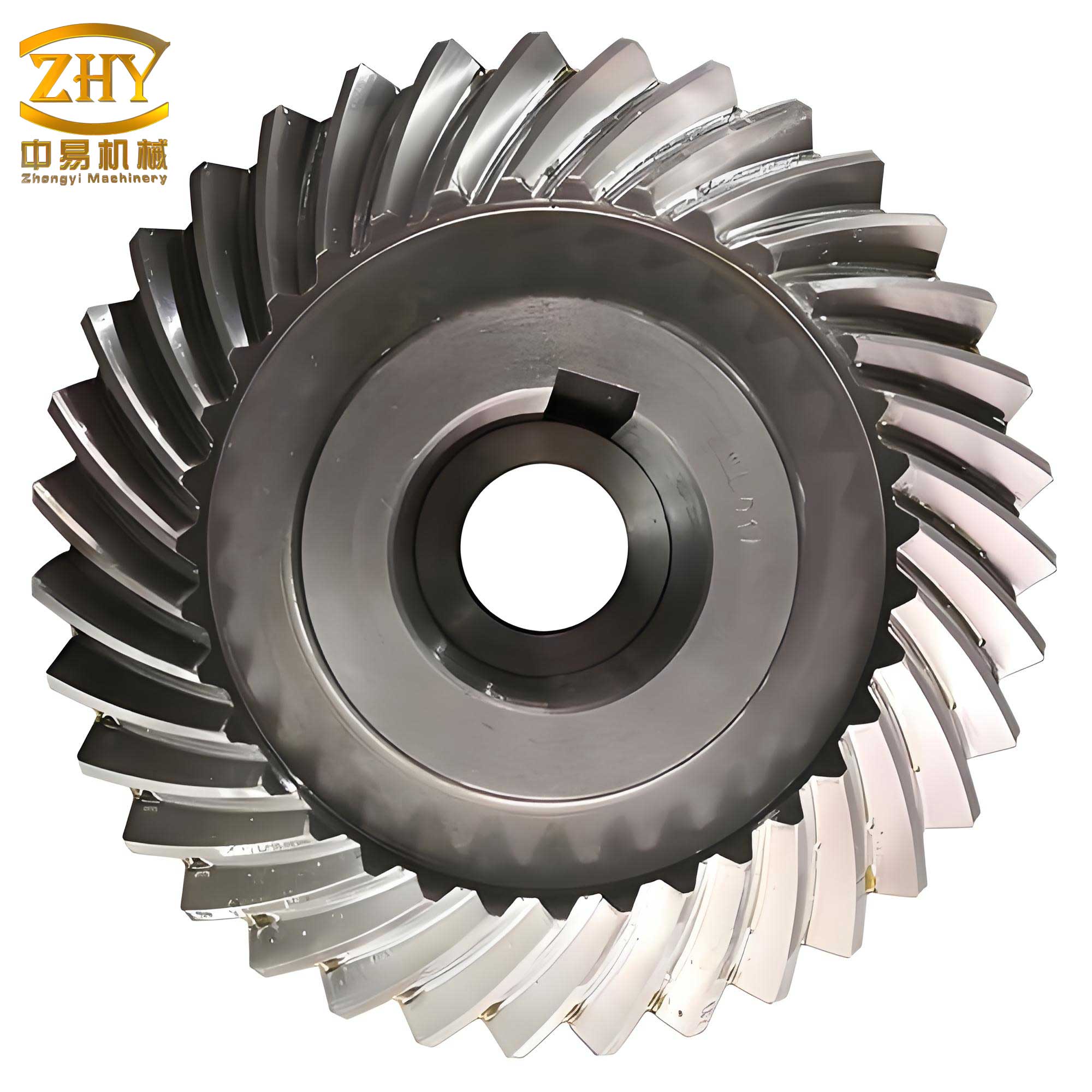
The fundamental operation of spiral gear pumps involves the meshing of helical gears with a circular arc tooth profile, which ensures continuous point contact and eliminates the need for trapping relief mechanisms. This design inherently reduces pulsation and enhances smooth fluid delivery. However, under high-speed and high-pressure regimes, the unbalanced radial forces become more pronounced, primarily due to the combined effects of hydraulic pressure distribution around the gear circumference and the torque-induced forces from gear meshing. To understand this, I established a mathematical model for the gear shaft forces. The radial force generated by hydraulic pressure along the gear circumference can be expressed as follows, where I consider the average radius to improve accuracy, as simplifying to only the tip or root circle can lead to overestimation or underestimation, respectively.
Let $\Delta p$ be the pressure difference between the suction and discharge chambers, $b$ the gear width, $r_a$ the tip circle radius, $r_b$ the root circle radius, and $\theta_1$ and $\theta_2$ the angles defining the low-pressure and high-pressure zones relative to the gear center. The hydraulic radial force components are:
$$F_{Px} = \Delta p b r \frac{\cos \theta_2 – \cos \theta_1}{\theta_2 – \theta_1}$$
$$F_{Py} = \Delta p b r \left(1 – \frac{\sin \theta_2 – \sin \theta_1}{\theta_2 – \theta_1}\right)$$
$$F_P = \sqrt{F_{Px}^2 + F_{Py}^2}$$
where $r = \frac{r_a + r_b}{2}$ is the average radius used to balance the calculation. For spiral gears, this adjustment is crucial due to the complex tooth profile composed of arcs and sinusoidal curves.
The radial force due to gear meshing torque is given by:
$$F_N = \frac{T}{R_b}$$
$$F_{Nx} = F_N \sin \alpha$$
$$F_{Ny} = F_N \cos \alpha$$
where $T$ is the meshing torque, $R_b$ the base circle radius, and $\alpha$ the pressure angle. The total radial force on the driving and driven gears can be derived using the cosine law, with the driven gear experiencing a larger force due to the acute angle between forces. Specifically:
$$F_{r1} = \sqrt{F_P^2 + F_N^2 – 2 F_N F_P \cos \alpha}$$
$$F_{r2} = \sqrt{F_P^2 + F_N^2 + 2 F_N F_P \cos \alpha}$$
where $F_{r1}$ and $F_{r2}$ are the radial forces on the driving and driven gears, respectively. In high-pressure conditions, $F_{r2}$ can become significantly large, leading to severe bearing loads.
To compensate for these unbalanced radial forces, I designed a novel sliding bearing that integrates a hydrostatic compensation mechanism. The key innovation lies in connecting the bearing directly to the high-pressure discharge chamber of the spiral gear pump. High-pressure oil from the discharge chamber enters the bearing through an inlet port, flows into strategically placed hydrostatic grooves, and exerts a counteracting force on the gear shaft. This design leverages the existing pump pressure to generate a compensating force, thereby reducing the net radial load on the bearing. The bearing features hydrostatic grooves symmetrically aligned with the primary force direction (mainly the Y-axis), as the radial force component in the X-axis is negligible. The groove arc length is determined based on the radial force magnitude to ensure optimal compensation. For the driven gear bearing, the groove arc $g_1$ is calculated as:
$$g = \frac{180 F_{ry}}{D_z p b_1}$$
where $F_{ry}$ is the Y-component of the radial force, $D_z$ the bearing inner diameter, $p$ the pressure in the hydrostatic groove, and $b_1$ the groove width. From my analysis, $g_1 = 156^\circ$ for the driven gear and $g_2 = 116^\circ$ for the driving gear, with the driven gear bearing being the focus due to higher loads.
The compensating force $F_h$ provided by the hydrostatic groove is:
$$F_h = \frac{p b_1 \theta D_z}{180}$$
This force directly opposes the radial force, enhancing bearing stability. The bearing inner diameter $D_z$ is selected considering both strength constraints and leakage limitations. Based on gear pump geometry and performance requirements, the range is derived as:
$$\sqrt[4]{\frac{5}{\pi^2 [\sigma]_b^2} \left( M^2 + T_a^2 \right)} \leq D_z \leq D_e – \frac{\pi s^3 \Delta p}{6 q_{v \text{max}} \mu}$$
where $[\sigma]_b$ is the tensile strength limit, $M$ the bending moment, $T_a$ the torque, $D_e$ the bearing outer diameter, $s$ the end clearance, $q_{v \text{max}}$ the maximum allowable leakage, $\mu$ the dynamic viscosity, and $\Delta p$ the pressure difference. For spiral gear pumps, radial leakage flow $Q_r$ is modeled using parallel plate gap flow theory:
$$Q_r = \frac{\Delta p \delta^3}{6 \mu W} – \frac{1}{30\pi} (n r_a \delta) \frac{b}{\cos \beta} \times 60 \times 10^3$$
where $\delta$ is the optimal radial clearance, $n$ the rotational speed, $W$ the total width of the gear tip transition zone, and $\beta$ the helix angle. After evaluation, I chose $D_z = 12 \text{ mm}$ to balance leakage reduction and structural feasibility. The bearing outer diameter $D$ matches the gear tip diameter, given by:
$$D = m (z + 2 f_1)$$
with $m$ as the module, $z$ the number of teeth, and $f_1$ the addendum coefficient. The complete bearing parameters are summarized in the table below.
| Parameter | Value |
|---|---|
| Bearing inner diameter $D_z$ (mm) | 12 |
| Bearing outer diameter $D$ (mm) | 25.36 |
| Bearing width $B$ (mm) | 19 |
| Inlet port diameter $d$ (mm) | 1.5 |
| Hydrostatic groove width $b_1$ (mm) | 14 |
| Hydrostatic groove depth $h$ (mm) | 1 |
| Groove arc length $\theta$ (degrees) | 156 |
| Flow channel width $b_2$ (mm) | 2 |
To validate the design, I conducted computational fluid dynamics (CFD) simulations using Fluent software, comparing the novel sliding bearing with a conventional one under high-speed and high-pressure conditions. The fluid domain between the bearing and gear shaft was extracted and meshed with structured grids. I assumed incompressible flow, steady-state conditions, and negligible inertia forces, with boundary conditions set to simulate realistic operation. The governing equations include the continuity equation:
$$\frac{\partial \rho}{\partial t} + \nabla \cdot (\rho \vec{v}) = 0$$
the motion equation:
$$\frac{d \vec{v}}{dt} = \vec{f} – \frac{1}{\rho} \text{grad} p$$
and the Navier-Stokes equation for incompressible flow:
$$\frac{\partial \vec{v}}{\partial t} + (\vec{v} \cdot \nabla) \vec{v} = \vec{f} – \frac{1}{\rho} \nabla p + \nu \nabla^2 \vec{v}$$
where $\rho$ is density, $\vec{v}$ velocity vector, $p$ pressure, $\vec{f}$ body force per unit mass, and $\nu$ kinematic viscosity. The energy equation with viscous heating was also considered to analyze thermal effects.
The simulations revealed significant differences in performance. For the conventional sliding bearing, pressure at the inlet drops substantially within the bearing, leading to eccentric shaft displacement and increased pressure on the opposite side due to oil film squeezing—a typical hydrodynamic effect. In contrast, the novel bearing maintains high pressure in the hydrostatic grooves, with minimal pressure drop, directly counteracting radial forces. Below, I summarize the impact of load pressure on bearing capacity and temperature rise based on simulation results at a constant speed of 10,000 rpm.
| Load Pressure (MPa) | Conventional Bearing Load Capacity (N) | Novel Bearing Load Capacity (N) | Conventional Bearing Temperature Rise (°C) | Novel Bearing Temperature Rise (°C) |
|---|---|---|---|---|
| 5 | 120 | 450 | 15 | 8 |
| 10 | 150 | 920 | 20 | 12 |
| 15 | 180 | 1380 | 25 | 16 |
| 20 | 210 | 1850 | 30 | 20 |
| 25 | 240 | 2320 | 35 | 25 |
The data shows that the novel bearing’s load capacity increases nearly fourfold at 25 MPa compared to the conventional one, due to the dominant hydrostatic effect. The temperature rise is also reduced by approximately 10°C at rated pressure, as compensation minimizes wear and frictional heating. The pressure and temperature distributions from simulations further illustrate these trends: in the novel bearing, the hydrostatic groove pressure aligns with load pressure, while the conventional bearing exhibits lower pressures and higher thermal gradients near the eccentric zone.
To experimentally verify these findings, I built a test rig consisting of a spiral gear pump prototype, a servo motor, filters, a tank, and measurement instruments. The pump was tested with both conventional and novel sliding bearings under conditions of 15 MPa load pressure and 6,000 rpm. Temperature was monitored using an infrared thermometer over time, and bearing wear was examined post-test. The results confirmed the simulation predictions: the pump with the novel bearing operated at about 11°C lower temperature than with the conventional bearing, and visual inspection showed significantly reduced wear on the novel bearing surfaces. This aligns with the improved radial force compensation, which stabilizes the gear shaft, maintains optimal radial clearances, and reduces leakage in spiral gear pumps.
In conclusion, my research demonstrates that the novel sliding bearing with hydrostatic compensation effectively addresses radial force challenges in high-speed and high-pressure spiral gear pumps. The mathematical models provide a foundation for force analysis, while the CFD simulations and experimental tests validate the design’s superiority in load capacity and thermal management. This approach not only enhances pump reliability and efficiency but also offers a scalable solution for advanced hydraulic systems. Future work could explore optimization of groove geometries for different spiral gear configurations or integration with smart control systems for adaptive compensation. Ultimately, the innovation underscores the importance of tailored bearing designs in harnessing the full potential of spiral gears for demanding applications.