
In the realm of gear transmission systems designed for non-parallel, non-intersecting axes, the spiral gears arrangement holds a unique position. As a designer and analyst of mechanical systems, I often encounter situations where motion must be transferred between skewed shafts. While a single spiral gear is geometrically identical to a helical gear, their collective operation in a pair—where the axes are neither parallel nor intersecting—introduces a distinct and more complex set of kinematic and load-bearing characteristics. This distinctness fundamentally alters the contact conditions from the line contact typical of parallel-axis helical gears to a theoretical point contact. This point contact, while offering some insensitivity to alignment errors, necessitates a more rigorous approach to contact stress analysis to prevent premature failure modes like pitting, wear, and scuffing, which are predominant in spiral gears applications.
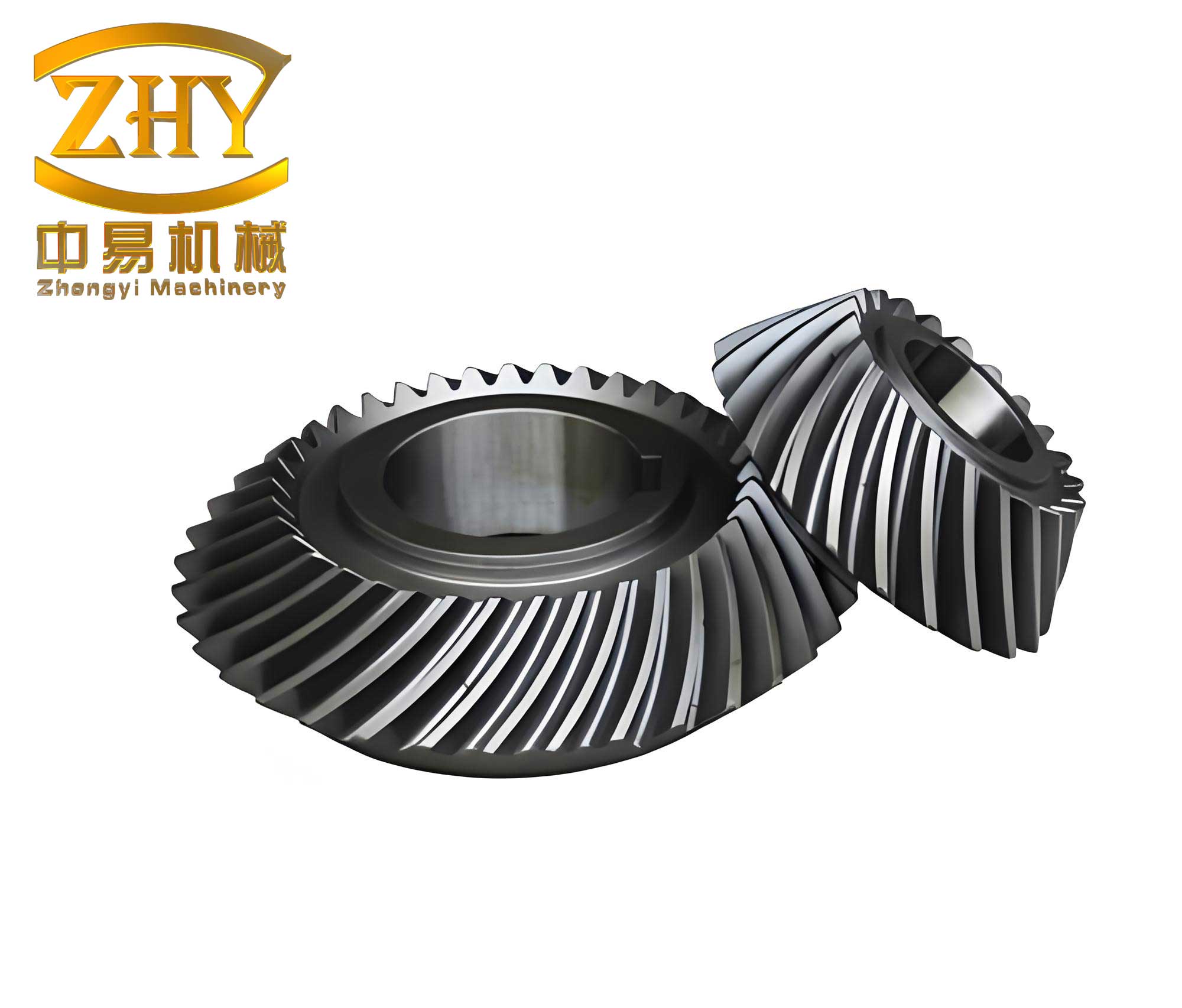
The core principle of spiral gears operation can be effectively visualized through the concept of a common virtual rack. Imagine two spiral gears in mesh, each with its own helix angle $\beta_1$ and $\beta_2$. Their interaction can be modeled as both gears simultaneously meshing with an imaginary rack in space. The relationship between their helix angles and the shaft angle $\Sigma$ is fundamental: $\Sigma = |\beta_1 \pm \beta_2|$, where the sign depends on the hand of the helices (same sign for opposite hands, different signs for the same hand). The kinematics reveal a significant sliding velocity component along the tooth, which is a primary reason why spiral gears are generally suited for low-to-moderate power and speed applications, often found in intricate mechanisms within packaging, textile, or instrumentation equipment. The primary design challenge, therefore, shifts from bending strength—which can be checked using modified helical gear formulas—to ensuring adequate surface durability under this complex point-contact condition.
Traditional design handbooks and resources often treat the design of spiral gears with simplified, empirical formulas for contact stress. This approach, while practical for initial estimates, lacks the precision demanded for reliable performance prediction. My objective here is to establish a more exact analytical foundation. By deriving the contact strength equations directly from the fundamental Hertzian theory for elastic contact, we can develop both precise verification formulas and direct design calculation methods for determining the primary dimensions of spiral gears. This methodology elevates the design process from reliance on experience-based rules to one grounded in mechanical contact physics.
Analysis of Contact Mechanics in Spiral Gears
The contact between two teeth of a pair of spiral gears at any instant is analogous to the contact between two curved elastic bodies: specifically, two cylinders whose axes are non-parallel and non-intersecting. At the pitch point, these “virtual cylinders” have radii equal to the transverse radii of curvature of the gear teeth profiles. Although theoretical contact is a point, elastic deformation under load creates a small elliptical contact area. The maximum compressive stress at the center of this ellipse is governed by the classic Hertzian contact theory for general curved surfaces.
The generalized Hertz formula for maximum contact stress $\sigma_H$ is:
$$ \sigma_H = \sqrt[2]{\frac{F_n}{\pi \zeta \eta} \cdot \frac{1}{\rho_{eq}}} $$
Where:
- $F_n$ is the normal load acting perpendicular to the contact ellipse plane.
- $\zeta$ and $\eta$ are the semi-axis lengths of the contact ellipse.
- $\rho_{eq}$ is the equivalent radius of curvature.
For two bodies in point contact, the equivalent curvature $\frac{1}{\rho_{eq}}$ is calculated from the principal radii of curvature of both bodies at the contact point. For spiral gears, these radii are derived from the geometry of the equivalent spur gears in the normal plane. The radii of curvature for the pinion and gear at the pitch point are:
$$ \rho_1 = \frac{d_{v1} \sin \alpha_n}{2} \quad \text{and} \quad \rho_2 = \frac{d_{v2} \sin \alpha_n}{2} $$
Here, $d_{v1}$ and $d_{v2}$ are the pitch diameters of the virtual spur gears (the equivalent gears in the normal plane), and $\alpha_n$ is the normal pressure angle. The equivalent virtual diameters are related to the actual spiral gear diameters by the helix angle: $d_v = d / \cos^2 \beta$. Therefore, the radii become:
$$ \rho_1 = \frac{d_1 \sin \alpha_n}{2 \cos^2 \beta_1} \quad \text{and} \quad \rho_2 = \frac{d_2 \sin \alpha_n}{2 \cos^2 \beta_2} $$
Since the cylinders are non-parallel, their axes form an angle $\theta$. This angle is not the shaft angle $\Sigma$, but rather the angle between the two instantaneous lines of contact, which is derived from the gear geometry. The geometry of the elliptical contact area is defined by an auxiliary angle $\varphi$, where:
$$ \cos \varphi = \frac{\cos \theta}{\sqrt{(\frac{1}{\rho_1} – \frac{1}{\rho_2})^2 + 4 \frac{1}{\rho_1} \frac{1}{\rho_2} \sin^2 \theta}} $$
The elliptical coefficients $\zeta$ and $\eta$ are then determined from look-up tables or functions based on this Hertzian angle $\varphi$.
Derivation of the Precise Contact Stress Formula
To make the Hertz formula practical for spiral gears design, we must express all geometric parameters in terms of standard gear design variables. The normal load $F_n$ is derived from the transmitted torque. For a pinion torque $T_1$, pitch diameter $d_1$, and helix angle $\beta_1$, the tangential force $F_t$ is $F_t = 2T_1 / d_1$. The normal load is then:
$$ F_n = \frac{F_t}{\cos \alpha_n \cos \beta_1} = \frac{2 T_1}{d_1 \cos \alpha_n \cos \beta_1} $$
Combining this with the expressions for curvature radii and incorporating the elastic properties of the gear materials (Young’s modulus $E$ and Poisson’s ratio $\nu$), we arrive at the core contact stress verification formula for spiral gears. After substantial algebraic manipulation to consolidate geometric terms, the formula for steel-on-steel spiral gears can be condensed to the following manageable form:
$$ \sigma_H = Z_E Z_H Z_\beta Z_K \sqrt[2]{\frac{2 K T_1}{d_1^3} \cdot \frac{u^2 + 1}{u}} \leq \sigma_{HP} $$
Where:
- $Z_E$ is the elastic coefficient $\sqrt[2]{\frac{1}{\pi ( \frac{1-\nu_1^2}{E_1} + \frac{1-\nu_2^2}{E_2} )}}$.
- $Z_H$ is the zone factor, accounting for the geometry at the pitch point: $Z_H = \sqrt[2]{\frac{2 \cos \beta_b}{\cos^2 \alpha_t \sin \alpha_t}}$, where $\beta_b$ is the base helix angle and $\alpha_t$ is the transverse pressure angle.
- $Z_\beta$ is the helix angle factor.
- $Z_K$ is the spiral gear contact coefficient, a unique factor encapsulating the effects of non-parallel axes, the Hertzian ellipse geometry ($\zeta, \eta$), and the specific curvature relationship. This coefficient is the key differentiator from parallel-axis gear formulas and must be calculated from the full geometric model described earlier.
- $K$ is the application factor (accounting for dynamic loads).
- $T_1$ is the pinion torque.
- $d_1$ is the pinion pitch diameter.
- $u$ is the gear ratio $z_2/z_1$.
- $\sigma_{HP}$ is the permissible contact stress for the spiral gears pair.
It is critical to note that while the calculated contact stress $\sigma_H$ is identical for both spiral gears in the pair, their permissible stresses $\sigma_{HP1}$ and $\sigma_{HP2}$ may differ due to material, hardness, or life requirements. The design must satisfy the condition against the lower of the two allowable stresses. Furthermore, for spiral gears, the permissible stress is often intentionally derated compared to parallel-axis gears to account for the high sliding velocities and increased risk of abrasive wear or scuffing.
Design Calculation Methodology and Parameter Selection
The verification formula above is essential for checking an existing design. However, the primary task in engineering is often synthesis: determining the main dimensions from scratch. We can rearrange the verification formula to solve for the pinion diameter $d_1$, the fundamental design variable. This yields the direct design formula for spiral gears:
$$ d_1 \geq \sqrt[3]{\frac{2 K T_1}{\sigma_{HP}^2} \cdot \frac{u^2 + 1}{u} \cdot (Z_E Z_H Z_\beta Z_K)^2 } $$
This formula provides a direct path to sizing. The steps for designing a pair of spiral gears are as follows:
- Define Input Parameters: Determine the transmitted power $P$, pinion speed $n_1$, gear ratio $u$, shaft angle $\Sigma$, and desired life.
- Select Materials and Permissible Stress $\sigma_{HP}$: Choose materials for both spiral gears. Determine the allowable contact stress $\sigma_{HP}$ for the weaker material, applying necessary derating factors for sliding conditions.
- Choose Tooth System Parameters: Select the normal module $m_n$, normal pressure angle $\alpha_n$ (typically 20°), and helix angles $\beta_1$ and $\beta_2$ that satisfy $\Sigma = |\beta_1 \pm \beta_2|$. The choice of helix angles significantly influences the contact ellipse shape and the $Z_K$ factor.
- Estimate Design Torque and Application Factor: Calculate pinion torque $T_1 = 9.55 \times 10^6 \frac{P}{n_1}$ and select an appropriate application factor $K$.
- Calculate Geometric Coefficients: Compute $Z_E$, $Z_H$, $Z_\beta$, and most importantly, the spiral gear contact coefficient $Z_K$ using the full Hertzian geometry model.
- Compute Minimum Pinion Diameter: Use the design formula above to find the required $d_1$.
- Determine Other Dimensions: Calculate the number of teeth ($z_1 = d_1 \cos \beta_1 / m_n$, round to integer), then recalculate exact $d_1$, $d_2$, center distance, etc. Face width for spiral gears is not a primary strength variable but is chosen based on manufacturing and assembly considerations.
- Perform Final Verification: Recalculate the contact stress $\sigma_H$ using the verification formula with the finalized dimensions to ensure it is below $\sigma_{HP}$. Also, perform a bending strength check as a secondary verification.
A key aspect in the design of spiral gears is the selection of parameters to optimize the contact ellipse and minimize stress. The following table summarizes critical design parameters and their typical ranges or values:
| Parameter | Symbol | Typical Range / Value | Notes |
|---|---|---|---|
| Shaft Angle | $\Sigma$ | 90° (Common) | Simplifies geometry, often used. |
| Normal Pressure Angle | $\alpha_n$ | 20° | Standard value. |
| Helix Angles | $\beta_1, \beta_2$ | 20° – 45° | Larger angles increase axial thrust but can improve smoothness. |
| Gear Ratio | $u$ | 1:1 to 6:1 | Higher ratios lead to more sliding on the gear. |
| Spiral Gears Contact Coeff. | $Z_K$ | 0.6 – 1.2 | Depends on $\beta_1$, $\beta_2$, $\Sigma$, and $\alpha_n$. Must be calculated. |
Numerical Design Example
To illustrate the application of this precise methodology, let’s consider the redesign of a pair of spiral gears in a low-power instrument drive. The goal is to ensure reliable operation under given loads.
Input Data:
- Power, $P = 0.5 \text{ kW}$
- Pinion speed, $n_1 = 1000 \text{ rpm}$
- Shaft angle, $\Sigma = 90^\circ$
- Gear ratio, $u = 3$
- Both spiral gears made from steel, permissible contact stress $\sigma_{HP} = 400 \text{ MPa}$ (derated for sliding).
- Normal module chosen as $m_n = 2 \text{ mm}$, $\alpha_n = 20^\circ$.
- Helix angles selected: $\beta_1 = 35^\circ$ (right hand), $\beta_2 = 55^\circ$ (right hand) to satisfy $\Sigma = 90^\circ$.
Step-by-Step Calculation:
- Pinion torque: $T_1 = 9.55 \times 10^6 \times \frac{0.5}{1000} = 4775 \text{ Nmm}$.
- Assume application factor $K = 1.3$.
- Elastic coefficient for steel: $Z_E = 189.8 \sqrt{\text{MPa}}$.
- Calculate transverse pressure angle: $\alpha_t = \arctan(\tan \alpha_n / \cos \beta_1) = \arctan(\tan 20^\circ / \cos 35^\circ) \approx 23.96^\circ$.
- Base helix angle: $\beta_b = \arcsin(\sin \beta_1 \cos \alpha_n) \approx \arcsin(\sin 35^\circ \cos 20^\circ) \approx 33.03^\circ$.
- Zone factor: $Z_H = \sqrt{\frac{2 \cos \beta_b}{\cos^2 \alpha_t \sin \alpha_t}} = \sqrt{\frac{2 \cos 33.03^\circ}{\cos^2 23.96^\circ \sin 23.96^\circ}} \approx 2.28$.
- Helix angle factor: $Z_\beta = \sqrt{\cos \beta_1} = \sqrt{\cos 35^\circ} \approx 0.91$.
- Determine $Z_K$: This requires calculating the Hertzian geometry. First, find the angle between contact lines $\theta$. For spiral gears with $\Sigma=90^\circ$, $\theta$ is found from the geometry of the equivalent rack. A detailed calculation (involving the normal vectors of the tooth surfaces at the pitch point) yields an approximate value. For this example, let’s assume the calculation results in $\theta \approx 80^\circ$ and a corresponding $Z_K \approx 0.85$.
- Apply the design formula:
$$ d_1 \geq \sqrt[3]{\frac{2 \times 1.3 \times 4775}{400^2} \times \frac{3^2 + 1}{3} \times (189.8 \times 2.28 \times 0.91 \times 0.85)^2 } $$
$$ d_1 \geq \sqrt[3]{\frac{12415}{160000} \times \frac{10}{3} \times (317.5)^2 } \approx \sqrt[3]{0.0776 \times 3.333 \times 100806.25} $$
$$ d_1 \geq \sqrt[3]{26070} \approx 29.7 \text{ mm} $$ - Determine teeth number: $z_1 = \frac{d_1 \cos \beta_1}{m_n} = \frac{29.7 \times \cos 35^\circ}{2} \approx 12.2$. Round to $z_1 = 12$.
- Recalculate exact $d_1$: $d_1 = \frac{m_n z_1}{\cos \beta_1} = \frac{2 \times 12}{\cos 35^\circ} \approx 29.30 \text{ mm}$.
- Gear teeth: $z_2 = u \times z_1 = 3 \times 12 = 36$.
- Gear diameter: $d_2 = \frac{m_n z_2}{\cos \beta_2} = \frac{2 \times 36}{\cos 55^\circ} \approx 125.52 \text{ mm}$.
- Final Verification: Substitute final $d_1$ and other parameters back into the verification formula to confirm $\sigma_H < 400 \text{ MPa}$.
The following table compares the initial calculated minimum diameter with the finalized dimensions based on integer teeth:
| Parameter | Symbol | Minimum Calc. | Final Design |
|---|---|---|---|
| Pinion Diameter | $d_1$ (mm) | 29.7 | 29.30 |
| Pinion Teeth | $z_1$ | 12.2 | 12 |
| Gear Diameter | $d_2$ (mm) | – | 125.52 |
| Center Distance | $a$ (mm) | – | $\approx 77.4$ |
Conclusion
The design of spiral gears requires special attention due to their unique point-contact condition and complex spatial geometry. Relying solely on empirical or simplified formulas can lead to under-designed components prone to surface fatigue or over-designed ones that are unnecessarily bulky. The methodology presented here, derived rigorously from Hertzian contact theory, provides a precise framework for both the verification and the synthesis of spiral gears pairs. By calculating the specific spiral gear contact coefficient $Z_K$ that accounts for the non-parallel axes and the resulting elliptical contact patch, engineers can achieve more accurate and reliable designs. This approach moves beyond traditional guidelines, offering a solid analytical foundation for ensuring the durability and performance of these useful but mechanically intricate components in applications where motion transfer between skewed shafts is essential. Proper application of these formulas, coupled with prudent material selection and derating for sliding action, is key to the successful implementation of spiral gears in mechanical systems.