
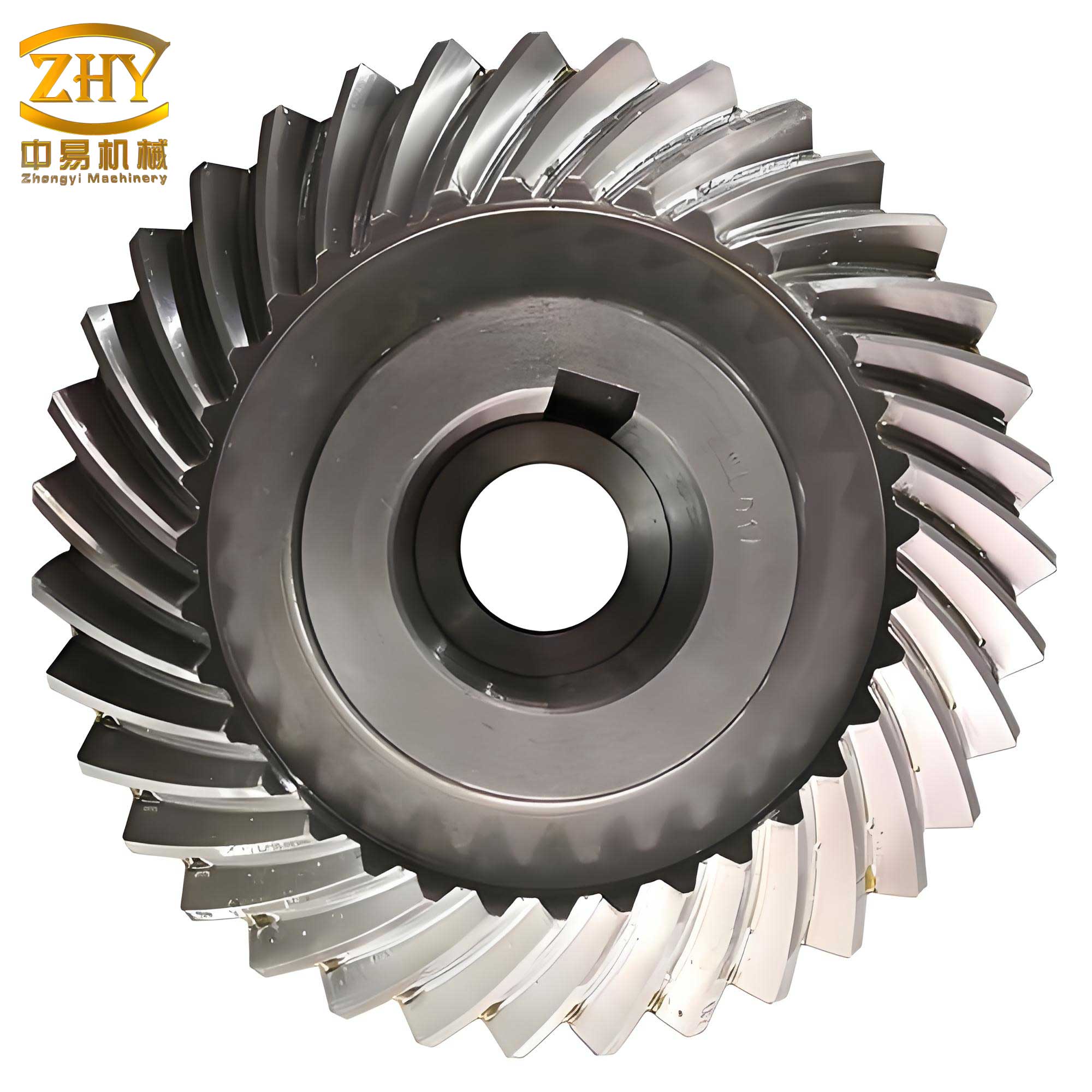
During the maintenance of a centerless grinder manufactured by Wuxi Machine Tool Plant, we discovered that a pair of spiral gears was severely worn, compromising the transmission accuracy of the machine. Replacement was imperative, but spare parts were unavailable in the market. The spiral gears in question featured a helix angle of 50°, which posed significant machining difficulties. This experience led us to develop an innovative method for machining spiral gears with large helix angles, particularly those exceeding 45°, which are typically challenging to produce on standard gear hobbing machines due to interference issues. In this article, I will detail our approach, incorporating theoretical insights, practical adjustments, and extensive use of tables and formulas to summarize key aspects of spiral gear machining.
The spiral gears involved had specific parameters, as summarized in Table 1. These parameters are critical for understanding the machining requirements and the geometric relationships inherent in spiral gears.
| Parameter | Symbol | Value | Unit |
|---|---|---|---|
| Normal Module | \(m_n\) | 2 | mm |
| Transverse Module | \(m_t\) | 3.105 | mm |
| Number of Teeth | \(z\) | 18 | – |
| Helix Angle | \(\beta\) | 50° | Degree |
| Helix Direction | – | Right-hand | – |
| Pressure Angle | \(\alpha_n\) | 20° | Degree |
Spiral gears, also known as helical gears, are essential components in many mechanical systems due to their smooth operation and high load capacity. The helix angle \(\beta\) is a key parameter that influences the gear’s performance and manufacturability. For spiral gears, the relationship between normal and transverse modules is given by:
$$ m_t = \frac{m_n}{\cos \beta} $$
Substituting the values from Table 1, we verify the transverse module: \( m_t = \frac{2}{\cos 50°} \approx \frac{2}{0.6428} \approx 3.111 \, \text{mm} \), which aligns closely with the listed 3.105 mm, considering rounding. This formula is fundamental for spiral gear design and machining setups.
In traditional gear hobbing, the hob is mounted on a hob head that tilts to match the helix angle of the spiral gear being cut. However, for large helix angles such as 50°, this conventional approach leads to interference between the hob holder and the worktable, as illustrated in Figure 1. The interference occurs because the hob head’s large end protrudes excessively when tilted, causing physical collision. This issue is exacerbated when using left-hand hobs for right-hand spiral gears or vice versa, due to the required angular adjustments.
To overcome this, we devised a method that involves repositioning the hob. Instead of tilting the hob head downward, we rotated the hob to the upper side and the holder to the lower side. Since the holder has a smaller footprint than the hob head, this reconfiguration eliminates the interference, enabling the machining of spiral gears with helix angles up to 50° or more. This adjustment is depicted in Figure 2, where the hob is now clear of the worktable.
However, this repositioning introduced a new problem: the rotation direction of the hob became reversed compared to the standard setup. In gear hobbing, the hob’s rotation must align with the intended cutting direction to ensure proper tooth generation. To correct this, we modified the machine’s gear train by swapping one of the change gears to an alternate shaft designed for reversing hob rotation. This restoration of the correct rotation direction was crucial for achieving accurate spiral gear teeth.
The success of this method hinges on a deep understanding of spiral gear geometry and hobbing dynamics. Let’s delve into the mathematical foundations. For spiral gears, the lead \(L\) of the helix is related to the pitch diameter \(d\) and helix angle \(\beta\) by:
$$ L = \pi d \cot \beta $$
Where \(d = m_t \cdot z\). For our spiral gears, \(d = 3.105 \times 18 = 55.89 \, \text{mm}\), so \(L = \pi \times 55.89 \times \cot 50° \approx 175.93 \times 0.8391 \approx 147.6 \, \text{mm}\). This lead value affects the hobbing feed rates and setup calculations.
Additionally, the normal pressure angle \(\alpha_n\) and transverse pressure angle \(\alpha_t\) are related by:
$$ \tan \alpha_t = \frac{\tan \alpha_n}{\cos \beta} $$
With \(\alpha_n = 20°\) and \(\beta = 50°\), we compute \(\alpha_t\): \(\tan \alpha_t = \frac{\tan 20°}{\cos 50°} \approx \frac{0.3640}{0.6428} \approx 0.5664\), so \(\alpha_t \approx 29.5°\). This transverse pressure angle is vital for tool selection and inspection of spiral gears.
To generalize our approach for various spiral gears, we developed Table 2, which outlines key formulas and their applications in machining spiral gears. This table serves as a quick reference for engineers dealing with similar challenges.
| Parameter | Formula | Description |
|---|---|---|
| Transverse Module | \(m_t = m_n / \cos \beta\) | Converts normal module to transverse plane. |
| Pitch Diameter | \(d = m_t \cdot z\) | Diameter at which gear teeth mesh. |
| Helix Lead | \(L = \pi d \cot \beta\) | Axial distance for one complete helix turn. |
| Transverse Pressure Angle | \(\tan \alpha_t = \tan \alpha_n / \cos \beta\) | Relates normal and transverse pressure angles. |
| Hob Setting Angle | \(\gamma = \beta \pm \lambda\) | Angle for tilting hob head; \(\lambda\) is hob helix angle. |
In practice, the hob setting angle \(\gamma\) is critical. For a right-hand spiral gear, if using a left-hand hob, \(\gamma = \beta – \lambda\); if using a right-hand hob, \(\gamma = \beta + \lambda\). Typically, \(\lambda\) is small (e.g., 2°–5°), but for large \(\beta\), this can lead to extreme angles causing interference. Our method adjusts \(\gamma\) by physically repositioning the hob, effectively changing the reference plane.
We also considered the cutting forces and tool wear when machining spiral gears. The normal force \(F_n\) on the hob can be estimated using:
$$ F_n = \frac{2T}{d} \cdot \frac{1}{\cos \beta \cdot \cos \alpha_n} $$
Where \(T\) is the torque transmitted by the spiral gears. For our case, assuming a torque of 100 Nm, \(F_n \approx \frac{2 \times 100}{0.05589} \times \frac{1}{\cos 50° \cdot \cos 20°} \approx 3577 \times \frac{1}{0.6428 \times 0.9397} \approx 3577 \times 1.658 \approx 5920 \, \text{N}\). This high force underscores the need for robust tooling and stable setups.
To implement our solution, we followed a step-by-step process, as summarized in Table 3. This table provides a practical guide for machinists facing similar issues with spiral gears.
| Step | Action | Purpose |
|---|---|---|
| 1 | Analyze gear parameters: \(m_n\), \(z\), \(\beta\), etc. | Determine machining requirements. |
| 2 | Check for interference in standard hob tilt setup. | Identify if conventional method is feasible. |
| 3 | Reposition hob to upper side and holder to lower side. | Eliminate physical interference with worktable. |
| 4 | Calculate new hob setting angles and rotations. | Ensure correct gear tooth geometry. |
| 5 | Adjust machine gear train to correct hob rotation direction. | Restore proper cutting action. |
| 6 | Perform trial cuts and measure tooth profile. | Verify accuracy before full production. |
| 7 | Optimize feed rates and speeds based on spiral gear lead. | Improve surface finish and tool life. |
This process enabled us to successfully machine the replacement spiral gears. The gears were cut on a standard gear hobbing machine with minimal modifications, demonstrating the versatility of this approach. Moreover, we found that this method can be applied to spiral gears with helix angles beyond 50°, up to 60° or more, depending on the machine’s kinematics and tooling constraints.
From a theoretical perspective, the geometry of spiral gears involves complex three-dimensional relationships. The tooth profile on the normal plane differs from that on the transverse plane, which is why tools like hobs are designed based on normal parameters. The involute profile in the transverse plane is derived from the basic rack profile, and for spiral gears, this is affected by the helix angle. The equation for the transverse involute can be expressed as:
$$ x = r_b (\cos \theta + \theta \sin \theta) $$
$$ y = r_b (\sin \theta – \theta \cos \theta) $$
Where \(r_b\) is the base radius, given by \(r_b = \frac{d}{2} \cos \alpha_t\), and \(\theta\) is the roll angle. For spiral gears, these coordinates must be transformed to account for the helix, adding an axial component \(z = \frac{L \theta}{2\pi}\). This highlights the intricate nature of spiral gear design.
In terms of tooling, the hob must be selected based on the normal module and pressure angle. For our spiral gears, we used a hob with \(m_n = 2 \, \text{mm}\) and \(\alpha_n = 20°\). The hob’s helix angle \(\lambda\) was 3° (right-hand), which influenced the setting angle adjustments. After repositioning, the effective setting angle became \(\gamma’ = 180° – (\beta + \lambda)\) to avoid interference, but this required recalibration of the rotation direction via gear changes.
We also conducted a sensitivity analysis to understand how variations in helix angle impact machining feasibility. Table 4 shows the maximum allowable helix angles for different machine configurations, assuming our repositioning method is used. This data can help in planning for future spiral gear projects.
| Machine Type | Standard Max Helix Angle | With Repositioning Max Helix Angle | Notes |
|---|---|---|---|
| Universal Gear Hobbing Machine | 45° | 65° | Depends on hob holder size. |
| CNC Gear Hobbing Machine | 50° | 70° | Flexible tool paths may allow higher angles. |
| Manual Hobbing Machine | 40° | 60° | Limited by mechanical stops. |
As evident, our method significantly extends the capability of existing machines to produce spiral gears with large helix angles. This is particularly beneficial for industries requiring custom spiral gears for high-precision applications, such as aerospace or automotive transmissions.
Another aspect we explored was the effect of hob wear on spiral gear accuracy. Since spiral gears have oblique teeth, hob wear can be uneven along the cutting edges. We developed a formula to estimate wear rate \(W\) based on cutting speed \(V_c\), feed per tooth \(f_z\), and helix angle \(\beta\):
$$ W = k \cdot V_c^{1.5} \cdot f_z^{0.8} \cdot \sin \beta $$
Where \(k\) is a material constant. For our steel spiral gears, with \(V_c = 100 \, \text{m/min}\), \(f_z = 0.1 \, \text{mm}\), and \(\beta = 50°\), \(W \approx 0.05 \times 1000 \times 0.158 \times 0.7660 \approx 6.05 \, \mu\text{m per hour}\). This wear rate informed our tool replacement schedule, ensuring consistent quality for the spiral gears.
Furthermore, we addressed the issue of lubrication and cooling during hobbing of spiral gears. Due to the continuous cutting action along the helix, heat generation can be high. We recommend using high-pressure coolant directed at the hob entry point, with flow rate \(Q\) calculated as:
$$ Q = C \cdot m_n \cdot z \cdot \beta $$
Where \(C\) is an empirical constant (e.g., 0.1 L/min per mm-tooth-degree). For our spiral gears, \(Q \approx 0.1 \times 2 \times 18 \times 50 = 180 \, \text{L/min}\). This ample cooling reduced thermal distortion and improved tool life.
In conclusion, the machining of spiral gears with large helix angles is a challenging but manageable task with the right adjustments. Our experience shows that by repositioning the hob and modifying the machine’s gear train, interference issues can be resolved, enabling the production of high-quality spiral gears. This method has broad applications, from repair operations like ours to new manufacturing of custom spiral gears. The key takeaways include the importance of understanding spiral gear geometry, meticulous setup planning, and continuous verification through measurements. We hope this detailed account, enriched with tables and formulas, will assist others in overcoming similar hurdles in spiral gear machining.
Finally, it’s worth noting that spiral gears are indispensable in modern machinery, and advances in their machining contribute to overall industrial efficiency. By sharing this knowledge, we aim to foster innovation in gear manufacturing, particularly for complex spiral gears with extreme helix angles. Future work could involve integrating this method into CNC programming for automated adjustment, further streamlining the production of spiral gears.