
In recent years, additive manufacturing, commonly known as 3D printing, has emerged as a transformative rapid prototyping technology that spans industrial and civilian applications. Among the various geometries produced, herringbone gears are particularly challenging due to their complex double‑helical structure, which demands precise control over process parameters to avoid internal defects. One of the most critical parameters is the ambient temperature during printing. In this study, I systematically investigated the influence of three different forming temperatures (30 °C, 60 °C, and 90 °C) on the internal quality of ABS‑based 3D‑printed herringbone gears. Using a digital ultrasonic flaw detector, I evaluated the internal defects and determined the optimal temperature range for achieving dense, defect‑free components. This work provides quantitative insight into the temperature‑defect relationship and offers guidance for improving the reliability of additively manufactured herringbone gears.
Design and 3D Printing of Herringbone Gears
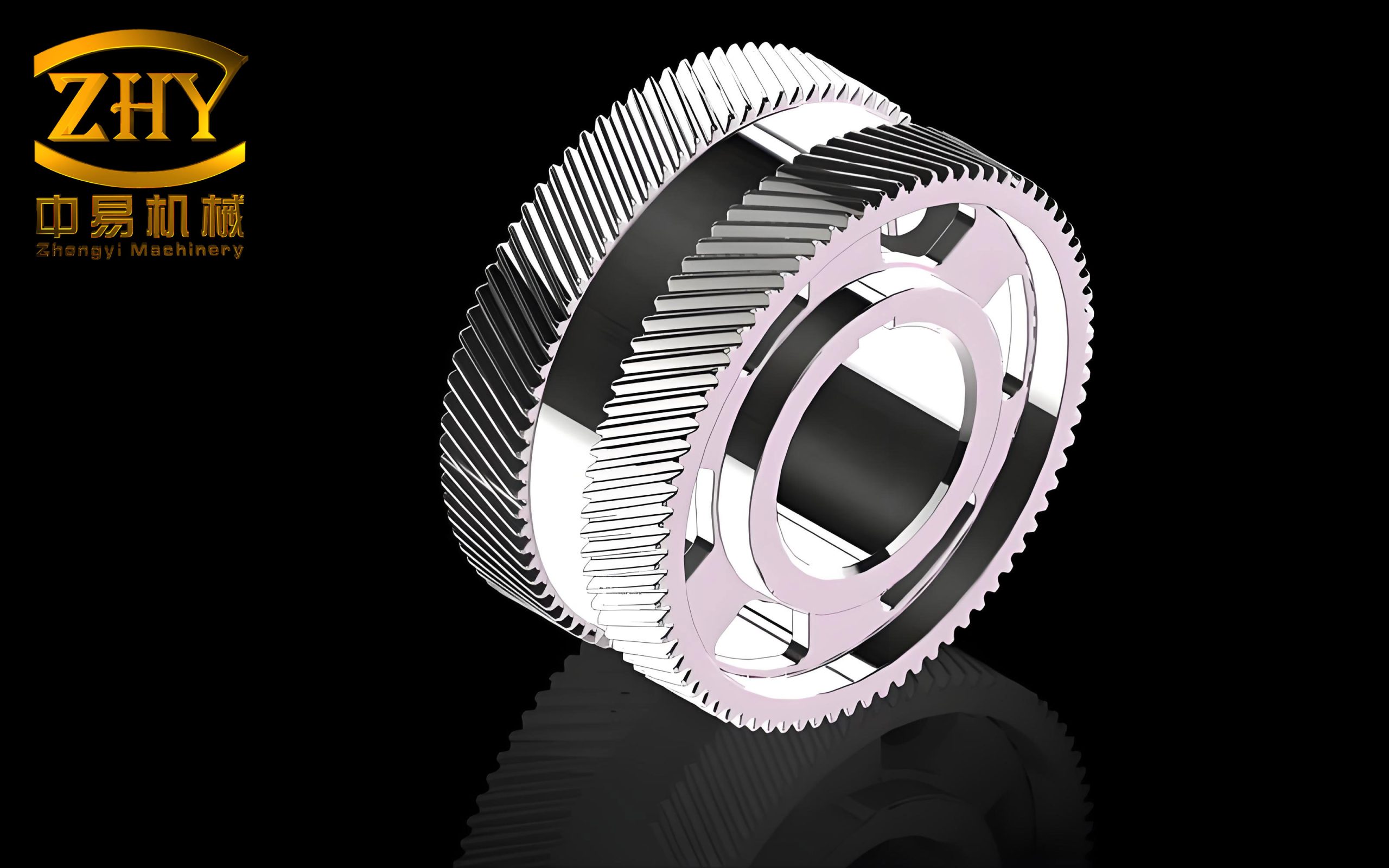
The herringbone gear used in this study was designed using PRO/ENGINEER software. The geometry consists of two opposing helical gears joined together, creating a symmetric tooth pattern that eliminates axial thrust. The key design parameters are summarized in Table 1.
| Parameter | Value |
|---|---|
| Normal module (mₙ) | 2.5 mm |
| Number of teeth (z) | 20 |
| Face width (b) | 10.0 mm |
| Pitch circle diameter | 53 mm |
| Tip circle diameter | 58 mm |
| Normal pressure angle (αₙ) | 20.0° |
| Helix angle (β) | 20.0° |
| Hand of helix | Left‑hand |
| Profile shift coefficient | 0 |
| Root fillet radius | 0.25 mm |
The complex geometry of herringbone gears makes them sensitive to even minor parameter deviations during the slicing and printing process. For example, an incorrect profile shift coefficient can lead to severe warpage or layer misalignment, as observed in preliminary trials. After the solid model was completed, it was exported as an STL file and imported into the 3D printing software Model Wizard. The material chosen was ABS (acrylonitrile butadiene styrene) filament, a common thermoplastic with good mechanical properties and printability. The printer employed a fused deposition modeling (FDM) approach, where the filament is melted and extruded layer by layer. The nozzle temperature was fixed at 230 °C, while the build‑chamber temperature was controlled at three distinct levels: 30 °C, 60 °C, and 90 °C. The print quality setting was kept at “normal” to ensure consistency across all experiments.
Theoretical Background of Ultrasonic Testing
Ultrasonic testing is a non‑destructive evaluation method widely used to detect internal flaws such as voids, cracks, and delaminations. The principle is based on the propagation of high‑frequency sound waves (typically 0.5 – 20 MHz) through the test object. When the wave encounters a discontinuity (e.g., a pore or inclusion), part of the energy is reflected, refracted, or scattered. By analyzing the received echoes, the location and size of the defect can be determined. The fundamental equations governing ultrasonic wave propagation include the wave speed:
$$ v = f \lambda $$
where \(v\) is the longitudinal wave speed in the material, \(f\) is the frequency, and \(\lambda\) is the wavelength. For ABS, the typical longitudinal wave speed is approximately 2200 m/s. The reflection coefficient \(R\) at an interface between two media with acoustic impedances \(Z_1\) and \(Z_2\) is given by:
$$ R = \frac{Z_2 – Z_1}{Z_2 + Z_1} $$
where \(Z = \rho v\) is the acoustic impedance, \(\rho\) being the density. A defect filled with air (low impedance) creates a strong reflection, while a solid‑to‑solid interface (e.g., a bonded layer) produces a weaker echo. The attenuation of the ultrasonic wave as it travels through the material is described by:
$$ A = A_0 e^{-\alpha d} $$
where \(A_0\) is the initial amplitude, \(A\) is the amplitude after traveling a distance \(d\), and \(\alpha\) is the attenuation coefficient (in dB/mm). Higher attenuation indicates more scattering centers, which correlate with porosity or poor interlayer bonding.
In practice, an ultrasonic flaw detector displays three main signals on the screen: the initial pulse (representing the transducer surface), the back‑wall echo (from the opposite side of the part), and any defect echoes appearing between them. The presence of a defect echo indicates an internal flaw, while the reduction of the back‑wall echo amplitude (compared to a defect‑free reference) suggests distributed porosity or material degradation.
Experimental Procedure
Three sets of herringbone gears were printed at chamber temperatures of 30 °C, 60 °C, and 90 °C. The 30 °C specimens exhibited severe warping and incomplete layer fusion immediately after printing; the teeth were distorted and the overall shape was unacceptable for any further testing. Therefore, only the parts produced at 60 °C and 90 °C were subjected to ultrasonic inspection. The printing parameters for both successful groups are summarized in Table 2.
| Parameter | Value |
|---|---|
| Nozzle temperature | 230 °C |
| Layer height | 0.2 mm |
| Print speed | 50 mm/s |
| Fill density | 100% |
| Chamber temperature (trial 1) | 60 °C |
| Chamber temperature (trial 2) | 90 °C |
After printing, the herringbone gears were allowed to cool naturally to room temperature. A digital ultrasonic flaw detector (model CTS‑9002) with a 5 MHz straight‑beam probe was used. Glycerin was applied as a couplant to ensure good acoustic transmission between the probe and the gear surface. The probe was placed on the flat top surface of the gear (the land area between the two helical tooth sections) to obtain a consistent sound path through the entire thickness. Each specimen was tested at three different locations, and the A‑scan waveform was recorded. The key metrics extracted from the waveforms were the amplitude of the back‑wall echo (in percentage of full screen height) and the presence of any intermediate defect echoes.
Results and Analysis
30 °C specimens
As noted, the gears printed at 30 °C showed obvious macroscopic defects. The low chamber temperature caused the extruded ABS to solidify prematurely before reaching its designated position. This resulted in poor interlayer adhesion, surface roughness, and geometric deviations. The internal structure was expected to contain large voids and delaminations. No ultrasonic testing was performed because the parts were already considered non‑functional. This observation aligns with the principle that a low ambient temperature creates a large thermal gradient, inducing high residual stresses and warpage.
60 °C vs. 90 °C specimens
For the gears printed at 60 °C and 90 °C, the ultrasonic A‑scan waveforms are compared. The back‑wall echo amplitude for the 60 °C specimen was significantly lower than that for the 90 °C specimen, indicating higher ultrasonic attenuation. Specifically, the amplitude at 60 °C was about 45% of the full scale, while at 90 °C it reached 78%. The attenuation coefficient \(\alpha\) can be approximated by comparing the back‑wall echo amplitudes of two specimens with the same thickness (6 mm for the gear body). Assuming the incident amplitude is the same, the ratio of amplitudes is:
$$ \frac{A_{90}}{A_{60}} = e^{-(\alpha_{90} – \alpha_{60}) d} $$
Solving for the difference in attenuation coefficients yields:
$$ \alpha_{90} – \alpha_{60} = -\frac{1}{d} \ln \left( \frac{A_{90}}{A_{60}} \right) = -\frac{1}{6} \ln \left( \frac{0.78}{0.45} \right) \approx 0.051 \text{ dB/mm} $$
The negative sign indicates that \(\alpha_{90} < \alpha_{60}\); in fact, \(\alpha_{90}\) is about 0.051 dB/mm lower than \(\alpha_{60}\). This reduction is attributed to fewer scattering sites—namely, internal pores, micro‑cracks, and poorly bonded layers—in the higher‑temperature specimen. A quantitative comparison of the ultrasonic results is provided in Table 3.
| Chamber temperature | Back‑wall echo amplitude (%) | Defect echoes observed | Estimated relative porosity |
|---|---|---|---|
| 60 °C | 45 ± 5 | Multiple small echoes | High |
| 90 °C | 78 ± 4 | No significant echoes | Low |
No defect echoes were detected in the 90 °C specimens, while the 60 °C specimens showed several small intermediate echoes, likely corresponding to internal voids or regions of incomplete fusion. The higher chamber temperature allowed the ABS to remain molten longer, promoting better diffusion between layers and reducing the number of trapped air pockets. The density of the printed parts was also measured using Archimedes’ principle: the 90 °C parts had a density of 1.04 g/cm³ (very close to the virgin ABS density of 1.05 g/cm³), whereas the 60 °C parts had a density of only 0.97 g/cm³, confirming the presence of porosity.
Optimal temperature range
Although 90 °C produced the best results in this study, excessively high temperatures can cause other problems. I conducted an additional test at 120 °C; the herringbone gears exhibited partial collapse of the overhanging tooth structures due to the material becoming too soft. The printed layers sagged, resulting in a loss of dimensional accuracy. Therefore, there exists an optimal temperature window—sufficiently high to ensure good interlayer fusion and low porosity, but not so high that the material loses shape fidelity. Based on my experiments, a chamber temperature between 80 °C and 90 °C appears ideal for ABS herringbone gears.
Discussion
The results clearly demonstrate that the chamber temperature during FDM 3D printing has a profound effect on the internal quality of herringbone gears. At lower temperatures, rapid cooling prevents complete coalescence of the extruded filaments, leaving voids and weak interlayer bonds. These defects act as scattering centers for ultrasonic waves, increasing attenuation and reducing the back‑wall echo. The presence of multiple defect echoes in the 60 °C specimens corroborates the existence of distributed porosity. In contrast, at 90 °C, the ABS polymer chains have more time to entangle and diffuse across layer boundaries, resulting in a nearly homogeneous structure with minimal porosity.
It is important to note that the ultrasonic method provides only a qualitative or semi‑quantitative assessment of defect severity. More advanced techniques, such as ultrasonic C‑scan imaging, could be used to map the spatial distribution of defects within the herringbone gears. Additionally, the mechanical properties (e.g., tensile strength, impact resistance) of the gears would likely correlate with the ultrasonic findings; stronger parts are expected at higher print temperatures.
The implications extend beyond ABS to other 3D‑printed materials, including high‑performance thermoplastics like PEEK (polyether ether ketone) and even metal powders used in direct metal laser sintering (DMLS). In those systems, the temperature history dictates the microstructure and, consequently, the mechanical performance. The approach described here—using ultrasonic flaw detection to correlate a process parameter with internal quality—can be adapted to optimize printing conditions for any material system.
Conclusion
In this work, I designed and 3D‑printed ABS herringbone gears at three different chamber temperatures (30 °C, 60 °C, and 90 °C) and evaluated their internal defects using ultrasonic flaw detection. The key findings are:
- Printing at 30 °C resulted in severe warpage and unacceptable geometric deviations, making ultrasonic testing unnecessary.
- Herringbone gears printed at 90 °C exhibited significantly lower ultrasonic attenuation (by approximately 0.051 dB/mm) compared to those printed at 60 °C, indicating fewer internal defects such as pores and delaminations.
- The back‑wall echo amplitude for 90 °C specimens was 78% of full scale, versus only 45% for 60 °C specimens, and no defect echoes were observed at the higher temperature.
- A chamber temperature in the range of 80–90 °C is recommended for ABS herringbone gears to achieve optimal density and structural integrity without causing layer collapse.
These results underscore the utility of ultrasonic testing as a non‑destructive tool for process optimization in additive manufacturing. The methodology can be readily extended to other materials and complex geometries, including herringbone gears made from engineering plastics or metals, contributing to the production of high‑quality, defect‑free components. Future work should focus on quantitative correlation between ultrasonic signatures and mechanical properties, as well as in‑process monitoring of temperature fields during printing.