
The journey to master the production of high-precision spiral gears for automotive air conditioning compressors represents a significant milestone in component localization. This article details the comprehensive development process, from initial reverse engineering to the establishment of a robust mass production system, focusing on the unique challenges posed by these complex spiral gears.
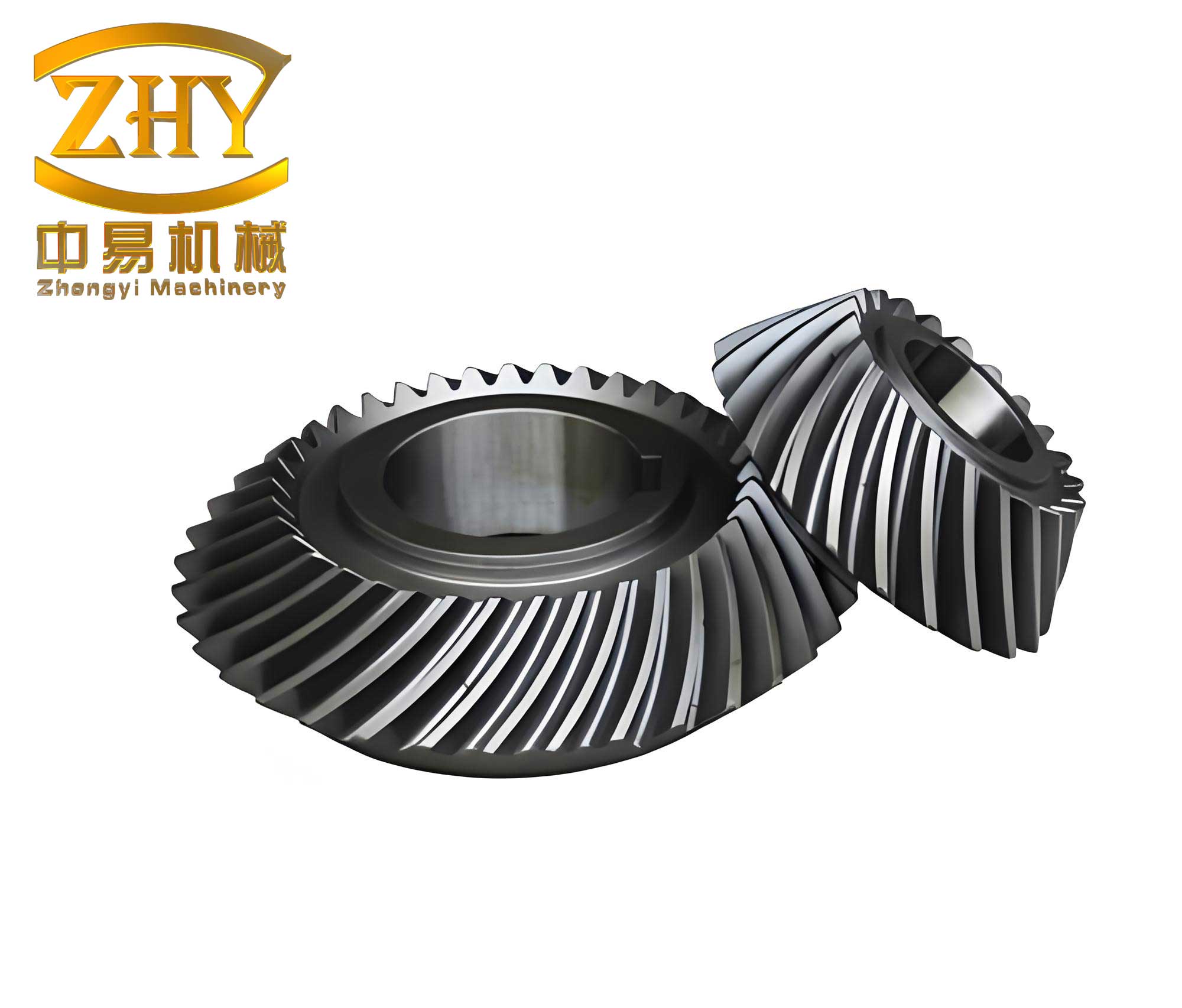
The demand for efficient, quiet, and reliable automotive air conditioning systems necessitated a move beyond traditional gear designs. While straight-tooth bevel gears served a purpose, the superior performance characteristics of spiral gears—notably their smoother engagement, higher load capacity, and significantly reduced noise generation—made them the target for next-generation compressors. However, the domestic production of these critical spiral gears was non-existent, with supply entirely dependent on imported components. This dependency not only incurred high costs but also constrained design flexibility and supply chain security. The development initiative was therefore launched to achieve complete technological independence in manufacturing these sophisticated spiral gears.
Technical Specifications and Quality Requirements
The foundation of any successful development project is a clear and precise set of technical targets. Through meticulous metrology of imported samples and rigorous analysis of compressor assembly and operational dynamics, a comprehensive specification sheet for the spiral gear pair was established. The key parameters for these spiral gears are summarized in the table below.
| Technical Indicator | Precision Requirement | Technical Indicator | Precision Requirement |
|---|---|---|---|
| Tooth Profile Accuracy (per JSB1704-1978) | Grade 4 | Runout of Bevel Center to Sphere | ≤ Φ0.15 mm |
| Module | 2 | Spherical Surface Roughness | Ra 0.4 μm |
| Single Pitch Error | ≤ 0.045 mm | Symmetry of Fixed Gear Keyway to Shaft | 0.05 mm |
| Adjacent Pitch Error | ≤ 0.058 mm | Symmetry of Fixed Gear Keyway to Teeth | 0.20 mm |
| Total Cumulative Pitch Error | ≤ 0.190 mm | Noise Test @ 1000 rpm | ≤ 77 dB(A) |
| Tooth Runout (Radial) | ≤ 0.071 mm | Noise Test @ 2000 rpm | ≤ 92 dB(A) |
| Noise Test @ 3000 rpm | ≤ 88 dB(A) | ||
| Endurance Test (Various Speeds for 1700h) | No Abnormalities | ||
These stringent requirements for the spiral gears, especially the tooth geometry precision and noise targets, directly dictated the selection of manufacturing processes and the level of process control necessary throughout production.
Overcoming Forging Challenges for Spiral Gears
The chosen manufacturing route for the spiral gear teeth was precision cold forging, a process that eliminates subsequent machining on the tooth flanks, ensuring high strength and consistency. However, forging a precise spiral tooth form with a small module (m=2) presented formidable obstacles:
- Formability and Distortion: The helical nature of the teeth complicates metal flow, making it difficult to fill the die completely without defects and increasing the tendency for post-forging distortion.
- Die Manufacturing: Achieving the required surface finish and dimensional accuracy on the forged teeth necessitates exceptionally precise and durable dies.
- Interchangeability: Mass production for automotive applications demands perfect part-to-part consistency, requiring ultra-stable forging processes.
- Production Efficiency: A commercially viable process needed a high production rate to meet market demand.
Electrode Machining for Die Manufacturing
The journey to a perfect forging die begins with the electrode used in its sinking process. To achieve the necessary fidelity in the spiral gear profile, a Gleason gear planer was employed for electrode machining. This ensured the spiral tooth form was generated in a single, continuous setup, holding profile errors within a critical 0.04 mm tolerance band and providing a flawless foundation for the die cavity.
Material Science for Die Life
Initial forging trials resulted in complete failure of the first 200 pieces. Analysis revealed that the die material could not withstand the stresses of forming the spiral gears, leading to plastic deformation of the die’s cutting edges and consequent inaccuracies in the forged helix angle. The search for a material with an optimal balance of high strength (to resist deformation) and sufficient toughness (to resist cracking) led to the selection of a high-performance die steel, DY4. Furthermore, a custom heat treatment regimen was developed for the die blocks, dramatically enhancing their service life and making the precision forging of spiral gears sustainable for high-volume production.
Innovative “Two-Station” Forging Process
The prototype forging sequence was inefficient for mass production: blanking, heating, pre-forming, trimming, re-heating, precision forging, and final trimming. To streamline this, a revolutionary “two-station” forging die was designed and implemented. This system integrates two die cavities within the upper die holder. The process was condensed into a single, efficient heat cycle: the blank is heated once, then undergoes pre-forming in the first station and immediately subsequent precision forging of the spiral gears in the second station within the same press stroke, followed by a single trimming operation. This innovation drastically reduced cycle time, minimized energy consumption, and created a smoother, more efficient production flow.
Tailored Heat Treatment for Spiral Gears
Heat treatment is critical for imparting the necessary surface hardness for wear resistance and a tough core for impact resistance in spiral gears. Initial attempts, using parameters successful for straight-tooth gears, resulted in qualified parts per laboratory checks but catastrophic field failures during endurance testing. The spiral gears, with their thinner web sections, were prone to cracking due to excessive case depth and embrittlement.
A fundamental relationship in gear performance links case depth to tooth size. For a module \( m \) gear, the optimal effective case depth \( d_{eff} \) at the pitch line is often a function of the module and operating stress. An excessive depth, especially in thin sections, increases brittleness. The new target was a shallower, more controlled carburization. The relationship governing bending stress at the tooth root, a key design factor, is given by the Lewis formula:
$$ \sigma_b = \frac{F_t}{b m_n Y} $$
where \( \sigma_b \) is the bending stress, \( F_t \) is the tangential tooth load, \( b \) is the face width, \( m_n \) is the normal module, and \( Y \) is the Lewis form factor. A brittle case (from over-carburizing) lowers the permissible \( \sigma_b \), leading to failure.
Through systematic experimentation, the ideal thermal chemical processing parameters were identified. The requirements for these spiral gears are detailed below.
| Location | Hardness Requirement |
|---|---|
| Tooth Flank (near pitch line) | 664 – 766 HV1 (58 – 62 HRC) |
| Core at Tooth Root Cross-section | 290 – 436 HV1 (30 – 42 HRC) |
| Effective Case Depth at Pitch Line | 0.60 – 0.85 mm |
| Effective Case Depth on Spherical Surface | ≥ 0.30 mm |
| Location | Microstructural Requirement |
|---|---|
| Near Pitch Line | Martensite & Retained Austenite: Better than Grade 3 |
| Tooth Tip (Carbide) | Carbide Morphology: Better than Grade 3 |
Furthermore, to prevent distortion from compromising prior machining operations—specifically, the keyway in the fixed gear and the bore, and the outer diameter of the swinging gear—a precise and controlled heat treatment sequence was mandated. The finalized process flow is: Carburizing → Quenching & Tempering → Washing → Hardness & Metallography Inspection → Rust Prevention. Each stage, especially the quench medium agitation and tempering parameters, is tightly controlled to ensure dimensional stability of the spiral gears alongside their metallurgical properties.
Conclusion
The successful development and industrialization of these high-precision spiral gears mark a significant achievement in advanced automotive component manufacturing. The project involved overcoming multi-faceted challenges: defining exacting specifications through reverse engineering, innovating in precision forging technology for complex spiral gear forms, developing specialized die materials and heat treatments, and designing novel production processes for efficiency. The result is a fully validated, document-controlled manufacturing system capable of producing over 600,000 high-quality spiral gear sets annually. This endeavor has not only secured a critical supply chain element but has also demonstrated a deep mastery over the entire value chain for one of the most demanding types of power transmission components: the spiral gear.