
The field of mechanical transmission has long been dominated by traditional spur gears, characterized by their simple cylindrical shape and constant rotational speed ratio. However, the evolving demands of modern industry for specialized motions—such as variable speed transmission, precise function generation, and compensation for non-linearities in other mechanisms—have necessitated the development of more advanced gearing solutions. This is where non-circular gears present a paradigm shift. Unlike their conventional counterparts, non-circular gears feature pitch curves that are not simple circles, enabling a transmission ratio that varies as a specific function of the input shaft’s angular position. This unique capability allows them to execute complex, programmed motions directly through gear meshing, eliminating the need for additional linkage or cam mechanisms.
Among the various types, high-order non-circular spur gears, particularly those based on elliptical and higher-order elliptic curves, are of significant interest due to their closed, periodic pitch curves and well-defined mathematical properties. The core of designing such gears lies in the precise definition of their pitch curves, which dictate the instantaneous kinematics and the overall functional performance of the gear pair. The design process involves solving complex integral equations and managing interdependent geometric parameters, which can be computationally intensive when done manually.
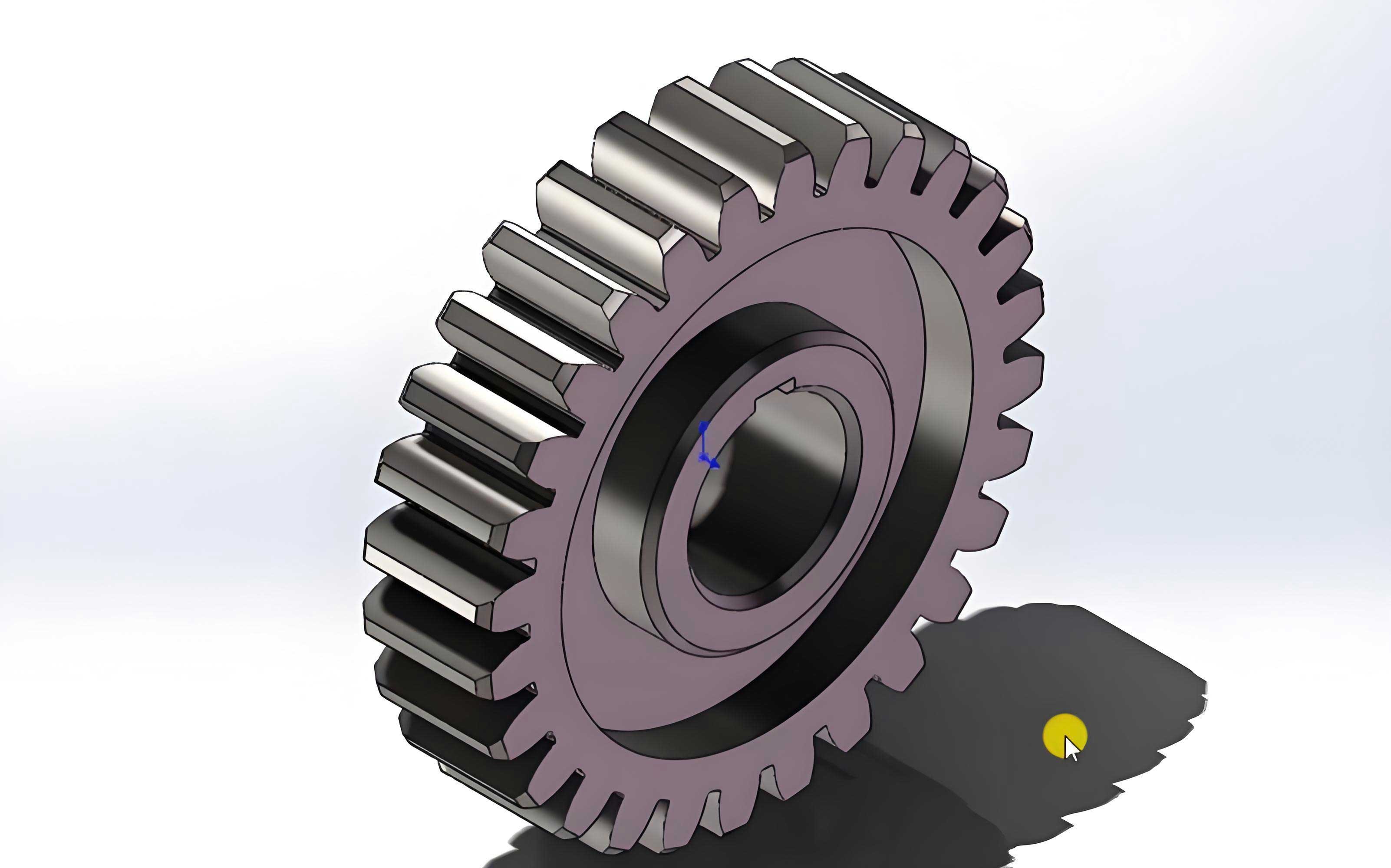
This article synthesizes and expands upon existing design theories for high-order non-circular spur gears. It presents a comprehensive, streamlined methodology for calculating all necessary geometric parameters and visualizing the resulting pitch curves by leveraging the powerful computational and graphical capabilities of MATLAB. Furthermore, a detailed analysis of the transmission ratio function is conducted, examining the influence of key design parameters. This provides valuable insights for engineers to adjust gear specifications to meet specific kinematic requirements in practical applications.
Theoretical Foundation for Pitch Curve Design of High-Order Non-Circular Spur Gears
The design typically starts with a high-order elliptical gear pair, where the driving gear’s parameters are initially defined. Let the driving gear have a module \(m\), number of teeth \(z_1\), eccentricity \(k_1\), and order \(n_1\). The order \(n\) indicates the number of lobes on the pitch curve. The goal is to derive the polar equations for both the driving and driven gear pitch curves, \(\rho_1(\theta_1)\) and \(\rho_2(\theta_2)\), respectively, and all associated dimensions.
The meshing configuration for two external non-circular spur gears is conceptually similar to that of circular spur gears but with time-varying center distances instantaneously defined by the pitch curves. The driving gear rotates about center \(O_1\) and the driven gear about center \(O_2\). The pitch curves remain tangent at the instantaneous pitch point \(P\) throughout the motion. When the driving gear rotates by an angle \(\theta_1\), the driven gear rotates by a corresponding angle \(\theta_2\), governed by the variable transmission ratio.
The polar equation for the driving gear’s pitch curve is given by a high-order ellipse:
$$
\rho_1(\theta_1) = \frac{p_1}{1 – k_1 \cos(n_1 \theta_1)}
$$
where \(p_1\) is the semi-latus rectum, calculated as:
$$
p_1 = A_1 (1 – k_1^2)
$$
and \(A_1\) is the major semi-axis of the driving gear’s pitch curve.
For a closed gear pair, the pitch curves of both gears must be closed. This imposes a periodicity condition. When the transmission ratio completes one full cycle, the driving gear rotates through an angle of \(2\pi / n_1\). Simultaneously, the driven gear, with order \(n_2\), rotates through an angle of \(2\pi / n_2\). This relationship is expressed by the integral:
$$
\frac{2\pi}{n_2} = \int_{0}^{\frac{2\pi}{n_1}} \frac{1}{i_{12}(\theta_1)} d\theta_1 = \int_{0}^{\frac{2\pi}{n_1}} \frac{\rho_1(\theta_1)}{a – \rho_1(\theta_1)} d\theta_1
$$
where \(i_{12}\) is the instantaneous transmission ratio and \(a\) is the constant center distance between the gear shafts.
Solving this integral using the expression for \(\rho_1(\theta_1)\) yields the center distance \(a\):
$$
a = A_1 \left[ 1 + \sqrt{ n^2 – k_1^2 (n^2 – 1) } \right]
$$
Here, \(n = n_2 / n_1\) is the order ratio of the gear pair.
The driven gear’s pitch curve can be described parametrically with \(\theta_1\) as the parameter:
$$
\begin{aligned}
\rho_2(\theta_1) &= a – \rho_1(\theta_1) \\
\theta_2(\theta_1) &= \int_{0}^{\theta_1} \frac{\rho_1(\theta)}{a – \rho_1(\theta)} d\theta
\end{aligned}
$$
Solving the integral for \(\theta_2(\theta_1)\) leads to a relationship between the angular positions:
$$
\tan\left(\frac{n_2 \theta_2}{2}\right) = \sqrt{ \frac{a – p_1 + a k_1}{a – p_1 – a k_1} } \tan\left(\frac{n_1 \theta_1}{2}\right)
$$
By eliminating \(\theta_1\), the polar equation for the driven gear’s pitch curve is obtained, which also takes the form of a high-order ellipse:
$$
\rho_2(\theta_2) = \frac{p_2}{1 + k_2 \cos(n_2 \theta_2)}
$$
where the parameters for the driven spur gear are:
$$
\begin{aligned}
p_2 &= \frac{n_2 \cdot p_1}{n^2 – k_1^2 (n^2 – 1)} \\
k_2 &= \frac{k_1}{\sqrt{n^2 – k_1^2 (n^2 – 1)}}
\end{aligned}
$$
A fundamental requirement for any gear, including non-circular spur gears, is that the teeth must be evenly spaced along the entire length of its pitch curve. This ensures proper meshing and uniform motion transmission. The circumference \(L_i\) of the pitch curve for gear \(i\) must equal an integer number of tooth pitches (\(\pi m\)):
$$
L_i = \pi m z_i = \int_{0}^{2\pi} \sqrt{ \rho_i^2(\theta_i) + \left( \frac{d\rho_i(\theta_i)}{d\theta_i} \right)^2 } d\theta_i
$$
Applying this condition to both spur gears establishes a critical relationship between their tooth counts and the order ratio:
$$
z_2 = n \cdot z_1
$$
Finally, combining this with the pitch curve equations allows for the calculation of the major semi-axis \(A_i\) for each gear. The computation involves an elliptic integral, which is efficiently handled numerically:
$$
A_i = \frac{\pi m z_i}{n_i M_i L_i^*}
$$
where:
$$
\begin{aligned}
L_i^* &= 4 \int_{0}^{\frac{\pi}{2}} \sqrt{1 – (K_i \sin \phi)^2} d\phi \\
M_i &= \frac{\sqrt{1 + (n_i^2 – 1)k_i^2}}{n_i} \\
K_i &= \frac{n_i k_i}{\sqrt{1 + (n_i^2 – 1)k_i^2}}
\end{aligned}
$$
The complete transmission ratio function for the non-circular spur gear pair is:
$$
i_{12}(\theta_1) = \frac{\rho_2(\theta_2)}{\rho_1(\theta_1)} = \frac{ [1 – k_1 \cos(n_1 \theta_1)] \left[ \sqrt{n^2 – k_1^2(n^2-1)} + k_1 \right] – k_1^2}{1 – k_1^2}
$$
The interdependency of these parameters makes manual calculation tedious and prone to error. The following table summarizes the key design variables and their relationships, highlighting the computational challenge.
| Parameter Symbol | Description | Dependency / Formula |
|---|---|---|
| \(m\) | Module (common to both gears) | Given, based on strength requirements. |
| \(z_1, z_2\) | Number of teeth on driving and driven spur gear | \(z_2 = n \cdot z_1\). \(z_1\) is often given initially. |
| \(n_1, n_2\) | Order of driving and driven gear | Define the lobe count. \(n = n_2/n_1\) is a primary design choice. |
| \(k_1, k_2\) | Eccentricity of driving and driven gear pitch curve | \(k_2 = k_1 / \sqrt{n^2 – k_1^2(n^2-1)}\). \(k_1\) is a primary design choice (\(0 < k_1 < 1\)). |
| \(A_1, A_2\) | Major semi-axis of pitch curves | Calculated via formula involving elliptic integral \(L_i^*\). |
| \(a\) | Center distance | \(a = A_1[1 + \sqrt{n^2 – k_1^2(n^2-1)}]\). |
| \(i_{12}(\theta_1)\) | Instantaneous transmission ratio function | Derived function of \(n\), \(k_1\), and \(n_1\theta_1\). |
A Streamlined MATLAB-Based Design Methodology
MATLAB provides an ideal environment for implementing this design theory due to its robust numerical computation, symbolic math capabilities, and advanced graphical tools. The following steps outline a systematic procedure to design a high-order non-circular spur gear pair.
Step 1: Define Primary Inputs. The process begins by specifying the fundamental parameters for the driving spur gear and the desired kinematic structure.
$$
\text{Input: } m, z_1, n_1, k_1, n_2
$$
The order of the driven spur gear \(n_2\) must be specified, defining the order ratio \(n = n_2 / n_1\).
Step 2: Calculate Dependent Geometric Parameters. Using the formulas from the theoretical foundation, the following parameters are computed sequentially:
1. Calculate the driven gear eccentricity \(k_2\).
$$
k_2 = \frac{k_1}{\sqrt{n^2 – k_1^2(n^2-1)}}
$$
2. Compute the complete elliptic integral of the second kind, \(L_i^*\), for both gears. In MATLAB, this is done accurately using the `ellipticE` function.
$$
L_1^* = 4 \cdot \text{ellipticE}(K_1) \quad \text{where } K_1 = \frac{n_1 k_1}{\sqrt{1 + (n_1^2 – 1)k_1^2}}
$$
$$
L_2^* = 4 \cdot \text{ellipticE}(K_2) \quad \text{where } K_2 = \frac{n_2 k_2}{\sqrt{1 + (n_2^2 – 1)k_2^2}}
$$
3. Calculate the major semi-axis \(A_1\) and \(A_2\).
$$
M_1 = \frac{\sqrt{1 + (n_1^2 – 1)k_1^2}}{n_1}, \quad A_1 = \frac{\pi m z_1}{n_1 M_1 L_1^*}
$$
$$
M_2 = \frac{\sqrt{1 + (n_2^2 – 1)k_2^2}}{n_2}, \quad A_2 = \frac{\pi m z_2}{n_2 M_2 L_2^*}
$$
4. Determine the center distance \(a\) and the driven gear tooth count \(z_2\).
$$
a = A_1 \left( 1 + \sqrt{n^2 – k_1^2(n^2-1)} \right), \quad z_2 = n \cdot z_1
$$
5. Calculate the semi-latus rectum parameters \(p_1\) and \(p_2\).
$$
p_1 = A_1 (1 – k_1^2), \quad p_2 = \frac{n_2 p_1}{n^2 – k_1^2(n^2-1)}
$$
Step 3: Generate and Visualize Pitch Curves. With all parameters known, the polar coordinates of the pitch curves are generated.
1. Create a fine array for the driving gear angle: \(\theta_1 = \text{linspace}(0, 2\pi, N)\).
2. Compute the driving gear pitch curve radius vector: \(\rho_1 = p_1 ./ (1 – k_1 \cos(n_1 \theta_1))\).
3. Compute the corresponding driven gear angle \(\theta_2\) using the derived relationship:
$$
\theta_2 = \frac{2}{n_2} \cdot \text{atan2}\left( \sqrt{ \frac{a – p_1 + a k_1}{a – p_1 – a k_1} } \cdot \tan\left(\frac{n_1 \theta_1}{2}\right), 1 \right)
$$
(Using `atan2` ensures the correct quadrant).
4. Compute the driven gear pitch curve radius vector: \(\rho_2 = p_2 ./ (1 + k_2 \cos(n_2 \theta_2))\).
5. Convert polar coordinates \((\rho_1, \theta_1)\) and \((\rho_2, \theta_2)\) to Cartesian coordinates \((x_1, y_1)\) and \((x_2, y_2)\) for plotting. The driven gear’s curve is typically plotted centered at \((a, 0)\).
6. Use MATLAB’s `plot` function to display both pitch curves accurately on the same figure, verifying their tangency at the mesh point for various angles.
Step 4: Calculate and Plot the Transmission Ratio Function. The instantaneous transmission ratio is computed and analyzed.
$$
i_{12}(\theta_1) = \frac{ [1 – k_1 \cos(n_1 \theta_1)] \left[ \sqrt{n^2 – k_1^2(n^2-1)} + k_1 \right] – k_1^2}{1 – k_1^2}
$$
Plotting \(i_{12}\) against \(\theta_1\) over one full revolution (\(0\) to \(2\pi\)) reveals the nature of the non-uniform motion transmission.
Comprehensive Design Case Study
To demonstrate the methodology, consider designing a gear pair where the driving spur gear is 2nd-order and the driven spur gear is 3rd-order. The primary inputs for the driving spur gear are specified in the table below.
| Parameter | Symbol | Value |
|---|---|---|
| Module | \(m\) | 3 mm |
| Number of Teeth | \(z_1\) | 26 |
| Order | \(n_1\) | 2 |
| Eccentricity | \(k_1\) | 0.20 |
Following the MATLAB-based procedure:
Step 1 & 2: With \(n_2 = 3\), the order ratio is \(n = 3/2 = 1.5\).
$$
\begin{aligned}
k_2 &= \frac{0.20}{\sqrt{1.5^2 – 0.20^2(1.5^2 – 1)}} \approx 0.13484 \\
L_1^* &\approx 5.96612, \quad M_1 \approx 0.51508, \quad A_1 \approx 38.2568 \text{ mm} \\
a &= 38.2568 \times \left(1 + \sqrt{1.5^2 – 0.20^2(1.5^2 – 1)}\right) \approx 95.0008 \text{ mm} \\
z_2 &= 1.5 \times 26 = 39
\end{aligned}
$$
The calculated parameters for the driven spur gear are summarized below.
| Parameter | Symbol | Value |
|---|---|---|
| Number of Teeth | \(z_2\) | 39 |
| Order | \(n_2\) | 3 |
| Eccentricity | \(k_2\) | 0.13484 |
| Center Distance | \(a\) | 95.0008 mm |
Step 3 & 4: Using these values, MATLAB scripts generate the pitch curves and the transmission ratio function. The plotted pitch curves clearly show a 2-lobe driving spur gear meshing with a 3-lobe driven spur gear. The transmission ratio plot over \(0 \le \theta_1 \le 2\pi\) exhibits two complete cycles of variation, corresponding to \(n_1 = 2\).
Analysis of Transmission Ratio Characteristics
The transmission ratio function \(i_{12}(\theta_1)\) is the definitive feature of a non-circular spur gear pair. Its behavior is governed by two key parameters derived from the design: the order ratio \(n\) and the driving gear eccentricity \(k_1\). A detailed analysis of their influence is crucial for tailoring gears to specific applications.
From the derived function, it is evident that the periodicity of the transmission ratio curve is determined solely by the order of the driving spur gear \(n_1\). The function \(i_{12}(\theta_1)\) completes \(n_1\) full cycles (i.e., \(n_1\) maxima and \(n_1\) minima) as \(\theta_1\) varies from \(0\) to \(2\pi\). The order of the driven spur gear \(n_2\) affects the amplitude and shape of these cycles but not their number. This principle is critical when the application requires a specific frequency of variation in the output motion per revolution of the input shaft.
The amplitude of fluctuation, or the difference between the maximum and minimum transmission ratio, is primarily controlled by the eccentricity \(k_1\) and the order ratio \(n\). The following parametric study illustrates this relationship. For a fixed driving spur gear order \(n_1=2\), we examine how \(i_{12}\) changes with increasing \(n\) and \(k_1\).
| Case | \(n\) (n2/n1) | \(k_1\) | Approx. \(i_{12, max}\) | Approx. \(i_{12, min}\) | Fluctuation Amplitude |
|---|---|---|---|---|---|
| A | 1.2 | 0.15 | 1.32 | 0.83 | 0.49 |
| B | 1.5 | 0.15 | 1.58 | 0.70 | 0.88 |
| C | 2.0 | 0.15 | 1.97 | 0.56 | 1.41 |
| D | 1.5 | 0.10 | 1.43 | 0.77 | 0.66 |
| E (Case Study) | 1.5 | 0.20 | 1.77 | 0.64 | 1.13 |
| F | 1.5 | 0.25 | 1.99 | 0.59 | 1.40 |
The data clearly shows two trends:
1. Increasing Order Ratio \(n\) (with constant \(k_1\)): Comparing cases A, B, and C, as \(n\) increases, the maximum transmission ratio rises significantly while the minimum ratio decreases. The net effect is a sharp increase in the fluctuation amplitude. This makes sense physically, as a higher \(n\) implies a driven spur gear with more lobes, creating a more pronounced speed variation.
2. Increasing Eccentricity \(k_1\) (with constant \(n\)): Comparing cases D, B, E, and F, as \(k_1\) increases, both the maximum and minimum ratios move away from the average ratio (which is approximately \(n\)). However, the increase in the maximum is more dramatic than the decrease in the minimum, leading to a larger overall amplitude. A higher \(k_1\) makes the driving spur gear’s pitch curve more “non-circular” or elliptical, directly intensifying the speed variation.
The general form of the transmission ratio function can be expressed for a constant \(n\) as:
$$
i_{12}(\theta_1) = C_1 – C_2 \cdot \cos(n_1 \theta_1)
$$
where \(C_1 = \frac{\sqrt{n^2 – k_1^2(n^2-1)} + k_1}{1 – k_1^2}\) and \(C_2 = \frac{k_1(\sqrt{n^2 – k_1^2(n^2-1)} + k_1)}{1 – k_1^2}\).
This confirms the sinusoidal nature of the variation with amplitude \(C_2\) and offset \(C_1\). The parameters \(n\) and \(k_1\) are embedded within these constants, controlling the function’s behavior. This mathematical insight allows for the inverse design process: specifying desired maximum/minimum ratios or a specific functional output to solve for the required \(n\) and \(k_1\).
Conclusion
The design of high-order non-circular spur gears, while conceptually more complex than that of standard spur gears, can be effectively systematized and implemented using computational tools like MATLAB. The methodology presented here consolidates the theoretical framework for designing high-order elliptical spur gear pairs into a coherent, step-by-step procedure. By automating the calculation of interdependent geometric parameters—such as eccentricities, major axes, center distance, and tooth numbers—and the generation of accurate pitch curve plots, this approach significantly reduces design time and minimizes potential errors inherent in manual calculations.
Furthermore, the detailed analysis of the transmission ratio function \(i_{12}(\theta_1)\) provides essential guidance for practical application. The key findings are: the periodicity of the output speed variation is determined exclusively by the order of the driving spur gear \(n_1\); and the amplitude of this variation is sensitively controlled by both the order ratio \(n\) and the driving gear eccentricity \(k_1\). Engineers can use these principles to strategically select \(n_1\) to match a required cycle frequency per input revolution, and then adjust \(n\) and \(k_1\) to achieve the desired range of speed fluctuation. Whether the application is in packaging machinery, automotive steering systems, press mechanisms, or instrumentation, this understanding enables the tailored design of non-circular spur gear pairs to generate precise, non-uniform motion profiles directly from a constant input rotation, enhancing mechanical system performance and integration.