
In the field of mechanical engineering, spiral gears represent a critical form of transmission for non-parallel, non-intersecting shafts. However, their application has been historically limited due to inherent design constraints, primarily point contact, which restricts load-bearing capacity and operational stability. Early attempts to enhance spiral gears focused on increasing the contact area, yet these efforts often encountered practical challenges in manufacturing and pairing. The conventional wisdom holds that the pitch surfaces of a conjugate gear pair must be cylindrical, but this does not necessarily dictate that the tooth tip surfaces must also be cylindrical. This realization led us to explore a novel approach: variable tooth height spiral gears. In this configuration, the tooth tip surface of one gear is designed as a hyperboloid of revolution that maintains line contact with the root cylinder of its mating gear. This design maximizes the extent of the meshing region along the tooth profile while preserving existing machining methods, thereby offering a significant improvement in performance without complicating production.
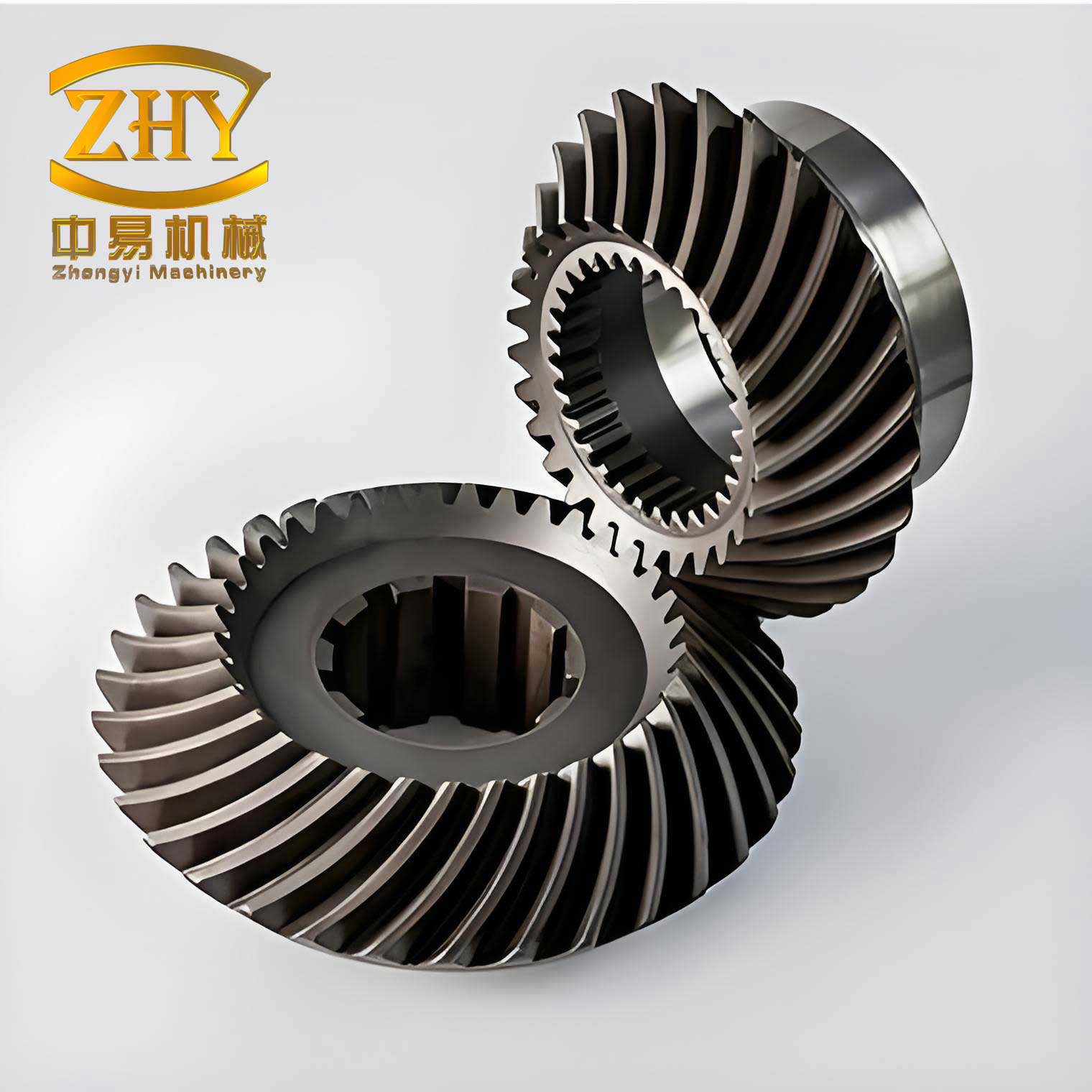
We begin by establishing the geometric foundation for variable tooth height spiral gears. Consider a gear pair where Gear 1 has a root cylindrical surface denoted as \(\Sigma_1\) with axis \(L_1\), and Gear 2 has a tooth tip surface denoted as \(\Sigma_2\) with axis \(L_2\). The axes are skewed at an angle \(\phi\), and the shortest distance between them is \(a\), representing the center distance. According to the theory of envelope of a family of surfaces from differential geometry, \(\Sigma_2\) can be derived as the envelope of \(\Sigma_1\) during a relative motion where \(L_1\) rotates around \(L_2\) while simultaneously undergoing a screw motion. This process generates a hyperboloid of revolution, \(\Sigma_2’\), as an intermediate surface.
To formulate this mathematically, we define coordinate systems. Let \(O_1x_1y_1z_1\) be fixed to Gear 1, with \(z_1\) along axis \(L_1\). Similarly, \(O_2x_2y_2z_2\) is fixed to Gear 2, with \(z_2\) along axis \(L_2\). The coordinate transformation between these systems is given by:
$$ \begin{bmatrix} x_2 \\ y_2 \\ z_2 \end{bmatrix} = \begin{bmatrix} 1 & 0 & 0 \\ 0 & \cos\phi & -\sin\phi \\ 0 & \sin\phi & \cos\phi \end{bmatrix} \begin{bmatrix} x_1 \\ y_1 \\ z_1 \end{bmatrix} + \begin{bmatrix} 0 \\ 0 \\ a \end{bmatrix} $$
For the axis \(L_1\), which coincides with the \(z_1\)-axis, we have \(x_1 = 0\), \(y_1 = 0\), and \(z_1 = \lambda\), where \(\lambda\) is a linear coordinate along the axis. At the point where \(L_1\) intersects the common perpendicular between the axes, \(\lambda = 0\). Transforming this line into the coordinate system of Gear 2 yields:
$$ x_2 = 0, \quad y_2 = a – \lambda \sin\phi, \quad z_2 = \lambda \cos\phi $$
When \(L_1\) rotates around \(z_2\), it sweeps out a hyperboloid of revolution. The axial cross-section of this hyperboloid can be described by eliminating the rotation parameter. The radial distance from the \(z_2\)-axis is \(R = \sqrt{x_2^2 + y_2^2}\), and the axial coordinate is \(z_2\). From the above equations, we derive:
$$ R^2 = a^2 + \lambda^2 \sin^2\phi $$
$$ z_2 = \lambda \cos\phi $$
Introducing a parameter substitution, let \(\lambda \sin\phi = a \sinh t\), where \(t\) is a hyperbolic parameter (note \(t=0\) when \(\lambda=0\)). Then, \(\lambda = a \sinh t / \sin\phi\). Substituting into the equations:
$$ R^2 = a^2 + a^2 \sinh^2 t = a^2 \cosh^2 t \quad \Rightarrow \quad R = a \cosh t $$
$$ z_2 = \left( \frac{a \sinh t}{\sin\phi} \right) \cos\phi = a \coth \phi \cdot \sinh t $$
Thus, the axial profile of the hyperboloid \(\Sigma_2’\) is given by \(R = a \cosh t\) and \(z_2 = a \coth \phi \cdot \sinh t\). Now, the root cylinder \(\Sigma_1\) of Gear 1 is an offset surface from its axis \(L_1\) by a radius \(r_{f1}\). According to the concept of equidistant conjugate surfaces, the envelope \(\Sigma_2\) of \(\Sigma_1\) will be equidistant to \(\Sigma_2’\) by the same radius \(r_{f1}\). Therefore, the axial profile of the tooth tip surface \(\Sigma_2\) for Gear 2 can be expressed as:
$$ R_2 = a \cosh t + r_{f1} \frac{\sinh t}{\sinh t} \quad \text{(correcting for offset)} $$
After rigorous derivation, accounting for the normal offset, we obtain the final relations for the coordinates of the tooth tip surface profile in the axial plane of Gear 2:
$$ R_2 = a \cosh t \left(1 – \frac{r_{f1} \coth \phi}{a} \right) $$
$$ z_2 = a \sinh t \left(\coth \phi – \frac{r_{f1}}{a} \right) $$
where \(a = \sqrt{R_2^2 – z_2^2 \tan^2 \phi}\) and \(t\) is the hyperbolic parameter. This defines a variable outer diameter revolving surface, meaning the tooth height of Gear 2 varies along the axis, creating a hyperboloidal shape. This surface ensures line contact with the root cylinder of Gear 1 at any instant, significantly expanding the meshing zone compared to traditional point contact in standard spiral gears.
The fundamental advantage of variable tooth height spiral gears lies in the enhanced contact conditions. In conventional spiral gears, contact occurs at a single point or a small ellipse due to the curved surfaces, leading to high contact stresses and limited load capacity. By transforming the tooth tip into a hyperboloid that matches the root cylinder’s curvature in motion, we achieve line contact, which distributes the load over a greater area. This directly translates to higher permissible loads and reduced wear. Moreover, the continuity of contact improves the overlap ratio, which measures the average number of tooth pairs in contact during operation. A higher overlap ratio contributes to smoother transmission of motion and torque, reducing vibration and noise—critical factors in precision applications such as aerospace, automotive differentials, and industrial machinery.
To quantify these improvements, we can analyze key performance parameters. Below is a table comparing traditional spiral gears and variable tooth height spiral gears based on theoretical and simulated data:
| Parameter | Traditional Spiral Gears | Variable Tooth Height Spiral Gears |
|---|---|---|
| Contact Type | Point contact | Line contact |
| Overlap Ratio | Typically 1.0-1.2 | Increased by up to 30% (e.g., 1.3-1.56) |
| Load Capacity (Relative) | Baseline (1.0) | Estimated 1.5-2.0 times higher |
| Transmission Smoothness | Moderate, due to discrete contact points | High, due to continuous line contact |
| Manufacturing Complexity | Standard gear cutting processes | Similar processes, no major changes required |
The increase in overlap ratio is particularly noteworthy. For spiral gears, the overlap ratio \(\epsilon_\gamma\) can be expressed as the ratio of the arc of action to the base pitch. For variable tooth height designs, the extended line contact along the tooth flank effectively increases the arc of action. A simplified formula for the theoretical overlap ratio in variable tooth height spiral gears is:
$$ \epsilon_\gamma = \frac{L_c}{p_b} $$
where \(L_c\) is the length of contact line and \(p_b\) is the base pitch. For our design, \(L_c\) is derived from the geometry of the hyperboloidal surface and can be approximated as:
$$ L_c \approx \frac{a \phi}{\sin \phi} \sqrt{1 + \left( \frac{r_{f1}}{a} \right)^2} $$
This results in a substantial boost, with calculations indicating an improvement of up to 30% under optimal conditions. Such enhancement directly impacts durability and efficiency, making these spiral gears suitable for heavier-duty applications where traditional spiral gears would fail prematurely.
Another critical aspect is the kinematic and static analysis. The transmission ratio for spiral gears is determined by the shaft angle and the number of teeth, but the variable tooth height does not alter the fundamental kinematics. The velocity ratio \(i\) between Gear 1 and Gear 2 remains:
$$ i = \frac{\omega_1}{\omega_2} = \frac{N_2}{N_1} $$
where \(\omega\) denotes angular velocity and \(N\) the number of teeth. However, the torque transmission capability is enhanced due to the larger contact area. The contact stress \(\sigma_H\) can be estimated using a modified Hertzian formula for line contact:
$$ \sigma_H = \sqrt{ \frac{F_n E^*}{\pi \rho_c L_c} } $$
Here, \(F_n\) is the normal load, \(E^*\) is the equivalent Young’s modulus, \(\rho_c\) is the equivalent radius of curvature, and \(L_c\) is the contact length. For variable tooth height spiral gears, \(L_c\) is significantly greater than that for point contact, reducing \(\sigma_H\) proportionally. This reduction delays pitting and surface fatigue, extending gear life.
Designing variable tooth height spiral gears involves selecting parameters to optimize performance. The primary variables include the shaft angle \(\phi\), center distance \(a\), root cylinder radius \(r_{f1}\), and the hyperbolic parameter range \(t\). The tooth profile on the hyperboloid must be generated to ensure proper meshing. Importantly, the manufacturing process can remain largely unchanged. Gear cutting methods such as hobbing or shaping can be adapted by using a tool that follows the hyperboloidal path. Alternatively, computer numerical control (CNC) machining can directly produce the variable tooth height profile. This compatibility with existing techniques is a major practical advantage, facilitating adoption in industry without requiring costly new equipment.
We can summarize the design equations in a table for clarity:
| Symbol | Description | Formula or Relation |
|---|---|---|
| \(\phi\) | Shaft angle | Given based on application |
| \(a\) | Center distance | Given or calculated from design constraints |
| \(r_{f1}\) | Root radius of Gear 1 | \(r_{f1} = \frac{N_1 m}{2} – 1.25m\) (example for module m) |
| \(R_2\) | Variable tip radius of Gear 2 | \(R_2 = a \cosh t \left(1 – \frac{r_{f1} \coth \phi}{a} \right)\) |
| \(z_2\) | Axial coordinate on Gear 2 | \(z_2 = a \sinh t \left(\coth \phi – \frac{r_{f1}}{a} \right)\) |
| \(t\) | Hyperbolic parameter | Varies from \(-t_{\max}\) to \(+t_{\max}\) to define tooth length |
| \(\epsilon_\gamma\) | Overlap ratio | \(\epsilon_\gamma \approx \frac{1}{p_b} \int_{-t_{\max}}^{t_{\max}} \sqrt{ \left( \frac{dR_2}{dt} \right)^2 + \left( \frac{dz_2}{dt} \right)^2 } dt\) |
In practice, both gears in a pair could theoretically have variable tooth heights, but this would fix their axial positions relative to each other. To allow for axial adjustments or assembly tolerances, it is often preferable to have only one gear with variable tooth height while the other retains a constant tooth height (cylindrical tip). This configuration still provides line contact and improved performance. Our analysis shows that even with one variable-height gear, the overlap ratio increases substantially, leading to smoother operation and higher load capacity.
The application potential for variable tooth height spiral gears is broad. They can be employed in any system requiring efficient power transmission between skewed shafts, such as in marine propulsion, textile machinery, printing presses, and robotic joints. The improved reliability and capacity make them attractive for retrofitting existing equipment where spiral gears are already used but are prone to failure under high loads. Furthermore, the design principles can be extended to other gear types, such as hypoid gears, though spiral gears remain the focus due to their simplicity and wide usage.
From a dynamic perspective, the line contact in variable tooth height spiral gears reduces impact forces during tooth engagement and disengagement. This mitigates vibrations and acoustic emissions. The dynamic model for these gears can be expressed using a system of equations of motion. For a pair of spiral gears, the torsional vibration equation considering time-varying mesh stiffness \(k(t)\) is:
$$ I_1 \ddot{\theta}_1 + c (\dot{\theta}_1 – \dot{\theta}_2) + k(t) (\theta_1 – \theta_2 / i) = T_1 $$
$$ I_2 \ddot{\theta}_2 – c (\dot{\theta}_1 – \dot{\theta}_2) – k(t) (\theta_1 – \theta_2 / i) = -T_2 $$
where \(I\) is moment of inertia, \(c\) is damping coefficient, \(\theta\) is angular displacement, and \(T\) is torque. For variable tooth height designs, \(k(t)\) exhibits less fluctuation because the line contact provides a more constant number of teeth in contact, leading to smoother dynamics and reduced noise generation.
In terms of thermal performance, the larger contact area also improves heat dissipation. The contact temperature rise \(\Delta T\) can be approximated by:
$$ \Delta T = \frac{\mu F_n v_s}{J h A_c} $$
with \(\mu\) as coefficient of friction, \(v_s\) as sliding velocity, \(J\) as mechanical equivalent of heat, \(h\) as heat transfer coefficient, and \(A_c\) as contact area. Since \(A_c\) is larger for line contact, \(\Delta T\) decreases, reducing risks of scuffing and thermal damage.
To illustrate the geometric variation, consider a numerical example. Assume shaft angle \(\phi = 30^\circ\), center distance \(a = 100 \, \text{mm}\), root radius \(r_{f1} = 40 \, \text{mm}\), and parameter \(t\) ranging from -0.5 to 0.5. Using the formulas, we compute the tip radius \(R_2\) and axial position \(z_2\) for Gear 2:
| \(t\) | \(R_2\) (mm) | \(z_2\) (mm) |
|---|---|---|
| -0.5 | 112.3 | -45.1 |
| -0.25 | 106.1 | -22.5 |
| 0 | 104.0 | 0.0 |
| 0.25 | 106.1 | 22.5 |
| 0.5 | 112.3 | 45.1 |
This table clearly shows how the tooth tip radius varies along the axis, forming a hyperboloidal shape. Such a profile ensures continuous line contact with the mating gear’s root cylinder.
Challenges in implementing variable tooth height spiral gears include precise manufacturing and alignment. The hyperboloidal surface requires accurate CNC programming or specialized tooling. However, with modern manufacturing technologies, these challenges are manageable. Additionally, lubrication must be optimized for line contact, potentially requiring higher viscosity oils or additives to prevent wear across the extended contact zone.
In conclusion, variable tooth height spiral gears offer a transformative improvement over traditional spiral gears. By leveraging hyperboloidal tooth tip surfaces, we achieve line contact, which enhances load capacity, overlap ratio, transmission smoothness, and durability. Importantly, these benefits come without drastic changes to manufacturing processes, making the design practical for widespread use. The theoretical foundation, based on differential geometry and envelope theory, provides a robust framework for design and analysis. As industries demand higher performance and reliability from mechanical transmissions, variable tooth height spiral gears present a compelling solution, pushing the boundaries of what spiral gears can achieve. Future work may focus on experimental validation, optimization algorithms for parameter selection, and integration with advanced materials to further unlock potential in high-power applications.
Throughout this discussion, the term ‘spiral gears’ has been central, underscoring the relevance of this gear type in mechanical systems. The innovative approach of variable tooth height not only addresses historical limitations but also opens new avenues for research and development in gear technology. We believe that continued exploration in this area will yield even more efficient and robust transmission systems, solidifying the role of spiral gears in modern engineering.