
In the manufacturing of machinery, large-module spiral gears or worms are often machined tooth by tooth using finger milling cutters. The helical tooth flank of the workpiece is generated as the envelope of the cutting tool’s revolving surface, which rotates about its own axis to form the cutting motion while simultaneously performing a helical motion relative to the workpiece axis. In other words, the revolving surface of the milling cutter and the finished helical tooth surface of the workpiece are mutually enveloping. If a finger milling cutter is placed into the tooth slot of a workpiece machined with that cutter, it can be observed that the cutter and the workpiece helical tooth surface contact along a spatial curve. This spatial curve is referred to as the contact line. Since the contact line is not a planar curve, the axial cross-sectional tooth profile of the cutter is not entirely identical to the tooth profile in any arbitrary section of the workpiece. Consequently, the widespread practice of using the tooth profile of the equivalent gear in the normal section as the cutter tooth profile is incorrect. We, in our research and practice, have developed a method that yields accurate and simple formulas for calculating the tooth profile of finger milling cutters for spiral gears. This method is based on a geometric analysis of cylindrical involute helicoidal surfaces and intuitive geometric constructions, eliminating the need for complex differential operations and transcendental equations, thereby enhancing computational accuracy and speed.
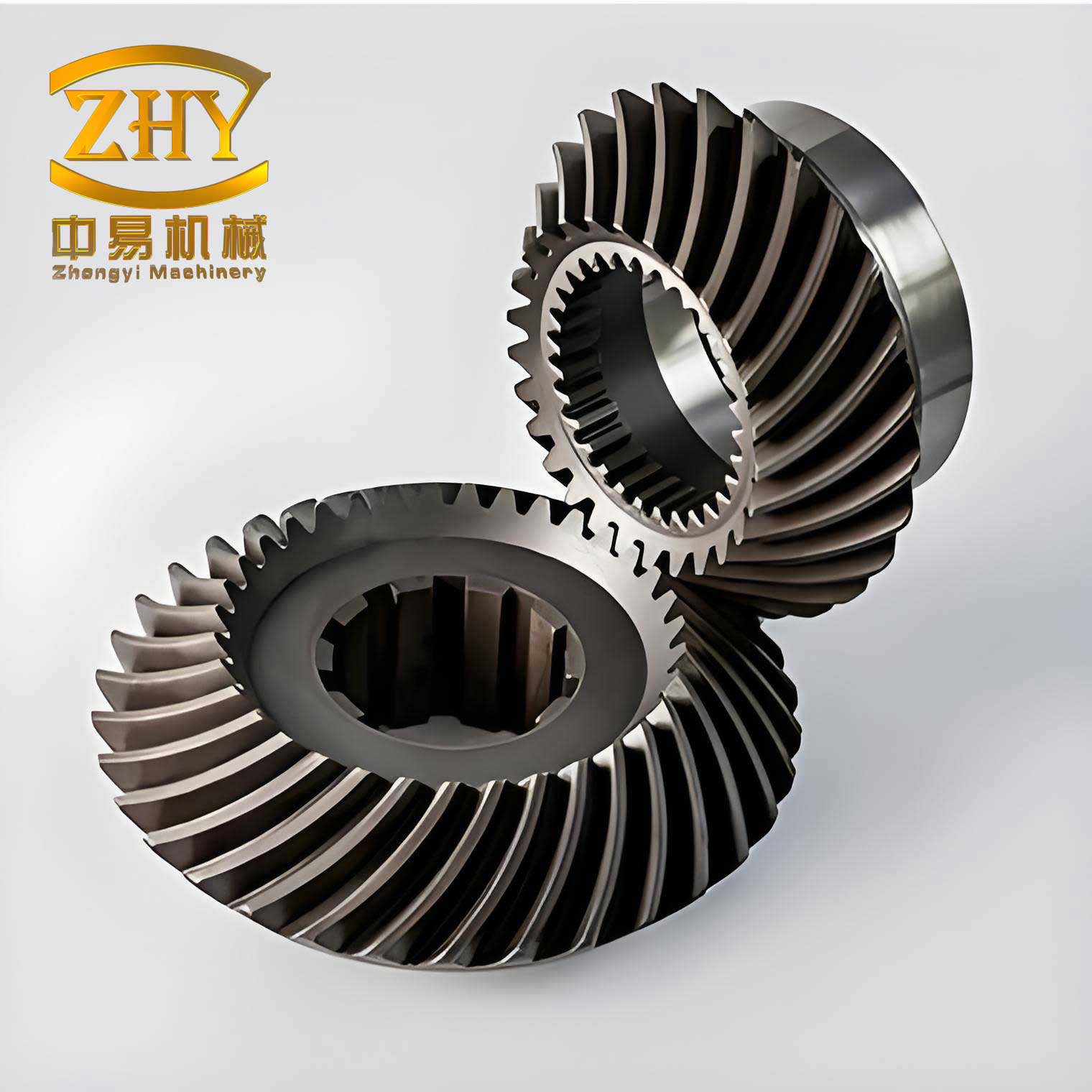
The machining of spiral gears requires precise tooling to ensure proper meshing and transmission efficiency. Spiral gears, characterized by their helical teeth, offer smoother operation and higher load capacity compared to spur gears. However, their manufacturing, especially for large modules, poses significant challenges. The finger milling cutter is a common tool for such tasks, but its tooth profile must be meticulously calculated to match the complex geometry of the spiral gear tooth flank. Traditional approximation methods lead to inaccuracies that can affect gear performance. Therefore, we present a detailed exposition of our geometric derivation, providing step-by-step calculations and comprehensive tables for engineers and machinists.
Our approach begins with an analysis of the geometric properties of the involute helicoidal surface. Consider a cylindrical involute helicoid, which is the surface generated by an involute curve performing a helical motion. This surface can also be defined as the locus of a straight line lying on the tangent plane to the base cylinder, inclined at the base helix angle. A key property we utilize is the relationship between the normals on this surface. At any point on the involute helicoid, the normal to the helical surface lies in the tangent plane to the base cylinder and forms a constant angle with the normal to the end-face tooth profile (the involute curve). This angle is equal to the base helix angle. This fundamental insight simplifies the derivation of the cutter profile equations.
Let us define the coordinate system and parameters. We consider the workpiece coordinate system where the z-axis coincides with the gear axis, and the x-axis is along the symmetry line of the tooth space in the end face. The workpiece tooth profile in the end face is an involute curve given in this coordinate system. The finger milling cutter, during the generation process, undergoes a relative helical motion with respect to the workpiece. If we consider the workpiece stationary, the cutter rotates about the workpiece axis while translating axially. For one full rotation, the axial translation equals the lead of the helical surface. The instantaneous position of the cutter is defined by the developed angle of its axis relative to the tooth space symmetry line and the corresponding axial displacement.
We denote the following symbols for spiral gears:
- $m_n$: Normal module.
- $\alpha_n$: Normal pressure angle at the reference circle.
- $\beta$: Helix angle at the reference circle.
- $x_n$: Normal profile shift coefficient.
- $z$: Number of teeth (or number of starts for a worm).
- $r_a$: Tip radius of the workpiece.
- $r_f$: Root radius of the workpiece.
- $\Delta s_n$: Reduction of normal tooth thickness at the reference circle.
First, we compute the necessary workpiece parameters that are essential for the cutter calculation. These are derived from the basic gear geometry and are listed in Table 1.
| No. | Item | Calculation Formula | Remarks |
|---|---|---|---|
| 1 | Transverse pressure angle at reference circle | $\alpha_t = \arctan\left(\frac{\tan \alpha_n}{\cos \beta}\right)$ | Calculated from normal parameters. |
| 2 | Base helix angle | $\beta_b = \arcsin(\sin \beta \cos \alpha_n)$ | Or $\beta_b = \arctan(\tan \beta \cos \alpha_t)$. |
| 3 | Base circle radius | $r_b = \frac{m_n z \cos \alpha_t}{2 \cos \beta}$ | Fundamental for involute geometry. |
| 4 | Half-angle of base circle tooth space | $\psi_0 = \frac{\pi}{2z} – \frac{2 x_n \tan \alpha_n}{z} + \frac{\Delta s_n}{2 m_n z \cos \alpha_n}$ | Accounts for profile shift and thinning. |
| 5 | Maximum developed angle | $\psi_{\text{max}} = \sqrt{\left(\frac{r_a}{r_b}\right)^2 – 1}$ | When $r_f \ge r_b$. |
| 6 | Minimum developed angle | $\psi_{\text{min}} = \sqrt{\left(\frac{r_f}{r_b}\right)^2 – 1}$ if $r_f > r_b$, else $\psi_{\text{min}}=0$ | For full tooth depth calculation. |
The derivation of the cutter tooth profile coordinates relies on the geometric construction shown in the figures (referenced conceptually). Let $P$ be a point on the workpiece involute helicoid. The cutter generates this point at an instant characterized by the developed angle $\theta$ and axial displacement $z_P$. The key is to find the length of the common normal from the cutter axis to the helical surface at point $P$. We denote this length as $R$. From the geometry, we establish the following relationships.
The axial displacement $z_P$ is related to the normal length $R$ and the base helix angle $\beta_b$ by:
$$ z_P = R \sin \beta_b $$
This stems from the right triangle formed by the normal, its projection, and the axial direction.
The helical motion parameter $p$ (axial displacement per unit radian of rotation) is:
$$ p = \frac{P_h}{2\pi} = r_b \tan \beta_b $$
where $P_h$ is the lead of the helical surface. Thus, the developed angle $\theta$ for displacement $z_P$ is:
$$ \theta = \frac{z_P}{p} = \frac{R \sin \beta_b}{r_b \tan \beta_b} = \frac{R}{r_b \cos \beta_b} $$
This parameter $\theta$ defines the rotational component of the cutter position.
Now, let $\psi$ be the angle parameterizing the involute in the end face. For a point on the involute, the radius $r$ and angle $\psi$ are related by:
$$ r = r_b \sqrt{1 + \psi^2} $$
and the pressure angle at radius $r$ is $\alpha_r = \arctan(\psi)$. The angle between the end-face normal and the x-axis is $\psi + \psi_0$. From the geometry of the base cylinder tangent plane, the angle $\theta’$ between the helical surface normal and the vertical plane is derived as:
$$ \theta’ = \arctan\left( \frac{\sin \beta_b}{\cos \beta_b \cos(\psi + \psi_0)} \right) $$
This leads to an expression for $R$ in terms of $\psi$:
$$ R = r_b \cos \beta_b \left( \psi + \psi_0 + \frac{\sin \beta_b \sin(\psi + \psi_0)}{\cos \beta_b \cos(\psi + \psi_0)} \right) $$
Simplifying, we obtain:
$$ R = r_b \left( \cos \beta_b (\psi + \psi_0) + \sin \beta_b \tan(\psi + \psi_0) \right) $$
This formula is central to our calculation.
The coordinates of the cutter tooth profile in its axial cross-section are then determined. The axial coordinate $y$ (distance from the cutter axis to the workpiece axis) is:
$$ y = R \cos \beta_b \cos(\psi + \psi_0) $$
And the radial coordinate $x$ (radius of the cutter section circle) is:
$$ x = \sqrt{R^2 – y^2} $$
These equations provide the precise profile points for the finger milling cutter.
The range for the parameter $\psi$ is crucial. It must span from $\psi_{\text{min}}$ to $\psi_{\text{max}}$ to cover the entire active tooth flank. Typically, to ensure some stock allowance, we use $\psi_{\text{max}}$ corresponding to the tip radius $r_a$. The minimum $\psi$ depends on the root geometry: if $r_f \ge r_b$, use $\psi_{\text{min}}$ from Table 1; if $r_f < r_b$, use $\psi_{\text{min}} = 0$. This ensures the cutter profiles the full tooth depth.
To compute the cutter profile, we select a series of $\psi$ values within the interval $[\psi_{\text{min}}, \psi_{\text{max}}]$. For each $\psi$, we calculate $R$ using the formula above, then compute $y$ and $x$. The number of points can be chosen based on required accuracy; for high precision or large spiral gears, more points are advisable. The results are tabulated and can be plotted to define the cutter contour.
We now present the complete calculation steps in a systematic procedure. This involves two main parts: (1) computing the workpiece parameters as per Table 1, and (2) computing the cutter tooth profile coordinates using the formulas derived. Table 2 outlines the step-by-step calculations for the cutter profile.
| Step | Description | Formula | Notes |
|---|---|---|---|
| 1 | Obtain workpiece basic data | $m_n, \alpha_n, \beta, x_n, z, r_a, r_f, \Delta s_n$ | From gear design specifications. |
| 2 | Compute auxiliary parameters | $\alpha_t, \beta_b, r_b, \psi_0$ as per Table 1 | Use precise trigonometric functions. |
| 3 | Determine $\psi$ range | $\psi_{\text{min}}$ and $\psi_{\text{max}}$ from Table 1 | Ensure $\psi_{\text{min}} \le \psi \le \psi_{\text{max}}$. |
| 4 | Select $\psi_i$ values | $\psi_i = \psi_{\text{min}} + i \cdot \Delta \psi$ for $i=0,1,…,N$ | $\Delta \psi$ chosen for resolution; e.g., 0.1 rad. |
| 5 | For each $\psi_i$, compute $R_i$ | $R_i = r_b \left( \cos \beta_b (\psi_i + \psi_0) + \sin \beta_b \tan(\psi_i + \psi_0) \right)$ | Core equation for normal length. |
| 6 | Compute axial coordinate $y_i$ | $y_i = R_i \cos \beta_b \cos(\psi_i + \psi_0)$ | Distance from cutter axis to gear axis. |
| 7 | Compute radial coordinate $x_i$ | $x_i = \sqrt{R_i^2 – y_i^2}$ | Cutter section radius at that axial position. |
| 8 | Tabulate results | List $(x_i, y_i)$ pairs | These define the cutter axial profile. |
| 9 | Plot profile | Draw curve through points, add tip relief and root fillet as needed | For cutter manufacturing drawings. |
To illustrate the application of these formulas, let us consider a numerical example for spiral gears. Suppose we have a spiral gear with: $m_n = 10$ mm, $\alpha_n = 20^\circ$, $\beta = 30^\circ$, $x_n = 0.5$, $z = 20$, $r_a = 120$ mm, $r_f = 90$ mm, $\Delta s_n = 0.1$ mm. We compute the parameters step by step.
First, calculate transverse pressure angle:
$$ \alpha_t = \arctan\left(\frac{\tan 20^\circ}{\cos 30^\circ}\right) = \arctan\left(\frac{0.36397}{0.86603}\right) \approx \arctan(0.4200) \approx 22.80^\circ $$
Next, base helix angle:
$$ \beta_b = \arcsin(\sin 30^\circ \cos 20^\circ) = \arcsin(0.5 \times 0.93969) = \arcsin(0.46985) \approx 28.00^\circ $$
Base circle radius:
$$ r_b = \frac{10 \times 20 \times \cos 22.80^\circ}{2 \cos 30^\circ} = \frac{200 \times 0.9219}{2 \times 0.8660} \approx \frac{184.38}{1.732} \approx 106.45 \text{ mm} $$
Half-angle of base circle tooth space:
$$ \psi_0 = \frac{\pi}{2 \times 20} – \frac{2 \times 0.5 \times \tan 20^\circ}{20} + \frac{0.1}{2 \times 10 \times 20 \times \cos 20^\circ} $$
$$ \psi_0 = \frac{3.1416}{40} – \frac{2 \times 0.5 \times 0.36397}{20} + \frac{0.1}{400 \times 0.93969} \approx 0.07854 – 0.01820 + 0.000266 \approx 0.06061 \text{ rad} $$
Maximum developed angle:
$$ \psi_{\text{max}} = \sqrt{\left(\frac{120}{106.45}\right)^2 – 1} = \sqrt{1.270 – 1} = \sqrt{0.270} \approx 0.5196 \text{ rad} $$
Minimum developed angle (since $r_f > r_b$):
$$ \psi_{\text{min}} = \sqrt{\left(\frac{90}{106.45}\right)^2 – 1} = \sqrt{0.714 – 1} = \sqrt{-0.286} \rightarrow \text{imaginary, so set } \psi_{\text{min}} = 0 $$
Thus, $\psi$ ranges from 0 to 0.5196 rad.
Now, select $\psi$ values, say at intervals of 0.1 rad: $\psi = 0, 0.1, 0.2, 0.3, 0.4, 0.5$ rad. For each, compute $R$, $y$, and $x$. Let’s compute for $\psi = 0.3$ rad as an example.
$\psi + \psi_0 = 0.3 + 0.06061 = 0.36061$ rad.
Compute $R$:
$$ R = 106.45 \left( \cos 28^\circ \times 0.36061 + \sin 28^\circ \times \tan(0.36061) \right) $$
$$ \cos 28^\circ \approx 0.88295, \sin 28^\circ \approx 0.46947, \tan(0.36061) \approx 0.3770 $$
$$ R = 106.45 \times (0.88295 \times 0.36061 + 0.46947 \times 0.3770) = 106.45 \times (0.3184 + 0.1770) = 106.45 \times 0.4954 \approx 52.73 \text{ mm} $$
Then $y$:
$$ y = 52.73 \times \cos 28^\circ \times \cos(0.36061) = 52.73 \times 0.88295 \times 0.9358 \approx 43.65 \text{ mm} $$
And $x$:
$$ x = \sqrt{52.73^2 – 43.65^2} = \sqrt{2780.5 – 1905.3} = \sqrt{875.2} \approx 29.58 \text{ mm} $$
Thus, one point on the cutter profile is $(x, y) = (29.58 \text{ mm}, 43.65 \text{ mm})$. Repeating for all $\psi$ gives the full profile.
This method ensures high accuracy because it directly derives from the geometry of involute spiral gears. The formulas avoid approximations inherent in the equivalent gear method. Moreover, the computational procedure is straightforward and can be easily programmed or executed via spreadsheet software. The use of tables, as shown, organizes the data clearly for practical application.
In addition to the profile coordinates, the design of the finger milling cutter includes other dimensions such as cutter outer diameter, flute depth, relief angles, and length. These are determined based on standard tool design practices and the specific machining setup. However, the core innovation lies in the tooth profile calculation, which is critical for achieving the correct tooth form on spiral gears.
The advantages of our method are manifold. It eliminates the need for solving transcendental equations or performing complex differential geometry, which are common in traditional approaches. The geometric derivation is intuitive, making it accessible to engineers without advanced mathematical training. The formulas are explicit and simple to evaluate, reducing computational time and potential errors. This is particularly beneficial for manufacturing large spiral gears where precision is paramount.
Furthermore, the method can be extended to modified tooth profiles or other types of helical surfaces. By adjusting the base geometry parameters, one can adapt the calculations for non-standard spiral gears or worms. This flexibility makes it a valuable tool in gear manufacturing technology.
To summarize, we have presented a comprehensive guide for calculating the tooth profile of finger milling cutters used in machining spiral gears. The key steps involve computing workpiece parameters, selecting the appropriate range for the involute angle, and applying the derived formulas to obtain cutter coordinates. Tables 1 and 2 encapsulate the necessary calculations. This approach ensures accurate generation of the involute helicoidal surface, leading to high-quality spiral gears with proper meshing characteristics.
We hope that this exposition will aid manufacturers and engineers in improving the accuracy and efficiency of spiral gear production. The method underscores the importance of precise geometric analysis in tool design for complex components like spiral gears. As technology advances, such calculations can be integrated into CAD/CAM systems, further streamlining the manufacturing process for spiral gears and similar components.
In conclusion, the precise calculation of finger milling cutter tooth profiles is essential for the correct machining of spiral gears. Our geometrically derived method offers a simple yet accurate solution, enhancing the manufacturing of these critical mechanical elements. By following the outlined procedure and utilizing the provided tables, practitioners can achieve superior results in the production of spiral gears, ensuring optimal performance in their applications.