
In my extensive experience as an engineering professional specializing in power transmission systems, I have encountered numerous cases of gear failure, particularly in demanding applications such as wheel loader drive axles. The development and optimization of spiral gears are critical for ensuring the reliability and longevity of these machines. This article details a first-hand investigation into the premature tooth fracture of a large spiral gear within a drive axle assembly, presenting a full suite of analytical methods, root cause determination, and effective corrective measures. The focus is on the intricate interplay between design geometry, material properties, and manufacturing processes in spiral gears.
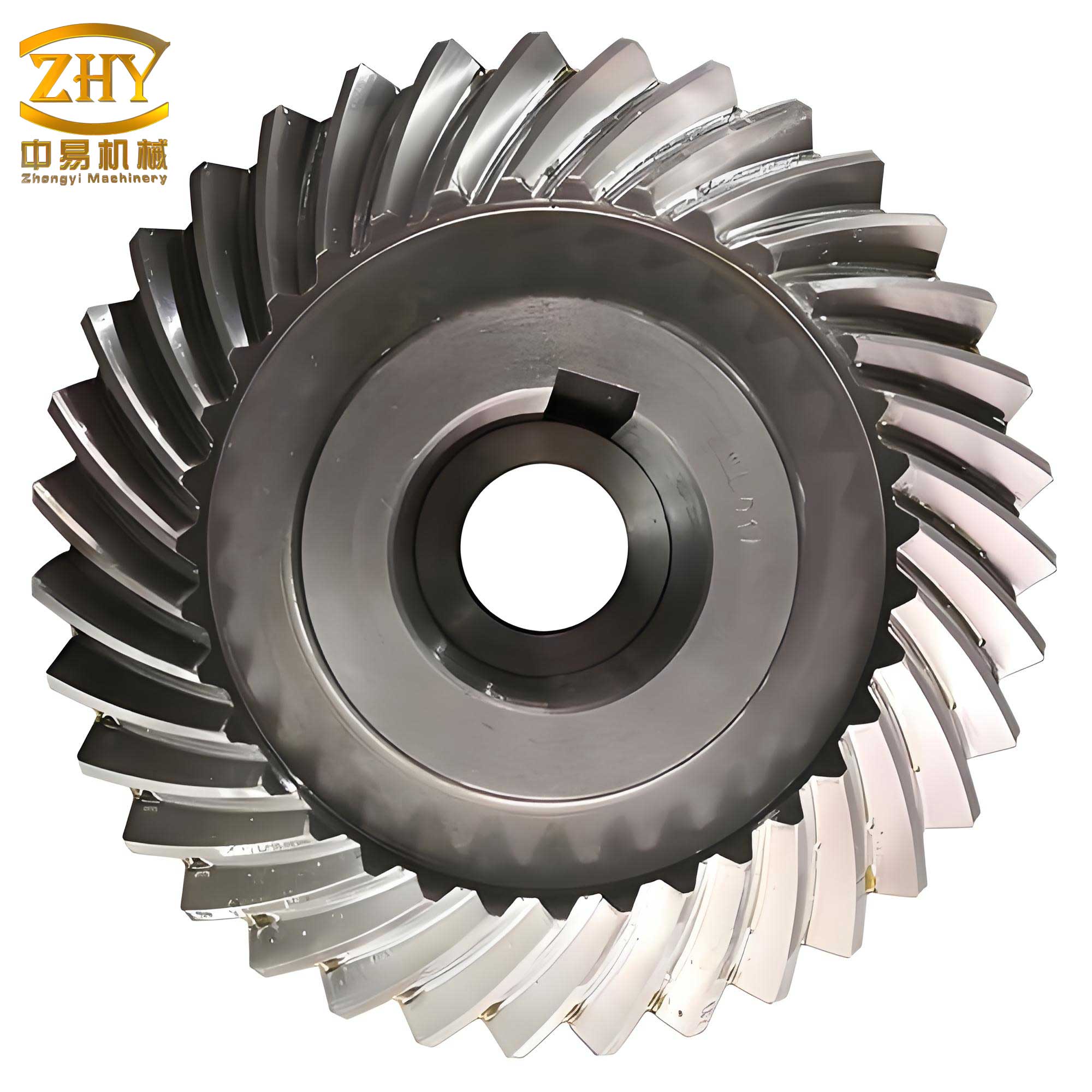
During the development phase of a new wheel loader model, our team observed a troubling pattern: the large spiral gear in the final drive axle was suffering from complete tooth fractures after only 200 to 1,300 hours of operation. This was a significant deviation from the expected service life, which was stipulated to be over 2,000 hours. The spiral gear in question had a substantial size, with an inner diameter of 210 mm and an outer diameter of 380 mm, and was manufactured from 20CrMnTi alloy steel. The premature failure of these spiral gears posed a serious risk to product reliability and prompted a rigorous forensic engineering analysis to uncover the underlying causes.
The investigation was structured to systematically eliminate potential failure modes. We began with a macroscopic examination of the failed spiral gears. The fracture pattern was consistent across multiple failed units: each tooth had broken off at the root, with a characteristic concave fracture surface and a small unbroken section remaining at the gear’s larger end. Magnetic particle inspection revealed incipient cracks at the root fillet of several intact teeth on the convex side, mirroring the fracture path of the broken teeth. Sectioning a gear perpendicular to these cracks confirmed that the cracks invariably originated at the transition zone between the tooth flank and the root fillet. This initial evidence strongly pointed towards a bending fatigue mechanism initiated at the stress-concentrated root region of the spiral gear teeth.
To delve deeper into the fracture mechanism, we performed a detailed fractographic analysis using scanning electron microscopy (SEM). The fracture surfaces exhibited clear fatigue striations and beach marks, which are definitive indicators of progressive crack growth under cyclic loading. The orientation of these marks was particularly revealing. Near the tooth root, the striations were perpendicular to the tooth width, indicating crack propagation along the width. Deeper into the tooth center, the striations became parallel to the tooth width, showing propagation through the tooth thickness. This crack path is classic for bending fatigue in gear teeth. The SEM analysis conclusively established that the primary failure mode was bending fatigue fracture.
We then turned our attention to the material’s conformance to specifications. Chemical composition analysis was performed on samples from three separate failed spiral gears. The results, summarized in the table below, confirmed that the material was within the specified limits for 20CrMnTi steel.
| Element | Sample 1 | Sample 2 | Sample 3 | Standard Requirement (20CrMnTi) |
|---|---|---|---|---|
| C | 0.20 | 0.22 | 0.19 | 0.17 – 0.23 |
| Si | 0.26 | 0.24 | 0.27 | 0.17 – 0.37 |
| Mn | 0.89 | 0.92 | 0.95 | 0.80 – 1.10 |
| Cr | 1.05 | 1.01 | 1.11 | 1.00 – 1.30 |
| Ti | 0.05 | 0.05 | 0.05 | 0.04 – 0.10 |
| S | 0.024 | 0.027 | 0.018 | ≤ 0.035 |
| P | 0.032 | 0.031 | 0.018 | ≤ 0.030 |
Next, we assessed the hardness profile and metallurgical structure, which are paramount for the performance of case-hardened spiral gears. Surface hardness, core hardness, and microstructural ratings were measured and evaluated against industry standards (JB/T 6041-2013 and GB/T 8539-2000). The data revealed a critical finding.
| Sample | Surface Hardness (HRC) | Core Hardness (HRC) | Carbide Rating | Martensite & Retained Austenite Rating | Core Ferrite Rating |
|---|---|---|---|---|---|
| 1 | 62 | 33 | 1 | 2 | 1 |
| 2 | 60 | 31 | 1 | 2 | 1 |
| 3 | 60 | 31 | 1 | 2 | 1 |
| Specification | 58 – 64 | 33 – 45 | ≤ 5 | ≤ 5 | ≤ 5 |
While the surface hardness and microstructural ratings (carbides, martensite, core ferrite) were acceptable, the core hardness was at or slightly below the lower specification limit of 33 HRC. In high-stress applications like these spiral gears, a robust core is essential to provide adequate support to the hardened case. A low core hardness diminishes this supportive effect, making the gear more susceptible to subsurface crack initiation and propagation under bending loads, thereby reducing the overall bending fatigue strength of the spiral gear.
The investigation then focused on the geometric design factors. A fundamental analysis of gear tooth bending stress is essential to understand the failure. In operation, a gear tooth is essentially a cantilever beam subjected to cyclic bending stress. The maximum tensile stress occurs at the root fillet on the side away from the applied load. The nominal bending stress at the root can be expressed by the Lewis formula, modified with modern correction factors. The critical equation for calculating tooth root bending stress is:
$$
\sigma_F = \frac{K F_t}{b m_n Y_F Y_S}
$$
Where:
$\sigma_F$ = Tooth root bending stress
$K$ = Load factor (accounts for dynamic loads, uneven load distribution)
$F_t$ = Tangential load at the reference circle
$b$ = Face width of the spiral gear
$m_n$ = Normal module
$Y_F$ = Tooth form factor (dependent on tooth geometry)
$Y_S$ = Stress concentration factor at the tooth root
The stress concentration factor $Y_S$ is of paramount importance as it quantifies the geometric amplification of stress at the root fillet. It is highly dependent on the root fillet radius. A more precise formulation for the stress concentration factor, considering the geometry of the tooth root, can be derived as:
$$
Y_S = (1.2 + 0.13 \cdot L) \cdot \left( \frac{1}{1.21 + \frac{2.3}{L}} \right)^{q_s}
$$
With the following auxiliary parameters defining the tooth root geometry:
$$
L = \frac{s_{Fn}}{h_{Fe}}, \quad q_s = \frac{s_{Fn}}{2 \rho_{F}}
$$
Where:
$s_{Fn}$ = Tooth thickness at the 30° tangent point of the root fillet
$h_{Fe}$ = Bending moment arm (effective tooth height)
$\rho_{F}$ = Critical root fillet radius of curvature
From these equations, it is unequivocally clear that for a given load and gear module, the root fillet radius $\rho_{F}$ is a primary determinant of the bending stress $\sigma_F$. A smaller $\rho_{F}$ leads to a larger $q_s$, which in turn increases $Y_S$ and consequently $\sigma_F$. This creates a severe stress concentration, drastically reducing the fatigue life of the spiral gear. Upon meticulous measurement using a profile projector, the root fillet radius of the failed spiral gears was found to be approximately 2.2 mm at both the toe and heel of the tooth. This was identified as a potential design deficiency.
Furthermore, the load distribution across the tooth face is critical. The contact pattern, or mesh spot, between the spiral pinion and the large spiral gear was inspected. The observed pattern was deficient; it was not centrally located and its length along the tooth face was significantly less than 70% of the face width, which is a minimum requirement for gears of this precision grade (AGMA 7-8 equivalent). A small, mislocated contact pattern indicates poor alignment or tooth geometry errors, leading to edge loading or localized high stress. This uneven load distribution effectively increases the local load factor $K$ in the bending stress equation, further exacerbating the stress condition at the root of the spiral gear teeth.
Synthesizing all analytical findings, the root cause sequence for the premature failure of these spiral gears became clear. The convergence of three key factors created a perfect storm for early fatigue failure:
- Excessive Stress Concentration: The inadequate root fillet radius (≈2.2 mm) created a severe geometric stress raiser at the tooth root fillet.
- Poor Load Distribution: The substandard contact pattern led to non-uniform loading, elevating localized bending stresses.
- Inadequate Core Support: The low core hardness (31-33 HRC) failed to provide sufficient resistance to subsurface plastic deformation and crack propagation, weakening the gear’s resistance to bending fatigue.
The fatigue process initiated at the point of highest stress concentration on the convex-side tooth root. The crack propagated initially along the tooth width (as seen in the fractography) and then through the tooth thickness. The asymmetry in crack growth resistance from the toe to the heel of the spiral gear explained the characteristic fracture morphology with a remaining section at the larger end.
Based on this comprehensive failure analysis, a multi-pronged improvement strategy was formulated and implemented for the production of these critical spiral gears:
1. Geometric Optimization: The single most impactful change was to increase the root fillet radius. We procured new gear cutting hobs with a larger tip radius, which directly manufactures a more generous root fillet on the generated spiral gear tooth. The target fillet radius was increased to 3.5 mm. This directly reduces the stress concentration factor $Y_S$. The relationship can be approximated for comparison: an increase in $\rho_F$ from 2.2 mm to 3.5 mm can reduce the theoretical bending stress by approximately 15-20%, which translates to a potential doubling or tripling of bending fatigue life based on the power-law relationship between stress and fatigue cycles (Basquin’s law: $N_f = C \cdot \sigma^{-m}$).
2. Material and Heat Treatment Upgrade: To ensure consistently adequate core hardness and mechanical support, the base material was changed from standard 20CrMnTi to a boron-modified, hardenability-controlled grade, 20CrMnTiH. This steel provides better and more consistent through-hardenability, guaranteeing that the core hardness after carburizing and quenching meets the mid-range of the specification (e.g., 38-42 HRC). The heat treatment cycle was also reviewed to ensure optimal austenitizing and tempering parameters.
3. Tooth Contact Pattern Optimization: The gear tooth geometry was slightly modified through adjustments to the hob setting and machine setup parameters to ensure a proper, centrally located contact pattern with a length greater than 70% of the face width under loaded conditions. This ensures even load distribution across the face of the spiral gear.
4. Surface Enhancement: A post-heat-treatment mechanical surface strengthening process, specifically shot peening, was introduced. Shot peening induces compressive residual stresses in the surface and near-surface layers, including the critical root fillet region. This compressive stress layer actively counteracts the tensile bending stresses experienced during service, effectively raising the fatigue strength limit of the spiral gear. The beneficial effect of shot peening on gear bending fatigue is well-documented and provides an additional safety margin.
The effectiveness of these integrated improvements was validated through rigorous extended field testing and laboratory bench testing. The modified spiral gears, with the larger root fillet, enhanced core properties, optimized contact, and shot-peened surfaces, were installed in multiple wheel loaders. These machines were subjected to accelerated durability testing and monitored in real-world applications. The results were definitive: no instances of premature tooth fracture were observed. All test units successfully exceeded the mandated 2,000-hour service life target by a substantial margin, with many gears showing no signs of distress even after 3,000+ hours of severe operation. This confirmed that the root causes had been correctly identified and effectively mitigated.
In conclusion, the failure analysis of these large spiral gears underscores a fundamental principle in mechanical design: fatigue strength is not solely a function of material strength but is profoundly influenced by geometric design details and manufacturing quality control. For spiral gears operating under high cyclic bending loads, particular attention must be paid to minimizing stress concentrations. The key takeaways from this investigation are:
- The root fillet radius is a critical design parameter for spiral gears. Maximizing this radius within manufacturing constraints is one of the most effective ways to enhance bending fatigue performance.
- A uniform and properly sized contact pattern is essential to avoid detrimental localized stress peaks in spiral gears.
- Adequate core hardness is mandatory to provide robust support to the hardened case, especially for large-module spiral gears.
- Surface enhancement techniques like shot peening offer a significant and reliable boost to the fatigue strength of spiral gears.
This case study serves as a valuable reference for engineers designing and troubleshooting heavy-duty spiral gears across various industries, from construction and mining to marine and energy. By adopting a holistic approach that integrates precise mechanical analysis, material science, and advanced manufacturing techniques, the reliability and durability of spiral gears can be consistently achieved, ensuring the operational success of the machinery they drive.