
The development of robust and reliable power transmission components is paramount in the design of heavy-duty off-road and military transport vehicles. Among these, the differential system plays a critical role in managing torque distribution between driving wheels, especially during cornering. A common point of failure in such demanding applications is the gear set within the differential, often succumbing to premature fatigue, pitting, or tooth breakage due to insufficient strength. My research focuses on addressing this exact challenge by proposing, modeling, and analyzing a novel high-strength bevel gear differential. The core innovation lies in fundamentally redesigning the planetary and side gear pair to surpass conventional design limits, thereby significantly enhancing its load-carrying capacity and durability under extreme operating conditions.
The traditional design of spiral or straight bevel gear pairs for differentials is constrained by the minimum tooth number required to avoid undercutting—a phenomenon that weakens the tooth root. Typically, this limit restricts planetary gears to a minimum of around 10-12 teeth. However, from fundamental gear theory, we know that for a constant pitch diameter, reducing the tooth count increases the module (tooth size), which directly enhances the tooth’s bending strength. My design boldly breaks this convention. I have developed a gear pair with a tooth count ratio of 7:10 (planetary gear to side gear). To successfully implement this aggressive reduction without incurring destructive undercutting, I employed a segmented tooth profile design combined with strategic profile modification. This approach not only avoids the geometric interference of undercutting but also allows for a localized thickening of the tooth root fillet, a key area of stress concentration. Furthermore, the tooth profile is meticulously optimized to ensure a contact ratio greater than one, guaranteeing smooth and continuous power transmission. The result is a bevel gear differential that is inherently stronger due to its fewer, larger, and optimally shaped teeth.
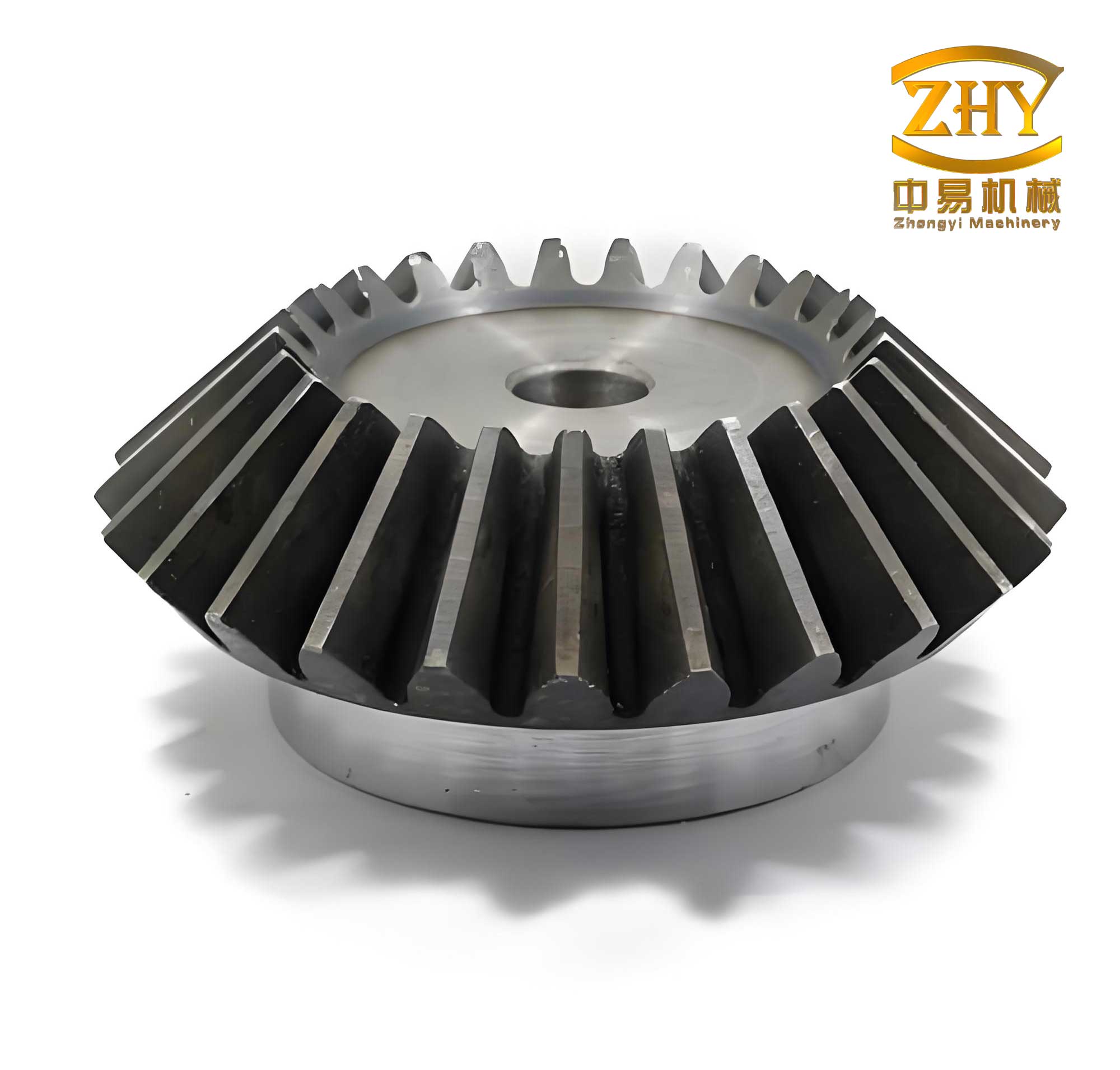
Constructing an accurate three-dimensional model of this non-standard bevel gear geometry is the first crucial step in the analysis. Given the complexity of the segmented and modified tooth form, conventional CAD sketching is impractical. Instead, I utilized a parametric programming approach. The process began within a CAD environment by recording the macro for creating a single tooth surface based on spherical involute principles. This code was then exported and refined in a Visual Studio environment, where the fixed parameters were converted into variables for the desired 7 and 10-tooth geometry. Finally, the model was constructed programmatically via the CAD software’s API. This method ensured precise control over every aspect of the tooth geometry, from the active flank to the reinforced root. The assembled virtual prototype of the differential gear set was then rigorously checked for interference to validate the correctness of the meshing geometry before proceeding to analysis.
The core of the evaluation lies in assessing the structural integrity of the gear teeth under load. For this, I employed Finite Element Analysis (FEA), a powerful computational tool that provides detailed insights into stress and deformation fields far surpassing traditional hand calculation methods like the Lewis formula. The analysis was performed using the ANSYS Workbench platform. The first and most critical step is setting up an appropriate finite element model to simulate the highly nonlinear contact between the meshing bevel gear teeth. The choice of model significantly impacts the result’s accuracy.
| Analysis Model Type | Advantages | Disadvantages |
|---|---|---|
| Single Gear Calculation | Simple setup, fast solution. | Inaccurately models load sharing and contact stresses; does not reflect real force transmission. |
| Node-Coupled Pair | More realistic than single gear; computationally efficient. | Complex pre-processing for coupling; often neglects sliding friction. |
| Full Contact Simulation | Most accurate; models sliding friction, separation, and true contact patch evolution. | Computationally intensive; requires careful definition of contact parameters. |
Given the need for high fidelity, I selected the full contact simulation model. The contact algorithm was based on the Augmented Lagrange method, known for its robustness and reduced sensitivity to the choice of contact stiffness. The material assigned to both the planetary and side gears is a high-grade alloy carburizing steel, 20CrMnTiH, commonly used for high-stress gearing applications. Its properties, not default in the ANSYS library, were manually defined as shown below:
| Material Property | Value | Unit |
|---|---|---|
| Density (ρ) | 7800 | kg/m³ |
| Young’s Modulus (E) | 207 | GPa |
| Poisson’s Ratio (ν) | 0.29 | – |
| Yield Strength (approx.) | >850 | MPa |
The geometry was discretized using a high-order 3D 10-node tetrahedral element (SOLID187), well-suited for complex geometries and nonlinear deformations. A global element size of 1 mm was specified, with local refinement applied to the contact regions on the tooth flanks to capture the steep stress gradients accurately. The mesh statistics for the analyzed sub-assembly (one planetary gear between two side gears) are summarized as follows:
| Component | Number of Nodes | Number of Elements |
|---|---|---|
| Planetary Gear | 11,874 | 7,192 |
| Side Gear (each) | 23,339 | 14,269 |
| Total Assembly | ~58,500 | ~35,700 |
Two critical operational scenarios were simulated: straight-line driving (no differential action) and maximum differential action during a tight turn. The boundary conditions were applied to replicate real-world loading:
- Loading: A representative maximum input torque of T = 5958 N·m was applied to the differential case. This torque is reacted by the side gears.
- Constraints: One side gear shaft was fixed in all degrees of freedom. The other side gear shaft was constrained radially and axially but left free to rotate, simulating the resistance from the wheel.
- Actuation: A small rotational displacement (0.25 mm arc length at the pitch circle) was applied to the planetary gear to initiate and maintain contact, simulating the driving condition.
- Contact Definition: Frictional contact (μ=0.1) was defined between the planetary gear teeth (contact surfaces) and the side gear teeth (target surfaces).
The FEA solver calculated the stress (von Mises) and total deformation fields. The results for the two scenarios are critically compared below:
| Operational Scenario | Maximum Stress (von Mises) | Location of Max Stress | Maximum Deformation |
|---|---|---|---|
| Straight-Line Driving | 573.83 MPa | Root fillet region of the planetary gear teeth in contact. | 0.111 mm |
| Turning (Differential Action) | 624.14 MPa | Tip region of the planetary gear teeth. | 0.898 mm |
The analysis reveals that the differential action during a turn presents the most severe loading condition, as expected. The peak stress of 624.14 MPa, while concentrated, is significantly below the yield strength of the 20CrMnTiH material (typically >850 MPa after carburizing and heat treatment). This confirms that the novel design of the bevel gear pair possesses the required static strength margin. The deformation patterns show that the largest displacements occur at the tips of the engaging teeth. The stress concentration at the tooth root and tip contact zones identifies them as the most likely initiation sites for fatigue-related failures like pitting and spalling, informing potential future design refinements for enhanced life.
Beyond static strength, the dynamic behavior of the bevel gear set is crucial to avoid resonant vibrations, which can lead to excessive noise, accelerated wear, and structural damage. Modal analysis is performed to determine the system’s natural frequencies and mode shapes—its inherent dynamic signatures. The governing equation for the undamped free vibration of the gear system, derived from the finite element discretization, is:
$$ \mathbf{M}\{\ddot{X}\} + \mathbf{K}\{X\} = 0 $$
where \(\mathbf{M}\) is the global mass matrix, \(\mathbf{K}\) is the global stiffness matrix, and \(\{X\}\) is the displacement vector. Assuming a harmonic solution of the form \(\{X\} = \{U\} \sin(\omega t + \phi)\), the equation leads to the classic eigenvalue problem:
$$ (\mathbf{K} – \omega_i^2 \mathbf{M}) \{U_i\} = 0 $$
Solving this yields the natural frequencies \(\omega_i\) (in rad/s) and their corresponding mode shapes \(\{U_i\}\) for the \(i\)-th mode. In practice, only the lowest few modes are critical, as they are most easily excited by operational forces. The primary excitation in a bevel gear differential is the meshing frequency, \(f_m\), calculated from the input speed \(n\) (in rpm) and the number of teeth on the pinion (planetary gear) \(z_p\):
$$ f_m = \frac{n \times z_p}{60} $$
For a high-speed scenario with an input of 5000 rpm and a 7-tooth planetary gear, the meshing frequency is:
$$ f_m = \frac{5000 \times 7}{60} \approx 583.3 \, \text{Hz} $$
I extracted the first six natural modes of the constrained gear assembly. The results are tabulated, showing that the lowest natural frequency is orders of magnitude higher than the operational meshing frequency.
| Mode Number | Natural Frequency (Hz) | Dominant Mode Shape Characteristic | Max Deformation (μm) |
|---|---|---|---|
| 1 | 19,692 | Circumferential (torsional) vibration of the side gear rim. | 102.5 |
| 2 | 20,416 | Circumferential vibration with axial component. | 101.8 |
| 3 | 20,596 | Bending (ovalization) of the side gear. | 151.7 |
| 4 | 20,696 | Localized bending of tooth groups. | 205.5 |
| 5 | 20,893 | Complex bending with axial distortion. | 150.8 |
| 6 | 20,928 | Higher-order bending of the gear structure. | 176.0 |
The key finding is the substantial gap between the highest possible operational excitation frequency (~583 Hz) and the first natural frequency of the assembly (~19,692 Hz). This large separation margin clearly indicates that the designed bevel gear differential will not experience resonance under normal or extreme operating conditions. The dynamic stiffness of the system is therefore validated, ensuring that vibration and noise will not be amplified by resonant effects.
In conclusion, the comprehensive design and analysis process undertaken for this high-strength bevel gear differential demonstrates its viability and superior performance characteristics. By overcoming the traditional limit on tooth count through segmented profile design and root reinforcement, a fundamentally stronger gear geometry was achieved. The detailed finite element contact analysis confirmed that the stress levels under peak operational torque, including the demanding differential action scenario, remain within the safe limits of the high-performance alloy steel. Furthermore, the modal analysis established a wide safety margin against resonant excitation, ensuring dynamic stability. This work validates the proposed bevel gear design as a robust solution for enhancing the durability and reliability of differential systems in heavy-duty vehicular applications, effectively addressing the common failure modes associated with conventional designs. Future work will involve prototyping, physical testing for fatigue life validation, and further optimization of the tooth micro-geometry to distribute contact stresses even more uniformly.