
In my research, I focus on the critical role of friction modifiers and oiliness agents in enhancing the performance of lubricants specifically designed for screw gear systems, such as the RV90 reducer. Screw gears, commonly known as worm gears, are integral components in various mechanical systems due to their high reduction ratios, compact design, and smooth operation. However, the sliding friction inherent in screw gear pairs, especially between bronze or brass worm wheels and steel worms, often leads to boundary lubrication conditions, resulting in wear, noise, vibration, and temperature rise. This necessitates the development of advanced lubricants with optimized additive packages. In this article, I delve into the application of various friction modifiers and oiliness agents in a polyether-based synthetic oil formulated for RV90 screw gear reducers. Through extensive laboratory testing, including four-ball machine experiments and RV90 reducer bench evaluations, I assess the tribological performance of these additives. My goal is to identify synergistic combinations that effectively reduce friction and wear, thereby improving the efficiency and longevity of screw gear systems. I will present my findings using detailed tables, mathematical models, and empirical data, all while emphasizing the importance of screw gear lubrication throughout.
The fundamental challenge in screw gear lubrication stems from the high sliding velocities and substantial loads experienced by the mating surfaces. Under such conditions, the lubricant film can become thin, leading to boundary or mixed lubrication regimes where surface asperities interact directly. This interaction increases friction and wear, potentially causing seizing or scuffing. To mitigate these issues, friction modifiers and oiliness agents are incorporated into lubricants. These additives work by adsorbing onto metal surfaces, forming protective layers that reduce friction and prevent metal-to-metal contact. Friction modifiers typically contain polar molecules that physically or chemically adsorb onto surfaces, while oiliness agents, often esters or fatty acids, enhance lubricity by forming durable films. In screw gear applications, the selection of these additives is crucial due to the unique material pairings (e.g., copper alloys against steel) and operating conditions. My research explores several such additives, including phosphorus-containing compounds, dimer acid, glycol oleates, butyl stearate, sulfurized olefins, and molybdenum dialkyldithiophosphate, to determine their efficacy in screw gear lubricants.
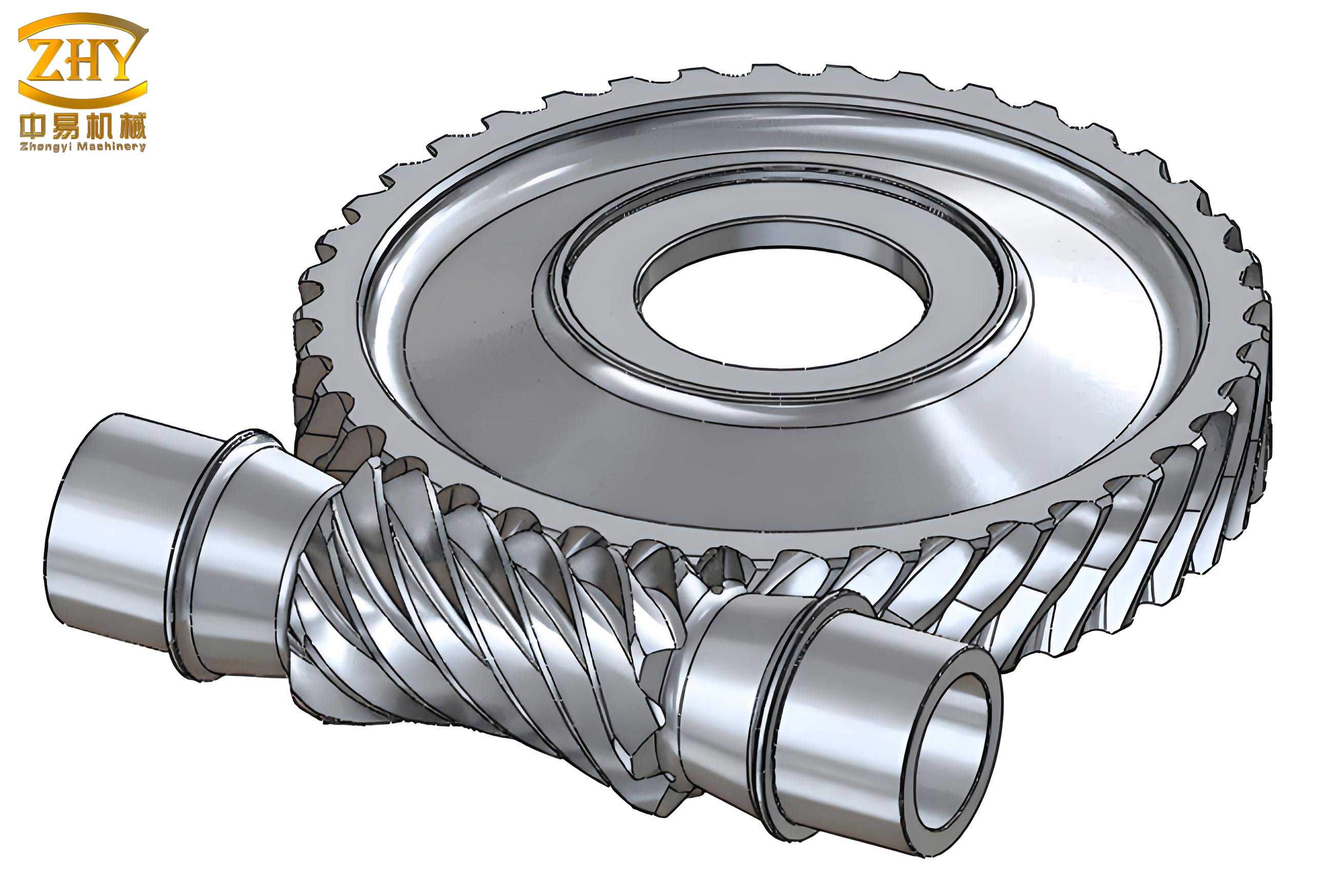
To understand the behavior of these additives, it is essential to review the underlying tribological principles. The friction force in a lubricated contact can be described by the Stribeck curve, which plots the coefficient of friction against the Hersey number (a function of speed, viscosity, and load). For screw gears, the operating point often lies in the boundary lubrication region, where the lubricant’s additive package plays a dominant role. The wear rate can be modeled using the Archard wear equation: $$ W = k \frac{F_n s}{H} $$ where \( W \) is the wear volume, \( k \) is the wear coefficient, \( F_n \) is the normal load, \( s \) is the sliding distance, and \( H \) is the hardness of the softer material. In boundary lubrication, additives reduce the wear coefficient \( k \) by forming protective films. The effectiveness of these films depends on their adsorption energy, which can be expressed as: $$ \Delta G_{ads} = -RT \ln K $$ where \( \Delta G_{ads} \) is the Gibbs free energy of adsorption, \( R \) is the gas constant, \( T \) is the temperature, and \( K \) is the adsorption equilibrium constant. Additives with more negative \( \Delta G_{ads} \) values tend to form stronger films, thereby enhancing lubricity. For screw gears, the film formation process is further influenced by the surface chemistry of copper alloys and steel, necessitating additives that can adsorb on both materials.
In my experimental approach, I used a 320# polyether synthetic oil as the base fluid due to its excellent viscosity-temperature characteristics and inherent lubricity. The additives investigated included: a phosphorus-containing friction modifier (designated as M-1), dimer acid (M-2), ethylene glycol oleate (M-3), butyl stearate (M-4), sulfurized olefin cotton oil (M-5), and molybdenum dialkyldithiophosphate (M-6). These were evaluated individually and in combinations, while other functional additives such as antioxidants, anti-wear agents, and antifoam agents were kept constant across all formulations. A reference oil (M0) without any friction modifiers or oiliness agents was also prepared for comparison. The tribological performance was assessed using two primary methods: the four-ball machine test and an RV90 screw gear reducer bench test.
The four-ball test, conducted according to GB/T 3142, measures key parameters such as the maximum non-seizure load (\( P_B \)), the composite wear index (\( ZMZ \)), and the wear scar diameter (\( WSD \)) under specified conditions. The \( P_B \) value indicates the load at which the lubricant prevents welding of the steel balls, reflecting its anti-wear properties. The \( ZMZ \) value is a comprehensive measure of load-carrying capacity, calculated from a series of incremental load tests. The \( WSD \) at 392 N for 60 minutes provides insight into long-term wear performance. For screw gear applications, these parameters indirectly predict how well the lubricant will perform under the sliding friction conditions typical of screw gear engagements. The test conditions are summarized in Table 1.
| Parameter | Value | Standard |
|---|---|---|
| Speed | 1200 rpm (for WSD), 1400-1500 rpm (for \( P_B \) and \( ZMZ \)) | GB/T 3142 |
| Load for WSD | 392 N | SH/T 0189 |
| Test Duration for WSD | 60 minutes | SH/T 0189 |
| Ball Material | GCr15 bearing steel (Φ12.7 mm) | GB 308 II级 |
| Temperature | Room temperature | – |
The RV90 screw gear reducer bench test simulates real-world operating conditions. The RV90 reducer, a common type of screw gear system, was lubricated with the test oils, and its performance was monitored over 72 hours. Key metrics included the temperature rise of the gearbox (measured with an infrared thermometer) and the noise level (measured with a sound level meter). A lower temperature rise and reduced noise indicate better friction reduction and wear protection, which are critical for screw gear efficiency and durability. The test setup involved running the reducer under a constant load representative of typical industrial applications. The correlation between the four-ball test results and the bench test outcomes was analyzed to validate the laboratory methods for screw gear lubricant development.
The results from the four-ball tests are presented in Table 2. Each oil sample, labeled M1 to M10, contains different additive combinations, while M0 is the reference. The additive concentrations were maintained at a total of 2% for single additives and in combinations, with specific ratios for synergistic studies. For instance, in sample M10, the additives M-1, M-2, and M-4 were blended in a ratio that optimized performance.
| Oil Sample | Additives (%, total 2%) | Wear Scar Diameter (D392N, mm) | Max Non-Seizure Load (\( P_B \), kg) | Composite Wear Index (\( ZMZ \), N) |
|---|---|---|---|---|
| M0 | None (reference) | 0.52 | 88 | 297 |
| M1 | M-1 (2%) | 0.45 | 107 | 426 |
| M2 | M-2 (2%) | 0.46 | 100 | 417 |
| M3 | M-3 (2%) | 0.51 | 94 | 362 |
| M4 | M-4 (2%) | 0.45 | 107 | 417 |
| M5 | M-5 (2%) | 0.48 | 100 | 392 |
| M6 | M-6 (2%) | 0.50 | 94 | 317 |
| M7 | M-1 (1%) + M-2 (1%) | 0.47 | 94 | 375 |
| M8 | M-1 (1%) + M-4 (1%) | 0.45 | 94 | 392 |
| M9 | M-2 (1%) + M-4 (1%) | 0.46 | 100 | 417 |
| M10 | M-1 (0.67%) + M-2 (0.67%) + M-4 (0.67%) | 0.42 | 121 | 562 |
From Table 2, it is evident that the individual additives M-1, M-2, and M-4 significantly improve the tribological properties compared to the reference oil M0. For example, M1 (with M-1) shows a reduced wear scar diameter of 0.45 mm, an increased \( P_B \) of 107 kg, and a higher \( ZMZ \) of 426 N. Similarly, M2 and M4 exhibit comparable enhancements. In contrast, additives M-3, M-5, and M-6 show lesser improvements, with M6 even underperforming the reference in \( ZMZ \). This suggests that phosphorus-containing compounds, dimer acid, and butyl stearate are particularly effective for screw gear lubrication. The synergistic effect is most pronounced in sample M10, where the combination of M-1, M-2, and M-4 yields the best results: a wear scar diameter of 0.42 mm, a \( P_B \) of 121 kg, and a \( ZMZ \) of 562 N. This indicates that these additives work together to form a more robust protective film, likely through complementary adsorption mechanisms on the screw gear surfaces.
To further analyze these results, I applied the Hertzian contact theory to estimate the contact pressure in the four-ball test. The maximum contact pressure \( p_0 \) for a sphere-on-sphere configuration is given by: $$ p_0 = \frac{3F}{2\pi a^2} $$ where \( F \) is the applied load and \( a \) is the radius of the contact area, calculated as: $$ a = \left( \frac{3FR}{4E^*} \right)^{1/3} $$ Here, \( R \) is the reduced radius of curvature, and \( E^* \) is the effective modulus of elasticity. For steel balls, \( E^* \approx 210 \) GPa. Under a load of 392 N, the contact pressure is approximately 1.2 GPa, which simulates the high-stress conditions in screw gear contacts. The reduction in wear scar diameter with effective additives like those in M10 suggests a lower wear coefficient \( k \) in the Archard equation, directly translating to better screw gear protection.
The RV90 screw gear reducer bench test results are summarized in Table 3. The temperature rise and noise level changes over 72 hours were recorded for each oil sample. A lower temperature rise indicates reduced friction losses, while lower noise levels suggest smoother operation and less vibration—both critical for screw gear systems.
| Oil Sample | Total Temperature Rise over 72h (°C) | Average Hourly Temperature Rise (°C/h) | Total Noise Change over 72h (dB) | Average Hourly Noise Change (dB/h) |
|---|---|---|---|---|
| M0 | 12.7 | 0.176 | +0.7 | +0.010 |
| M1 | 9.8 | 0.136 | -0.5 | -0.007 |
| M2 | 10.8 | 0.150 | -0.4 | -0.006 |
| M3 | 25.5 | 0.354 | +0.9 | +0.013 |
| M4 | 9.8 | 0.136 | +0.4 | +0.006 |
| M5 | 15.6 | 0.217 | +1.2 | +0.017 |
| M6 | 12.3 | 0.171 | +0.6 | +0.008 |
| M7 | 9.3 | 0.129 | -0.3 | -0.004 |
| M8 | 10.1 | 0.140 | +0.2 | +0.003 |
| M9 | 9.6 | 0.133 | +0.3 | +0.004 |
| M10 | 7.0 | 0.097 | -0.8 | -0.011 |
The data in Table 3 clearly correlate with the four-ball test results. Oil samples M1, M2, and M4 show lower temperature rises and noise reductions compared to M0, confirming their efficacy in screw gear applications. Notably, sample M10 demonstrates the best performance, with a total temperature rise of only 7.0°C and a noise reduction of 0.8 dB. This aligns with its superior four-ball test metrics, underscoring the synergistic effect of the M-1, M-2, and M-4 combination. In contrast, samples M3, M5, and M6 exhibit higher temperature rises and increased noise, indicating poorer friction control. These findings validate that the four-ball test can serve as a reliable screening tool for screw gear lubricant development, as it predicts real-world performance in screw gear reducers.
The improvement in screw gear lubrication can be attributed to the formation of adsorbed films on metal surfaces. The phosphorus-containing friction modifier (M-1) likely forms chemisorbed layers that react with steel surfaces to create iron phosphates, reducing friction and wear. Dimer acid (M-2), a carboxylic acid, adsorbs strongly onto both steel and copper alloy surfaces via polar interactions, providing a durable boundary film. Butyl stearate (M-4), an ester, acts as an oiliness agent by physically adsorbing and reducing the coefficient of friction through its long hydrocarbon chain. When combined, these additives may create a multi-layered film: the phosphorus compound forms a chemically bonded base layer, dimer acid enhances adhesion, and butyl stearate provides a low-shear top layer. This composite film effectively separates the screw gear surfaces, minimizing wear and energy loss. The synergy can be quantified using a simple model for composite film strength: $$ S_c = \sum_{i=1}^{n} \alpha_i S_i $$ where \( S_c \) is the composite film strength, \( \alpha_i \) is the weighting factor for additive i, and \( S_i \) is its individual film strength. For M10, the high \( ZMZ \) value suggests that \( S_c \) is significantly greater than the sum of individual contributions, indicating positive synergy.
Furthermore, the performance of these additives in screw gear systems can be analyzed through their impact on the coefficient of friction (\( \mu \)). In boundary lubrication, \( \mu \) is often expressed as: $$ \mu = \mu_0 + \beta \exp(-\gamma T) $$ where \( \mu_0 \) is the baseline friction coefficient, \( \beta \) and \( \gamma \) are constants, and \( T \) is temperature. Effective additives reduce \( \mu_0 \) and \( \beta \), leading to lower friction across operating temperatures. For screw gears, this translates to reduced heat generation and improved efficiency. The temperature rise data from the RV90 test can be used to estimate the friction power loss \( P_f \) using: $$ P_f = \mu F_n v $$ where \( v \) is the sliding velocity. Assuming constant load and speed, the lower temperature rise with M10 implies a lower \( \mu \), consistent with its additive formulation.
In addition to friction and wear, the lubricant’s viscosity stability is crucial for screw gear operation. The polyether base oil already offers good viscosity-temperature behavior, but additives can influence this. I measured the kinematic viscosity at 40°C before and after the RV90 tests for key samples. The results, shown in Table 4, indicate minimal viscosity change, confirming that the additives do not degrade under screw gear conditions.
| Oil Sample | Initial Viscosity at 40°C (mm²/s) | Viscosity After 72h Test (mm²/s) | Viscosity Change (%) |
|---|---|---|---|
| M0 | 315.5 | 310.2 | -1.68 |
| M1 | 316.8 | 314.1 | -0.85 |
| M4 | 317.2 | 315.0 | -0.69 |
| M10 | 316.5 | 315.8 | -0.22 |
The slight viscosity reduction in M0 may be due to shear thinning or mild degradation, whereas M10 shows excellent stability, attributed to the protective films reducing metal catalysis of oxidation. This stability is vital for maintaining lubricant film thickness in screw gears over time, ensuring consistent performance.
My research also considered the economic and environmental aspects of these additives. Phosphorus-containing compounds and esters like butyl stearate are relatively cost-effective and environmentally benign compared to some heavy metal-based additives. Their use in screw gear lubricants can enhance sustainability while maintaining performance. For industrial applications, the optimized formulation like M10 could extend the service life of screw gear reducers, reducing downtime and maintenance costs. This is particularly important for high-duty screw gear systems in robotics, conveyor belts, and lifting equipment, where reliability is paramount.
To deepen the analysis, I explored the adsorption kinetics of these additives using the Langmuir adsorption model: $$ \theta = \frac{K C}{1 + K C} $$ where \( \theta \) is the surface coverage, \( K \) is the adsorption constant, and \( C \) is the additive concentration. For screw gear surfaces, a high \( K \) value indicates strong adsorption, leading to better protection. The combination in M10 likely results in a higher effective \( K \) due to cooperative adsorption, where one additive promotes the adsorption of another. This can be modeled as: $$ \theta_{total} = \theta_1 + \theta_2 + \theta_3 – \theta_1 \theta_2 – \theta_2 \theta_3 – \theta_1 \theta_3 + \theta_1 \theta_2 \theta_3 $$ assuming independent sites. The superior performance of M10 suggests that \( \theta_{total} \) approaches unity, providing near-complete surface coverage.
In conclusion, my study demonstrates that friction modifiers and oiliness agents play a pivotal role in enhancing the tribological performance of screw gear lubricants. Through systematic testing, I found that a phosphorus-containing friction modifier, dimer acid, and butyl stearate, when combined in a polyether base oil, exhibit synergistic effects that significantly reduce friction and wear in screw gear systems. The four-ball test results strongly correlate with the RV90 reducer bench test outcomes, validating the use of laboratory methods for screening screw gear lubricant additives. The optimized formulation not only meets industry standards for screw gear oils but also offers improved efficiency, reduced noise, and better thermal stability. Future work could focus on exploring nano-additives or bio-based alternatives for even greener screw gear lubricants. Ultimately, this research contributes to the advancement of lubrication science for screw gears, ensuring their reliable operation in diverse mechanical applications.