
In the automotive industry, the drive axle is a critical component of the transmission system, directly influencing vehicle power and fuel economy. At the heart of the drive axle lie the hypoid bevel gears, specifically the main and slave bevel gears, which transmit torque while changing direction. The assembly quality of these bevel gears is paramount, as it determines performance metrics such as noise, vibration, harshness (NVH), and durability. Traditional assembly methods rely heavily on empirical adjustments and iterative physical testing, which are time-consuming, costly, and prone to errors due to component deformations. To address these challenges, we have developed a virtual assembly approach leveraging simulation software to optimize the shim selection process, ensuring precise control over gear contact pattern and backlash. This article details our research, focusing on a passenger car drive axle case study, where we used Gems software to diagnose assembly issues and derive corrective shim schemes, ultimately enhancing assembly efficiency and gear meshing quality.
The performance of bevel gears in a drive axle is predominantly governed by two factors: the tooth contact pattern and the backlash. The contact pattern refers to the area on the tooth flank where the gears mesh under load, and its optimal positioning ensures even stress distribution, preventing edge loading, pitting, scuffing, or even tooth breakage. Backlash, the clearance between mating teeth, affects NVH characteristics; excessive backlash leads to impact noise and accelerated wear, while insufficient backlash can cause binding and overheating. In our study, we encountered an initial assembly where both the contact pattern and backlash deviated significantly from design specifications. The drive pattern was biased toward the toe and top, while the coast pattern shifted toward the heel and top, with an average backlash of 0.42 mm, far exceeding the design range of 0.14–0.26 mm. Such deviations, if unaddressed, compromise the entire drive axle’s reliability.
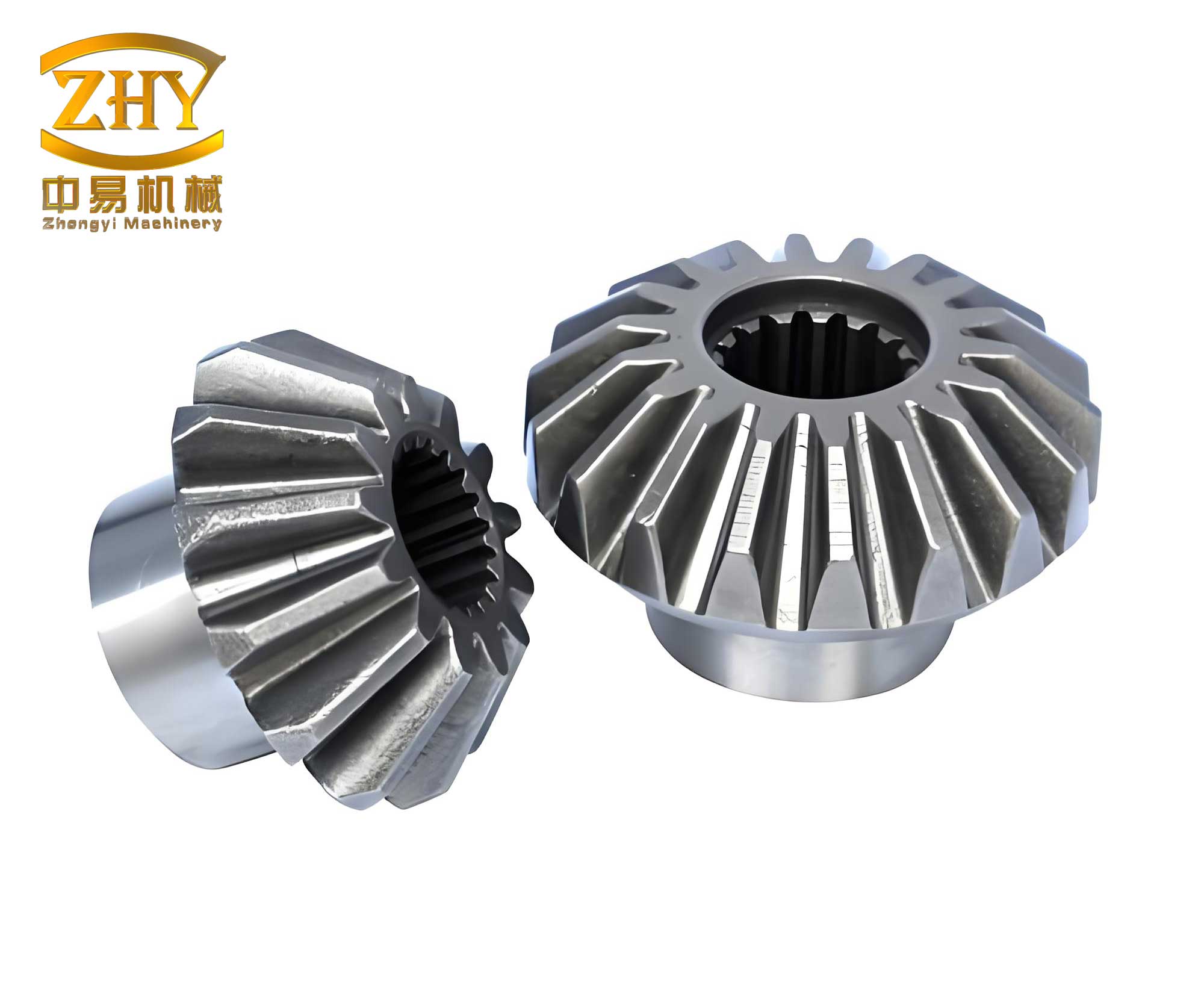
To understand these anomalies, we first analyzed the fundamental mechanics of bevel gear meshing. The misalignment between the main and slave bevel gears can be decomposed into four orthogonal components: pinion offset (P), gear offset (G), shaft angle error (A), and offset distance error (E). These misalignments arise from manufacturing tolerances, assembly variations, and component deformations. Mathematically, the effective misalignment vector $\mathbf{M}$ can be expressed as:
$$ \mathbf{M} = P \mathbf{i} + G \mathbf{j} + A \mathbf{k} + E \mathbf{l} $$
where $\mathbf{i}, \mathbf{j}, \mathbf{k}, \mathbf{l}$ represent unit vectors along respective misalignment directions. The contact pattern and backlash are sensitive functions of $\mathbf{M}$. For a hypoid bevel gear pair, the tooth surface geometry is defined by complex curvatures, and the meshing condition under misalignment can be modeled using the equation of meshing:
$$ \mathbf{n}_1 \cdot (\mathbf{v}_1 – \mathbf{v}_2) = 0 $$
where $\mathbf{n}_1$ is the normal vector on the pinion tooth surface, and $\mathbf{v}_1, \mathbf{v}_2$ are the relative velocities of the pinion and gear. Under misalignment, this condition is perturbed, leading to shifts in contact pattern. Similarly, backlash $B$ can be approximated as a linear combination of misalignments for small errors:
$$ B = B_0 + \alpha_P P + \alpha_G G + \alpha_A A + \alpha_E E $$
where $B_0$ is the nominal backlash, and $\alpha$ coefficients are sensitivity factors derived from gear geometry. In our analysis, we neglected shaft angle error A due to its minimal magnitude, focusing on P, G, and E.
We utilized Gems software, a specialized tool for gear contact analysis, to simulate the bevel gear assembly. The software inputs include gear geometry data, material properties, and misalignment parameters, outputting contact pattern images and backlash values. Our virtual model replicated the actual drive axle components: the main bevel gear (pinion), slave bevel gear (ring gear), differential case, bearings, and housing. The simulation process involved:
- Importing the gear design specifications, including tooth numbers, module, spiral angle, and pressure angle.
- Defining the assembly constraints, such as bearing preloads and housing stiffness.
- Applying misalignments based on manufacturing error measurements.
- Running static contact analysis under a light load (5 N·m) to mimic the assembly check condition.
- Iteratively adjusting misalignments to match observed contact patterns and backlash.
To quantify manufacturing errors, we collected inspection reports for key components: the housing bore positions, bearing thickness variations, and gear machining tolerances. These errors were translated into misalignment contributions, as summarized in Table 1.
| Component | Error Type | Magnitude (mm) | Resulting Misalignment |
|---|---|---|---|
| Housing | Bore position offset | ±0.02 | E = 0.015 mm |
| Bearings | Thickness variation | ±0.01 | P, G influence |
| Gears | Tooth profile error | < 0.005 | Negligible |
| Shims | Thickness tolerance | ±0.005 | P, G adjustment |
With these errors, the simulated backlash was 0.153 mm, within design range, but the contact pattern showed a slight root bias. However, the actual assembly exhibited severe deviations, indicating that manufacturing errors alone were insufficient to explain the issue. We hypothesized that assembly shim selection was the primary culprit. In the drive axle, four shims control adjustments: the pinion inner shim (for pinion position), pinion outer shim (for preload), and two differential side shims (for gear position and preload). The initial shim scheme was based on standard practices, but it led to misalignments P = 0.025 mm and G = 0.4 mm in our simulation, reproducing the poor contact pattern and excessive backlash.
We derived a corrected shim scheme by inversely calculating the required misalignment corrections. From the simulation, we needed to reduce P by 0.025 mm and G by 0.4 mm. Using the shim sensitivity coefficients, we determined new thicknesses. The shim adjustment principles are governed by the following relationships:
$$ \Delta P = \Delta S_{\text{pinion inner}} $$
$$ \Delta G = \Delta S_{\text{differential left}} – \Delta S_{\text{differential right}} $$
where $\Delta S$ denotes shim thickness change. To maintain preload, the sum of differential shim changes must be balanced. The initial and optimized shim schemes are compared in Table 2.
| Shim Location | Initial Thickness (mm) | Optimized Thickness (mm) | Function |
|---|---|---|---|
| Pinion Inner Shim | 3.650 | 3.675 | Adjusts pinion offset P |
| Pinion Outer Shim | 2.200 | 2.225 | Sets pinion bearing preload |
| Differential Left Shim (Gear Far Side) | 3.000 | 2.600 | Adjusts gear offset G |
| Differential Right Shim (Gear Near Side) | 2.775 | 3.175 |
After physical assembly with this optimized scheme, we observed insufficient differential preload, so we further adjusted the differential right shim to 3.200 mm. The final shim scheme yielded a backlash of 0.20 mm and a centered contact pattern, as confirmed by rolling tests. The success of this virtual adjustment underscores the value of simulation in bevel gear assembly.
Our research demonstrates that virtual assembly technology for bevel gears can significantly reduce trial-and-error in physical assembly. The Gems software enabled us to model misalignments accurately, diagnose issues, and predict optimal shim combinations. However, we note that simulation accuracy depends on precise input data; for instance, contact pattern shifts in reality were more pronounced than in simulation, indicating areas for model refinement. Future work will incorporate nonlinear effects from housing deformation under load and thermal expansions.
In conclusion, the virtual assembly of bevel gears is a powerful methodology for enhancing drive axle quality. By integrating simulation with measured manufacturing errors, we can rapidly identify root causes of assembly defects, propose data-driven shim plans, and streamline the entire process. This approach not only improves the performance and durability of bevel gears but also reduces costs and time in automotive production. As bevel gear designs evolve toward higher precision, virtual tools will become indispensable in achieving optimal meshing conditions.