
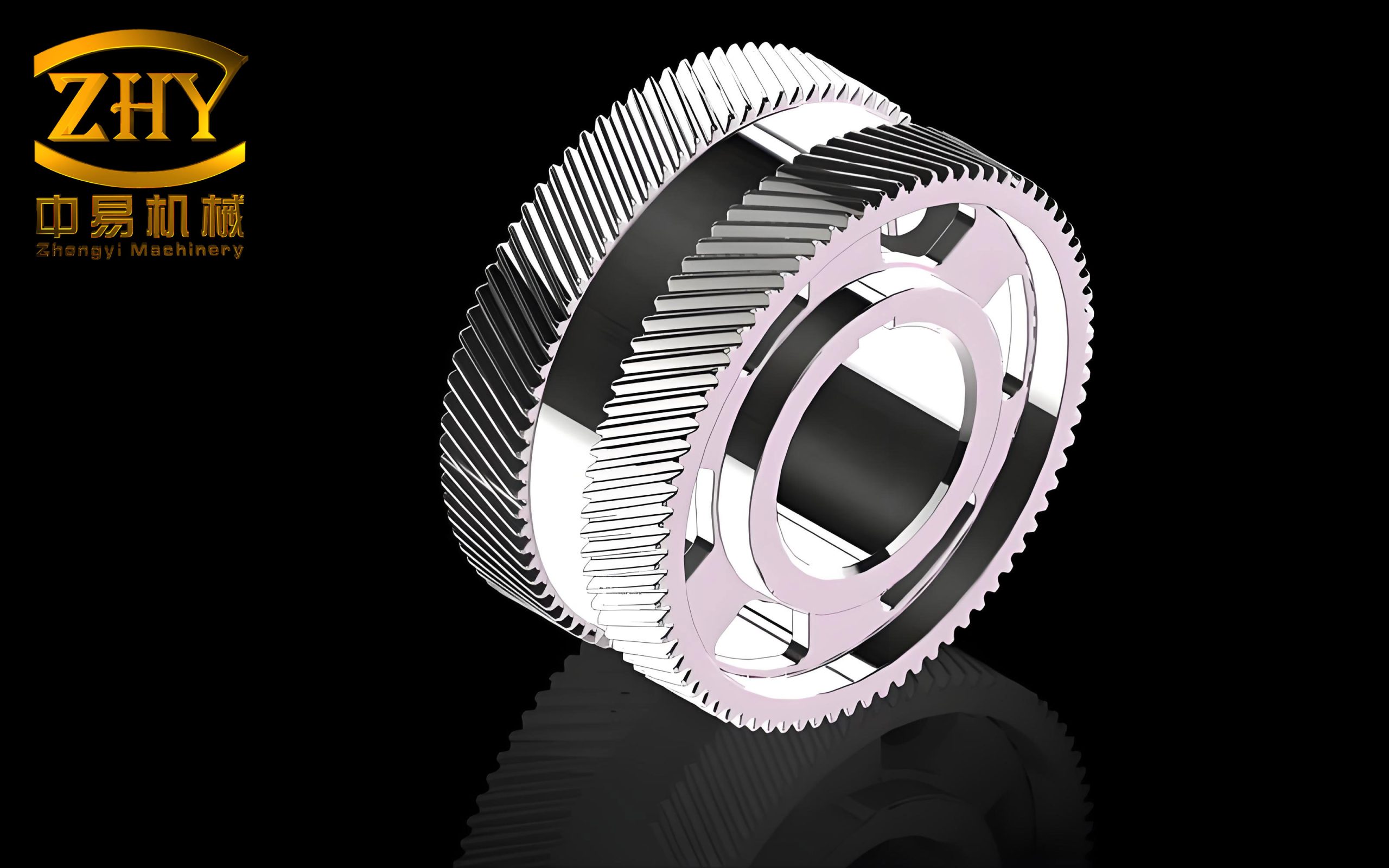
In this work, we systematically investigate the lubrication and friction characteristics of crowned herringbone gears based on thermal elastohydrodynamic lubrication (TEHL) theory. Our study focuses on the time-varying contact line distribution, the evaluation of oil film profiles under different operating conditions, and the determination of the friction coefficient along the meshing line. The herringbone gears under consideration feature a crowned tooth profile with a modification amount of 20 μm. The basic geometric parameters are: pinion tooth number Z1 = 44, gear tooth number Z2 = 41, normal module mn = 3.5 mm, normal pressure angle αn = 22.5°, face width B = 60 mm, and helix angle β = 28.019°. The reference operating condition is an input torque M1 = 80 N·m and a pinion speed n1 = 300 r/min.
We first perform a detailed contact analysis of the crowned herringbone gears. The instantaneous contact line length varies periodically during meshing due to the combined effect of transverse contact ratio εα and axial contact ratio εβ. For our gears, εα < εβ, and the contact line length li for the i-th tooth pair is expressed as:
$$
l_i =
\begin{cases}
s_i / \sin\beta_b, & 0 \le s_i < \varepsilon_\alpha p_{bt} \\
\varepsilon_\alpha p_{bt} / \sin\beta_b, & \varepsilon_\alpha p_{bt} \le s_i < \varepsilon_\beta p_{bt} \\
– s_i + b\tan\beta_b + L_0 / \sin\beta_b, & \varepsilon_\beta p_{bt} \le s_i < (\varepsilon_\alpha + \varepsilon_\beta) p_{bt} \\
0, & (\varepsilon_\alpha + \varepsilon_\beta) p_{bt} \le s_i < \lceil \varepsilon_\alpha + \varepsilon_\beta \rceil p_{bt}
\end{cases}
$$
where si is the distance along the transverse plane, pbt is the transverse base pitch, βb is the base helix angle, b is the face width, and L0 is the length of the actual meshing zone. The total contact line length L is the sum of all instantaneous lengths.
We select three representative meshing points along the meshing line: the engaging-in point S1, the pitch point S2, and the engaging-out point S3. The variation of contact parameters such as curvature radius, entrainment speed, normal force, and slide-to-roll ratio is calculated for these points. The equivalent curvature radii in the x-direction (along the tooth profile) and y-direction (along the face width) are given by:
$$
R_x = \frac{R_{x1}R_{x2}}{R_{x1}+R_{x2}}, \quad R_y = \frac{b^2}{8C_\alpha \cos\beta_b}
$$
with R’x1 = N1B2 + (1/2)li sinβb, R’x2 = N1N2 – R’x1 during certain phases, and Rx1 = R’x1 / cosβb, Rx2 = R’x2 / cosβb. Here, Cα is the amount of crowned modification.
The entrainment speed Ue = (U1+U2)/2, where U1 = ω1 Rx1, U2 = ω2 Rx2, and ω1, ω2 are angular velocities. The normal force on a single tooth pair is Fni = γFn, with γ = li / L, and Fn = M / rb1 (M is the input torque, rb1 the base radius of the pinion). The slide-to-roll ratio is s = |U1 – U2| / Ue.
To analyze the film characteristics, we employ the full TEHL model for point contact. The governing equations include the Reynolds equation, film thickness equation, energy equation, load balance equation, and rheological relations. The generalized two-dimensional Reynolds equation under thermal conditions is:
$$
\frac{\partial}{\partial x}\left( \frac{\rho h^3}{\eta}\frac{\partial p}{\partial x} \right) + \frac{\partial}{\partial y}\left( \frac{\rho h^3}{\eta}\frac{\partial p}{\partial y} \right) = 12U_e \frac{\partial (\rho h)}{\partial x}
$$
where p is the oil film pressure, h the film thickness, ρ the density, η the viscosity, and Ue the entrainment speed. The film thickness including elastic deformation is:
$$
h(x,y) = h_0 + \frac{x^2}{2R_x} + \frac{y^2}{2R_y} + \frac{2}{\pi E^*} \iint_{\Omega} \frac{p(s,t)\, ds\, dt}{\sqrt{(x-s)^2+(y-t)^2}}
$$
The energy equation for the oil film is:
$$
c_p \rho \left( u\frac{\partial T}{\partial x} + v\frac{\partial T}{\partial y} \right) = k \frac{\partial^2 T}{\partial z^2} – \frac{T}{\rho}\frac{\partial\rho}{\partial T}\left( u\frac{\partial p}{\partial x} + v\frac{\partial p}{\partial y} \right) + \eta \left[ \left( \frac{\partial u}{\partial z} \right)^2 + \left( \frac{\partial v}{\partial z} \right)^2 \right]
$$
with boundary conditions given by thermal interface equations for the solid surfaces. The lubricant viscosity-pressure-temperature relationship follows the Roelands equation:
$$
\eta = \eta_0 \exp\left\{ \left( \ln\eta_0 + 9.67 \right) \left[ \left(1+5.1\times10^{-9}p\right)^z \left( \frac{T-138}{T_0-138} \right)^{-s_0} – 1 \right] \right\}
$$
and the density variation is:
$$
\rho = \rho_0 \left[ 1 + \frac{Ap}{1+Bp} + D(T-T_0) \right]
$$
where A = 0.6×10⁻⁹ m²/N, B = 1.7×10⁻⁹ m²/N, D = -0.00065 K⁻¹.
We validate our TEHL program by comparing with experimental data from literature. Under conditions of full-film lubrication with sufficiently large oil droplets, the computed central film thickness of about 1.5327 μm shows a relative error of 8.66% with respect to the measured value of ~1400 nm, confirming the reliability of our numerical code.
Numerical results for the three meshing points S1, S2, and S3 under the reference condition are summarized in Table 1. The oil film profiles exhibit typical EHL features: a flat central region, a pressure spike near the outlet, and a film necking phenomenon.
| Meshing point | Minimum film thickness (μm) | Maximum film pressure (GPa) | Maximum film temperature rise (K) |
|---|---|---|---|
| S1 (engaging-in) | 0.1499 | 0.9146 | 44.289 |
| S2 (pitch point) | 0.1251 | 1.0983 | 4.110 |
| S3 (engaging-out) | 0.1341 | 1.0335 | 32.637 |
The maximum film pressure first increases and then decreases along the meshing line, while the minimum film thickness shows the opposite trend. The highest temperature rise occurs at the engaging-in and engaging-out sides due to large sliding, and the pitch point shows a very low temperature rise because it is nearly pure rolling.
We further investigate the influence of operating parameters on the oil film profile at point S1. Two sets of cases are defined: varying pinion speed (300, 400, 500 r/min) at fixed torque of 80 N·m, and varying input torque (80, 120, 160 N·m) at fixed speed of 300 r/min. The results reveal that a higher pinion speed increases both film thickness and temperature rise, but has little effect on pressure. Increasing torque raises the pressure peak and temperature rise significantly, and also depresses the film necking valley.
The amount of crowned modification Cα also plays a role. We compare Cα = 10, 15, and 20 μm. As Cα increases, the effective radius in the y-direction decreases, leading to a more concentrated contact ellipse and a higher pressure peak. The film temperature rise rises accordingly, although the film thickness at the center remains almost unchanged. This phenomenon emphasizes that careful selection of the modification amount is necessary to avoid local overheating and ensure adequate lubrication in herringbone gears.
Finally, we analyze the friction characteristics using the Ree-Eyring non-Newtonian fluid model. The total friction force on the tooth surface is:
$$
F_z = \iint_{\Omega} \left( \frac{\partial p}{\partial x} h + \tau_0 \sinh(c) \right) dxdy
$$
where c is derived from integrals of hyperbolic functions involving the shear stress and pressure gradient. The friction coefficient is then μ = Fz / w. For the three meshing points under the reference condition, we obtain μ(S1) = 0.0309, μ(S2) = 0.0010, μ(S3) = 0.0152. The friction coefficient is nearly zero at the pitch point, consistent with pure rolling, while it is higher at the engaging-in and engaging-out sides where sliding is significant. This variation closely follows the slide-to-roll ratio distribution along the meshing line.
Table 2 summarizes the computed friction coefficients for all three points, highlighting the strong dependency on the sliding conditions.
| Meshing point | Friction coefficient |
|---|---|
| S1 | 0.0309 |
| S2 | 0.0010 |
| S3 | 0.0152 |
In conclusion, our comprehensive analysis of crowned herringbone gears reveals that the oil film pressure, thickness, and temperature rise exhibit strong time-varying characteristics along the meshing line. The pitch point corresponds to a near-pure rolling state with minimal friction, while the engaging-in and engaging-out sides experience high sliding and thus higher friction and thermal risk. Increasing pinion speed improves film thickness but also raises temperature, whereas increasing torque or crown modification amount intensifies both pressure and temperature. These findings provide practical guidance for the design and lubrication optimization of herringbone gears in high-power transmissions such as geared turbofan engines.