
In the rapidly evolving landscape of pure electric passenger vehicles, the differential stands as a core component within the drivetrain, directly influencing overall vehicle efficiency, driving dynamics, and acoustic comfort. The precise assembly and control of internal components, particularly the bevel gears—comprising the side gears (semi-axial gears) and planet gears—are paramount. Among various critical tolerances, the axial clearance of the side bevel gears is a key parameter that indirectly governs gear mesh quality, load distribution, and ultimately, the noise, vibration, and harshness (NVH) performance. Traditional manual inspection methods for this clearance are slow, inconsistent, and unsuitable for high-volume production. This article, from our engineering perspective, delves into the structural nuances of pure electric passenger vehicle differentials, analyzes the challenges in axial clearance control, and presents a robust, automated solution for inline measurement and control during mass production. We will extensively employ formulas and tables to summarize technical relationships and specifications, with a recurring focus on the design and behavior of the bevel gears.
The fundamental role of a differential is to allow the driving wheels to rotate at different speeds while cornering, adhering to the kinematic condition: the sum of the left and right axle shaft speeds equals twice the speed of the planet carrier. In a pure electric vehicle, power from the electric motor is transmitted through a reducer into the differential casing, which drives the side bevel gears via the planet bevel gears and cross-pin. When not differentiating, the planet gears and their pin act as a solid unit rotating with the casing. During differentiation, relative motion occurs between the planet bevel gears and side bevel gears.
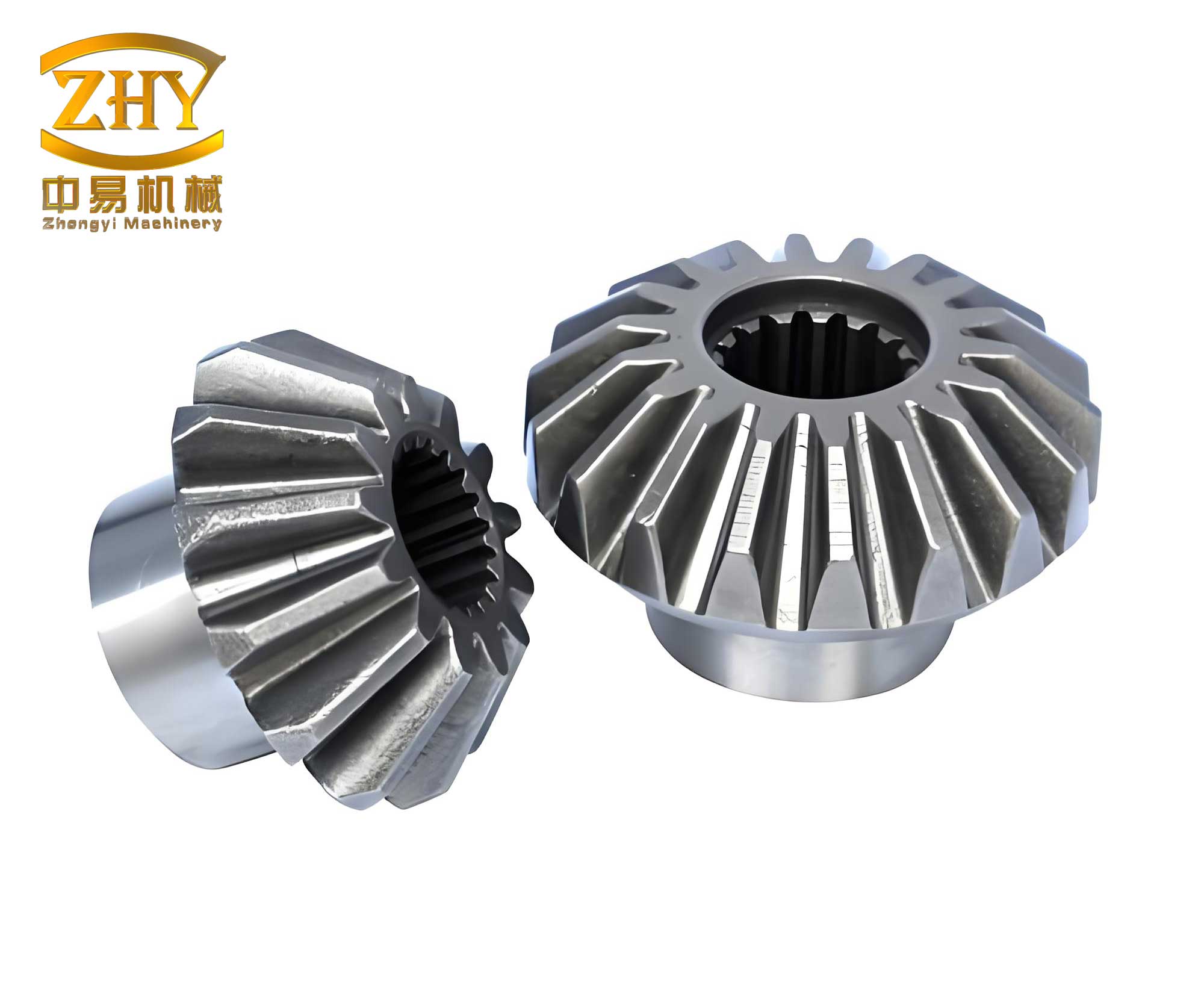
Structurally, the differential for a pure electric passenger vehicle is notably compact and integrated. Its casing is typically a single, unitary casting, housing two planet bevel gears (mounted on a single cross-pin), two side bevel gears, and their respective thrust washers. This contrasts sharply with commercial vehicle differentials, which are often designed for higher loads and feature a split casing, four planet bevel gears (on a cross or spider pin), and different assembly methodologies. The table below summarizes the critical structural and functional differences, highlighting why passenger vehicle bevel gear systems demand higher precision.
| Feature | Pure Electric Passenger Vehicle Differential | Commercial Vehicle Differential |
|---|---|---|
| Casing Design | Unitary, one-piece casting. | Split, two-piece casing. |
| Number of Planet Bevel Gears | Typically 2. | Typically 4. |
| Planet Gear Arrangement | Two gears do not form a continuous pitch circle plane, leading to higher potential for wobble and impact. | Four gears form a stable pitch circle plane, ensuring smoother load transfer. |
| Assembly & Inspection Access | Limited access for measuring gear mesh patterns and backlash after assembly. | Good access due to split casing, facilitating direct measurement. |
| Precision Requirement | Very high for bevel gear geometry and positioning to compensate for structural limitations. | Relatively lower, though still significant for durability. |
The NVH performance of a pure electric vehicle is exceptionally sensitive to drivetrain imperfections. The absence of an internal combustion engine leaves gear whine, rattle, and click noises from the reduction gearset and differential highly audible. Improper axial clearance of the side bevel gears can lead to excessive gear lash or preload, altering the contact pattern between the planet and side bevel gears. This results in non-uniform load distribution, accelerated wear, and elevated transmission error—a primary excitation source for gear noise. Therefore, stringent control of the bevel gear axial clearance is not merely a dimensional exercise but a critical NVH countermeasure.
The assembly process for the differential in a high-volume production setting is highly automated. A typical sequence is as follows:
- Place side bevel gear and its thrust washer into one side of the differential casing.
- Insert planet bevel gears with their thrust washers.
- Install the planet gear cross-pin.
- Place the opposite side bevel gear and thrust washer.
- Measure the axial clearance for both side bevel gears.
- If clearance is within specification, proceed to final assembly (e.g., casing closure, bearing mounting). If out of spec, disassemble and adjust shims or re-select components.
The assembly quality is governed by several requirements to ensure strength and quiet operation. Key among them are the bevel gear contact pattern and the normal backlash (齿侧间隙). The contact pattern should be centered on the tooth flank: approximately 10% from the toe end along the face width and at the mid-point of the tooth height. The normal backlash between the planet and side bevel gears, denoted as $L_n$, typically must fall within a range, for example:
$$ L_{n,min} \leq L_n \leq L_{n,max} $$
where a common specification might be $L_{n,min} = 0.05\, \text{mm}$ and $L_{n,max} = 0.20\, \text{mm}$, with a permissible variation of $0.05\, \text{mm}$. However, directly measuring the normal backlash of the bevel gears inside a unitary casing post-assembly is impractical. Hence, in production, we control it indirectly by precisely controlling the axial clearance of the side bevel gears, which has a deterministic relationship with the normal backlash.
The axial clearance of a side bevel gear is defined as the total allowable axial movement of the gear within its housing. Specifically, it is the distance between two extreme positions: when the gear’s back face is seated flush against the inner shoulder of the differential casing (Position A), and when the gear is pushed axially inward until its teeth are in full contact with the planet bevel gear teeth, preventing further movement (Position B). This clearance, denoted as $\Delta L$, accommodates thermal expansion, manufacturing tolerances, and ensures proper lubrication while minimizing unwanted axial play that contributes to noise.
Manual measurement of this clearance involves using dial indicators and fixtures to push and pull the side gear, but it suffers from low repeatability and throughput. Our developed solution for automatic inline control involves a dedicated measuring station integrated into the assembly line. The system’s core components are two measuring spindles (C and F) equipped with expanding collets (D and E). The differential casing is clamped onto a fixture referencing surface G. The spindles, rotating at a low speed (e.g., 20-30 rpm), advance and engage the splined bore of each side bevel gear. The collets expand to lock the gears to the spindles. The measurement protocol is as follows:
- The spindles move axially to pull the side bevel gears outward until face contact is made with the casing shoulder (Position A). The position encoder records this coordinate as $M_1$.
- The spindles then reverse direction, pushing the gears inward until the flanks of the side bevel gears contact the planet bevel gears. At this point, further axial motion is resisted. The spindles continue to rotate slowly.
- Due to gear tooth geometry variations and eccentricities, the exact point of contact varies per angular position. The system continuously records the axial position $M$ during at least a minimum number of spindle revolutions, $N_{min}$, to capture the maximum inward position, $M_2$. The minimum required revolutions ensure all tooth pairing variations are sampled:
$$ N_{min} = \frac{Z_s \cdot Z_p}{2} $$
where $Z_s$ is the number of teeth on the side bevel gear and $Z_p$ is the number of teeth on the planet bevel gear. - The actual axial clearance $\Delta L$ for each side is then calculated as:
$$ \Delta L = | M_2 – M_1 | $$
This automated method ensures rapid, repeatable, and reliable measurement of the bevel gear axial clearance for every differential unit.
The critical step for quality assurance is correlating the measured axial clearance $\Delta L$ with the functionally important normal backlash $L_n$ of the bevel gears. Since the gears are often crowned, and heat treatment induces distortions, theoretical kinematic conversion using the gear pitch cone angles is insufficiently accurate for production validation. Therefore, we establish this correlation empirically during process development using a gear rolling tester. The side and planet bevel gears are mounted at their theoretical mounting distances. The side gear is moved axially from a zero-backlash position ($L_{i1}$) to a position achieving the target normal backlash ($L_{i2}$). The corresponding axial travel is the reference axial clearance $\Delta L_i$:
$$ \Delta L_i = | L_{i2} – L_{i1} | $$
This $\Delta L_i$, derived for nominal gears, defines the target axial clearance range that corresponds to the acceptable normal backlash range $[L_{n,min}, L_{n,max}]$. A summary of the key parameters and their relationships is provided in the table below.
| Parameter | Symbol | Typical Specification / Formula | Remarks |
|---|---|---|---|
| Normal Backlash | $L_n$ | $0.05 \, \text{mm} \leq L_n \leq 0.20 \, \text{mm}$ | Design requirement for bevel gear pair. |
| Axial Clearance (Measured) | $\Delta L$ | $\Delta L = |M_2 – M_1|$ | Inline automated measurement output. |
| Reference Axial Clearance | $\Delta L_i$ | $\Delta L_i = |L_{i2} – L_{i1}|$ | Determined from gear rolling test to correlate with $L_n$. |
| Minimum Spindle Revolutions | $N_{min}$ | $N_{min} = \frac{Z_s \cdot Z_p}{2}$ | Ensures sampling of all tooth engagements for max $M_2$. |
| Allowable Variation | $\delta$ | $\delta \leq 0.05 \, \text{mm}$ | Permissible variation in backlash or clearance difference between sides. |
The acceptance criterion for the differential unit is straightforward. The measured axial clearance $\Delta L$ for both left and right side bevel gears must fall within the specified limits derived from the correlation study:
$$ \Delta L_{min} < \Delta L < \Delta L_{max} $$
Furthermore, to ensure symmetrical operation, the difference in axial clearance between the two sides must be within a tight tolerance, often as small as $\pm 0.02\, \text{mm}$:
$$ | \Delta L_{left} – \Delta L_{right} | \leq 0.02 \, \text{mm} $$
If a unit passes these checks, it proceeds down the line. If it fails, the automated system flags it for rework, typically involving replacement of thrust washers with different thicknesses to adjust the bevel gear axial position.
The implementation of this automated axial clearance control system brings substantial benefits. First, it eliminates human error and subjectivity inherent in manual gauging. Second, the high-speed measurement (typically a few seconds per differential) aligns with the cycle time demands of mass production. Third, the digital data acquisition enables full traceability and statistical process control (SPC). Trends in $\Delta L$ measurements can signal tool wear in gear cutting or heat treatment drift, allowing for proactive maintenance. Ultimately, by ensuring every bevel gear pair operates with optimal axial clearance, we achieve consistent gear mesh conditions, which directly translates to reduced differential noise, improved durability, and enhanced overall vehicle quality.
In conclusion, the transition to electric mobility amplifies the importance of precision in powertrain components. The differential’s bevel gears are a focal point for NVH refinement. Controlling their axial clearance through automated, inline measurement provides a robust, scalable solution that meets the dual challenges of high production volume and exceptional quality standards. The methodology described, combining mechanized measurement with empirical data correlation, ensures that the functional requirement of proper bevel gear backlash is reliably maintained for every vehicle leaving the assembly line. As we continue to advance electric vehicle technology, such precise and automated control strategies will become increasingly indispensable in manufacturing.