
The rotary vector reducer (RV reducer) is a precision transmission device pivotal in applications demanding high torque, compact size, and exceptional positional accuracy, such as industrial robotics and aerospace mechanisms. Its performance, particularly its load capacity and operational lifespan, is fundamentally governed by the contact characteristics within its gearing stages. While the first stage typically employs an involute planetary gear train, the core of its high reduction ratio and compact design lies in the second stage: the cycloid pinwheel planetary drive. This study delves into the mechanical analysis and finite element simulation of this critical cycloid drive pair to elucidate the influence of key structural parameters on its contact behavior.
The unique motion of the cycloid drive involves a cycloid disc undergoing an eccentric revolution around a stationary ring of pins (the pinwheel). This motion, coupled with the reaction from the pins, forces the cycloid disc to rotate on its own axis in the opposite direction. The output is taken from this slower rotation. Understanding the load distribution across the multiple simultaneously engaged teeth is essential for accurate stress prediction. We begin by establishing a theoretical mechanical model. In a coordinate system where the pinwheel center is the origin, the theoretical tooth profile of the cycloid disc, generated by the pins, can be described by the following parametric equations:
$$x = R_z \sin \phi – e \sin(z_b \phi) + r_z \frac{K_1 \sin(z_b \phi) – \sin \phi}{\sqrt{1 + K_1^2 – 2K_1 \cos(z_b \phi)}}$$
$$y = R_z \cos \phi – e \cos(z_b \phi) – r_z \frac{-K_1 \cos(z_b \phi) + \cos \phi}{\sqrt{1 + K_1^2 – 2K_1 \cos(z_b \phi)}}$$
where:
$R_z$ is the radius of the pin circle (pin distribution radius),
$r_z$ is the radius of the pins,
$e$ is the eccentricity,
$z_b$ is the number of pins,
$K_1$ is the short width coefficient, defined as $K_1 = e z_b / R_z$,
$\phi$ is the generating (or meshing phase) angle.
To analyze force equilibrium, we consider the cycloid disc to be stationary. Applying a moment to the pinwheel housing equivalent to the output torque, each engaged pin experiences a load. The force on the i-th pin, $F_i$, is proportional to its effective lever arm relative to the point of contact. Through geometric relationships and static equilibrium for the system, the maximum contact force $F_{max}$ occurring at a specific meshing phase and the force at any pin can be derived. Assuming two cycloid discs share the load unevenly (with a factor of 0.55 per disc for a total output torque $T_v$), these are:
$$F_{max} = \frac{2.2 T_v}{K_1 z_b R_z}$$
$$F_i = F_{max} \cdot \frac{\sin \phi_i}{\sqrt{1 + K_1^2 – 2K_1 \cos \phi_i}} = \frac{2.2 T_v}{K_1 z_b R_z} \cdot \frac{\sin \phi_i}{\sqrt{1 + K_1^2 – 2K_1 \cos \phi_i}}$$
The contact stress at each meshing point is then calculated using Hertzian contact theory:
$$\sigma_i = \sqrt{ \frac{F_i}{\pi b} \cdot \frac{E^*}{\rho^*} }$$
where $b$ is the face width of the cycloid disc, $E^*$ is the equivalent elastic modulus, and $\rho^*$ is the equivalent radius of curvature at the contact point. For a pin and a convex cycloid tooth flank, these are given by:
$$E^* = \frac{E_1 E_2}{E_1(1-\nu_2^2) + E_2(1-\nu_1^2)}$$
$$\frac{1}{\rho^*} = \frac{1}{\rho_1} – \frac{1}{\rho_2}$$
$$\rho_1 = \frac{R_z (1 + K_1^2 – 2K_1 \cos \phi)^{3/2}}{K_1(1+z_b)\cos \phi – (1+z_b K_1^2)} + r_z, \quad \rho_2 = r_z$$
Here, $\rho_1$ is the radius of curvature of the cycloid tooth profile at the contact point, and $\rho_2$ is the pin radius (positive for convex surface).
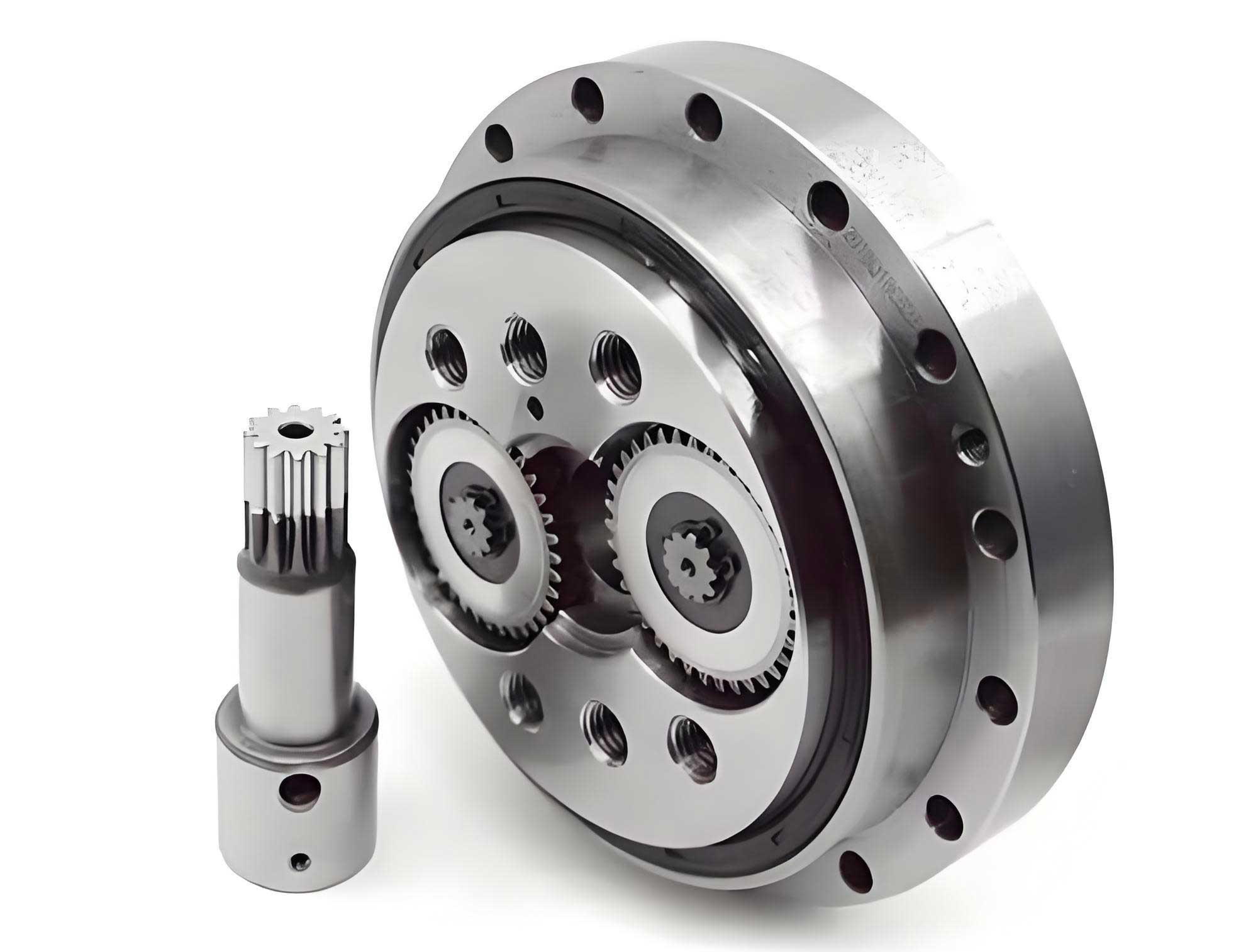
The performance and contact characteristics of the cycloid drive in a rotary vector reducer are highly sensitive to its core geometric parameters. We employ a single-variable method to investigate the influence of four key parameters: number of pins $z_b$, eccentricity $e$, pin circle radius $R_z$, and pin radius $r_z$. A baseline model, representative of an RV-80E type rotary vector reducer, is used for reference, with parameters listed in the table below.
| Parameter | Symbol | Baseline Value |
|---|---|---|
| Number of Cycloid Teeth | $z_g$ | 39 |
| Number of Pins | $z_b$ | 40 |
| Short Width Coefficient | $K_1$ | 0.78947 |
| Pin Radius Coefficient | $K_2$ | 1.49 |
| Eccentricity | $e$ | 1.5 mm |
| Pin Radius | $r_z$ | 4 mm |
| Pin Circle Radius | $R_z$ | 76 mm |
1. Influence of Number of Pins ($z_b$): Holding $e$, $R_z$, and $r_z$ constant, $z_b$ is varied. The contact stress $\sigma_i$ as a function of meshing phase angle $\phi_i$ shows a consistent trend: stress increases to a maximum near $\phi_i = \arccos(K_1)$ and then decreases. Crucially, for the central range of engagement (approximately $18^\circ \leq \phi_i \leq 108^\circ$), the contact stress increases with $z_b$. A higher number of pins increases the force distribution factor but also modifies the tooth curvature and load sharing, leading to higher peak stress for the same output torque from the rotary vector reducer. Outside this central range, the effect is less pronounced and slightly reversed.
2. Influence of Eccentricity ($e$): With $z_b$, $R_z$, and $r_z$ fixed, varying $e$ directly alters the short width coefficient $K_1$. The peak contact stress increases significantly with larger eccentricity. This is because a larger $e$ increases the input leverage to the cycloid disc, raising the transmitted force $F_{max}$ proportionally, as seen in its equation. The stress concentration becomes more severe, which is a critical consideration in the design of a high-torque rotary vector reducer.
3. Influence of Pin Circle Radius ($R_z$): Keeping other parameters constant, increasing $R_z$ has a beneficial effect on contact stress. A larger $R_z$ reduces the force $F_{max}$ for a given torque, as the moment arm increases. Furthermore, it generally leads to larger radii of curvature $\rho_1$ on the cycloid tooth, improving the contact geometry. Therefore, the contact stress decreases monotonically with an increase in $R_z$ across most of the meshing cycle, offering a direct way to enhance the load capacity of the rotary vector reducer stage.
4. Influence of Pin Radius ($r_z$): The effect of pin radius $r_z$ is twofold and varies with meshing phase. For the initial engagement phase ($0^\circ \leq \phi_i \leq 45^\circ$), a larger $r_z$ can slightly increase stress. However, for the majority of the meshing arc ($45^\circ \leq \phi_i \leq 180^\circ$), a larger pin radius is advantageous. It increases the second radius of curvature $\rho_2$ in the Hertz formula, improving the equivalent curvature $\rho^*$ and thus reducing the calculated contact stress. This makes increasing pin radius an effective measure for improving durability within spatial constraints.
To validate the theoretical model and gain deeper insight into the dynamic contact process and stress distribution, including effects not captured by simple Hertzian analysis (such as load sharing between multiple teeth and structural deformation), we conducted a series of transient dynamic finite element analyses (FEA). A full, detailed 3D model of an RV reducer was utilized, focusing on the cycloid drive stage.
The FEA model was constructed with high fidelity. The cycloid discs and pins were modeled as flexible bodies with material properties of GCr15 bearing steel (Density: $7.83 \times 10^{-6}$ kg/mm³, Young’s Modulus: 208 GPa, Poisson’s ratio: 0.30). All other components (housing, crankshafts, planetary carrier) were treated as rigid bodies to reduce computational cost while maintaining correct kinematics. A refined hex-dominant mesh was applied to the flexible components. Contact pairs between the cycloid disc teeth and pins, as well as between the disc and the output pins in the carrier, were defined with a frictional formulation. The boundary conditions simulated real operation: the pinwheel housing was fixed, a rotational velocity was applied to the sun gear input, and a constant output torque load was applied to the planetary carrier. The analysis solved the transient dynamic equation:
$$[M]\{\ddot{u}\} + [C]\{\dot{u}\} + [K]\{u\} = \{F(t)\}$$
where $[M]$, $[C]$, and $[K]$ are the mass, damping, and stiffness matrices, $\{\ddot{u}\}$, $\{\dot{u}\}$, and $\{u\}$ are the nodal acceleration, velocity, and displacement vectors, and $\{F(t)\}$ is the time-varying load vector.
For the baseline parameters under an output torque of 700,000 Nmm, the FEA predicted a maximum contact stress of approximately 1002 MPa on the cycloid-pin interface, with 17 teeth in simultaneous contact. This showed excellent agreement with the theoretical Hertzian calculation of 1054 MPa (a deviation of about 5%), effectively validating the correctness of the mechanical model. The simulation also revealed critical secondary stress concentrations in the cycloid disc around the holes for the output pins, indicating areas prone to bending and structural fatigue, a detail beyond simple contact theory.
Subsequently, a series of FEA simulations were run using the single-variable method to corroborate the parametric trends identified theoretically. The results are summarized below:
| Varied Parameter | Value 1 (Lower) | FEA Max Stress (MPa) | Value 2 (Higher) | FEA Max Stress (MPa) | Confirmed Trend |
|---|---|---|---|---|---|
| Number of Pins ($z_b$) | 38 | ~937 | 44 | ~2217 | Stress increases with $z_b$. |
| Eccentricity ($e$) | 1.4 mm | ~971 | 1.6 mm | ~1269 | Stress increases with $e$. |
| Pin Circle Radius ($R_z$) | 75 mm | ~1172 | 77 mm | ~1015 | Stress decreases with $R_z$. |
| Pin Radius ($r_z$) | 3 mm | ~1313 | 5 mm | ~958 | Stress decreases with $r_z$ (for main meshing arc). |
The FEA results strongly corroborated the theoretical predictions for each parameter’s influence on the contact stress within the cycloid drive of a rotary vector reducer. The comprehensive study, combining analytical mechanics and advanced nonlinear finite element analysis, leads to several key conclusions for the design and optimization of rotary vector reducers:
- The maximum contact stress in the cycloid-pinwheel pair consistently occurs at a meshing phase angle near $\phi_i = \arccos(K_1)$, aligning with the pin experiencing the greatest effective lever arm.
- Parametric sensitivity is clear: Contact stress increases with the number of pins ($z_b$) and eccentricity ($e$), while it decreases with a larger pin circle radius ($R_z$) and larger pin radius ($r_z$). This provides a direct guideline for improving the load capacity of a rotary vector reducer.
- Finite element analysis confirms the theoretical model’s accuracy and reveals additional critical information, such as stress concentrations around the output pin holes on the cycloid disc. This highlights the importance of considering structural bending and local stiffness in addition to pure contact Hertzian stress.
- For designers, to enhance the contact strength and longevity of the rotary vector reducer, it is advisable to:
- Increase the pin radius ($r_z$) or the pin circle radius ($R_z$) where space permits.
- Carefully balance the increase in reduction ratio (linked to $z_b$) against the resultant increase in contact stress.
- Minimize the size of non-functional holes (for output pins, bearings) in the cycloid disc to strengthen the surrounding web and mitigate secondary stress concentrations identified by FEA.
This integrated analytical and numerical approach forms a robust theoretical foundation for the structural design and performance optimization of high-precision rotary vector reducers. Future work will extend this analysis to include the effects of tooth profile modifications (e.g., equidistant, isometric) on these parametric trends and their interaction with manufacturing tolerances.