
In my extensive experience as a heat treatment engineer, distortion during heat treatment is an inherent challenge that consistently demands attention. For many components, especially precision parts like bevel gears, post-heat-treatment correction often consumes significant labor hours, and in severe cases, leads to scrapping due to excessive deformation. Therefore, minimizing heat treatment distortion remains a primary task for professionals like myself. This article delves into the specific case of a driven bevel gear within a transmission system, a typical thin-walled disk-shaped component prone to distortion during carburizing and nitriding quenching. The failure to control this distortion compromises gear meshing alignment, adversely affecting transmission accuracy, noise levels, and overall efficiency. This drove me to develop and implement a new process methodology to effectively control the quenching distortion of this critical bevel gear.
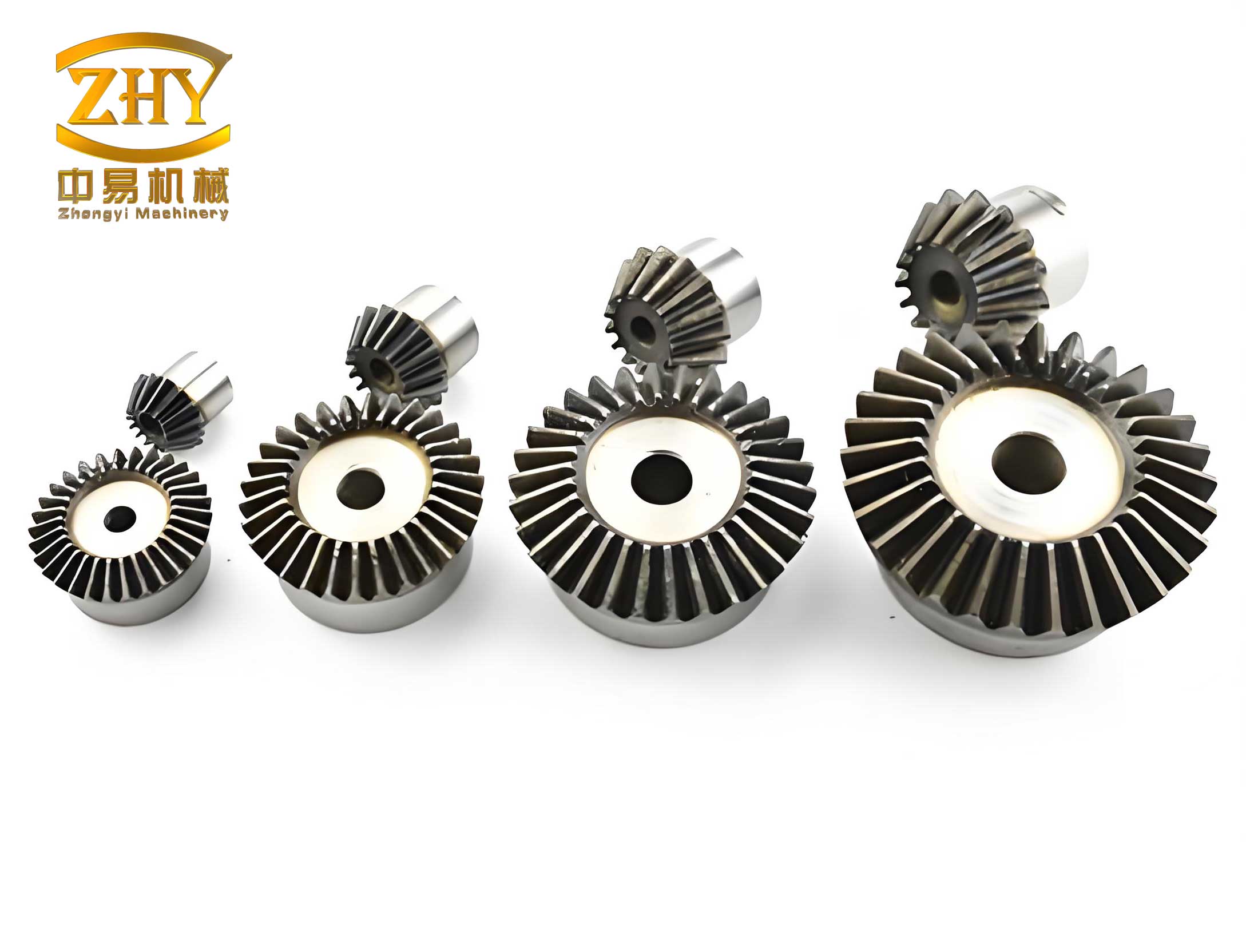
The driven bevel gear in question is characterized by a high tooth count and a relatively thin-walled splined bore. After carburizing and nitriding followed by quenching, it frequently exhibited significant warping or dish-shaped distortion. The original process involved free quenching with a mandrel through the bore. While this method somewhat controlled the roundness of the inner diameter, it failed to restrict the warping of the gear’s face, particularly the rim. Distortions often reached 0.5 to 0.6 mm, far exceeding the specified limit of 0.2 mm for face warpage and 0.15 mm for bore cylindricity. Such distortion in a bevel gear directly impacts tooth contact patterns, leading to premature wear, increased noise, and reduced transmission precision, rendering the gear unusable without costly rework.
The fundamental cause of distortion in any heat treatment, including for this bevel gear, stems from the complex interplay of thermal stress and transformation stress. Thermal stress arises from temperature gradients during heating and cooling, while transformation stress results from non-simultaneous and non-uniform phase changes, primarily the formation of martensite. For a disk-shaped bevel gear, the geometry itself introduces inherent stress imbalances. The thinner rim and web sections cool faster than the thicker hub, creating differential contraction. Furthermore, the gear’s face and back may cool at different rates due to immersion orientation or fluid dynamics. The combined effect of these stresses manifests as dimensional changes: volumetric expansion due to martensitic transformation and geometric distortion (warping, bending, twisting). The total strain $\epsilon_{total}$ can be conceptually expressed as a sum:
$$ \epsilon_{total} = \epsilon_{thermal} + \epsilon_{phase} + \epsilon_{creep} + \epsilon_{external} $$
Where $\epsilon_{thermal}$ is strain from thermal gradients, $\epsilon_{phase}$ is strain from phase transformation, $\epsilon_{creep}$ is potential creep strain at high temperature, and $\epsilon_{external}$ accounts for stresses from fixturing or gravity. For the bevel gear, $\epsilon_{thermal}$ and $\epsilon_{phase}$ are the dominant contributors leading to face warpage.
To systematically address the distortion of the transmission bevel gear, I analyzed all influencing factors and designed a comprehensive new process centered on controlled quenching using a press quenching machine and custom-designed tooling. The key aspects of this methodology are outlined below.
Material and Core Process Parameters
The bevel gear is manufactured from 30CrMnTi alloy steel. Its chemical composition and the specified heat treatment requirements form the foundation for process design.
| Element | Weight Percentage (w%) |
|---|---|
| Carbon (C) | 0.24 – 0.32 |
| Manganese (Mn) | 0.80 – 1.10 |
| Chromium (Cr) | 1.00 – 1.30 |
| Titanium (Ti) | 0.06 – 0.12 |
| Process Requirement | Specification |
|---|---|
| Case Depth (Carburizing & Nitriding) | 0.7 – 1.2 mm |
| Surface Hardness | 58 – 64 HRC |
| Core Hardness | 35 – 49 HRC |
| Maximum Face Warpage (Runout) | ≤ 0.20 mm |
| Maximum Bore Cylindricity | ≤ 0.15 mm |
Design of Press Quenching Tooling for the Bevel Gear
The cornerstone of the new method is the design of a dedicated quenching die set for use on a hydraulic press quenching machine. The design philosophy focuses on two critical factors: managing the heat dissipation ratio between the gear’s inner and outer regions, and uniformly controlling the flow of quenching oil across all surfaces of the bevel gear. The die set consists of three main components: a lower die (base plate), an upper die (pressure plate), and a central mandrel.
The lower die provides a flat, supportive base for the bevel gear. Its surface is machined with 24 radial grooves. These grooves are not merely for alignment; they serve as critical channels for quenching oil flow. During immersion, oil can rapidly circulate through these grooves, ensuring efficient and uniform heat extraction from the gear’s back face. This minimizes the thermal gradient between the gear’s face contacting the die and the oil, reducing one source of warping stress. The mandrel, inserted through the gear’s bore, controls the inner diameter’s cylindricity. It also effectively increases the effective wall thickness uniformity during cooling by providing a massive metallic heat sink, thereby reducing the cooling rate differential between the thin web and the thicker hub area of the bevel gear.
The upper die is the key element for controlling face warpage. Its contoured cavity matches the topography of the gear’s face side. When pressure is applied, the die surface makes full contact with the gear’s face, physically restraining any tendency to warp or dish. Similar to the lower die, the upper die’s contact surface is also machined with 24 corresponding grooves. This ensures that quenching oil has unrestricted access to the gear’s face even under pressure, preventing the formation of insulating vapor pockets that could lead to soft spots or uneven hardness on this critical bevel gear surface. The synergy of grooved surfaces on both dies optimizes the overall heat transfer coefficient, promoting a more uniform cooling regime for the entire bevel gear component.
The quenching process can be modeled by considering the heat transfer equation. The cooling rate at any point on the bevel gear is a function of the local heat transfer coefficient $h$, the temperature difference between the gear surface $T_s$ and the oil bulk temperature $T_o$, and the geometry. The grooves enhance $h$ by promoting turbulent flow:
$$ \frac{dT}{dt} = – \frac{h A (T_s – T_o)}{\rho V C_p} $$
where $A$ is the surface area, $\rho$ is density, $V$ is volume, and $C_p$ is specific heat capacity. A more uniform $h$ across the bevel gear surface leads to a more uniform $\frac{dT}{dt}$, minimizing thermal stress.
Optimized Heat Treatment Process Sequence
The new process integrates several optimized steps, from pre-treatment to final quenching.
| Process Step | Parameters & Details | Objective for Bevel Gear |
|---|---|---|
| 1. Forging & Pre-Heat Treatment | Normalizing followed by High-Temperature Tempering. | Refine grain structure, obtain uniform sorbite, dissolve alloy carbides, homogenize microstructure, reduce inherent stresses from forging, and minimize the specific volume difference between initial structure and martensite. |
| 2. Carburizing & Nitriding | Atmosphere-controlled furnace. Temperature: 840-860°C. Carbon and Nitrogen potential carefully controlled to achieve a gradual case-core carbon/nitrogen gradient. | Achieve specified case depth (0.7-1.2 mm) with a smooth hardness transition. A steep gradient exacerbates transformation stresses. |
| 3. Quenching Preparation | Transfer time from furnace to press quench is minimized. Bevel gear is placed on the lower die, mandrel inserted. | Prevent temperature non-uniformity before quenching. |
| 4. Press Quenching | Machine: Hydraulic Press Quench. Oil Temperature: 40-80°C. Pressure: Adjustable (typically 5-15 bar, optimized empirically). Dwell time under pressure: Until temperature is below Ms point. | Restrain geometric distortion physically. Use warm oil to reduce thermal shock and slow cooling in the martensitic transformation range (below Ms) to lower transformation stress. Pressure counteracts warping forces. |
| 5. Tempering | Temperature: 160-200°C. Time: 2-4 hours. | Relieve quenching stresses, achieve final hardness and toughness. |
The use of warm oil (40-80°C) is crucial. While it slightly reduces the quenching intensity compared to cold oil, the presence of nitrogen in the case lowers the martensite start temperature $M_s$. This allows adequate hardening even with a slower cooling rate in the martensite formation region. The benefit is a significant reduction in quenching stress. The relationship between cooling rate, $M_s$, and distortion is complex, but empirically, warm oil quenching for carburized and nitrided components like this bevel gear provides an excellent balance between hardness attainment and distortion control.
The pressure applied during quenching must be carefully calibrated. It should be sufficient to plastically deform the gear slightly against the dies to counteract the transformation stresses, but not so high as to cause indentation or excessive residual stress. The pressure $P$ required can be related to the yield strength of the material at the quenching temperature $\sigma_y(T_q)$ and the projected area $A_{proj}$ of the restraining surface. A simplified force balance during the critical phase transformation period involves the stress from volume expansion $\sigma_{trans}$:
$$ P \cdot A_{proj} \geq k \cdot \sigma_{trans} \cdot A_{gear} $$
where $k$ is an empirical factor accounting for stress distribution and $A_{gear}$ is the area over which transformation stress acts. In practice, the pressure is set based on experience and trial runs for the specific bevel gear geometry.
In-Depth Analysis of Distortion Mechanisms and Control
The success of this press quenching method for the bevel gear lies in its multi-faceted attack on the root causes of distortion. Let’s analyze the primary distortion mechanisms for a thin-walled bevel gear and how the new process addresses each.
1. Thermal Stress-Induced Warpage: During cooling, the thin rim and web of the bevel gear contract faster than the hub. This differential contraction $\Delta L$ can be approximated by:
$$ \Delta L = \alpha \cdot L_0 \cdot \Delta T $$
where $\alpha$ is the coefficient of thermal expansion, $L_0$ is a characteristic length (e.g., radius), and $\Delta T$ is the temperature difference between sections. If unconstrained, this causes the rim to dish upward. The press quenching die physically constrains the gear face, preventing this displacement. The grooved dies ensure that while constrained, cooling remains effective and uniform, minimizing the $\Delta T$ itself.
2. Transformation Stress-Induced Warpage: Martensitic transformation is accompanied by a volumetric expansion $\frac{\Delta V}{V}$. The expansion strain $\epsilon_{phase}$ is related to the carbon/nitrogen content and the fraction of martensite $f_m$:
$$ \epsilon_{phase} \approx \beta \cdot f_m $$
where $\beta$ is the expansion coefficient for martensite formation. In a bevel gear, transformation may not occur simultaneously in the case and core, or across the face due to temperature gradients. This non-uniform expansion generates bending moments. The press quenching tooling applies a counteracting moment. Furthermore, the improved cooling uniformity from the grooved dies promotes more simultaneous transformation across the bevel gear’s section.
3. Stress from Prior Processing: The normalizing and high-temperature tempering pre-treatment homogenizes the microstructure, increasing its specific volume/density. This reduces the specific volume difference $\Delta v$ between the pre-quench structure (sorbite) and martensite:
$$ \Delta v = v_{martensite} – v_{sorbite} $$
A smaller $\Delta v$ directly translates to lower transformation strain $\epsilon_{phase}$, hence less distortion for the final bevel gear.
4. Effect of Case Gradient: A steep carbon/nitrogen gradient creates a sharp gradient in $M_s$ temperature and expansion behavior. The careful control of atmosphere during carburizing and nitriding ensures a gradual gradient, allowing the transformation to proceed more harmoniously from case to core in the bevel gear, reducing interfacial stresses.
The interplay of these factors can be summarized in a qualitative distortion potential function $D$ for the bevel gear:
$$ D \propto \int ( \nabla T \cdot \alpha + \nabla f_m \cdot \beta + \nabla \sigma_{res} ) \, dV $$
where $\nabla T$ is the temperature gradient, $\nabla f_m$ is the gradient in martensite fraction, and $\nabla \sigma_{res}$ is the gradient in residual stress from prior steps. Our new process aims to minimize each gradient term through uniform cooling (min $\nabla T$), uniform transformation (min $\nabla f_m$), and stress-relieving pre-treatment (reduce $\nabla \sigma_{res}$), while the press quench directly counteracts the integrated effect $D$ through mechanical constraint.
Results and Validation
Implementation of this press quenching methodology for the transmission bevel gear yielded dramatic improvements. Statistical process control data collected over multiple batches confirmed the effectiveness.
| Quality Characteristic | Original Process (Free Quench) | New Process (Press Quench) | Specification Limit |
|---|---|---|---|
| Face Warpage (Avg. / Max) mm | 0.35 / 0.62 | 0.08 / 0.18 | ≤ 0.20 |
| Bore Cylindricity (Avg. / Max) mm | 0.10 / 0.20 | 0.05 / 0.12 | ≤ 0.15 |
| Surface Hardness (HRC) | 59-63 | 60-63 | 58-64 |
| Core Hardness (HRC) | 38-46 | 40-47 | 35-49 |
| Case Depth Consistency | Moderate | High | 0.7-1.2 mm |
| Scrap Rate due to Distortion | ~12% | <1% | – |
The consistency in distortion control allowed for reliable prediction of post-heat-treatment dimensions, facilitating tighter integration with subsequent machining steps like grinding. The enhanced gear meshing quality led to reported improvements in transmission assembly performance, including lower noise levels and higher efficiency.
Conclusions and Broader Implications
Through this project, I have reinforced the understanding that controlling heat treatment distortion, especially for complex geometries like a bevel gear, requires a systems approach. It is not sufficient to focus solely on the quenching step; the entire thermal history, from pre-treatment to final tempering, must be engineered for dimensional stability. The innovative press quenching method, featuring custom-designed grooved dies and controlled warm oil quenching, proved highly effective for this specific thin-walled bevel gear. The dies function not only as restraining tools but also as heat transfer management devices, ensuring cooling uniformity.
The principles established here—managing thermal gradients, promoting uniform phase transformation, and applying targeted mechanical constraint during the most critical phase change period—are broadly applicable to other distortion-prone components. The key takeaway is that for precision components like the bevel gear, an investment in specialized tooling and process refinement pays substantial dividends in reduced scrap, eliminated corrective operations, and superior final product performance. Future work could involve finite element modeling to simulate the stress evolution during the press quenching of the bevel gear for further optimization of die geometry and pressure profiles, pushing the boundaries of distortion control even further.